You're sitting in the Georgia DDS chair with a fresh learner-permit application in front of you, and the part that feels simple is usually the part that causes the most trouble. A lot of applicants think they need to “study the rules” and hope the rest works out, but Georgia's process is more specific than that, especially if you're moving from a practice test to an actual permit, a road test, or later DUI-related requirements.
The drivers license practice test GA search usually starts with one question in mind, can I pass the written exam. In Georgia, the better question is, do I understand the system well enough to pass the right part, at the right time, with the right documents, and without a test-day surprise. That's the difference between cramming and preparing.
How the Georgia Written Knowledge Test Works
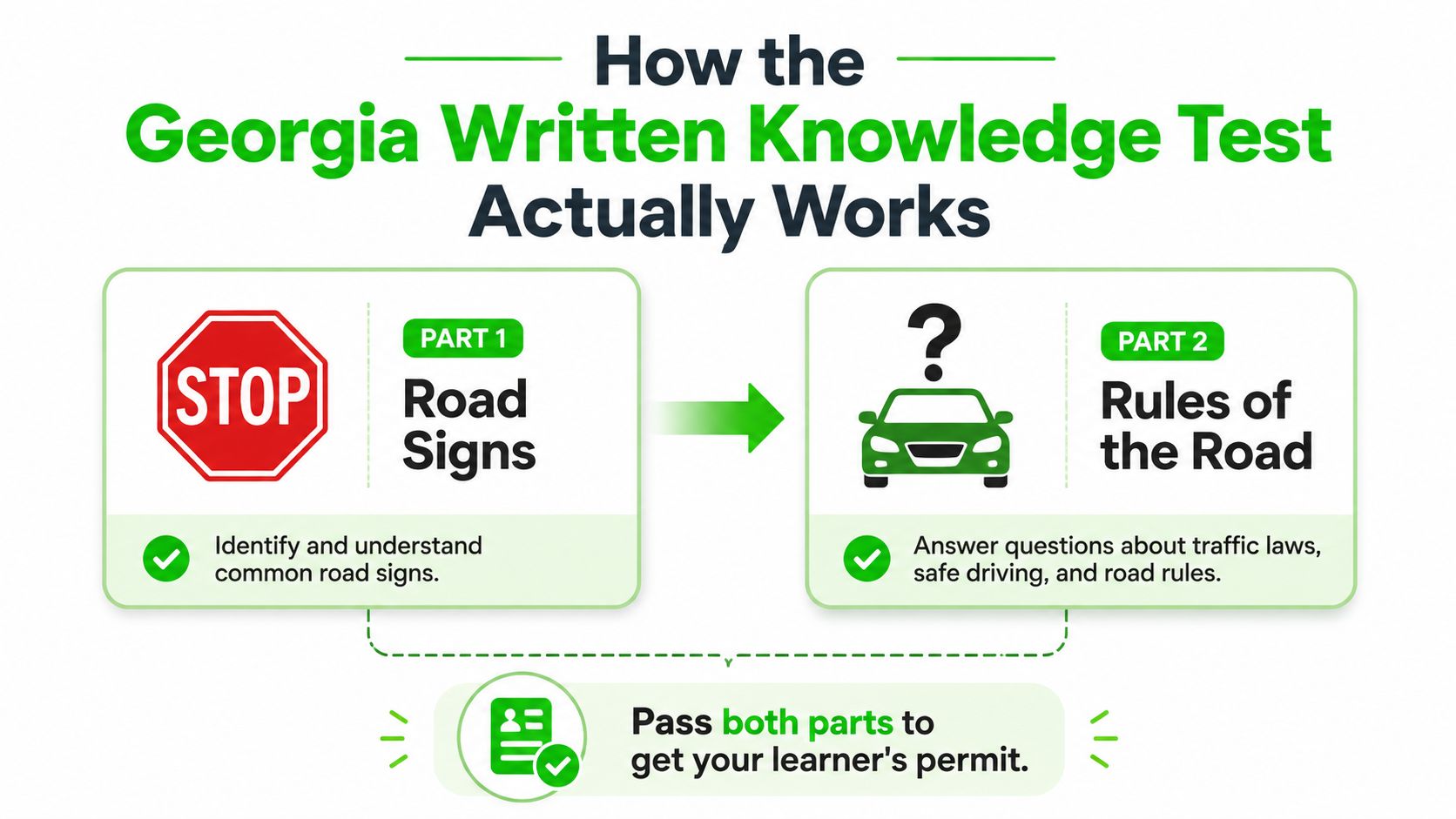
If you're a first-time applicant in Georgia, the written exam is not one vague block of trivia. It has two separate knowledge parts, a Road Signs Test and a Road Rules Test, and Georgia DDS requires applicants to pass both parts to qualify for a permit or license. The state's online practice test is hosted by Georgia DDS, so it gives you a clear view of the structure before test day.
What the score means
Each section has 20 questions, and you need at least 15 correct out of 20 on each one, which is a 75% score per section. The target is not just to do well overall, it is to pass both sections independently. A strong Road Signs result does not rescue a weak Road Rules result, and that is where many nervous applicants get caught.
For practical studying, keep the test split in mind. One part checks whether you can recognize signs quickly. The other checks whether you understand the rules that guide real driving decisions, like right-of-way, lane behavior, and safe operation.
Practical rule: if you cannot explain why an answer is right, you probably do not know it well enough yet.
That matters because Georgia's official practice test trains you for the same two-part structure, not for random memorization. If you want a plain-language look at the permit test setup, what does a permit test look like is a useful companion. For a comparison with another state's study process, the G1ready.ca practice test guides show how clear explanation can make practice questions easier to absorb.
Where to Find Real Georgia Practice Tests
A Georgia permit test study session can go off track fast if the site you picked is built for some other state and only wears Georgia's name. Start with the official DDS material first, because it matches the actual testing structure and keeps you closest to the source Georgia DDS practice test. After that, use outside question banks only if they follow Georgia's two-part format and the passing standard described earlier.

How to judge whether a practice site is worth your time
A solid practice site should feel like a rehearsal for the test. That means clear road signs questions, clear road rules questions, and explanations that match how Georgia asks new drivers to think on the road. If the quiz leans on vague “common sense” items or ignores the two-part structure, it may be easy to click through, but it will not prepare you well for DDS.
The best study pages also save time. Clean organization matters because it lets you focus on the question bank instead of sorting through confusing layouts or unrelated material. If you have used a well-organized study guide like G1ready.ca practice test guides, you already know how helpful it is when the questions, explanations, and layout line up with the test you are trying to pass.
What to prioritize first
Georgia applicants usually need the most repetition on warning signs, regulatory signs, right-of-way, and the rules that control speed and lane decisions. The goal is not to memorize one exact quiz. The goal is to recognize the pattern even when the wording changes.
A good habit is to read the question first, then look at the sign or rule being tested. That simple order prevents a lot of careless misses, because many wrong answers come from rushing past the wording and guessing from the picture alone.
If you want a Georgia-specific sign reference after your practice sessions, keep this sign-focused page handy: GA road sign test.
A Three-Week Study Plan That Fits Real Schedules
The students who have the hardest time with the permit test usually try to cram everything into one long, tired session. That approach breaks down fast. A better plan starts with a diagnostic first pass, then moves into short practice sets, and finishes with a focused review of the misses. The goal is steady recall, not just recognizing the right answer when it pops back up.
Week 1, find your weak spots
Start with one full practice set and do not overthink it. Treat it like a snapshot, not a grade. The result should show you whether your trouble is sign recognition, rule comprehension, or both.
After that, review only what you missed and sort the errors into two piles, signs and rules. Keep this first week light and specific. You are learning the pattern of your own mistakes before you try to build speed.
That matters because Georgia test prep does not stop at the written questions. If you are already planning for Joshua's Law hours, the road test, or later point reduction and Risk Reduction steps after a DUI interruption, the habits you build now should carry forward. A clean study routine makes the next stages less surprising.
Week 2, tighten the categories
Work through 2 to 3 short practice sets across the week, and keep each session short enough that your attention stays sharp. An efficient study plan recommends 3 to 5 short sessions per week, roughly 80 to 120 total practice questions, and retesting until you are consistently at or above 75% Georgia learner's permit study plan.
Use that structure in a simple order.
- First session: signs only, especially the ones that look similar.
- Second session: rules and right-of-way questions.
- Third session: review every missed question and write the reason you missed it in plain words.
If you keep confusing sign shapes, slow down and review the category names before you retake anything. A yellow warning sign is not the same kind of cue as a red regulatory sign, and Georgia questions often punish that kind of blur. A focused sign review page like Georgia road sign test reference can help you separate the shapes before test day.
Week 3, simulate the test
Now switch to full timed sets that match the official format. If you are still falling below 75% on full 40-question practice sets, you are not ready yet. That is the point to pause, study the misses again, and avoid paying the $10.00 permit fee before your score is steady Georgia learner's permit fee and process.
Self-check rule: if you cannot pass a full-length practice set twice in a row, delay the DDS visit.
Keep the review honest. If you miss the same right-of-way question three different ways, the problem is usually not memory. It is that the rule has not become automatic yet. That is exactly what the timed set is supposed to reveal.
If you use a website analytics tool to see which study pages you return to most often, a practical guide like how to check website traffic can show you which resources you are using. The number that matters most, though, is still your practice score, because that is the closest rehearsal for the DDS test itself.
Sample Practice Questions With Georgia-Specific Explanations
Real confidence comes from seeing how Georgia asks questions, not just from reading about the rules. The examples below are the kind of things that trip up applicants who know the material loosely but not well enough under pressure.
Sign recognition and driving judgment
Question 1. A yellow diamond sign with a curved arrow usually means what.
The correct answer is that the road ahead curves. A lot of people confuse this with a winding-road warning because both signs suggest turning, but the exact shape matters. Yellow warning signs tell you to slow down and prepare, not to speed through.
Takeaway: yellow means caution, not speed.
Question 2. A red octagon means what.
The answer is stop. People often overthink this because they assume all signs require interpretation, but some shapes are meant to be instant recognition tools. The stop sign is one of the most important recognition cues on the road.
Takeaway: octagon means stop every time.
Rules of the road and common traps
Question 3. Two cars reach an uncontrolled intersection at the same time. What should the driver on the left do.
The safer answer is to yield to the vehicle on the right. New drivers often want a more complicated rule, but Georgia's test usually checks whether you know the basic right-of-way habit that keeps traffic moving safely.
Takeaway: when arrival is even, the right side gets priority.
Question 4. You're approaching a school zone. What should you do.
Slow down and follow the posted limit. Don't guess from what the road “feels” like. School zones are exactly where rushed reading gets people in trouble, because the expected behavior is careful and deliberate.
Takeaway: school zones demand extra attention, not assumptions.
Alcohol-related rules and under-21 questions
Question 5. What does implied consent mean for a Georgia driver.
It means that by driving on a public road, you've accepted chemical testing rules tied to driving enforcement. Applicants often miss this because the wording sounds legalistic, but the idea is simple, if you drive, you're subject to the state's testing framework.
Takeaway: Georgia uses implied consent once you drive on public roads.
Question 6. What matters most for an under-21 driver and alcohol.
Under-21 drivers are held to a strict standard, so any alcohol question should be treated as a zero-margin issue. That's why younger applicants should never skim these questions or assume they can reason them out from everyday experience.
Takeaway: under-21 alcohol questions are not casual questions.
If you want to keep drilling this category, the Georgia sign and rule format stays easier to understand when you move between examples and explanations instead of just clicking answers.
Test-Day Logistics at a Georgia DDS Center
Knowing the material is only half the battle. Plenty of applicants lose time because they arrive with the wrong documents, the wrong assumption about appointments, or the wrong vehicle setup. At a Georgia DDS center, the learner's permit process usually means a Vision Exam, the Knowledge Exam, a photo, and the $10.00 permit fee Georgia learner's permit process.
What to expect before the knowledge exam
Georgia DDS says no appointment is needed for the knowledge exam, and the department also provides a free online practice test. That makes the written-test side easier to approach than the road-test side, but only if you bring the required paperwork and show up prepared.
For the road test, the rules are stricter. DDS says the test requires an appointment, walk-ins are not accepted, and the applicant must be accompanied by a licensed driver age 21 or older Georgia road test rules.
Vehicle and passenger rules that surprise people
Only the applicant and the supervising driver may be in the car during the road test, and no children or pets are allowed Georgia road test rules. That rule catches people off guard because they treat the car like an ordinary family trip. On test day, the examiner is checking whether you can follow instructions, keep the cabin quiet, and arrive in a vehicle that is ready for the test, not full of extra distractions.
Use the official DDS page for the nearest center and current procedures, not a guess from a friend or cousin. For location planning and center details, this page can help you sort out the testing site side of the process: driving testing centres.
Arrive with a clean vehicle, the right adult supervisor, and no extra people. Those details matter as much as your answers do.
Common Mistakes That Cost Georgia Applicants the Test
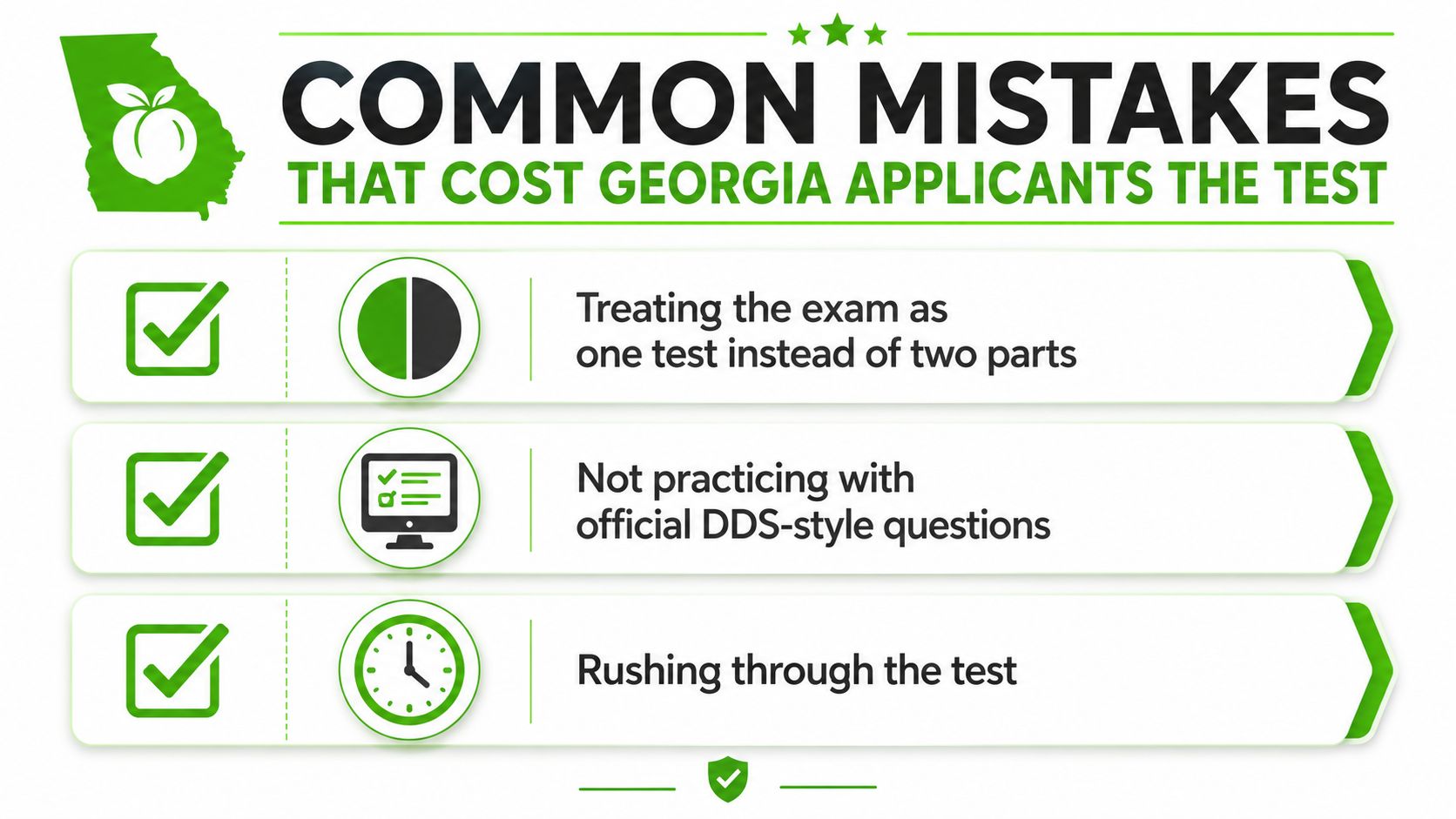
A lot of Georgia applicants do not fail because they know nothing. They miss one or two familiar traps, the kind that show up again and again at the DDS counter. The biggest trap is treating the permit exam like one overall score instead of two separate 75% sections.
The errors I see most often
- Treating the exam as one test instead of two parts. A strong signs score does not cover a weak rules score, and that misunderstanding sends plenty of people home for another visit.
- Not practicing with official DDS-style questions. If your study material does not look or feel like Georgia's format, you are training for the wrong task.
- Rushing through the test. Fast readers miss details in sign wording, right-of-way wording, and alcohol-related questions.
Teen applicants run into a second set of problems because Georgia licensing rules stretch past the written test. If you are under 18, Joshua's Law requires 40 hours of supervised driving, including 6 hours at night, plus a DDS-approved driver education course, and the learner's permit generally must be held for 1 year and 1 day before a Class D road test is allowed teen licensing requirements. That is a timeline rule, not a study suggestion, and it does not bend just because someone feels ready sooner.
A permit can be passed on paper and still create trouble later if the next steps were ignored. That is why instructors keep tying the written exam to the rest of the license process.
How to avoid a bad test day
Build your prep around Georgia's actual thresholds. Match the official format, check your documents before you leave, and read every question as if one extra word changes the meaning, because it often does. If you are getting ready for the road test, make sure the supervising driver is 21 or older and the car has no unnecessary passengers.
After You Pass the Georgia Written Test
Passing the written test is a checkpoint, not the finish line. The next steps depend on the kind of driver you are becoming, and Georgia treats those steps differently for teens and adults. For teens, the permit often leads into Joshua's Law, supervised driving hours, the required driver education course, the permit hold period, and then the Class D road test. For adults, the path usually shifts toward keeping skills sharp, staying organized with DDS paperwork, and preparing for the road test with realistic expectations.
Where the road goes next
A clean record and a desire to stay sharp usually point toward defensive driving. Georgia DDS-approved providers offer that training in self-paced online, live virtual Zoom, and in-person classroom formats, and drivers commonly use it to work on point reduction or to lower insurance costs. That turns the written test into the first step in a larger licensing process, the same way a permit is the first safe outing before a driver is trusted with the full road.
If a DUI has interrupted your license journey, the next step changes completely. Georgia's Risk Reduction Program is the state-approved route many drivers need, and the full compliance picture can also involve clinical evaluations, ASAM Level 1 treatment, and Victim Impact Panels. Those requirements belong to reinstatement and court compliance, so they deserve the same attention you gave the permit test, just aimed at the right finish line.
The smartest Georgia drivers do not stop at one passed exam. They match the course to the requirement and keep the paperwork moving.
If you are trying to get your permit, restore your privileges after a DUI, or choose the right defensive driving option, Georgia DUI Schools offers the Georgia DDS-approved courses that fit each step, including Risk Reduction, defensive driving, and related services. Visit Georgia DUI Schools to find the course that matches your situation and get back on track with a clear plan.