

You leave court, open your paperwork in the parking lot, and see one more item buried among everything else: Victim Impact Panel. If you're dealing with a court order in Atlanta or the surrounding metro area, that line can raise more questions than the judge answered. Is this the same as DUI school? Can you do it online? Who gets the certificate? What happens if you choose the wrong format?
That confusion is common. A Victim Impact Panel is separate from Risk Reduction, separate from any clinical evaluation, and separate from the other boxes you may be trying to check at the same time. The problem for many people is not willingness. It's figuring out the exact steps without making a compliance mistake that creates a new problem.
If your case has connections outside Georgia, it can also help to compare how nearby states handle these requirements. Ticket Shield's Victim Impact Panel Florida guide is useful for seeing how similar court-ordered panels work in another state, even though your Atlanta-area court will follow Georgia rules.
For Georgia-specific DUI class requirements, the clearest starting point is reviewing the available Georgia DUI class options so you can separate the VIP from the other programs you may have been ordered to complete.
Navigating Your Court-Ordered Requirement
The practical way to approach a Victim Impact Panel Atlanta order is to treat it like any other court deadline. Read the exact wording. Confirm what format your court accepts. Register only after you know what counts in your case. Then keep your proof.
What usually causes the trouble
Most mistakes happen because the paperwork is short and the consequences are not. A probation order may say only that you must attend a VIP, without telling you whether your judge accepts virtual attendance, where to register, or how to submit your completion record.
Practical rule: Attendance alone doesn't close the requirement. The court usually expects proof, and the proof has to match the order.
A lot of metro Atlanta drivers also assume every court handles the panel the same way. They don't. A courtroom in Atlanta, a municipal court in a nearby suburb, and a county-level probation office may each handle format and proof a little differently.
The simplest way to think about it
Keep the process in this order:
- First, confirm the requirement. Make sure your order specifically requires a Victim Impact Panel.
- Then verify format. Ask whether your court accepts virtual attendance or requires in-person participation.
- Register with the correct provider. Don't pay first and ask questions later.
- Finish the session and secure proof. Keep your certificate and submission records.
This isn't a complicated process when you handle it in sequence. It becomes stressful when people guess, rush, or assume one class is interchangeable with another.
The Purpose of a Victim Impact Panel
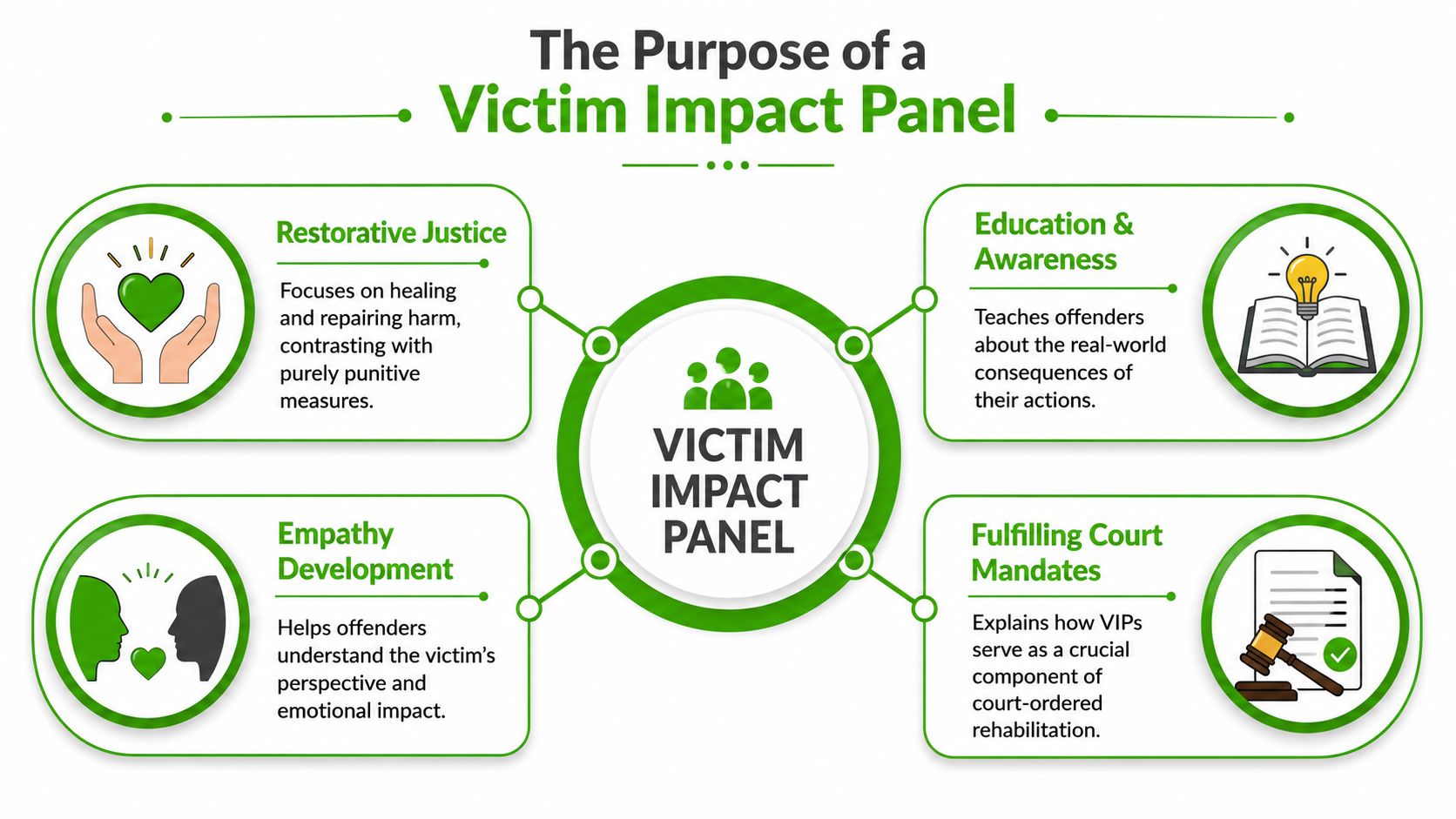
Courts don't order a Victim Impact Panel just to add another obligation. The panel exists to do something a fine, a suspension notice, or a probation warning often can't do on its own. It puts real human harm in front of the person who has been convicted.
Why courts use this format
A VIP is rooted in restorative justice. That means the focus isn't only punishment. The focus is also on making the harm real, personal, and difficult to dismiss. Instead of hearing another abstract warning about impaired driving, attendees hear directly from people whose lives were altered by it.
That matters because many DUI cases feel procedural once they enter court. There are hearings, deadlines, fees, classes, and compliance terms. A panel interrupts that routine and forces attention back to the lived consequences.
What the evidence shows in Georgia
Georgia courts have a strong reason to keep using this requirement. In Clarke County, Georgia, a study found that DUI offenders who attended Victim Impact Panels had a 15.8% rearrest rate after five years, compared to 33.5% for those who did not attend, a 52.8% reduction in recidivism for participants, according to the National Institute of Justice Crime Solutions summary of the Clarke County program.
That doesn't mean a panel fixes everything. It does mean courts have evidence that this kind of intervention can matter over time.
The panel isn't there to relitigate your case. It's there to make sure you hear what impaired driving can cost other people.
What works and what doesn't
Some attendees come in defensive. That usually gets them very little. The people who get the most from the session are the ones who stop trying to evaluate whether the requirement is fair and instead pay attention to what the speakers are saying.
What doesn't work is treating the panel like background noise. Looking for shortcuts, tuning out, or viewing it as a technicality misses the one thing the court wants from the requirement: actual engagement with the human side of the offense.
What to Expect During a VIP Session

The biggest source of anxiety is often not the order itself. It's not knowing what will happen once you show up. The good news is that the format is structured and predictable.
In Georgia, Victim Impact Panels are structured as two-hour interventions where three to four victims or family members deliver approximately 15-minute testimonies detailing the consequences of impaired driving, as described in the Georgia MADD DUI Victim Impact Panel class overview.
The session from start to finish
Expect a check-in process first. Staff will usually verify your identity, attendance status, and basic compliance information. Being late can cause issues. If you miss sign-in or arrive after the session has begun, you may not receive credit.
After check-in, the presentation begins. The core of the panel is the speaker testimony. The stories usually come from victims, survivors, or family members affected by drunk or drugged driving. The tone is serious, personal, and often emotional.
You are not there to speak unless the provider specifically asks for participation. In most cases, your job is simple: sit down, stay attentive, and listen all the way through.
What the speakers usually cover
The testimony often follows a pattern:
- Life before the crash or incident. Speakers may describe normal routines, family life, work, or health before everything changed.
- What happened. This is usually the point where attendees hear the event described in plain, human terms rather than legal language.
- What remained afterward. Ongoing injury, grief, financial strain, family disruption, and fear are common themes.
That structure is why the panel can feel heavier than a classroom course. It isn't designed like defensive driving. It isn't focused on traffic rules or test answers. If you're trying to understand how some providers frame review material around the requirement, this overview of Victim Impact Panel quiz answers and expectations can help clarify the educational side without changing what your court order requires.
Conduct that helps you get through it cleanly
You don't need a special strategy. You need basic compliance habits.
| What to do | Why it matters |
|---|---|
| Arrive early | Late arrival can affect whether you receive credit |
| Bring your identification | Staff may need to verify who completed the panel |
| Silence your phone | Disruptions can lead to warnings or removal |
| Stay for the full session | Leaving early can make the attendance invalid |
If you're nervous about the emotional tone, that's normal. What helps most is showing up rested, on time, and ready to pay attention.
How to Register for a Panel in Metro Atlanta
Registration is where many avoidable mistakes happen. People pick a date before confirming the format their court accepts. They assume any panel with a certificate will work. Or they bring the wrong payment and get turned away.
For Atlanta-area cases, the most important habit is to slow down and confirm details before you spend time or money.
The cost and payment rules
For many Georgia panels, the standard cost is $50, payable only by money order or certified bank check made out to MADD. Cash is not accepted, and participants must bring a photo ID, according to the Atlanta Community Court information page.
That payment rule matters because it catches people off guard. If you show up with cash because you assumed cash would be easier, you may leave without getting registered or credited.
What to bring
Use this checklist before you leave home:
- Photo ID. Bring a valid identification document that matches your registration details.
- Court paperwork. If your order names the requirement, bring it.
- Correct payment form. If the session uses the MADD payment rule, bring a money order or certified bank check made out exactly as required.
- Your case information. Keep your court date, case number, or probation details available in case staff asks for them.
A practical registration sequence
People usually do best when they follow a simple order:
- Read the wording of the order carefully. Look for any mention of in-person attendance, deadlines, or proof requirements.
- Call the court, probation officer, or attorney if the format isn't clear. Don't assume online is accepted.
- Choose a provider after that confirmation. One Atlanta-area option is the Atlanta location information for Georgia DUI Schools, which lists local course access for metro-area participants.
- Register under your legal name. Your certificate needs to match your court records.
- Save every confirmation. Keep emails, receipts, and scheduling messages.
What works and what usually backfires
What works is boring, but effective. Confirm the format first. Double-check the name on the registration. Bring the right payment and ID. Save paperwork.
What backfires is treating the panel like a casual appointment. If you wait until the deadline is close, your options narrow. If you choose a provider before checking court acceptance, you may finish a session your judge won't count. If your name is entered incorrectly, fixing the certificate later can turn into another delay.
Ensuring Court Compliance After the Panel
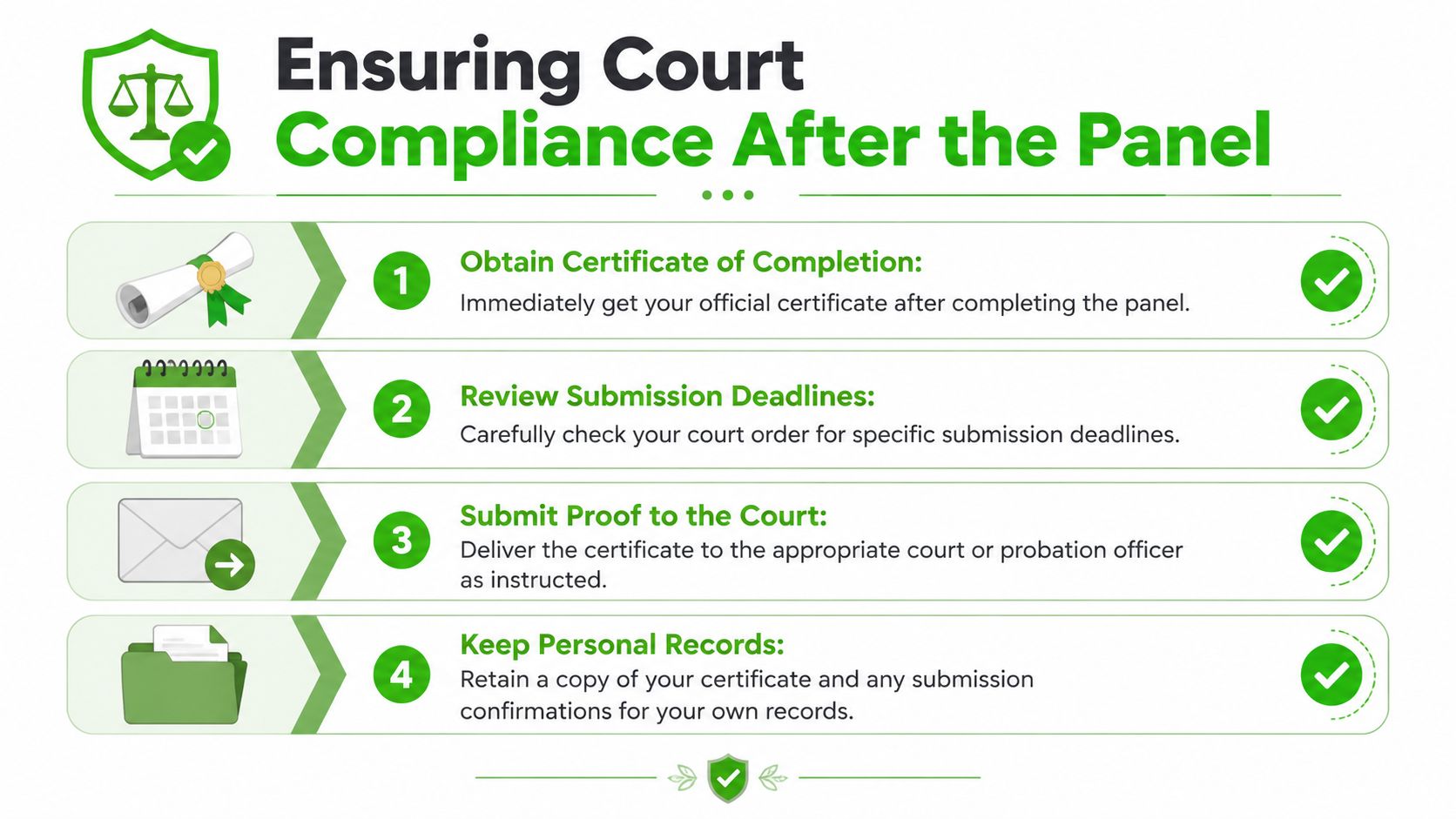
Completing the panel is only half the job. The court cares about proof. If the right office never receives your certificate, your case may still show an incomplete requirement.
This is the point where many people in the Atlanta area get tripped up, especially when they assume a provider will automatically send everything for them.
Your certificate is the key document
When the panel ends, get your Certificate of Completion and inspect it before you leave or log off. Make sure your name is correct and readable. If anything is wrong, ask the provider to correct it immediately.
Then keep your own records. Save a paper copy if you have one. Save a digital copy if you receive it electronically. If you submit it by email, keep the sent message. If you hand-deliver it, ask for confirmation if that option exists.
Compliance warning: Never assume the provider, the clerk, and probation are all sharing the same records in real time.
The virtual versus in-person problem in Atlanta
The local issue becomes serious when, despite online Victim Impact Panels being advertised for statewide access, acceptance varies significantly by jurisdiction, and many Atlanta-area courts still mandate in-person attendance, according to the Georgia Victim Impact Panel guide discussing court-by-court variation.
That means an online completion certificate can still create a problem if your judge, probation office, or court division required physical attendance. The risk isn't theoretical. The rule may be different depending on where your case is pending.
Use this post-panel check:
- Verify your format matched the order. If your court wanted in-person, an online panel may not satisfy the requirement.
- Confirm who receives proof. It may be a probation officer, clerk, attorney, or another designated office.
- Check the deadline. Some courts want immediate submission.
- Keep proof of submission. Your own records matter if there is later confusion.
One more issue drivers ask about
Once people finish the panel, they often start asking about the next financial consequence, especially insurance. The panel itself doesn't answer that. If your case also requires filing proof of high-risk coverage, a practical next read is this guide to securing affordable SR22 auto insurance, which walks through the Georgia filing issue that often follows DUI-related cases.
The bottom line is simple. For a victim impact panel Atlanta requirement, completion isn't enough. Verified completion in the correct format, delivered to the correct place, is what closes the loop.
Frequently Asked Questions About Atlanta VIPs
Does a Victim Impact Panel lower my insurance or remove points
A Victim Impact Panel usually does not change your insurance premium or remove license points by itself. Those issues are generally handled through other requirements, such as a DDS-approved Defensive Driving course or Risk Reduction program, if your case calls for one.
Treat the panel as its own court requirement. Finish it for compliance, not because you expect it to fix licensing or insurance consequences.
Is the panel the same as DUI school
No. A Victim Impact Panel and DUI school are separate programs with different purposes.
One focuses on hearing from people affected by impaired driving. The other covers education and state-required course content. If your paperwork lists both, complete both, and do not assume one will substitute for the other unless the court says so in writing.
What if I miss my scheduled session
Call the provider as soon as you know there is a problem. Ask about the reschedule fee, the next available date, and whether your original registration can be transferred.
Then check your court order and probation instructions. Some Atlanta-area courts care less about why you missed and more about whether you still meet the deadline. A missed session can usually be fixed. A missed deadline is harder to explain.
If I finished online, am I done
You are done only if your court accepts an online panel for your case.
This is the point that causes the most confusion in metro Atlanta. One court may accept a virtual certificate. Another may want in-person attendance, or may leave the decision to a probation officer or a specific judge's division. If your order is vague, do not guess. Confirm the format with the court, your lawyer, or probation before you rely on that certificate.
What mindset helps most during the session
Take it seriously and make it easy for staff to mark you compliant. Arrive early, follow check-in instructions, silence your phone, and stay for the full session.
The panel is not a debate and not a formality. Courts use it to make sure you were present, attentive, and respectful. If you act bored, disruptive, or distracted, you can create a problem where none existed before.
If you need to complete this requirement and want a direct next step, review the available Victim Impact Panel and related DUI compliance options through Georgia DUI Schools.