

You just got the notice, and now you're staring at a line item that says Victim Impact Panel. If you've never heard of it before, it can feel vague, serious, and a little embarrassing all at once. The safest way to handle it is simple, confirm what your court ordered, find the right Texas-approved panel, and keep proof of completion in your hands until the court accepts it.
A lot of people start with the same first question, especially if the arrest also triggered bond questions or license problems. If you're still trying to understand the bigger DWI picture, the bail amount for Texas DWI page is a useful place to see how release decisions can affect the rest of the case. For a broader court-order comparison, the process for a substance-abuse evaluation at navigating a court-ordered substance abuse evaluation shows how Texas compliance tasks often stack up one after another.
Your First Step After a Court Order
A court order for a Victim Impact Panel can feel plain on paper and confusing in practice. The paperwork may list a deadline, a probation contact, and a requirement that assumes you already know the next step. If this is your first court-ordered program, the safest approach is to slow down and read the order as instructions, not as a suggestion.
Start with the exact wording on the notice. Write down whether the court wants a local, approved, in-person, or online panel. Texas uses county-level administration for VIPs, so the place where you were ordered to attend matters as much as the program name itself. A panel accepted in one county may still be rejected in another if it does not match the court's order.
That is the point where many people get tripped up. A common mistake is signing up for the first panel found online, only to learn later that it was not approved by the specific court. If you are unsure, ask the court clerk or probation office which panel they accept, what proof of completion they want, and how that proof should be delivered. The bail amount for Texas DWI page can help you understand why early case requirements often arrive before someone has a full picture of the case, while a court-ordered substance abuse evaluation shows how one court requirement can sit alongside another.
Practical rule: the cheapest or fastest option is only the right one if the court says it is.
If your case includes other required education, Texas DUI Schools often see people comparing those obligations side by side so they do not duplicate work or miss a deadline. A VIP is not the same thing as an evaluation or a general class, and each one creates its own paperwork trail. Use the court's exact language first, then choose the panel that matches it.
Understanding the Texas Victim Impact Panel
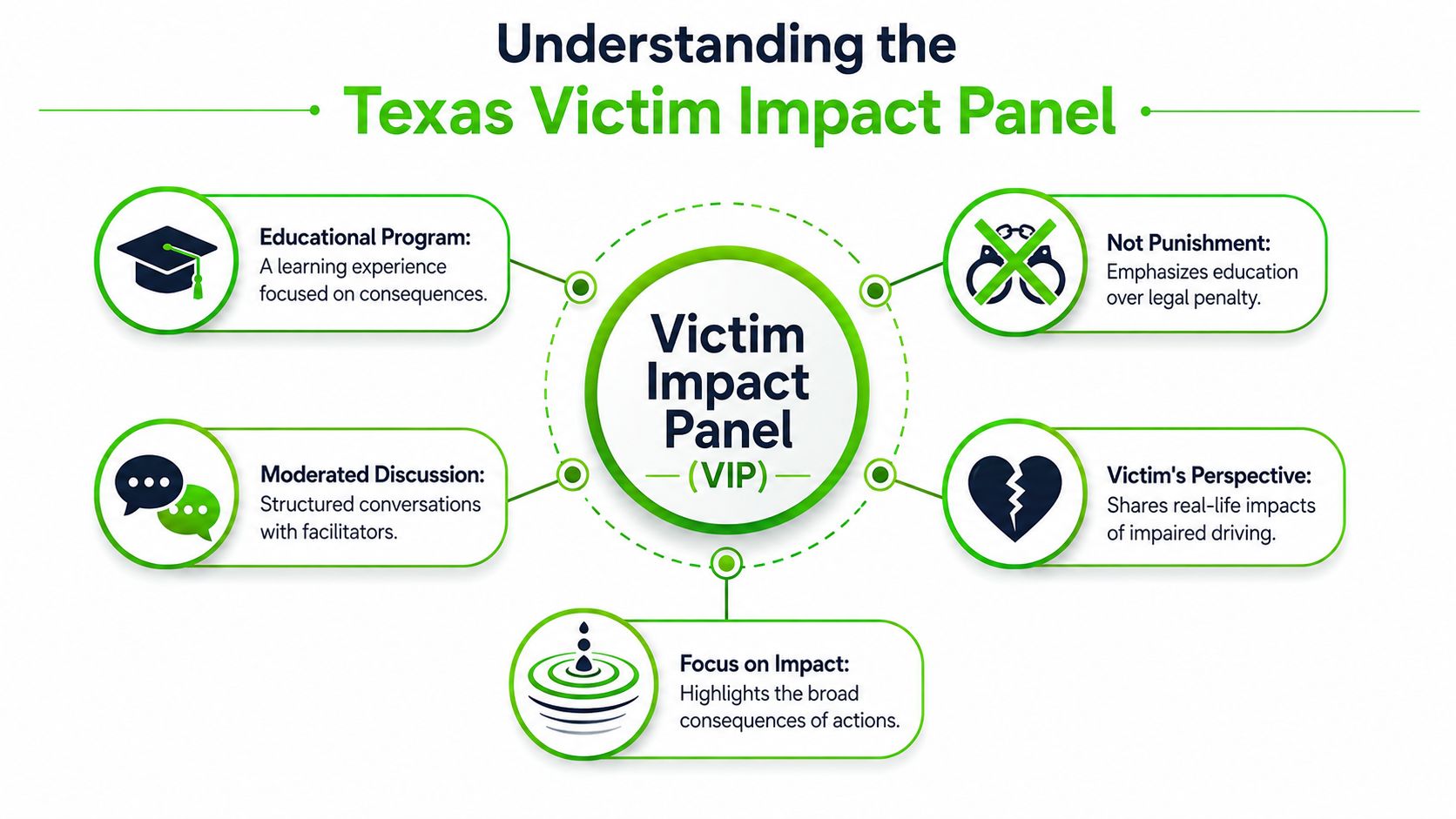
A Victim Impact Panel, or VIP, is an educational program, not a courtroom hearing. In Texas, the program is set up to stay focused on the harm caused by impaired driving, with a controlled format that typically includes about 2 to 3 crime victims, lasts 1 to 2 hours, and ends with a Q&A plus evaluation so the educational purpose stays clear Texas VIP program form. The goal is practical, to make the impact of a bad driving decision feel specific instead of distant.
A VIP works more like a guided account from people who lived through the consequences than like a formal class. The moderator keeps the session on track while the speakers describe what happened to them, how the crash changed their lives, and why the effects of impaired driving reach far beyond the moment of the offense. Texas county guidance describes panels with 2 to 4 victims who speak briefly about the financial, psychological, and physical consequences of a crash, with the goal of building empathy and reducing repeat offenses Brazoria County VIP guidance.
Who Attends and why it matters
The state's annual reporting shows the program reaches more than one type of audience. In FY 2011, Texas reported 51 panels, 104 panelists, and 1,846 attendees, including 1,243 offenders, 603 criminal-justice professionals or students, 91 existing panelists, and 13 new panelists TDCJ annual report. That mix matters because the panel serves both as a court compliance step and as a public education tool.
The session is moderated, not argumentative. You are not there to dispute the facts, and you are not there to reopen the case. You are there to listen, complete the requirement the court ordered, and leave with documentation that shows you attended the approved program.
For a comparative look at how another state handles this requirement, see the process for a Victim Impact Panel in GA. Georgia DUI Schools uses that format in its own court-compliance education lineup, which makes it easier to compare how different states describe similar obligations when a court order includes more than one educational step.
Victim Impact Panels vs Victim Impact Statements
A Victim Impact Panel and a Victim Impact Statement sound similar, but they serve different roles in Texas criminal justice. A panel is something an offender attends. A statement is something the victim submits to the court. The panel is used for education and compliance. The statement becomes part of the formal record.
Side by side comparison
| Attribute | Victim Impact Panel (VIP) | Victim Impact Statement (VIS) |
|---|---|---|
| Who creates it | Victims speak to offenders in a moderated session | The victim provides a written or oral statement |
| Primary purpose | Education, empathy, compliance | Sentencing, parole notice, court record |
| Format | Live panel with victims and moderator | Formal document with specific information |
| Legal weight | Court-ordered requirement or program component | Formal part of the record under Texas law |
| Typical content | Personal stories about harm and consequences | Victim's name, address, economic loss, physical or psychological injury, and parole notification preference Texas victim impact statement law |
A VIS follows a set form. Texas law requires specific information, including the victim's name, address and telephone number, economic loss, physical or psychological injury, requested psychological services, changes to family relationships, and whether the victim wants notice of a parole hearing Texas victim impact statement law. That is why a VIS is filed as a formal court document rather than handled like a general account of harm. It gives the court and parole authorities structured information they can use in later decisions.
A VIP works differently. It is a required educational session for the person ordered to attend, and the format can change by county or provider. A local court may use it as part of DWI compliance, while a victim services office may point a victim to a VIS for sentencing or parole purposes. The two processes can appear in the same case, but they answer different questions.
Why the difference matters to you
If your order says VIP, do not turn in a VIS and assume the court will treat them as the same thing. If your victim services paperwork refers to a VIS, do not assume that listening to a panel satisfies that obligation either. Courts care about the exact requirement, and problems usually start when people blur the two.
A court liaison would put it this way. The panel is attendance-based education, while the statement is record-based information. If you are trying to comply, the first step is reading the paperwork carefully and matching the right document or program to the right order. For a related example of how courts describe a panel requirement in another state, see Georgia DUI Schools' Savannah VIP page.
The safest assumption is that the panel and the statement satisfy different legal purposes unless your court paperwork says otherwise.
That separation also explains why a VIP often shows up in DWI-related compliance, while a VIS is tied to victim rights and sentencing. Keep those roles distinct, and it becomes easier to ask the right questions and avoid a repeat trip to court.
How to Find and Attend an Approved Texas VIP
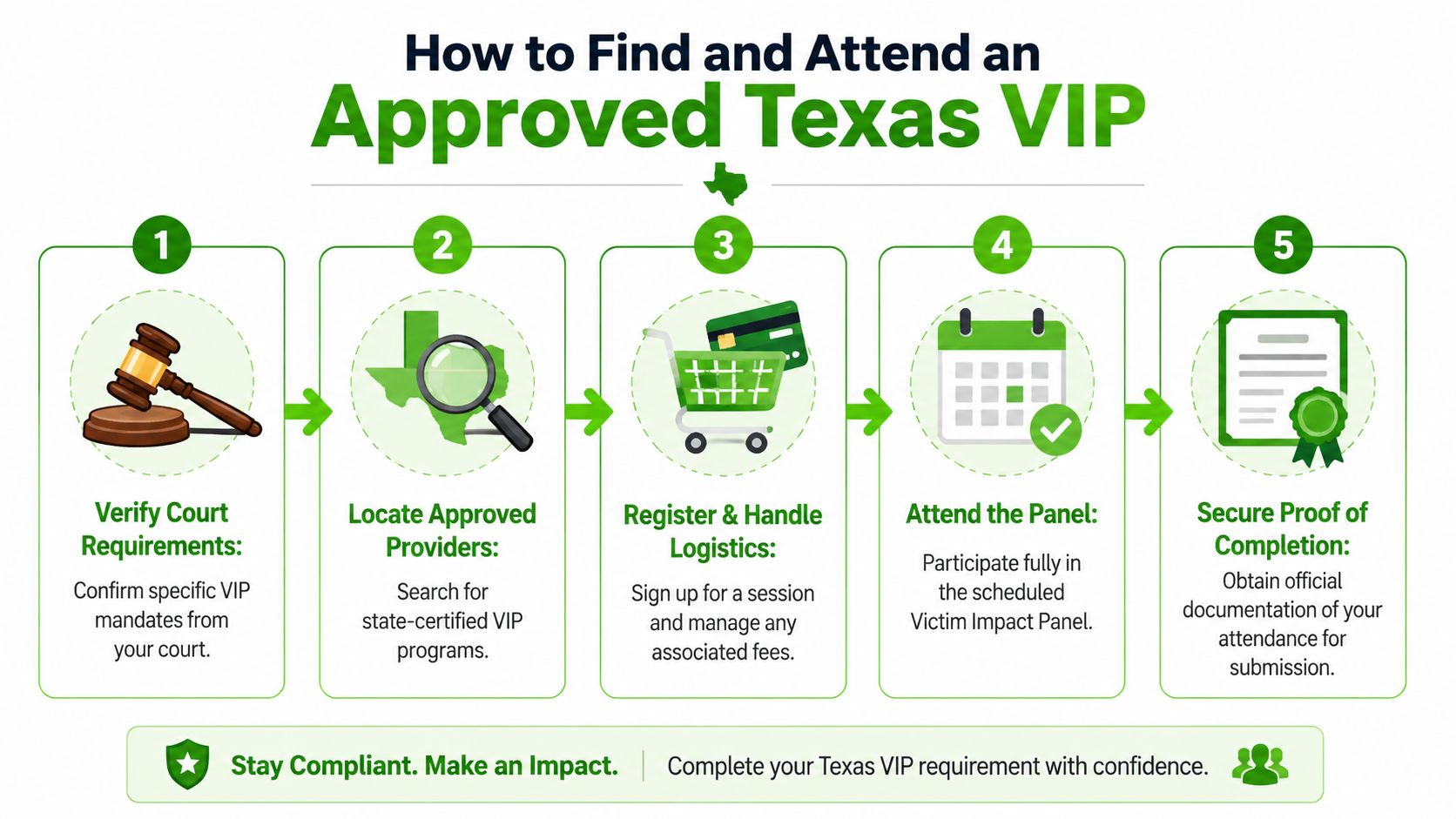
A person who receives a VIP order usually starts with one practical question, where do I go, and who is allowed to count my attendance? In Texas, the answer often begins with the court or probation department, because VIP placement is handled locally and can change from county to county. The panel your friend used may not be the one your case requires, so the safest first move is to follow the agency named on your paperwork.
The approval question comes first
Before you register, get clear answers to three things. Is the provider approved for your court, does the court require a specific county, and will an online session count for your case? If any part of that is unclear, ask before you pay or attend, because a wrong choice can leave you with an attendance record the court does not accept.
County guidance often shows why this matters. A provider may describe the panel in general terms, while the court still controls the exact approval, format, and reporting rules. If you are comparing examples from outside Texas, a page like a Victim Impact Panel in Savannah, GA can show how location-specific these programs can be, even when the basic idea sounds similar. The point is simple, the name alone does not tell you whether it fits your order.
Use a simple approval checklist
- Confirm the court order: Make sure the VIP is required in your case, and note any deadline written in the order.
- Ask about location: Some courts direct you to a specific county, provider, or schedule.
- Verify format: If your court allows virtual attendance, get that approval in writing when possible.
- Check language availability: County pages may list English and Spanish options, but your court's instructions still control.
- Save provider details: Keep the registration confirmation, attendance instructions, and contact information.
When you compare providers, look at the whole process, not just the title of the program. A page may explain the panel format, but your probation officer or court coordinator is the one who decides whether that format satisfies your order. That is why two people in different counties can receive similar VIP instructions and still have to use different providers.
Attend like compliance depends on it
Arrive on time, stay attentive, and follow the rules for the session. You are not there to socialize or debate the material. You are there to satisfy a court requirement, and the provider can only document your attendance correctly if you complete the session as instructed.
If the provider gives you sign-in steps, paperwork, or an online completion screen, keep every record. Courts and probation offices often want proof, and a missing certificate can create problems even when you sat through the panel. Treat the confirmation like a receipt, because that is what shows the court the requirement was met.
Navigating Costs Scheduling and Documentation

A VIP does not become a court credit just because you found a session. The schedule, the approval path, and the paperwork all have to line up with the order you received. In Texas, a formal request to hold a Victim Impact Panel must be submitted at least 30 days before the requested date, and every request still has to be approved. That means the panel is planned and tracked, not treated like a walk-in class. VIP request form
What to handle before the date
Start with the details your court or probation office is likely to ask for, such as your case information, contact information, and the provider's registration steps. If your order includes a deadline, work backward from that date so you can see whether the panel date, sign-up process, and any follow-up all fit together. A rescheduled panel can create a problem if proof is due before the new date.
The number of people allowed in a session can also affect your timing. Texas Department of Criminal Justice policy says a panel typically caps attendance at 50 offenders per panel Texas parole policy. When a session has a cap, waiting until the last minute can leave you without a seat, which means you may miss the deadline even if you were ready to attend.
What proof you need afterward
Completion proof is the part that gets misplaced most often. Keep the certificate, confirmation email, or completion form in a safe place, then send it exactly where your court or probation office told you to send it. If the document is lost, you may need to request another copy from the provider, and that can slow the process.
Court-liaison rule: if the court wants written proof, do not assume a verbal promise from the provider is enough.
Some programs issue documentation right away, while others send it only after attendance is verified. Read every instruction closely, and keep the registration notice, receipt, and follow-up messages until your file shows the requirement was accepted. A small paper trail can prevent a large compliance problem later.
Tips for Ensuring Your VIP Attendance is Accepted

A finished panel can still be rejected if the paperwork does not match the court's order. The court usually checks whether you attended the right program, stayed for the full session, and submitted proof in the exact way it was requested. If you leave early, miss part of the class, or forget the certificate, the requirement may still be treated as unfinished.
The safest approach is to treat the approval process like a filing check, not just an attendance check. You are not only showing up, you are creating a record the court can accept.
Before the panel
Start by confirming the provider with your court or probation office before you go. If the order names a specific county or approved program, use that information as the reference point, because a provider's own website may not tell you how your case will be handled. Bring your registration confirmation, and if the session is in person, arrive early enough to get through check-in without rushing. If the class begins without you, do not assume you will still be counted.
If the provider's name on your certificate does not match the court's approved list exactly, do not ignore the difference. A clerk may accept a certificate with a slightly different business name, but that is a local filing question, not something to guess at. Ask the court or probation office how they want the name shown before the session if you can, or as soon as you notice the mismatch after completion.
During the panel
Listen closely and stay focused on the presentation. The panel is meant to make the consequences of impaired driving concrete, and county guidance often describes victims speaking about financial, psychological, and physical harm to help build empathy and remorse. If the moderator opens a question period, keep your questions tied to the requirement itself. Use that time to clarify what attendance, sign-in, or proof will be expected, not to argue with the program.
Small interruptions can create bigger problems later. If you step out, arrive late, or leave before the session ends, the provider may not be able to certify full attendance. A clerk reviewing your file will usually look at the document, not at your explanation.
After the panel
Submit proof of completion promptly, exactly where the court told you to send it. Keep a copy for yourself, because paperwork gets misplaced more often than people expect. If your court wants the original certificate, make a copy before you hand it over.
After you submit it, follow up with the clerk or probation office to confirm that the document was received and placed in your file. That kind of check matters when a deadline is close, because a certificate that was mailed, scanned, or dropped off is not always the same as a certificate that was formally accepted. If the office gives you a receipt, case note, or email confirmation, save it with the rest of your records.
A good rule is to treat the panel the same way you would treat any court filing. Show up prepared, stay respectful, keep your documents organized, and confirm receipt after submission. That is how you reduce the chance of repeat attendance and avoid unnecessary follow-up.
Texas Victim Impact Panel FAQ
A court order can make the panel feel straightforward on paper and confusing in practice. The questions below address the parts people usually ask about first, especially the county-level differences that affect where you go, how you register, and what proof the court will accept.
Can I attend a VIP in a different county? Sometimes, but only if your court or probation department says that county's panel is acceptable. Texas relies on local supervision, so the county handling your case matters more than the location listed by the provider.
What happens if I miss my scheduled panel? Contact the court or probation office right away and ask what approved option is available next. Do not assume the missed session carries over automatically, because the request and approval process is formal and tied to deadlines.
Are online VIPs always accepted by Texas courts? No. Acceptance depends on the court order, the supervising probation office, and the county's rules. A provider may offer virtual attendance, but your case may still require a specific format or location.
Do the speakers always come from the same county? Not necessarily. The program follows a statewide framework, but local panels can still differ by provider, language, and scheduling details.
Can a Victim Impact Panel replace a Victim Impact Statement? No. The panel is an educational requirement for offenders, while the statement is a formal document from a victim for the court record Texas victim impact statement law.
If you're trying to keep your Texas DUI paperwork clean, Georgia DUI Schools offers a Victim Impact Panel course, along with other compliance-focused education services that can help you stay organized when court requirements overlap. Visit Georgia DUI Schools if you want a provider that also handles DUI/Risk Reduction, defensive driving, clinical evaluations, and related completion documentation with a straightforward enrollment process.