You're sitting on a ticket, a court date, or a warning from DDS, and now you need a defensive driving course video that counts. The hard part isn't finding a video, it's finding one that fits the exact requirement on your paper, whether that's point reduction, a judge's order, or an insurance form.
A lot of drivers get tripped up here because “video course” can mean very different things. Some courses are simple, unstructured clips that teach safe habits. Others are regulated programs with quizzes, timed modules, instructor support, and a completion certificate that a court or agency will recognize.
What a Defensive Driving Course Video Actually Is
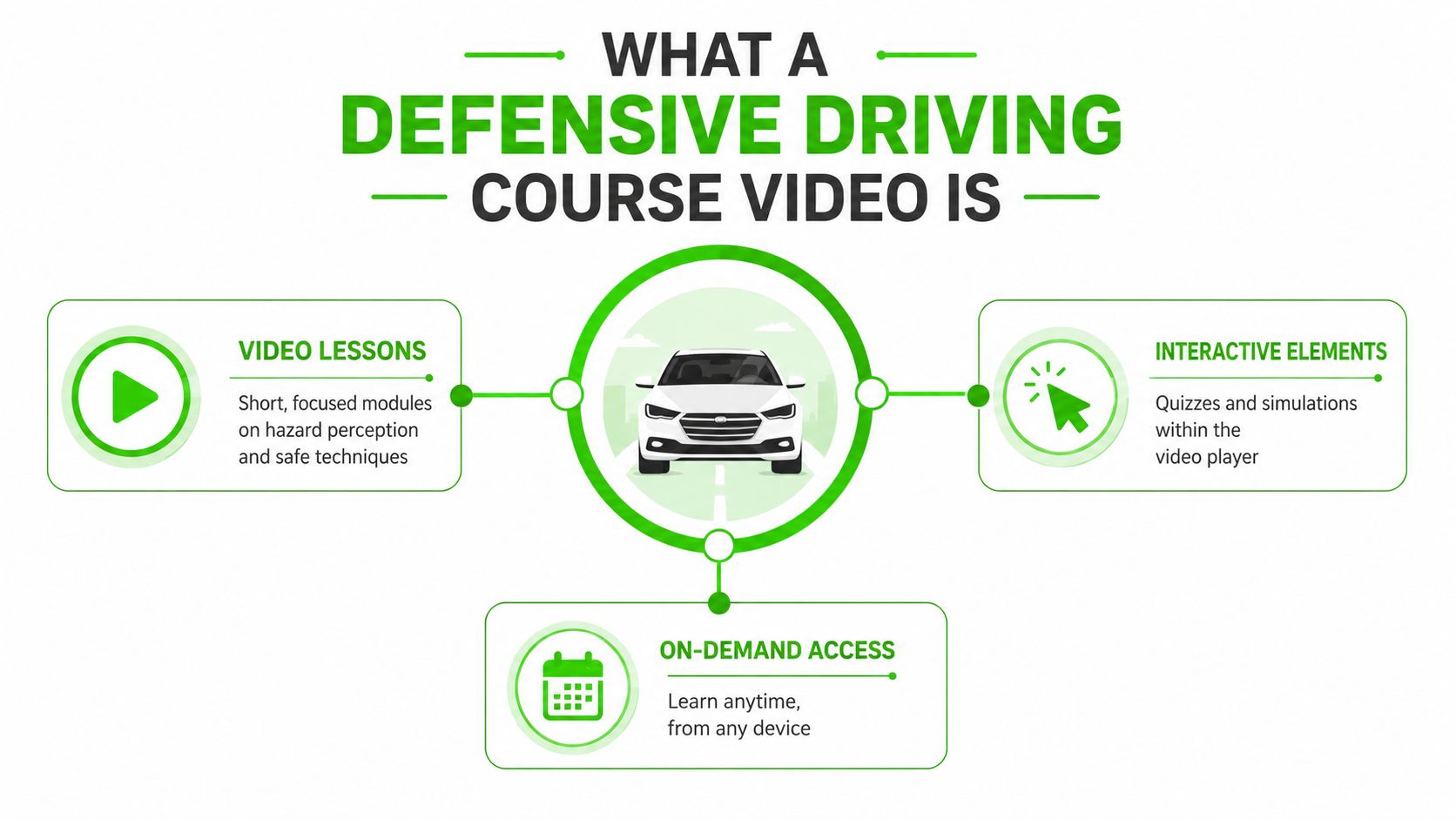
A defensive driving course video isn't just someone talking at a camera about safe driving. In a compliant course, the video is part of a structured lesson plan that teaches hazard perception, scanning, space management, and decision-making in short sections, then checks whether you understood it. That difference matters because a YouTube clip can be helpful, but it won't automatically satisfy a court, DDS, or insurance requirement.
In practice, the best video courses break the material into short, focused pieces. Alberta's approval framework, for example, requires clips of 1 to 5 minutes each, with audio-narrative enhancement and no more than 1.5 hours of video used to illustrate course content, not replace it (Alberta approval document). That setup keeps the learner moving instead of drifting through one long lecture.
The point is accountability. New Jersey's video and online rules require module quizzes, a proficiency exam, explanations of right and wrong answers, technical support, and even a 24-hour live hotline staffed by a certified instructor (New Jersey regulation). That's what separates a course from casual viewing.
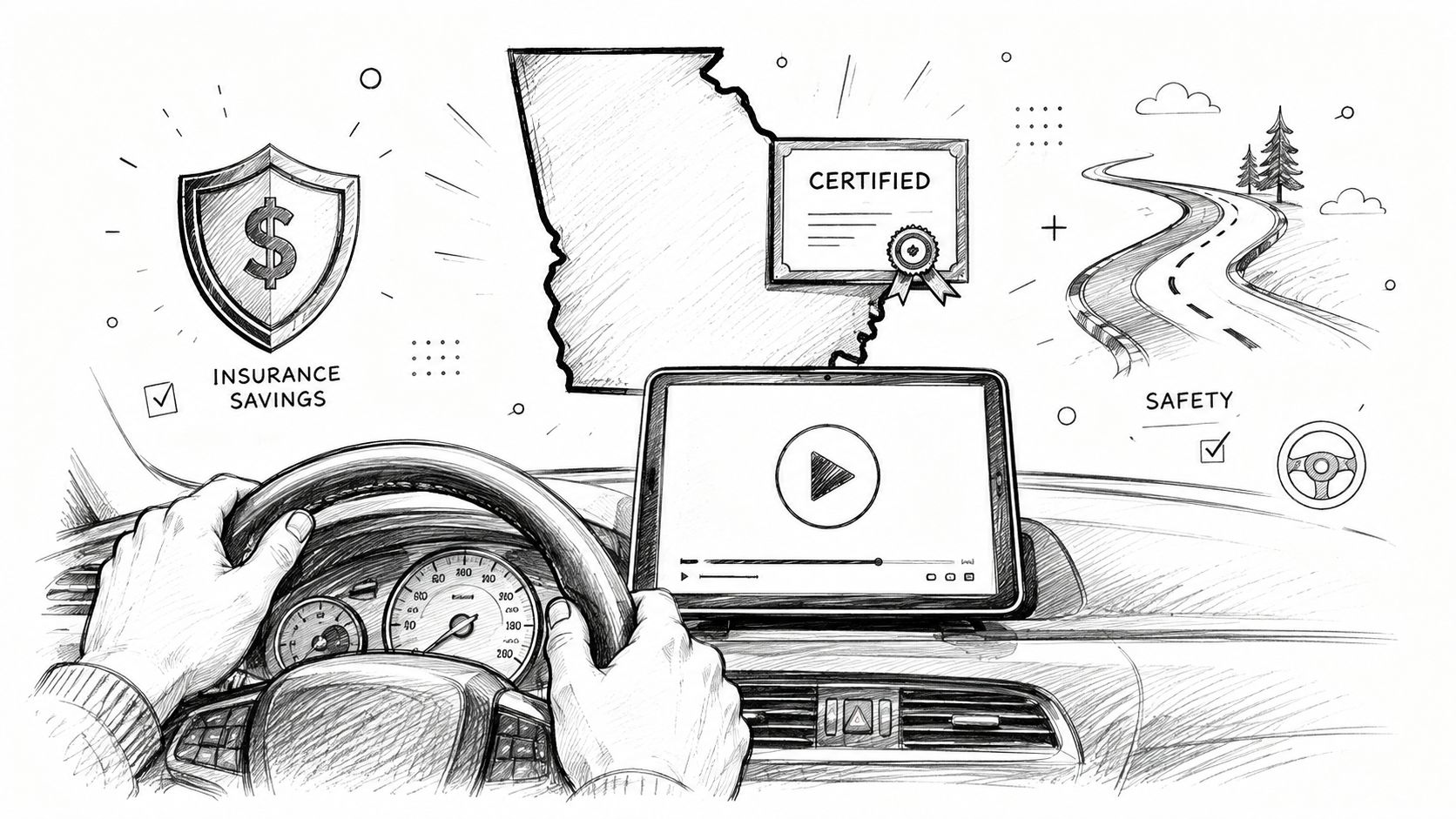
For Georgia drivers, that structure is the part that counts. The safest assumption is simple, if a course doesn't explain how it handles quizzes, verification, and completion reporting, it may be educational, but it may not be compliant. A quick overview video can help you learn, but a real course has to prove you finished.
Practical rule: if the course can't show you its completion path before you enroll, don't assume it will satisfy your requirement.
Self-Paced Video vs Live Virtual vs Classroom Formats
Georgia drivers usually compare three formats, self-paced video, live virtual instruction, and traditional classroom learning. Each one can work, but they solve different problems. The right choice depends on whether you need flexibility, interaction, or a familiar in-person setting.
| Format | Flexibility | Instructor Interaction | Best For |
|---|---|---|---|
| Self-paced video | Highest, you can usually work around your schedule | Lower unless the course adds quizzes or support | Drivers who need convenience and want to move through material on their own |
| Live virtual | High, but tied to a scheduled session | High, because the instructor is present in real time | Drivers who want questions answered during class without leaving home |
| Classroom | Lowest, because you have to be there in person | Highest face-to-face interaction | Drivers who learn best in a room with direct supervision |
Self-paced video is the format drivers ask about first because it fits around work, parenting, and court deadlines. If you need a regulated course, though, self-paced doesn't mean “untracked.” The course still has to verify progress, usually through module checks and a final assessment. That's where a structured provider matters more than the format label.
Live virtual instruction works better if you want real-time feedback without commuting. A remote class can feel much closer to the classroom experience, especially for drivers who want to ask about traffic laws, court paperwork, or completion timing as they go. If you're helping clients or producing live instruction content, publish live video via OctoStream is a useful technical reference for understanding how live video delivery is put together.
Classroom instruction still has a place for drivers who focus better with a teacher in the room. Some people don't want to stare at a screen alone, and that's fair. If you're comparing options offered by Georgia DUI Schools' online defensive driving course, the main question is whether you need absolute flexibility or the accountability of a scheduled session.
A good rule of thumb, choose the format that matches your deadline and your learning style, not the one that sounds easiest in theory.
Georgia Compliance and Court Acceptance Rules
The question Georgia drivers ask most is simple. Will this course count? The answer depends on what you're trying to satisfy, DDS point reduction, an insurance request, or a court order, and you need to verify that before you pay.
Georgia DDS frames defensive driving around point reduction and driver-risk education, so the course has to do more than entertain you. It needs to be from a provider that the state accepts for your purpose, and the completion certificate has to line up with the exact requirement you're trying to meet. If a judge, probation officer, or insurance company gave you instructions, those instructions control.
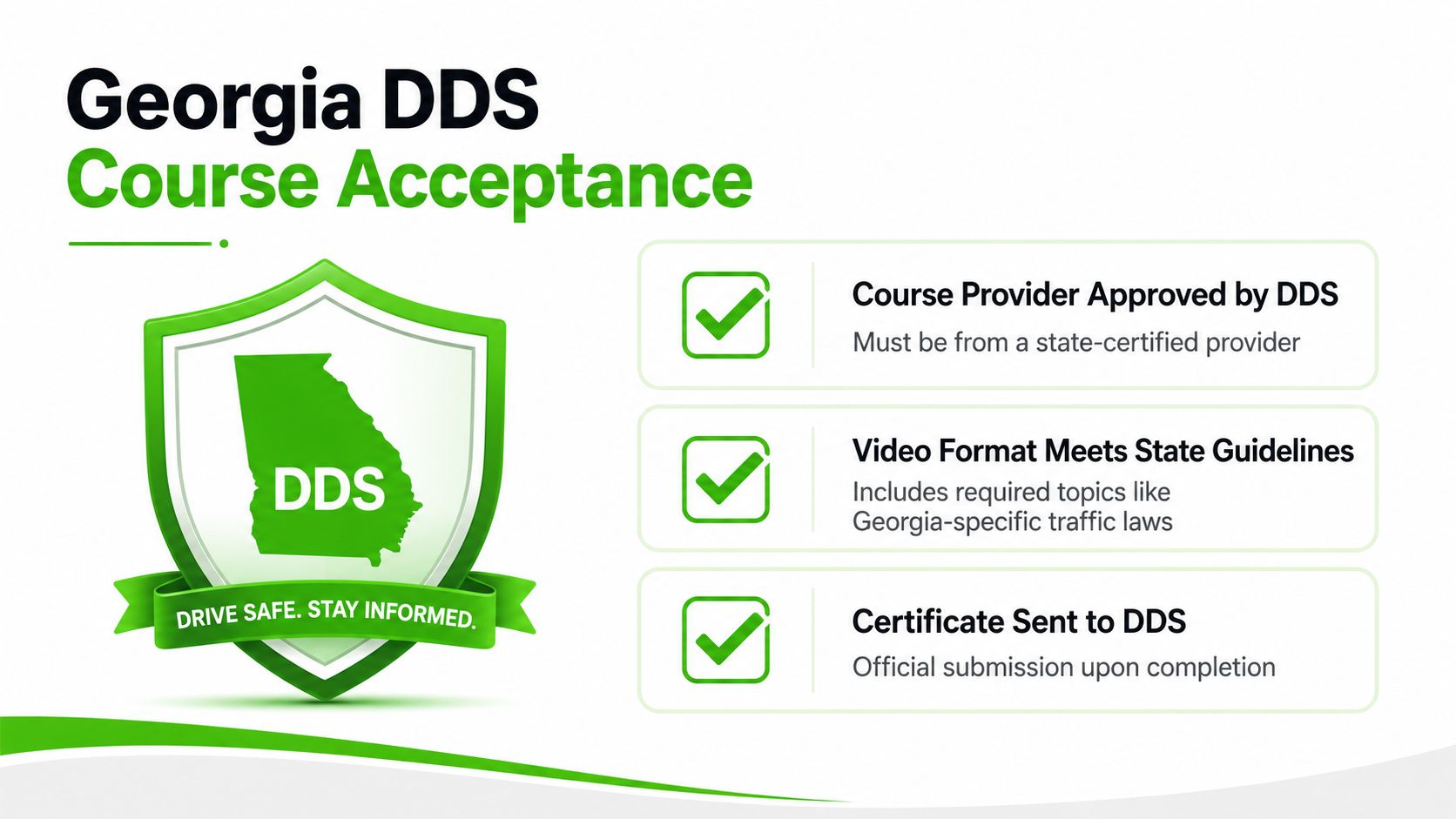
A lot of confusion happens because people look at generic tips, following distance, blind spots, lane changes, and think any driving video will do. It won't. Courts and agencies care about provider approval, course content, and whether you receive the right documentation at the end. That's why a video course has to be selected as a compliance product, not just a learning video.
If you want a practical explanation of legitimacy questions, the article at Are Online Defensive Driving Courses Legit is a good companion read. For a process-focused view of AI-generated content quality, the AI blog writing tools comparison is a helpful reminder that delivery and verification matter more than flashy presentation.
Here's the cleanest way to avoid a mistake:
- Check the requirement first. Court, DDS, insurance, or employer rules can differ.
- Confirm the provider is accepted. Don't assume “online” automatically means approved.
- Ask how the certificate is issued. Some situations need proof sent a certain way.
- Keep your paperwork. Save the certificate, receipt, and any enrollment confirmation.
Georgia drivers often want a quick yes or no, but compliance is usually a checklist. The safest move is to verify before you start, because a course that looks convenient but doesn't match the order wastes more time than a longer, approved option.
Step-by-Step Completion and Certification Process
Enrollment should feel straightforward, even if the requirement itself is strict. Start by choosing the format that matches your situation, then make sure your device and browser can handle video playback, quizzes, and certificate delivery. If you're using a phone, tablet, or laptop, test sound and internet access before you begin so you don't lose time midway through a module.
The course itself should move in a clear sequence. You watch a lesson, answer a few questions, and continue to the next module only after the system records your progress. That structure is there for a reason, because approved video courses aren't meant to be passive watching sessions.
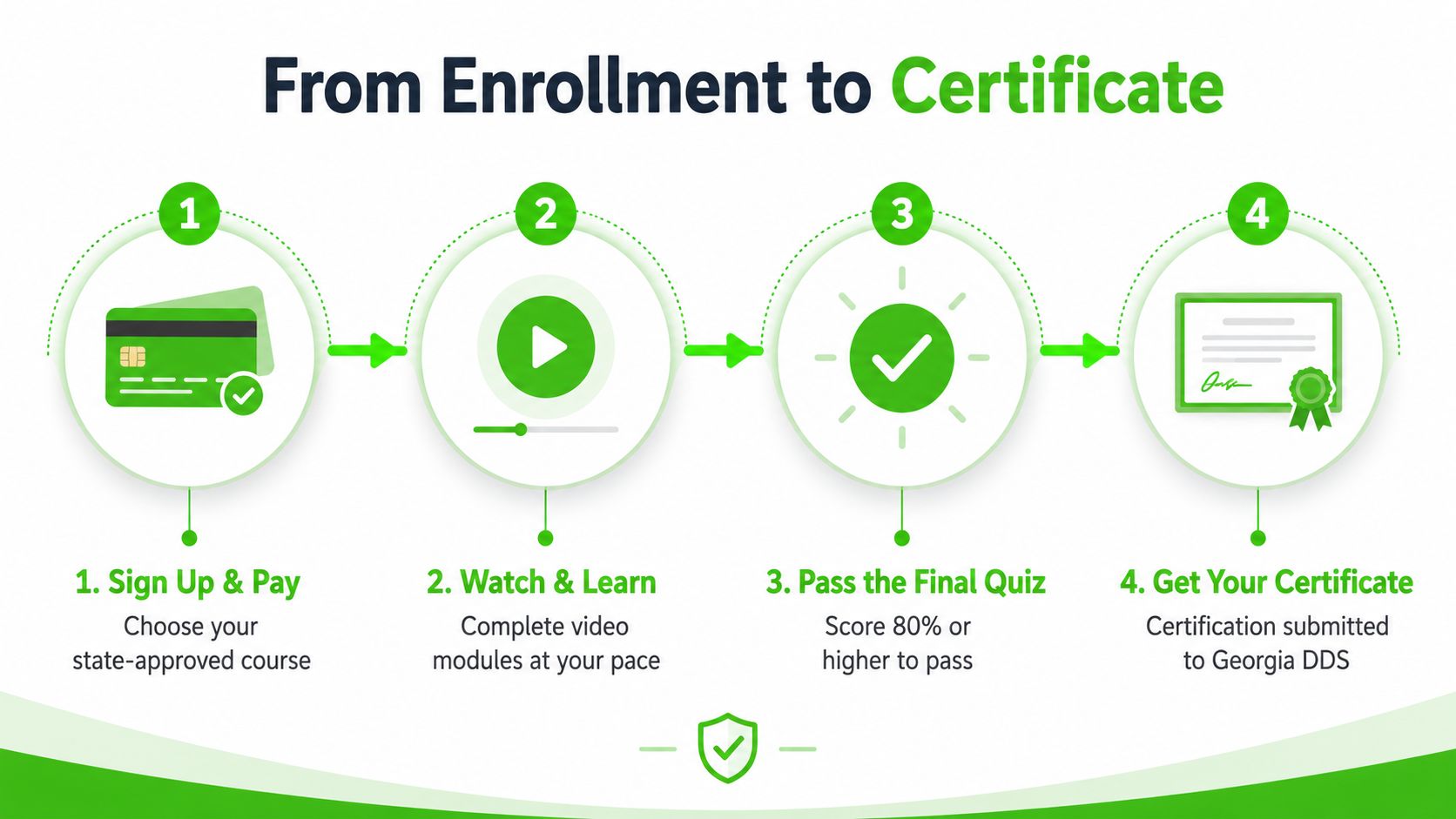
A typical completion path looks like this:
- Sign up and pay. Choose the course that matches your Georgia requirement.
- Watch and learn. Work through the video modules at your own pace or in a scheduled session.
- Pass the final quiz. Some courses use quizzes after each section, plus a final check.
- Get your certificate. Keep the completion record and submit it where it needs to go.
Technical problems are usually simple, but they can stop a course cold. If a video freezes, refresh the browser, try a different device, or clear cached data. If a quiz won't submit, check whether the course wants every question answered before it advances. Small fixes matter because the platform usually won't mark a section complete until the system receives your response.
Georgia DUI Schools offers compliant delivery options for drivers who want the convenience of video without losing the structure required for completion. That can be useful if you need a course that fits around work hours or a court deadline.
The key is not speed alone. The key is finishing with the right proof in your hands, because that's what closes the loop for DDS, court, or insurance use.
Benefits of Completing a Defensive Driving Video Course
The most immediate benefit is practical. A completed course can help with point reduction, insurance documentation, or a court requirement, so many Georgia drivers treat it like a deadline they have to satisfy, not an optional lesson. If your license is on the line or your insurer wants proof, the certificate matters more than whether you watched it on a screen, in a classroom, or through a live virtual session.
The safety argument has weight too. The National Safety Council cites research indicating that 77% of all crashes involve driver error and that 94% of serious motor vehicle accidents result from human errors that can be addressed through instruction (ICW Group safety article). That helps explain why courts and agencies keep using driver education as part of compliance and correction.
Training also shows a measurable connection to safer outcomes. The same research notes a 4.3% lower crash rate with formal training, and teen drivers who take defensive driving courses are reported to be 62% less likely to receive traffic violations and 43% less likely to be involved in an auto accident. Those figures do not guarantee the same result for every driver, but they do show why structured instruction remains part of traffic safety policy.
For Georgia drivers, the main payoff is often the paperwork outcome. If you need lower points, a better insurance position, or a way to satisfy a judge, the course gives you a clear path to that result. If you are comparing options for an insurance-related filing or discount request, Georgia DUI Schools' defensive driving course to lower insurance explains how completion may fit that kind of request.
A well-run course also helps the lesson stick after the certificate is issued. That matters because the goal is not only to pass the quiz, it is to make better choices the next time traffic is heavy, time is short, and patience runs thin.
Common Questions and Misconceptions About Video Courses
A lot of drivers hear “video” and assume it means a softer standard. That assumption misses how these courses are built. A structured defensive driving course video can hold attention better than a long lecture because it breaks the material into smaller pieces, checks understanding along the way, and keeps each lesson tied to a real driving decision.
The bigger question is whether the course format will count for the requirement you are trying to meet. Courts and state agencies usually care about what the course contains and how completion is documented, not just whether a student sat in a room or watched on a screen. New Jersey's rules show that clearly, because the course must include quizzes, a final proficiency exam, explanations of correct and incorrect answers, and support options for the learner (New Jersey regulation).
Passive video lectures fall short. Courses that build in checks, feedback, and documentation function as compliance tools instead.
Drivers also wonder whether watching video changes how they drive later. The useful answer is that video by itself usually is not the whole lesson, but video paired with active instruction can reinforce what a driver needs to remember. Alberta's approval document requires short clips used to illustrate course content, while the course itself must remain current within three years and use relevant graphics and visual aids (Alberta approval document). That setup is meant to support retention, not replace judgment.
Another misconception is that all video courses are interchangeable. They are not. Some are built mainly for convenience, while others are built to satisfy a court, DDS, or insurance requirement, and the difference shows up in the quiz structure, support options, topic coverage, and how the certificate is handled. If the course has to count, the approval path matters just as much as the format.
How to Enroll with Georgia DUI Schools
If you need a compliant course in Georgia, start by matching the format to your situation. Self-paced video works well if your schedule is tight, live virtual instruction fits drivers who want real-time guidance, and classroom sessions help people who prefer face-to-face accountability. Georgia DUI Schools also serves drivers across Atlanta, Athens, and surrounding metro communities, with online access available statewide.
The cleanest next step is to choose the course that matches your requirement before you register. That matters because court orders, DDS needs, and insurance requests can all point to different documentation expectations. Once you know what you need, registration is much easier and you won't waste time on the wrong format.
If your goal is to finish quickly and keep your paperwork in order, the most direct option is to review the course page and enroll in the format that fits your deadline. Georgia DUI Schools offers flexible scheduling, including weekday and weekend options, so you can fit the course around work or family obligations.
If you need a Georgia defensive driving course video that's built for compliance, not guesswork, start with a provider that understands court, DDS, and insurance requirements. Georgia DUI Schools offers self-paced online, live virtual, and classroom options, plus the support you need to finish with the right certificate in hand.