A clinical assessment is not a pass or fail test. In Georgia, the DUI Risk Reduction Program begins with a 130-question screening of your alcohol and drug use and how it affected your driving, continues through a 20-hour intervention course, and a separately ordered clinical evaluation goes further still to determine whether a substance use disorder exists and which level of care fits.
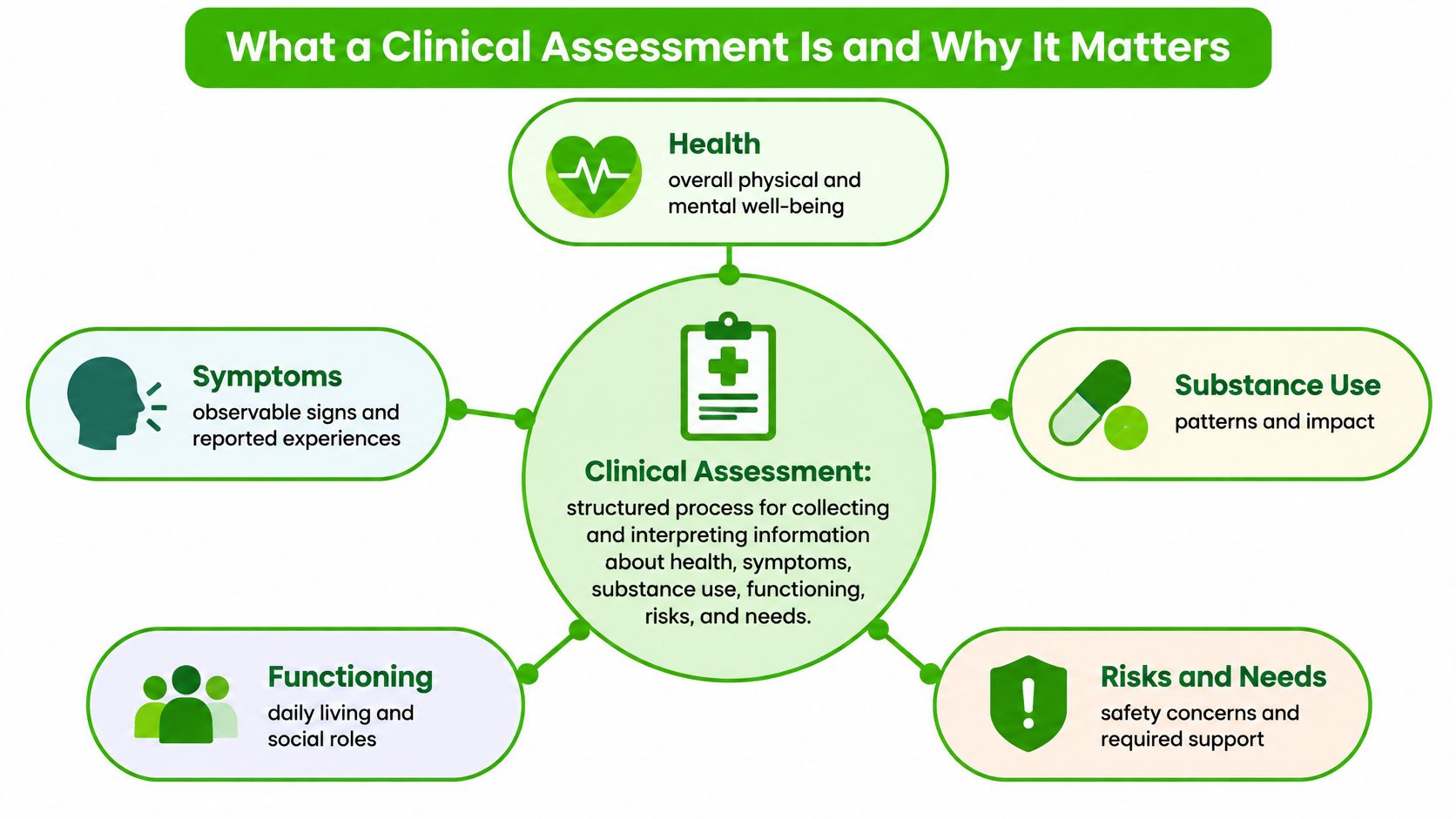
A clinical assessment is a structured process for collecting and interpreting information about a person's health, symptoms, substance use, functioning, risks and treatment needs, and it happens before anyone decides anything. That ordering matters more than the definition does.
People searching for what clinical assessment is aren't hunting for a textbook sentence. They want to know what happens in the room, who sees the answers, and whether being honest makes things worse. Those are the questions worth answering in order.
What a Clinical Assessment Is and Why It Matters
What is the evaluator deciding, and does telling the truth make the outcome worse?
A clinical assessment works like a mechanic's diagnostic visit. The scan, the road test, and your description of the noise all feed one conclusion. No single reading names the repair by itself. In a Georgia DUI case, that conclusion is a recommended level of care, not a pass or a fail.
The scale of the problem is why the process exists. A substantial share of the world's population lives with a mental disorder. Systematic assessment is how symptoms get identified, how one condition gets separated from another, and how people get matched to services that fit the problem in front of them. It also sets a baseline, so a later change in risk or day-to-day functioning has something real to be measured against.
Four terms people use as if they mean the same thing
Screening, assessment, diagnosis, and treatment plan are stages of one sequence. They are not four names for the same step. Lining them up side by side clears most of the confusion.
| Term | What it does | Typical output | Georgia DUI example |
|---|---|---|---|
| Screening | Quick check for possible risk | Yes, no, or elevated risk | A screen of alcohol and drug use that signals risk and is not scored pass or fail |
| Clinical assessment | Structured gathering and interpretation of evidence | Findings, risk profile, and level-of-care recommendation | In-depth clinical evaluation a judge orders in addition to the Risk Reduction Program |
| Diagnosis | Naming a condition using recognized criteria | Diagnostic label with severity | Substance use disorder finding under DSM-5 criteria |
| Treatment plan | Actions that address the findings | Services, schedule, and goals | Outpatient counseling plan recommended after the evaluation |
What that looks like for a driver in Atlanta
Say you were arrested for DUI in Fulton County and the judge ordered a clinical evaluation on top of the Risk Reduction Program. The evaluator is not deciding whether you are a bad person. The narrower question is whether a substance use disorder is present, and if it is, which level of support fits your actual circumstances.
Honesty helps that match. Minimizing use can point the recommendation at support that is too light for the risk. Describing a worse pattern than you have can point it the other way. The interview and history carry most of the weight, and scores support the conclusion rather than replacing it.
The wider psychiatric evaluation process explained by Refresh Psychiatry & Therapy shows the same shape. Before you book anything in Georgia, understand the difference between an assessment and an evaluation, because the two appear on different paperwork and follow different paths.
Quick check: if you can name which of those four terms your court order or DDS letter actually uses, you know which stage you are standing in.
How Clinical Evaluations Fit Georgia DUI Requirements
A Georgia DUI case can list three separate items. Drivers often treat them as one appointment.
| Component | What it involves | Length or format | Required for |
|---|---|---|---|
| Assessment Component (NEEDS) | 130-question screening of alcohol and drug use and how it affected driving | 25 to 45 minutes, completed before class | Starts the Risk Reduction Program and feeds the certificate |
| Intervention Component | Group lessons, therapeutic education and peer-group counseling | 20-hour course across multiple sessions | Completes the Risk Reduction Program together with the Assessment |
| Clinical Evaluation | In-depth evaluation by a DBHDD-approved professional | Extended session with a licensed evaluator, booked separately from the class | Ordered by a judge in addition to the RRP; RRP completion does not satisfy it |
The Risk Reduction Program works like a two-step gate. You complete the Assessment Component first, then the Intervention Component. The assessment is a 130-question screening instrument, often called the NEEDS assessment, and it is not a pass or fail test. Georgia's Department of Driver Services DUI FAQ describes the assessment as an instrument built to evaluate alcohol and drug use and how that use affected driving. It takes 25 to 45 minutes, and you finish it before the class.
The Intervention Component is the 20-hour course. Sessions mix group lessons, therapeutic education, and peer-group counseling about alcohol, drug use, and driving consequences. A certificate of completion is not issued until both the Assessment and the Intervention are finished. Sitting in class without the screening leaves the program incomplete.
A clinical evaluation sits outside that sequence. A medical or mental health professional, specifically a DBHDD-approved evaluator, determines whether a substance use disorder is present and whether treatment is required. The finding recommends a level of care. It is not a grade. A judge may order the evaluation in addition to the Risk Reduction Program, and finishing the program does not satisfy that separate order.
Read the order first: if the words "clinical evaluation" appear on your paperwork, that's a different appointment from the Risk Reduction class, and one doesn't substitute for the other.
Georgia DUI Schools conducts clinical evaluations with a DBHDD-approved professional. The appointment is scheduled on its own timeline rather than bundled into the class. Match the wording on your order to the right appointment before you book.
The Four Sources an Evaluator Combines

For a Georgia driver ordered to get a clinical evaluation, the outcome depends on more than a questionnaire score. The evaluator brings together four kinds of information, like pieces of a decision-making map. Each adds context to help determine whether treatment is recommended and, if so, what level of care may fit.
- The clinical interview: Your account of substance use, patterns, consequences, and goals gives the evaluator context that a score alone cannot provide.
- Standardized instruments: Structured questionnaires help organize responses and compare them with reference groups. Their results are one input, not a diagnosis on their own.
- Behavioral observation: The evaluator considers how you communicate and respond during the appointment alongside your other information.
- Records and collateral information: Court documents, prior treatment records, or statements from family members may add context when they are available and gathered with your consent.
Why reliability and validity decide whether a score means anything
Two ideas help explain how an evaluator interprets a tool's results. Reliability is about consistency across raters or repeated administrations. Validity is about whether the tool measures what it is intended to measure. A scale that reads five pounds heavy every time is reliable, but it is not valid.
Reliability coefficients generally run from 0 to 1.0, with higher values indicating greater consistency. What counts as acceptable reliability depends on the decision the score supports. A screening result can guide further questions, while the overall evaluation draws on all four sources.
One answer on one form is a starting point, not a verdict.
For example, a Georgia driver's questionnaire responses may prompt the evaluator to ask about patterns or consequences in the interview. The responses are considered alongside relevant observations and records, rather than treated as a final diagnosis. If you are considering a remote appointment, the format may differ, but book a telehealth psychiatric evaluation is still a separate choice from how an evaluator weighs the information gathered.
What Happens During an Evaluation, Step by Step
Knowing the sequence removes most of the dread, because each step has a job and none of them is a trap.
Here's how the process typically runs, from the first phone call to the report that leaves the building.
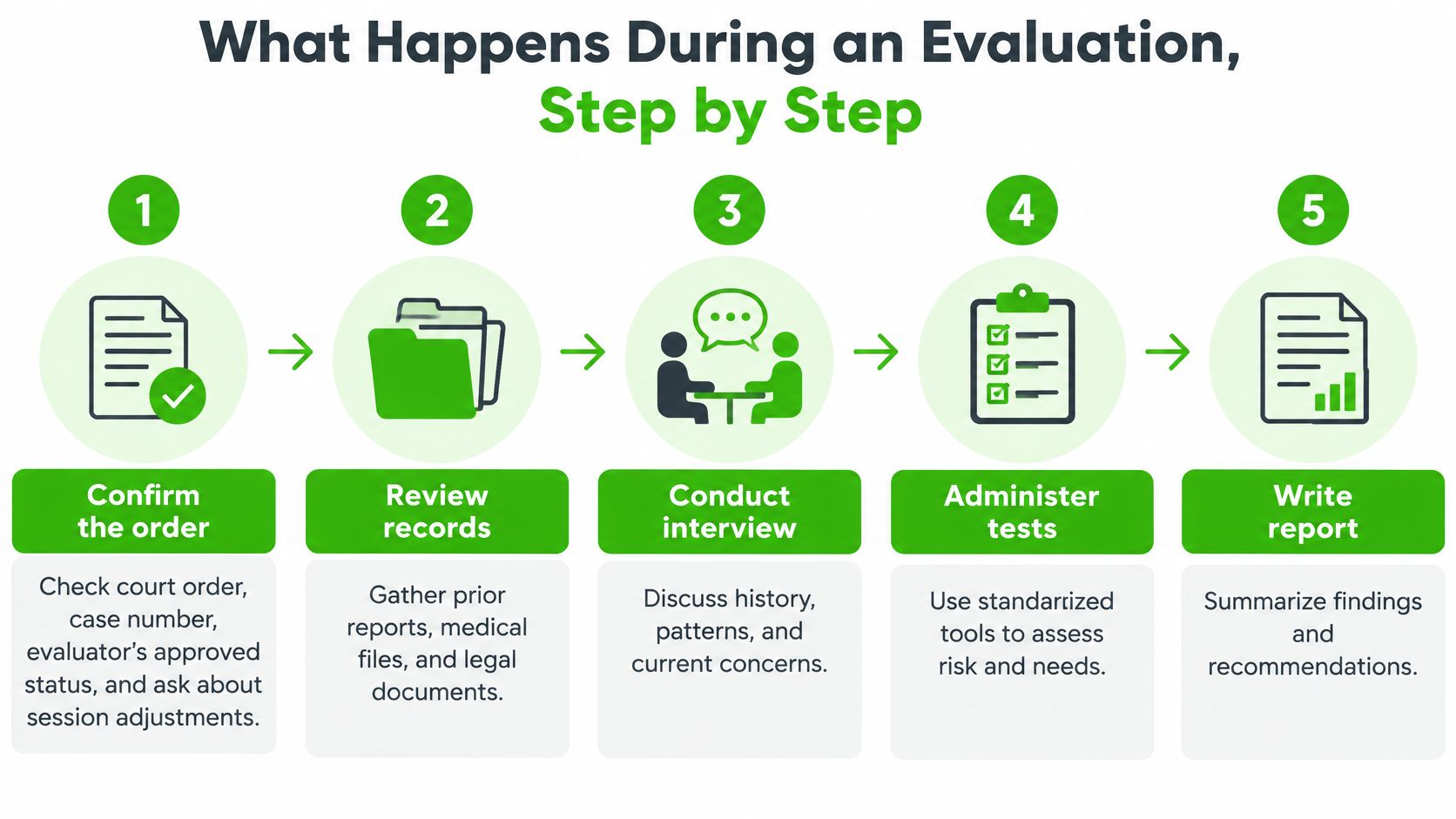
- Confirm the order and the details. Check the court order, the case number and the evaluator's approved status. Ask whether the session can be virtual and what accommodations exist, such as an interpreter, because those are easier to arrange before the appointment than during it.
- Review consent and its limits. The evaluator explains confidentiality, what gets shared with the court or DDS, and any mandated reporting. Clinical recommendations and legal decisions are separate products, made by different people.
- Complete a brief screen. The NIDA TAPS model uses a four-item initial screen covering tobacco, alcohol, illicit drugs and nonmedical prescription-drug use. A positive result doesn't diagnose anything; it triggers a deeper conversation.
- Sit for the clinician-led interview. This covers substance use history, severity, timing, consequences, prior treatment, withdrawal risk and safety, often guided by DSM-5 substance-use-disorder criteria. NIDA advises that people with problem use or higher risk need a clinical interview beyond screening.
- Release records and collateral. With your permission, the evaluator requests prior reports and compares your account against them. Discrepancies aren't treated as lies automatically; they're explored.
- Interpret the findings. The evaluator identifies what's still missing and discusses uncertainty with you before settling on a conclusion.
- Issue the written report. Findings and recommendations go to the court or DDS, and that body applies them.
Honest, specific answers help the evaluator do the job accurately. So does confirming practical details early. Ask at scheduling how long the session runs and what it costs, since neither figure is set by the court order.
How Evaluators Decide the Level of Care
Placement isn't decided by your charge or by a single diagnosis. An ASAM-informed analysis rates risk across six domains and then applies admission criteria to find the least intensive setting that can safely address your needs, as the ASAM Criteria overview sets out.
| Domain | What the evaluator checks | Why it changes the level of care |
|---|---|---|
| Intoxication or withdrawal potential | Current use, withdrawal history and risk | Clinically significant withdrawal can require a more intensive setting |
| Biomedical conditions | Medical problems and medications | Instability can require medical monitoring |
| Emotional, behavioral and cognitive conditions | Mood, thinking and behavior symptoms | Co-occurring conditions can affect treatment participation |
| Readiness to change | Motivation and awareness of use | Low readiness may call for more structured engagement |
| Relapse or continued-use potential | Patterns, triggers and past relapses | High relapse risk can point to structured outpatient care and monitoring |
| Recovery or living environment | Housing, family support and daily stability | Weak support can require added services; strong support lowers barriers |
The link between findings and service intensity runs in both directions. Clinically significant withdrawal or medical instability can push someone toward a more intensive setting. Stable medical status paired with substantial relapse risk or thin recovery support typically points to structured outpatient services with coordinated monitoring instead, which is often the more demanding option in practice rather than the easier one.
Why strengths count as much as problems
A driver in good health with a stable home and a supportive family but a high relapse risk is a realistic candidate for structured outpatient care rather than residential treatment. The assessment captures protective factors such as motivation, housing stability, family support and treatment preferences, because those lower barriers and shape the plan.
Expect questions about what's going well, not just what's going wrong. The framework is person-centered and strength-based, and the result gets used for treatment planning and later decisions about continuing, transferring or stepping down. If you want to see how those levels are laid out in Georgia, the breakdown of ASAM treatment levels maps the same six domains onto the services you'd attend. The level-of-care determination guidance from Addiction Resource Center is a useful second read on how the domains translate into a placement recommendation.
Myths About Honesty, Diagnosis and Results
Four beliefs cause most of the anxiety that shows up in the waiting room, and each one is worth correcting plainly.
The pass or fail myth. An assessment gathers and interprets information. No one grades you, and there's no score at the end that reads "fail." Readiness to change is one of the six domains, and low readiness influences the recommendation rather than disqualifying you.
The honesty myth. Holding back feels protective, but evaluators cross-check self-reports against records and screening results. A 2025 study of substance-use assessment published in Frontiers in Public Health found that 21.3% of participants underreported using at least one substance when their self-reports were compared with objective data. That gap is exactly why verification exists, and why an accurate account protects the credibility of your whole evaluation.
The single score myth. A brief screen triggers a clinical interview. It doesn't produce a label on its own, no matter how the questions feel in the moment.
The treatment myth. The evaluation recommends a level of care. Treatment starts when the plan is carried out and documented, which is a separate record and often a separate requirement.
Give specific answers, including dates, amounts and prior attempts, and ask the evaluator how each finding feeds the recommendation. Vague answers cost you more than honest ones do.
When Repeat Offenses Change the Requirements
What changes when the same driver is back for a second or third offense? The licensing question is settled first. The clinical question waits.
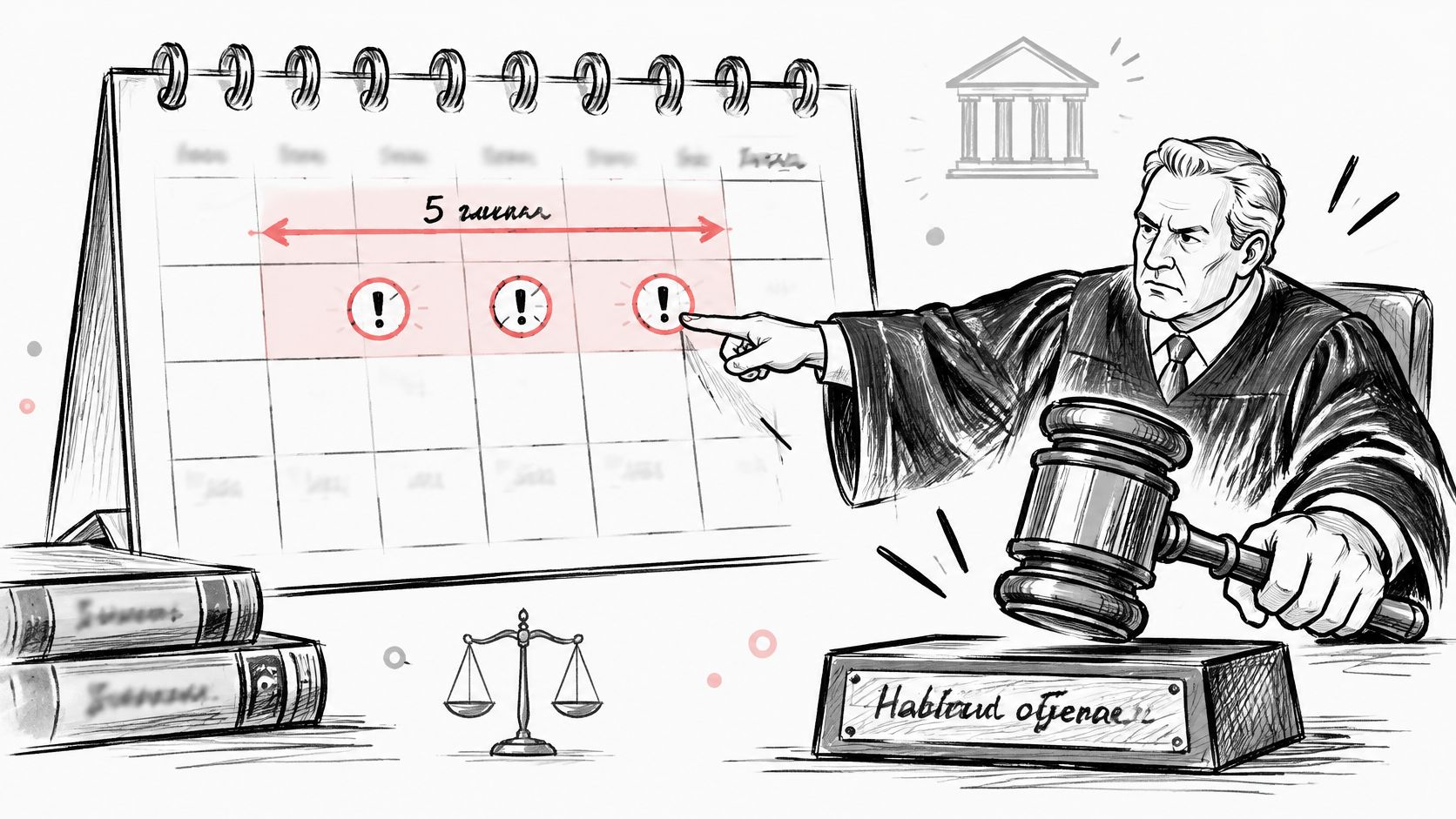
Georgia's habitual-violator framework uses a five-year lookback period for specified serious traffic offenses. The DDS section on the Safety Responsibility Law states that a person can be declared a Habitual Violator after a third conviction for any combination of listed qualifying offenses within five years. A qualifying offense can lead to either a license suspension or a habitual-violator revocation, depending on the driver's prior record and the dates involved. Timing decides which one applies.
Compare two Georgia drivers with the same new charge. One has a DUI and two other listed offenses inside that five-year window and may face revocation. The other driver's earliest offense falls outside those five years and may face a suspension instead. Same paperwork. Different clock.
For certain habitual violators whose revocation rested on two or more DUI convictions, an ignition-interlock pathway may open only after a two-year revocation period and a 120-day hard suspension. During that hard suspension, the driver must complete a certified DUI Risk Reduction program, obtain a clinical evaluation, and submit evidence of qualifying treatment enrollment or completion, according to DDS ignition interlock forms and instructions.
The evaluation works like a triage desk. It sorts the history and recommends a level of care. It does not hand you a pass or a fail.
A clinical evaluation is not treatment. Treatment documentation is a separate requirement, triggered when the evaluation or the governing pathway calls for it.
DDS rules decide eligibility, so check your own offense dates before you choose a next step. If you are sorting out how a repeat charge plays out, the explanation of multiple DUI offenses in Georgia walks through the consequences in order.
Confirm Your Requirements Before You Enroll
A clinical evaluation recommends a level of care, the way a clinician chooses a treatment plan instead of grading a quiz. An Athens driver who finishes only the 20-hour class still owes a separately ordered evaluation.
- Find the paperwork. Locate the court order or DDS letter and mark whether it names a clinical evaluation, the Risk Reduction Program, or both.
- Note the order of operations. The Assessment Component must come before the 20-hour class, and the certificate isn't issued until both are finished.
- Confirm the format. Decide between in-person classroom and online, and check whether the schedule fits your work week.
- Gather documents. Prior evaluations, treatment records and case numbers shorten the intake conversation.
- Book in sequence. Schedule each component in the right order and confirm the details with the provider handling it.
Georgia DUI Schools has spent more than 38 years guiding drivers through the state's DUI requirements, with the Risk Reduction Program, clinical evaluations, ASAM Level 1 treatment and Victim Impact Panels all available through one provider. If your paperwork names a clinical evaluation, a Risk Reduction class, or both, we can help you sort out which comes first and help you schedule each component in the right order. Visit Georgia DUI Schools to review your options and start the component you need.