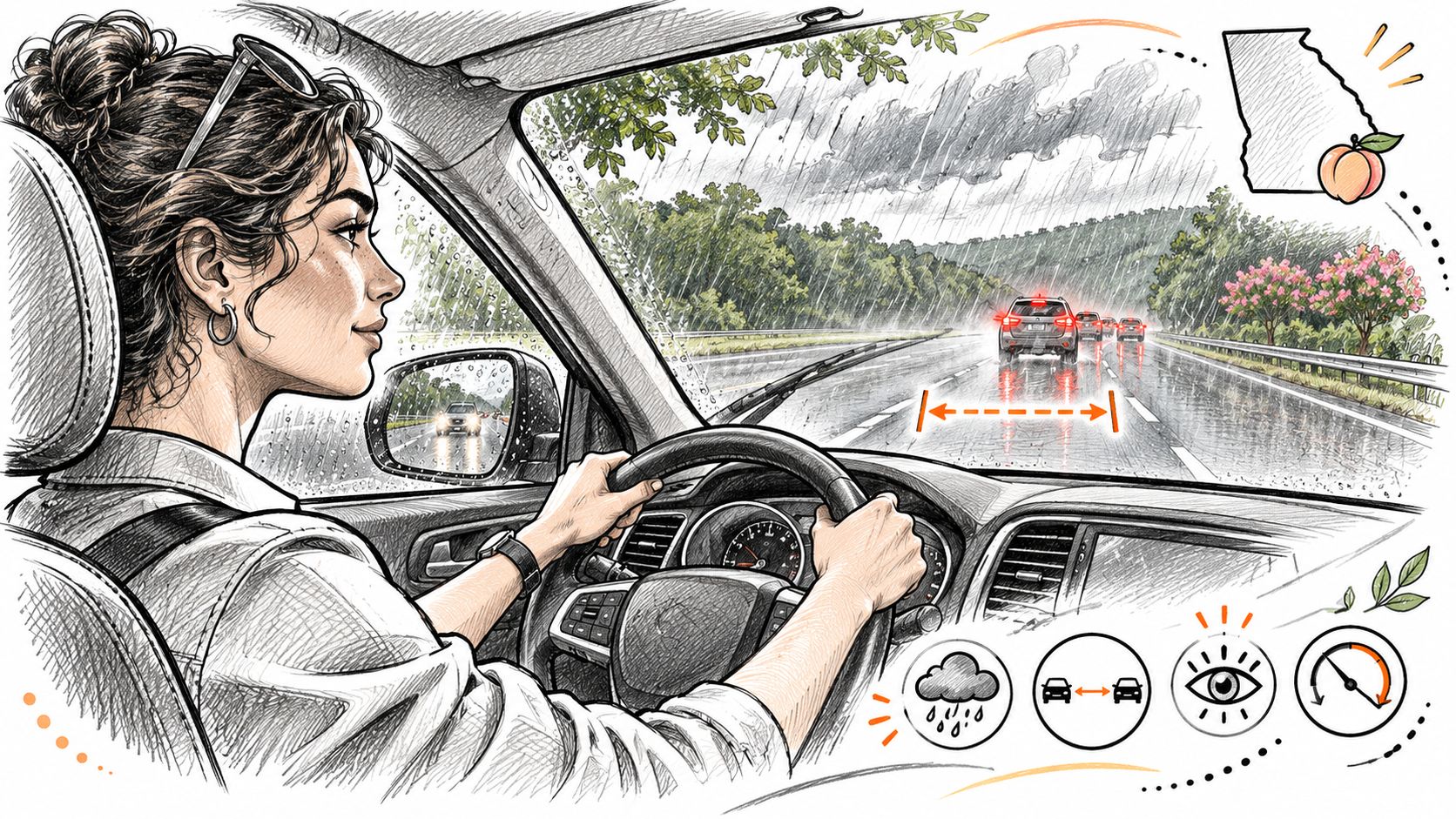
Brake lights bloom three cars ahead on GA-400. Rain turns the wipers into a metronome, and your foot is already moving toward the pedal before you've decided whether this is a slowdown or a full stop. That half second settles the whole drive.
A chain-reaction crash on the Perimeter rarely starts with a dramatic move. The driver followed a little too closely, looked a little too near, or spent one beat too long reacting to someone else's mistake. Defensive driving is a stack of small decisions made early, on dry pavement, so a bad moment stays a bad moment instead of an expensive one.
What follows are eight defensive driving examples pulled from roads you drive: the Downtown Connector, Ponce de Leon, Broad Street in Athens, and the two-lane stretches in between. Each one pairs a specific corridor with a tactic you can copy, the failure it prevents, and the trade-off most drivers miss.
Hold the gap before the brake lights stack up. The tactic is cheap. The crash is not.
A short gap that becomes a crash can leave you sorting medical bills through strategies for injury claim compensation long after the lanes reopen. Building the gap first is cheaper.
1. Maintaining Safe Following Distance on the I-285 Perimeter and Downtown Connector
Traffic on I-285 doesn't flow, it pulses. Between the Ashford Dunwoody and Cobb Parkway exits, a semi can drop from highway speed to a standstill faster than you can check a mirror, and the cars behind it bunch up three deep.
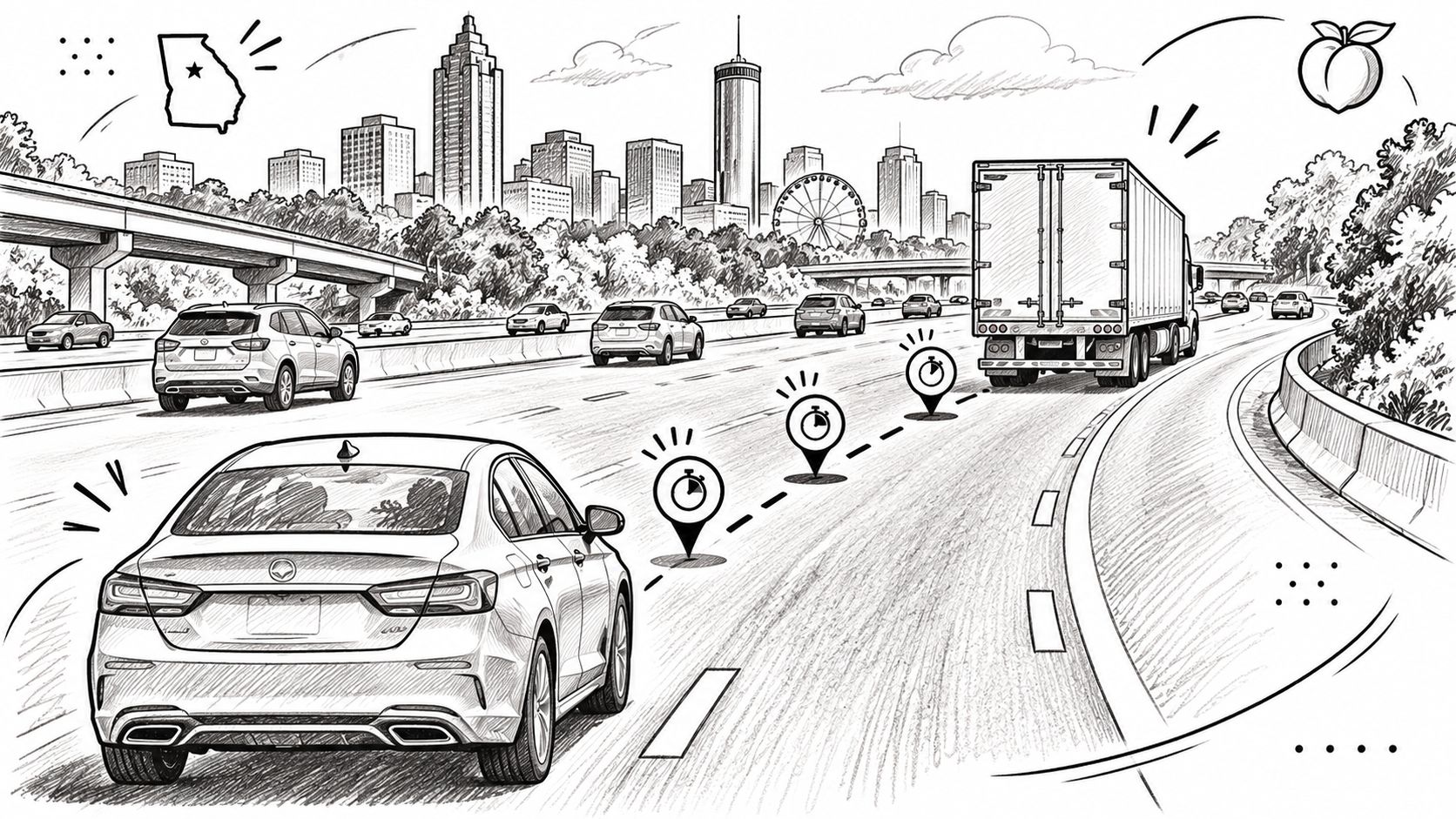
The fix isn't a faster reaction. It's a bigger gap, chosen before you need it. The three-second rule works with a fixed object: the overhead sign gantry, a light pole, the shadow of a bridge. When the car ahead passes it, count. If you reach the same object before you finish counting, you're too close, and you close the gap by lifting off the gas, not by braking hard.
The failure mode is always the same
Rear-end collisions arrive in chains, and the second and third cars are usually the ones that were tailgating for the conditions. Speed widens the error. The NHTSA 2023 speeding report counted 11,775 deaths in speeding-related crashes and found that 88% of those fatalities occurred on non-interstate roads, which means the habit matters just as much on Highway 78 or a two-lane road outside Athens as it does on the Perimeter.
The trade-off drivers miss: A three-second gap costs you a few car lengths of position in a merge queue. It returns the reaction time that decides whether a stop is a brake pedal or a collision report. If another driver fills your gap, don't fight for it. Rebuild it.
What works: counting out loud, adding a second in rain or darkness, and dropping back behind box trucks and buses so you can see around them. The 4-second rule for box trucks is a good calibration for how much extra room a vehicle with no rear visibility needs. Drill one habit at a time, and the defensive driving tips instructors repeat will stick faster than trying all of them in one commute.
2. Recognizing and Avoiding Impaired Drivers on Weekend Nightlife Routes
Midtown at 1 a.m. is a different road than Midtown at noon. On Peachtree Street, and again on Broad Street and Milledge Avenue in Athens after a home game, the vehicles around you are being driven by people whose judgment has changed since dinner.
Impaired drivers announce themselves in patterns, not single mistakes. Watch for weaving inside one lane, a drift over the line followed by a late correction, braking for nothing, a car that sits through a green light, or speed that rises and falls without traffic explaining it.
What to do instead of passing
The correct response feels backwards to most drivers. Give up the pass. Increase your following distance until you can see the whole vehicle, let it move ahead of you, and take an exit if it stays in front.
Do not pass a weaving car. Passing puts you alongside it at the exact moment it drifts.
Pedestrians and cyclists absorb most of this damage. The WHO 2023 global road-safety report found that more than half of road traffic deaths involve pedestrians, cyclists, or motorcyclists, which is why the sidewalks around Midtown and downtown Athens at closing time are the worst place to be near a drifting car.
Georgia treats repeat behavior as its own problem. Under the state's Habitual Violator rule, a third conviction within five years across a list that includes DUI, hit-and-run, and fleeing an officer triggers revocation, and a driver becomes eligible for a probationary license only after serving two years of that revocation. That matters less as a penalty and more as a reminder about who is likely beside you at 1 a.m. If the driving is dangerous, call 911 with the description, location, and direction of travel, and practice the defensive driving practices that keep you behind the problem instead of inside it.
3. Defensive Intersection Navigation and Avoiding Red-Light Running
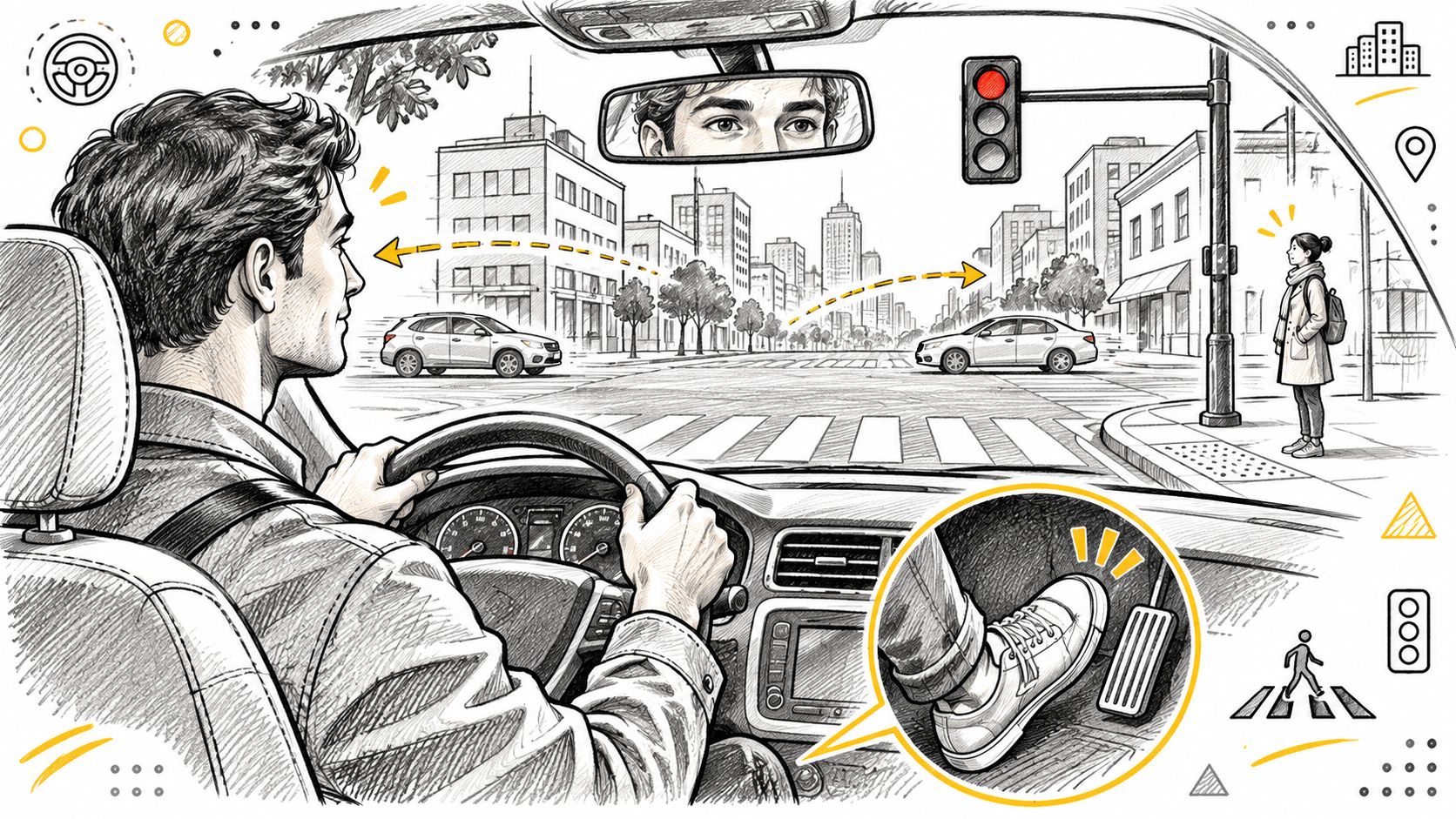
You are rolling toward the light at Ponce de Leon and Monroe Drive. It is still green, the cross street is stacked, and the lanes on Peachtree Road already start to shift. Lift off the gas while the light is still yours.
Cover the brake before the signal changes. That early correction keeps the stop outside the intersection.
A green light only tells you the signal is working. Cross traffic may still be finishing a late yellow. Drivers push that tail harder where the cycle feels long and the next one looks worse.
One corridor, one early correction
The habit is a small speed drop before the intersection. At Ponce and Monroe, ease off while you can still see the crosswalk and the cars waiting on the cross street. What that prevents is a choice made in the middle of the box: stop, go, or meet someone who started late.
The trade-off is time. You may sit through the next cycle, and the driver behind you will close the gap. Take that. A late sprint through yellow puts your car where the cross street has already started to move.
Cover the brake as the light turns yellow. Keep your foot over the pedal, not on it, so the stop is one motion.
Look left, right, left before you enter on green. The second look is for the driver who treated the yellow as extra green.
Wait for a clear gap on a left turn at Milledge Avenue or Monroe Drive. A shrinking gap looks usable until the oncoming car is at your door. Keep your eyes moving instead of locking onto the bumper ahead.
4. Hands-Free Driving Under Georgia's Distracted Driving Law
A phone balanced on a knee is still a common violation on GA-400 and on I-75 through Cobb and Cherokee counties. Georgia's Hands-Free Georgia Act has been in force since July 1, 2018. The law bans holding or supporting a device while driving. Set the habit before the car moves.
Georgia's most recent observational survey, published by the Governor's Office of Highway Safety, found visible distraction among 24.1% of drivers, including 29.8% of drivers aged 16 to 24. Nationally, NHTSA's distracted driving data counts 3,208 people killed in 2024 in crashes involving distracted drivers.
Voice commands still cost attention
A legal voice-dictated text still borrows the part of your attention that watches brake lights two cars ahead.
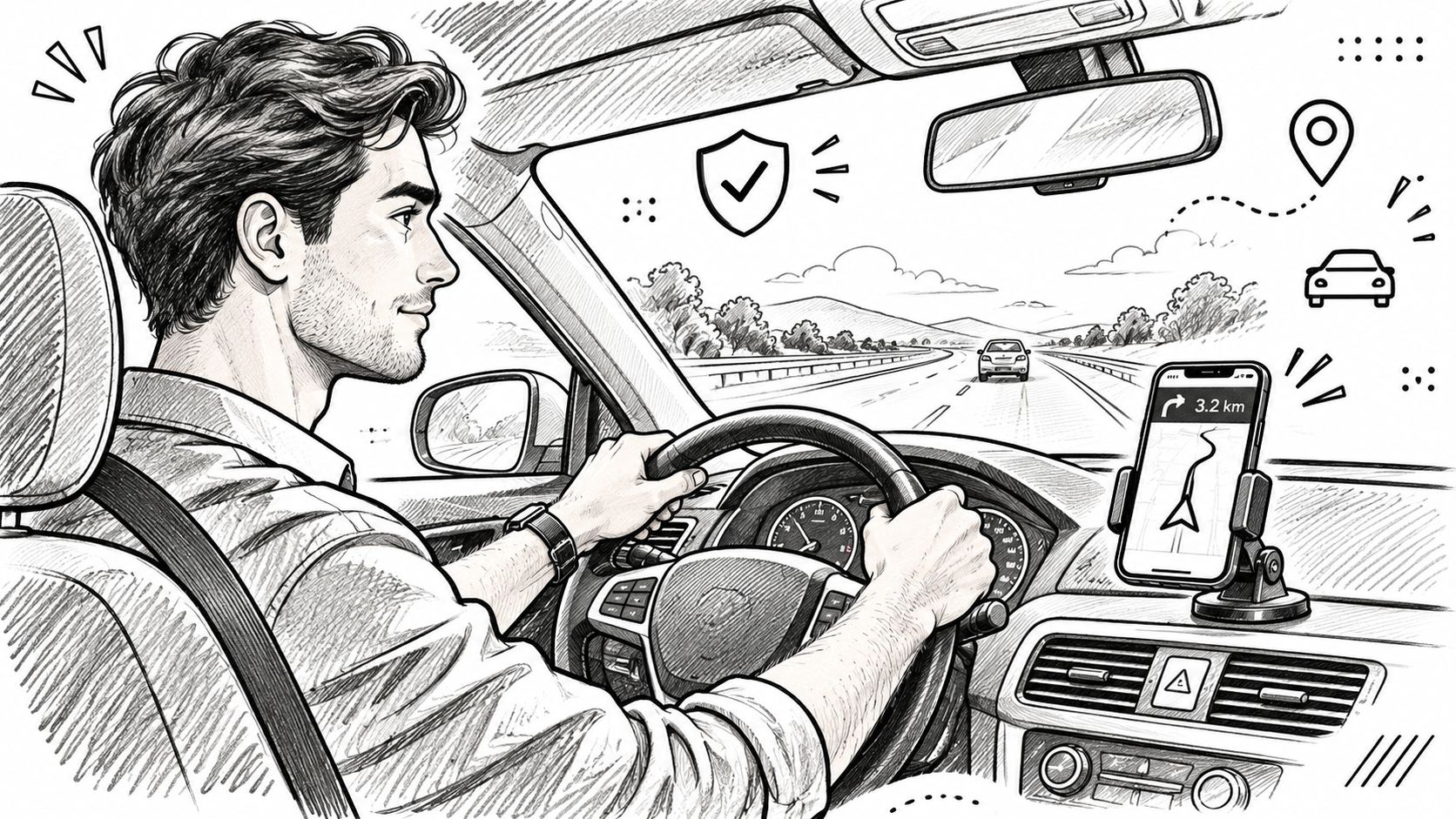
On a Sandy Springs commute, set the destination and the playlist in the driveway, put the phone in the console or a bag, and take calls by voice. Cut the call when traffic thickens. Looking down to type, or bracing the phone on a knee, is the failure that hides the brake lights two cars ahead. You trade a live reply, and about two minutes at the start of the trip, for that look.
A parent driving to a school event in Athens uses a dash mount and voice commands so both hands stay on the wheel. If you must handle the phone, pull off somewhere safe. These distracted driving prevention tips hold up in real traffic. I would rather drop the text than drop the gap in front of me.
5. Complying with Georgia's Move Over Law at Roadside Incidents
Flashing blue lights on the right shoulder of I-20 near the Downtown Connector, a tow truck hooking up a sedan on I-285 near a work zone, a utility crew behind cones. These scenes put people on foot a few feet from traffic moving at highway speed, and Georgia's Move Over law, O.C.G.A. 40-6-16, exists for exactly that geometry. It requires drivers approaching stationary emergency vehicles, tow trucks, utility vehicles, and other roadside workers with flashing lights to change lanes when safe or slow down.
Scan early and commit early
The drivers who get this right spot the lights a quarter mile out, check the mirror, and move over while there's still room. The drivers who get it wrong see the lights at the last second, brake hard, and create a second incident behind the first.
Slowing down is the whole law when a lane change isn't available. Passing a scene at full speed without lifting off is the violation.
Move over early rather than waiting for the last gap. Slow gradually so the driver behind you isn't surprised. Don't stop beside an incident unless a responder directs you to. Leave room behind you when another car is also changing lanes, because two vehicles converging on the same gap is its own hazard.
The trade-off is time. Moving over and slowing down costs a few seconds on a trip and protects people who are standing in the one place on the road where nobody can swerve.
6. Managing Fatigue and Drowsy Driving on Long Georgia Trips
A late shift ends. You point the car south on I-75, and the first twenty minutes feel fine. They always do. Fatigue shows up later as a missed exit, a rumble strip, or a stretch of highway you can't account for.
Drowsy driving produces the same deficits as impairment: slower reaction, narrowed attention, and worse judgment about your own state. That's why fatigue belongs in the same conversation as alcohol and drugs. A plain account of what sleep deprivation does to executives describes that same hit to reaction time and decisions, which is why a 2 a.m. drive from Athens on I-85 is a bad plan.
Stop on I-16 before your eyes close
The move on a long run toward Savannah is to break about every two hours and take the first rest area once your attention starts to slide. That stop is what keeps a one-second eye closure from turning into a shoulder departure or an exit you never see.
Yawning over and over, drifting toward the shoulder, losing the last few miles, and fighting to keep your eyes focused are late notices from the body.
A nap in a rest area costs less than the exit you miss when your eyes close for a second.
I would rather give up those minutes than trust the easy first stretch on I-75. Coffee is the trade-off drivers skip past.
Coffee buys alertness, not rest. The low point still arrives in the small hours or mid-afternoon. Split the wheel between Athens and Savannah, and never stack fatigue on alcohol, cannabis, or drowsy medication.
7. Responding to Hydroplaning and Wet-Weather Hazards on Georgia Highways
Summer storms in Georgia arrive like a dropped bucket. Ten minutes of rain on I-285 or I-75 lifts the oil film off the asphalt, and standing water collects in the same low spots every time, usually in the lane where traffic is heaviest.
Hydroplaning happens when water builds up under the tire faster than the tread can channel it away, and the tire stops touching the road. The car goes light, the steering goes vague, and braking makes everything worse.
Correct before the feature, not inside it
A national demonstration project led by Iowa State University, recorded in the ITS knowledge base, evaluated dynamic speed-feedback signs on rural two-lane curves. In the direction facing the sign, crashes fell 35% per quarter for all vehicles and 49% per quarter for single-vehicle crashes. The lesson transfers to water on US-441 near Athens: the correction has to happen before the hazard, not inside it.
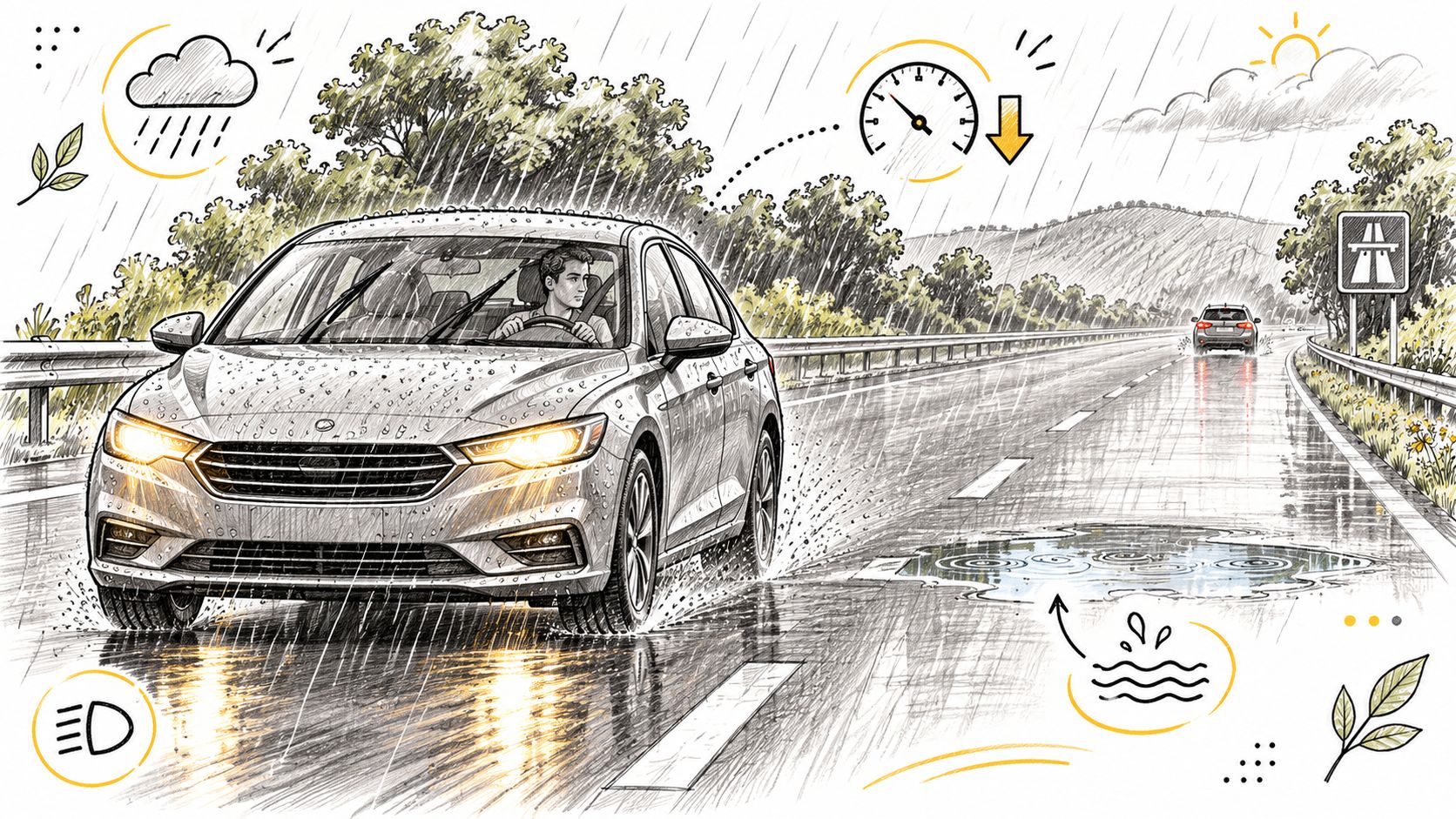
What to do instead: Ease off the accelerator, hold the wheel straight, and let the tires find the road. Hard braking or a sudden steering input during a slide is how a wet-road scare becomes a multi-vehicle crash.
Slow before standing water, not in it. Turn off cruise control in heavy rain. Check tread depth before storm season, since worn tires channel less water. Turn on headlights and add following distance so the driver behind you can see your car and judge your speed.
8. Handling Aggressive Drivers and Road Rage on Metro Atlanta Corridors
Tailgating, hard lane cuts, horn blasts, and speed that surges then collapses all count as aggressive driving. On GA-400 northbound around 6 p.m., a two-car gap is often treated as an opening to take. Peachtree Industrial Boulevard in Duluth runs the same pattern at rush hour.
Speeding is the fuel. NHTSA's speeding data attributes 29% of all U.S. traffic fatalities in 2024 to speeding, the behavior aggressive drivers fall back on once they are frustrated.
Create space, not a point
The replicable move is one lane change at the first safe opening, then hold your speed and let them go. That move blocks the failure that matters here: a brake tap or a gesture that turns a tailgate into a rear-end, or a chase that follows you off the exit.
The trade-off is position. You give up the gap you were protecting, and you may arrive a few minutes later. Drivers usually miss that cost because winning the merge feels like safety. It is not.
You cannot win a merge contest with someone who has already decided to risk a crash.
Skip eye contact and the explanatory gesture. Both escalate. Do not tap the brake to warn a tailgater. That tap is how the collision you are trying to avoid starts.
If the same driver stays with you after the lane change, do not lead them toward home. Drive to a police station or a busy store and call 911. Give the plate, the location, and the direction of travel.
I recommend leaving extra time on these corridors so your own frustration does not join theirs. Managing your temper is a safety skill, not a personality trait.
How the eight defensive driving examples compare by setting and risk
| Item | Core Tactic | Main Georgia Setting | Primary Risk Addressed |
|---|---|---|---|
| Maintaining Safe Following Distance on the I-285 Perimeter and Downtown Connector | Use a three-second gap or more in poor conditions; scan ahead | I-285 and the Downtown Connector in metro Atlanta | Rear-end and chain-reaction crashes |
| Recognizing and Avoiding Impaired Drivers on Weekend Nightlife Routes | Spot erratic driving, increase distance, and avoid confrontation | Atlanta nightlife districts and downtown Athens | Crashes involving impaired drivers |
| Defensive Intersection Navigation and Avoiding Red-Light Running | Cover the brake and check both directions before proceeding | Busy Atlanta and Athens intersections | T-bone, left-turn, and pedestrian crashes |
| Hands-Free Driving Under Georgia's Distracted Driving Law | Set up devices before driving and use hands-free features | GA-400 and I-75 through metro Atlanta and nearby counties | Distracted-driving crashes and citations |
| Complying with Georgia's Move Over Law at Roadside Incidents | Move over when safe or slow down for flashing-light vehicles | I-20 and I-285, including construction zones | Collisions involving roadside workers and responders |
| Managing Fatigue and Drowsy Driving on Long Georgia Trips | Recognize fatigue and take planned breaks or share driving | I-16, I-75, and I-85 long-distance routes | Drowsy-driving and run-off-road crashes |
| Responding to Hydroplaning and Wet-Weather Hazards on Georgia Highways | Slow down, increase following distance, and steer smoothly | I-75 and I-285 near Atlanta; US-441 and I-85 near Athens | Hydroplaning and loss-of-control crashes |
| Handling Aggressive Drivers and Road Rage on Metro Atlanta Corridors | Stay calm, create space, and avoid confrontation | GA-400, I-75, and Peachtree Industrial Boulevard | Collisions and confrontations caused by aggressive driving |
Turning These Examples Into Daily Habits
Eight corridors, one routine. Scan farther ahead than feels natural. Keep three seconds between you and the car in front, more in weather. Decide the phone, the route, and the playlist before the car moves. Treat other drivers' mistakes as information rather than insult. Do those four things consistently and most of what goes wrong around you stops being a surprise.
The habits improve with reps, and a Georgia defensive driving course gives them structure plus a certificate of completion. Pick one habit from this list and drill it on your next commute. Then let a class do the rest.
What a course actually gives you
Georgia allows a driver to remove up to 7 points once every 5 years by completing a DDS-certified 6-hour course and submitting the original certificate, according to the Georgia driver's manual. The same source notes that accumulating 15 points within 24 months brings a suspension, which is why point reduction is worth planning rather than panicking about.
Our six-hour defensive driving course is $95, a price set by Georgia law, and it runs on weekends at our Atlanta, Athens, and Decatur locations, with live virtual sessions available statewide. The in-person class issues the certificate at the end of the session, and virtual students typically receive theirs within 24 hours. The material covers the same ground as this list: crash-avoidance technique, impaired driving, distraction, fatigue, and road rage, followed by a final exam.
If a DUI is the reason you're here rather than a points problem, the DUI Risk Reduction Program is a different course with two mandatory parts: a 130-question NEEDS Assessment completed first, then a 20-hour Intervention Component, and both must be finished before a Certificate of Completion is issued.
Choose the format that fits your deadline. A self-paced online course is generally accepted only for an insurance discount, and it isn't accepted by Georgia DDS for point reduction, court orders, or reinstatement, so confirm with your insurer first. Point reduction and court requirements call for the live virtual or classroom version, where you're present for the full six hours.
Georgia DUI Schools is a Georgia DDS-approved provider of defensive driving and DUI/Risk Reduction education, with in-person classes in Atlanta, Athens, Decatur, and other Georgia locations plus live virtual sessions statewide. Our six-hour defensive driving course covers the tactics in this article, from following distance on the Perimeter to wet-weather recovery, and it's built for drivers who need point reduction, a court requirement, or an insurance discount. Visit Georgia DUI Schools to check weekend class times and reserve a seat.