When did you last call your insurer and ask, in plain words, which discounts your policy really qualifies for? Most drivers can't remember. They renew every six months, watch the premium creep up, and assume the rate is the rate.
In Georgia, that silence costs money. Mature-driver savings rarely arrive on their own. They come from a course certificate you submit, a driving record you can document, a mileage figure you report, or a discount an agent has to type into your file. The seven routes below cover the ones that matter most for older drivers in this state: defensive driving courses, safe-driver history, low mileage, and insurer-specific programs from Georgia Farm Bureau, GEICO, State Farm, The Hartford, Progressive, and USAA.
Every entry comes back to the same question you should ask before you pay for anything: Will this provider and course format trigger the discount on your policy?
1. Online Defensive Driving Course for Seniors in Georgia

Georgia is one of the few states where a mature-driver course discount has a statute behind it. The Georgia Driver Improvement program FAQ describes a six-hour course open to licensed drivers of any age, taken for insurance reduction, point reduction, reinstatement, or a court order, and it sends drivers straight to O.C.G.A. § 33-9-42 for the insurance rules themselves.
That statute sets a floor, not a promise. Georgia's insurance code requires insurers to offer at least a 10% reduction on liability, medical payments, and collision coverage when every listed driver is 25 or older, completes an approved six-hour defensive-driving course, and has no traffic offenses or at-fault claims in the previous three years.
Read that again with a household in mind. One adult child with a ticket on the policy can knock out the whole discount. So can a spouse who never takes the course.
Where the senior version fits
An online course built for older drivers removes the two reasons people quit: a drive across town and a six-hour block in a classroom. The self-paced senior course at Georgia DUI Schools covers Georgia traffic law, crash-avoidance techniques, and the effects of impaired driving, distraction, and fatigue, all at a pace you set.
Format is the catch. Insurers generally accept an online defensive driving completion only after they confirm the provider and format, and Georgia DDS does not accept self-paced online courses for point reduction, court orders, or license reinstatement. Drivers who need points removed, a suspended license reinstated, or a court requirement satisfied should enroll in a DDS-accepted classroom course instead.
Practical rule: Get your insurer's answer before you pay. A certificate your carrier doesn't recognize is a receipt, not a discount.
Pros
- Built for older drivers. The material assumes decades of experience instead of teaching from scratch.
- No classroom, no travel. Finish in sessions that fit around appointments and family.
Cons
- Not guaranteed. Your insurer decides whether the certificate lowers your premium and by how much.
- Insurance discount only. The self-paced format does not count toward DDS point reduction, license reinstatement, or a court order.
Start with the Online Defensive Driving Course for Seniors in Georgia, then read how a defensive driving course can lower your insurance before you call your agent.
2. Georgia Farm Bureau Insurance

A member carrier earns its discount differently. Georgia Farm Bureau routes everything through a local agent who can read your policy line by line, and the SafeDriver course FAQ spells out the terms more precisely than most carrier pages: a six-hour course, drivers 25 and older, and a 10% reduction on bodily-injury, property-damage, medical-payments, and collision coverage.
That percentage needs context. The reduction applies to four named coverages, so damage to your own vehicle beyond collision and any add-ons sit outside it. Ask the agent which lines move before you count the savings. The discount also runs three years from the completion date, conditional on staying free of violations and at-fault accidents. Pick up a ticket and the savings stop, though retaking the course may let you recertify. And the certificate does not apply itself. You hand it to the agent, and the agent applies it to the policy.
Course cost and eligibility are the two details to settle before enrolling. Confirm both directly with a Georgia Farm Bureau agent, since membership status affects what you pay for the course and whether you qualify for the reduction.
The trade-off is scale. A 10% cut on four coverages totals less than 10% off the full bill, and a review of the company notes fewer discounts and online features than some national competitors. In exchange, you get a person who knows your file rather than a portal.
Request a policy review at Georgia Farm Bureau Insurance.
3. GEICO

GEICO does something most carriers don't. It publishes Georgia-specific mature-driver information rather than burying the discount in a national page, and eligible Georgia policyholders may save up to 10% on applicable coverages after completing an approved defensive-driving course.
The qualifiers determine eligibility. GEICO states that eligibility can hinge on whether you've had an at-fault accident or a traffic-violation conviction, so a clean recent record is the entry ticket. The course also has to be one the company approves, and the policy gets updated from your completion record after you finish. Enrollment alone proves nothing.
Beyond the course, the mature-driver page lists a good-driving discount tied to a five-year clean record, multi-car savings, and discounts tied to certain military or government affiliations. Stacking is where the math gets interesting, so ask the agent which of these your household already qualifies for and which are missing from your file.
What to ask: which coverages the course discount touches, and whether it stacks with the good-driving discount. Get the answer in writing before you enroll.
Pros
- Several routes at once. Course completion, clean record, multi-car, affiliation.
- A published Georgia figure. Up to 10% on applicable coverages, not a vague promise.
- Fast online quotes. Easy to price a change before you commit.
Cons
- Not a guaranteed 10% off the total premium. It's a ceiling on eligible coverages.
- Approval is specific. A course that worked for a neighbor may not qualify.
See how the GEICO defensive driving discount works before you pick a provider.
4. State Farm
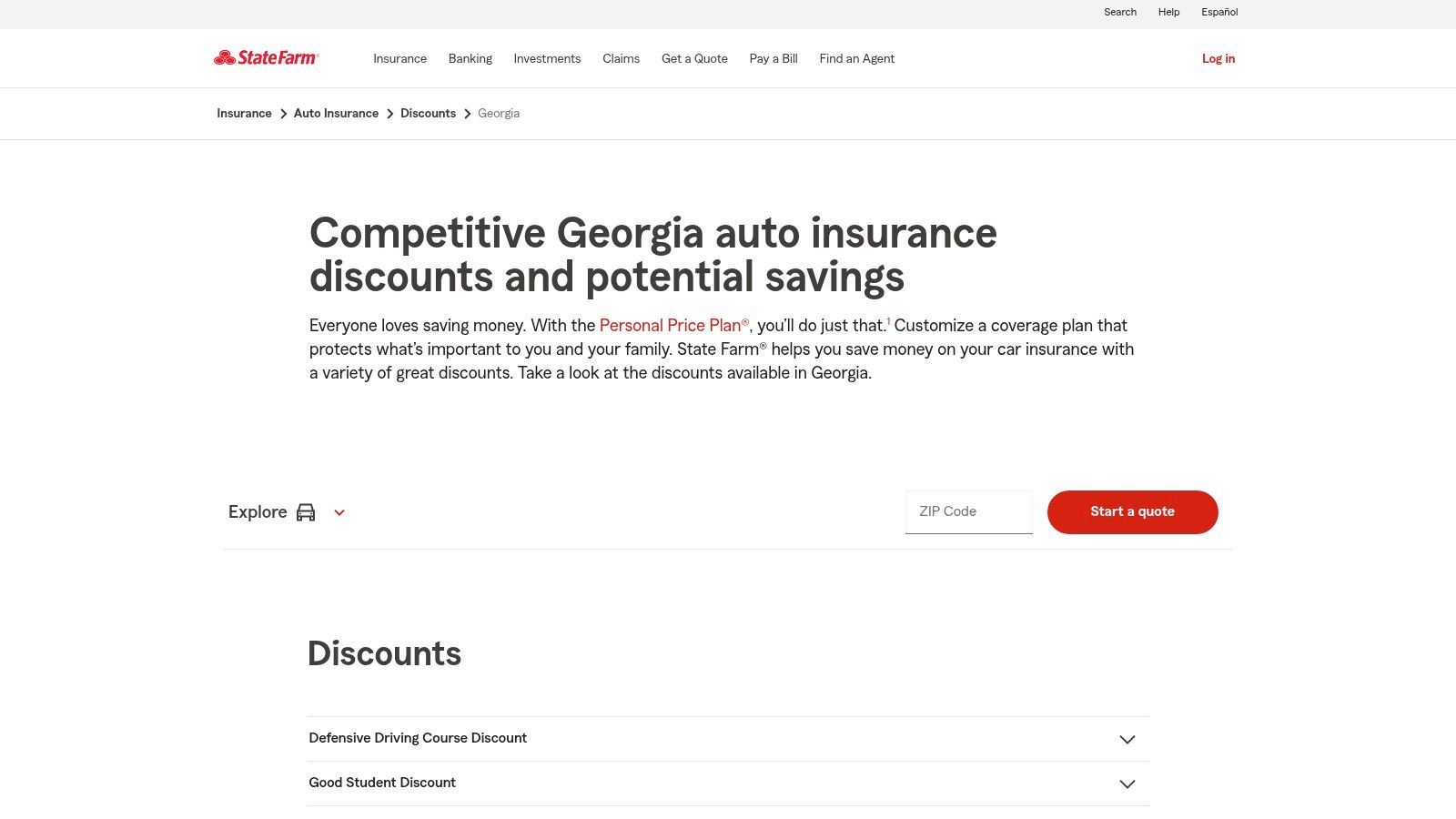
State Farm's Georgia auto discount page is unusually clear about one detail. The approved Motor Vehicle Accident Prevention Course established by the Georgia Department of Driver Services must have been completed within the last three years. That window is the part people miss, and a certificate from five years ago won't move a renewal.
What the page doesn't publish is a percentage. That's not an oversight. Reaching 65 or 70 doesn't create an automatic discount in most rating plans, and the NAIC consumer guidance on personal lines pricing explains why. Insurers price on age and driving experience and extend discounts when they judge a driver a better risk. A course is evidence of that. It isn't an entitlement.
Three things to do with a State Farm agent.
- Confirm the date on file. Ask which completion date the agent has and whether the three-year clock has run.
- Price the bundle first. Multiple-car and multiple-line discounts often beat the course discount in dollars, so quote both.
- Send the certificate. Email the completion document and keep a copy in the glovebox.
The course discount isn't seniors-only here, which is good news for a household with a spouse or adult child on the same policy. Both drivers can use the same approved pathway.
What works is the local agent and a clearly stated completion window. What to watch is the missing number. Only a quote tells you whether the policy beats the competition, and a senior household should always price two carriers before renewing.
5. AARP Auto Insurance Program from The Hartford

The Hartford writes the AARP-branded auto program, and it's the most transparent of this group about the course ceiling. The Hartford's AARP auto page lists an approved defensive-driving course, such as the AARP Driver Safety course, as a route to up to 5% off for three years.
Five percent sounds small until you run it against a real premium. A 2025 CNBC Select analysis of senior discounts reported that approved defensive-driving discounts commonly start at 5% or 10% and may reach 15%, and it cited a 60-year-old driver with full coverage who could save more than $308 a year at 15%. The same analysis reported that 34 states plus the District of Columbia require insurers to offer mature-driver discounts for qualifying approved courses.
Membership is the trade-off. The AARP program is built for members, and Georgia availability, rates, and membership requirements should be confirmed before you count on the discount.
Pros
- A disclosed ceiling and duration. Up to 5% for three years, stated on the page.
- Other savings stack. Online quote discounts and bundling home with auto.
- Mature-driver features. Accident Forgiveness and a disappearing deductible, subject to terms and availability.
Cons
- Membership is generally required. Verify Georgia eligibility first.
- Conditional percentage. The 5% is a maximum, not a quote.
Read an independent AARP auto insurance review before switching a long-held policy.
6. Progressive

A Georgia retiree asks Progressive whether a defensive-driving course lowers the premium, and the honest answer is that it depends on the state. Progressive's guidance on car insurance for seniors covers safe driving, multiple policies, and low mileage, and it says plainly that defensive-driving course discounts vary by state and insurer. No Georgia senior course amount is published.
Treat that as honesty rather than a gap. Progressive is a telematics-first carrier, so for an older driver the most likely saving often comes from a driving-based program instead of a certificate. Recent consumer reporting on telematics programs found a typical enrollment discount of 5% to 10%, with median annual savings around $115 for drivers aged 60 to 69 and $93 for drivers 70 and older.
Those amounts are smaller than a solid course discount, and they come with continuous monitoring of speed, braking, acceleration, mileage, and time of day. That scoring can reward an occasional highway driver and penalize someone doing short congested trips around Atlanta.
Ask whether the carrier offers a traditional low-mileage discount without an app. For a retiree driving 4,000 miles a year, that's often the cleanest saving on the policy.
Pros
- Multiple routes. Safe-driving, multi-policy, and low-mileage savings are all live options.
- Quotes show real numbers. Discounts appear based on your details, not a marketing average.
Cons
- No published Georgia course figure. Don't assume a certificate pays here.
- Telematics varies. Savings and scoring differ by driver profile.
Compare options by requesting a quote directly from Progressive and asking whether a defensive-driving certificate changes your rate. Ask before you enroll, not after: in Georgia, a self-paced online course generally counts toward an insurance discount only once your provider confirms it. Georgia DUI Schools lays out how that conversation works on its Progressive defensive driving discount page.
7. USAA

USAA only matters if you can get in. Membership is limited to qualifying military members, veterans, and eligible family members, and no discount justifies a policy you aren't eligible to buy. For households that do qualify, USAA's auto discount page lists defensive driving among the available savings alongside safe-driving programs and policy combinations, without publishing a Georgia senior figure.
The telematics question is sharper here than anywhere else on this list, because USAA's members skew toward people who moved often and now drive less. A U.S. telematics value report found that 82% of older drivers were driving less, and 72% of them selected rewards for safe driving, compared with 40% of the youngest drivers. The same report found 63% of drivers overall said they were likely or very likely to switch to usage-based insurance.
Preference doesn't always follow behavior. That report also found 29% of Baby Boomers and 40% of Traditionalists preferred traditional pricing plans. That's a defensible position for someone who wants a fixed premium and no app on the phone.
Get a side-by-side quote before trading pricing certainty for a monitored discount, and ask what a poor score does. Some programs only shrink a discount. Others raise the renewal price.
Pros
- Worth comparing for eligible military-connected households.
- Defensive driving is listed as a possible savings route.
- Multiple discounts reviewable alongside auto coverage online.
Cons
- Membership limits availability. Confirm eligibility before you shop seriously.
- No Georgia senior percentage stated. Course acceptance needs written confirmation.
Senior Car Insurance Savings Options at a Glance
| Option | Type | Potential Discount | Georgia Eligibility Notes | Best For |
|---|---|---|---|---|
| Online Defensive Driving Course for Seniors in Georgia | Online defensive-driving course | Possible insurer discount; amount varies | Confirm insurer accepts the provider and online format | Seniors seeking a flexible course |
| Georgia Farm Bureau Insurance | Auto insurer | Up to 10% on specified coverages for eligible members | Membership and course, driving-history, and policy requirements apply | Drivers wanting local agent support |
| GEICO | Auto insurer | Up to 10% on applicable coverages | Confirm course approval and policy eligibility with GEICO | Drivers comparing multiple discount options |
| State Farm | Auto insurer | Not specified | Georgia-approved course must be completed within the last three years | Drivers seeking local agent guidance |
| AARP Auto Insurance Program from The Hartford | Auto insurance program | Up to 5% for three years | AARP membership and Georgia availability should be confirmed | AARP members seeking mature-driver savings |
| Progressive | Auto insurer | No Georgia course discount amount specified | Confirm whether the course qualifies in Georgia | Seniors comparing online quotes and other savings |
| USAA | Auto insurer | Amount not specified | Available to qualifying military-connected members; confirm course acceptance | Eligible military households |
Check Eligibility First, Then Enroll: Your Next Step
The order matters more than the discount. Call your insurer before you pay for any course and ask two things in one sentence: do you accept this provider, and do you accept this format? Get the answer from a person, note the name and date, and keep the note with your certificate.
Then work through three follow-ups. Which coverages does the reduction touch? Does it start on the completion date or at the next renewal? How long does it last before you have to recertify? A 10% cut on collision and medical payments is a different number from 10% off the whole policy, and three years of eligibility is a different number from one.
Shop the post-course premium. Request a revised quote from your current carrier and at least one competitor once the certificate is on file. Comparing a discounted renewal against an undiscounted competitor tells you nothing useful.
Georgia's rules are specific, so know which lane you're in. Self-paced online defensive driving courses are not accepted by Georgia DDS for point reduction, court orders, or license reinstatement. They're generally only usable for an insurance discount after the insurer confirms both the provider and the format. If you need points removed or a court requirement satisfied, you need a DDS-approved course delivered in a format DDS accepts. Point reduction takes off up to 7 points and can be used only once every 5 years, so weigh that allowance against an insurance-only goal before you pick a format.
Start with the insurer's answer, then enroll in the self-paced online defensive driving course offered by the same DDS-approved provider that runs classroom sessions across metro Atlanta. The six-hour course costs $95, a price set by Georgia state law, so the choice is format and schedule, not price.
Georgia DUI Schools is a DDS-approved provider of defensive driving and DUI/Risk Reduction education, with self-paced online, live virtual, and classroom formats serving Atlanta, Athens, and the rest of Georgia. If you're sorting out car insurance discounts for seniors, our six-hour defensive driving course gives you the completion certificate insurers ask for, and one call to your carrier confirms whether it applies to your policy. Visit Georgia DUI Schools to pick a course format and a session that fits your week.