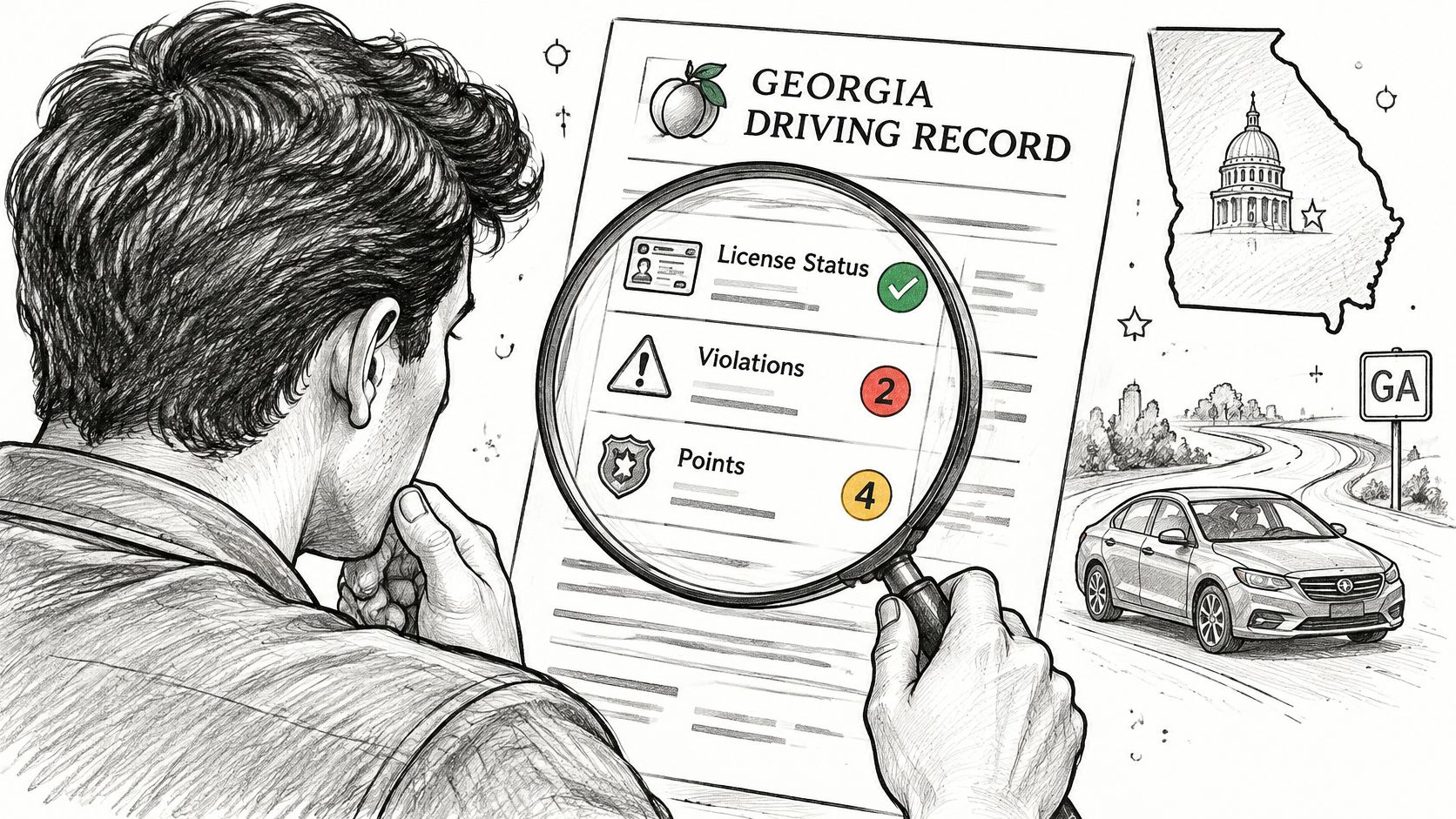
You get the letter on a Tuesday. A court date is set for next month, or an employer's onboarding packet lists a motor vehicle report among the documents you must supply, or DDS has told you a reinstatement hearing needs proof of your history. You pay the fee, open the envelope, and find a page of codes, dates and abbreviations that doesn't match the story you remember living.
Reading that page is a skill, and most drivers learn it at the worst possible moment. A Georgia driving record follows a fixed structure. Once you know what each block is for, you can work through the whole document in about ten minutes and know exactly where you stand.
There's a second layer that most explanations skip. The same record reads differently depending on which version you order and who is allowed to see which fields. Learning how to read a DMV driving record in Georgia means learning both: the page in front of you, and the version someone else is holding.
Choosing the Right Georgia Report and Fee
Three lengths of the same document exist. Which one you order decides what the page can prove, because a 3-year record cannot show a conviction from five years ago no matter how closely you read it. Georgia DDS issues the Motor Vehicle Report (MVR), the state's driving-history record, as a 3-year, 7-year or lifetime report, and the DDS driving history request page lists $6 for the 3-year MVR and $8 for either the 7-year or the lifetime report.
| Report | Fee | Online | In person or by mail |
|---|---|---|---|
| 3-year MVR | $6 | Yes, non-certified copy | Certified copy available |
| 7-year MVR | $8 | Yes, non-certified copy | Certified copy available |
| Lifetime MVR | $8 | No, order in person or by mail | Certified copy available |
Choose by the period the receiving party asks for, not by habit. A court handling a recent matter usually wants the shorter window. A reinstatement file or an employment screening that reaches back over several years calls for the 7-year or the lifetime version. Order close to the date you need it, because every entry is only as fresh as the day it prints.
Two channels, two kinds of paper
The channel matters as much as the length, and drivers get this part wrong more often than they get the fees wrong. DDS Online Services returns a non-certified copy. Certified copies come from a DDS Customer Service Center in person or by mail. A court, a lawyer, a probation officer, an employer or a licensing agency may insist on the certified version. Your own review rarely needs it.
Picture two envelopes holding identical facts: the same violations, the same dates, the same status line. Only one of them satisfies the clerk at the counter. Before you pay, ask the person requesting the record which version they will accept, then order that one.
Requesting by mail is straightforward if you follow the format DDS requires:
- Write your full name exactly as it appears on your license.
- Add your Georgia driver's license number, date of birth and complete mailing address.
- Enclose the required payment and a business-sized, self-addressed stamped envelope.
- Mail it to Georgia Department of Driver Services, MVR Request, P.O. Box 80447, Conyers, Georgia 30013.
Those instructions and the release consent for a named person or entity come straight from the DDS mail-in request form. Sign that consent only for the recipient you intend, since it is what authorizes DDS to hand your history to someone else.
Georgia Driving Record Fields at a Glance
Before you read a single violation, know what the document is built to show. Every Georgia MVR carries the same core blocks, and each one answers a different question.
| Field | Where to look | What it tells you |
|---|---|---|
| Identity block | Top of the record | Name, date of birth, license number and class must match your license |
| License status | Status line | Valid, suspended, revoked, canceled or restricted |
| Class and endorsements | License section | Vehicle types and extra permissions you hold |
| Restrictions | License section | Conditions attached to the license |
| Expiration date | License section | When the license must be renewed |
| Convictions | Violations section | Offense, conviction date and outcome |
| Citation and suspension entries | Actions section | Ticket issue dates, suspension dates and reinstatement needs |
| Points | Violations section, where listed | Points assessed; confirm the total with DDS before relying on it |
| Report date | Header | When the record was printed and whether it is certified |
Identity and status come first
Start at the top and read the identity block before anything else. A wrong middle name, a transposed date of birth or a class that doesn't match the license in your wallet means the document either belongs to someone else or carries a data error worth raising with DDS. Either way, nothing below it is trustworthy until you've settled that question.
Then read the status line. Valid, suspended, revoked, canceled or restricted decides whether you can legally drive today and what has to happen before that changes. Drivers routinely skip this line and jump to the tickets, which is like checking the weather report and ignoring the storm warning at the top.
Class and endorsements tell you what you're licensed to operate, restrictions list conditions such as corrective lenses, and the expiration date tells you when the whole thing needs renewing. On a commercial record these three fields matter more than the violations, because a lapsed medical certification or a dropped endorsement can end a job faster than a speeding ticket.
Where the violations sit
Georgia records pair each citation or suspension with its dates, so the violations section reads in sequence rather than as one total. You can see when a ticket was issued, when the court acted and what the outcome was. Points appear beside convictions where they apply, and that number, not the fine you paid, is what moves a license.
Practical rule: treat the points column as a claim to verify, not a verdict. Add the entries yourself, then confirm the total with DDS before you make any decision based on it.
If the points line is what worries you, our guide on how to remove points from a driving record lays out the options in order.
Before you move on, write down any field that looks wrong: a misspelled name, a conviction you don't recognize, a suspension with no matching case, a points total that doesn't add up. That list becomes the starting point for the reading routine below.
How to Read Your Record in Five Steps
Reading a record out of order is how mistakes happen. Work through these five steps in sequence and the page stops being a wall of codes.
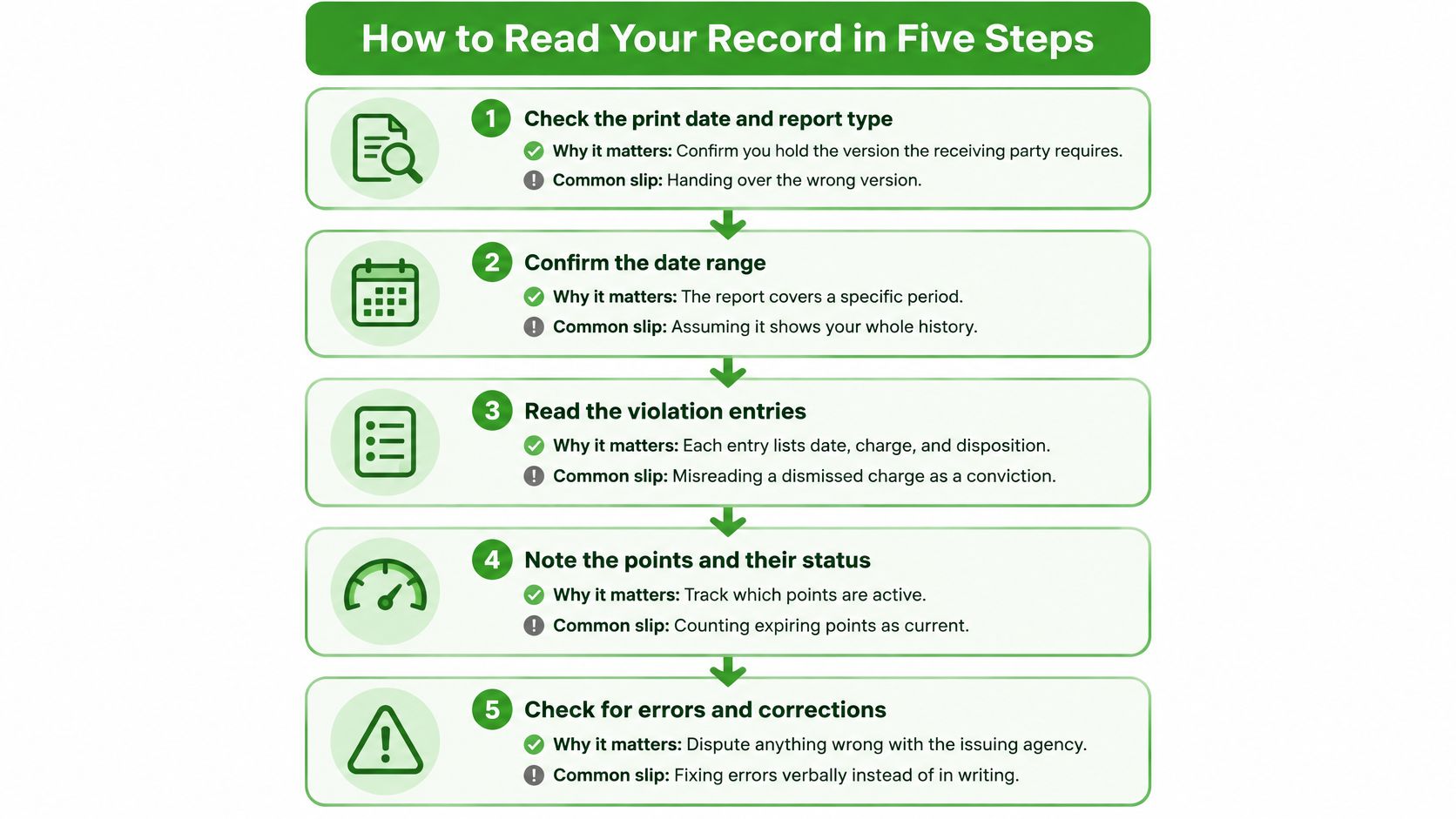
1. Check the print date and the report type. A certified MVR reflects information available on the date it is printed and certified, carries an official stamp and signature, and is what employers, insurance companies, courts and schools use to verify license status and activity, according to Georgia DDS guidance. A non-certified copy is for personal, informational use and is generally not accepted by employers or government agencies as proof of driving history. The usual slip is handing over the wrong version after paying for a copy that can't be used. DDS also issues specialized reports for reckless-driving convictions, distracted-driving convictions, DUI and drug convictions, and administrative license-suspension refusals, so confirm which one your recipient asked for.
2. Check license status before anything else. The status line decides whether you can drive today and what must happen before that changes. Reading the tickets first buries the one line that affects your week.
3. Match each citation to its conviction. A ticket carries an offense date; the court records a conviction on a later date. Treating the two as interchangeable is the single most common reading error, because courts report convictions to the licensing agency, not the date you were pulled over. Record both dates for every entry.
4. Count points inside the report's period only. Add the entries that fall within the window your report covers, and note any older entry that has aged off the page. Retention rules, not the seriousness of the offense, decide what still appears.
5. List every suspension, reinstatement condition or restriction. For each one, write down the agency that controls it, the date it begins or ends, and the proof required to clear it. If you're a CDL holder or applying for work behind the wheel, it helps to prepare your record for carrier applications using the same fields and dates, laid out for a reviewer.
The test: state your license status, your most recent conviction and any open action without looking at the page. If you can, you've read the record correctly.
Who Sees Which Fields on Your Record
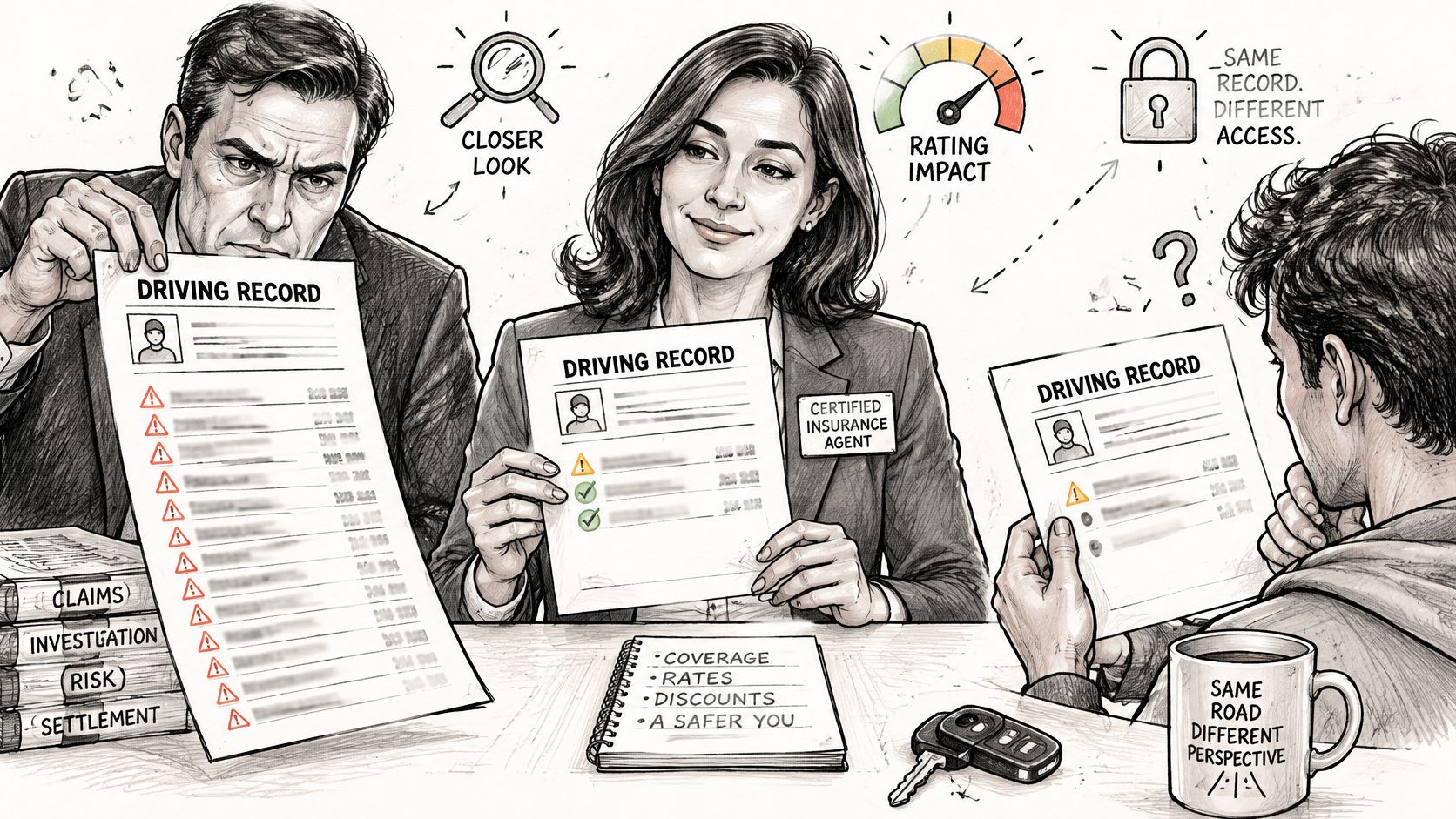
An Atlanta driver preparing for a reinstatement hearing requests a personal copy for her own review. Her lender runs a credit-purpose check the same month. The attorney handling the hearing orders a certified report. The three documents describe the same driver, but they are not built for the same reader, and that is the first thing to understand before treating any missing line as an error.
A Georgia MVR can include license class and endorsements, restrictions, expiration date, status, citation and suspension descriptions, and dates. The information varies by purpose, as the Georgia motor vehicle report guidance explains. Think of the record as one folder of facts sorted into different packets. The full packet is not handed to every requester.
What each audience actually receives
Insurance-related reports may include violation details. Limited rating information available to certified insurance agents summarizes DUI and drug-related violations along with other moving violations. Credit-purpose reports carry a narrower set of identity and license-status data. That narrower slice is why a lender's copy can look sparse next to the copy in your hand.
Privacy explains the sorting. MVRs are not open public records, and a third party generally needs your authorization, a subpoena or a court order to obtain one. A record you did not authorize should not surface at all. An unexplained copy is worth questioning.
When you find a discrepancy: identify the report type and intended use first. Then check whether the field you are missing is one that requester is allowed to see. Only after those two checks should you treat the gap as an error.
A clean personal copy tells you nothing about what an insurer or a court-related requester can access. The same driving history can look complete to you, summarized for an insurer, and reduced to identity and status for a lender. If the entry in question is a DUI, our explainer on how long a DUI stays on record in Georgia covers the timelines that apply.
Spotting Repeat DUI Patterns and Out-of-State Entries
Repeat DUI convictions are where a date error costs the most. Georgia's DDS materials describe a specific trigger: a driver may be declared a Habitual Violator after a third conviction within five years for any combination of listed offenses that includes driving under the influence (DUI). The license is revoked on that declaration, and a probationary license may be possible after serving two years of the revocation period, per the Georgia driver's manual.
The habit most guides teach is counting DUI entries on the page. Counting tells you how many there are. It doesn't tell you whether the five-year grouping applies, because the rule turns on the conviction dates and their spacing.
Lay the dates on a line instead. Take each DUI conviction date, mark it, and measure the gaps. Three convictions spread across eight years read very differently from three packed into four. When the spacing puts the third inside the window, confirm the consequence with DDS before you assume anything, because a revocation changes what you can do next.
When another state shows up on your Georgia record
Georgia's State-to-State Verification and Driver History Record system means a non-CDL driver's history can follow them across participating states, with convictions and withdrawals from every participating state where the person held a license or ID appearing in the record. DDS describes the updates as real time, per its State-to-State verification page. An offense from another state is usually not a clerical error. It's the system doing what it's built to do.
That creates a question worth answering plainly: does completing a Georgia course erase it? No. Separate three things. Record visibility is what appears on the MVR. Point assessment is what the agency counts. License reinstatement is what you must prove to drive again. A course can satisfy a court, an insurer or a reinstatement requirement without the underlying conviction leaving the record.
| Symptom | Likely cause | What to do |
|---|---|---|
| Out-of-state offense appears | History follows you across participating states | Check the issuing state and report period with DDS |
| Conviction dated after the ticket | Court reports the conviction later | Use the conviction date, not the citation date |
| Several DUI entries close together | Possible habitual-violator grouping over a five-year span | Map each conviction date on a timeline and confirm with DDS before assuming |
If you're sorting through an offense from another state, our guide on out-of-state DUI in Georgia walks through how those entries are treated.
What to Do When an Entry Looks Wrong
A mismatch is a question to verify, not a conclusion to act on. Work through these in order and you'll have a documented answer rather than a guess.
- Gather the source paperwork. Pull the court disposition for each disputed conviction, any completion certificate, and a certified copy of the record you're checking. Without these three, you're arguing with a printout.
- Compare each entry against those documents, using the conviction date as the anchor rather than the date on the ticket.
- Check the retention period. Confirm whether the entry is still inside the window the issuing jurisdiction applies, because older entries and their points can age off entirely.
- Contact DDS directly with your full name, license number and the specific entry in question, and keep a written record of the answer you receive.
- Identify the issuing state for any out-of-state entry, since the State-to-State system can carry an offense from any participating state where you held a license or ID.
A completed course is not a corrected record. Ask DDS what the course changes and what it leaves in place before you assume a certificate settles the matter.
Confirm Your Record Before Enrolling in a DUI Course
Reading the record should end in a decision, not a stack of paper. Before you enroll in anything, check these five points against your own document.
- Report type: confirm which version the court, DDS or your program will accept, and whether it must be certified.
- License status: confirm whether a suspension, revocation or restriction limits enrollment or driving today.
- Conviction dates: match each DUI conviction to the court paperwork using the conviction date, not the citation date.
- Required program: confirm which components your court or DDS requires, whether that's the clinical evaluation, the Risk Reduction course or the Victim Impact Panel.
- Accepted format: confirm the format meets your requirement before you pay. Georgia DDS does not accept certificates from self-paced online DUI/Risk Reduction programs for license reinstatement or court purposes, so an online option that looks convenient can be the wrong choice for a court-ordered file.
Georgia DUI Schools is a state-certified DUI school, certified by the Georgia Department of Driver Services. When the required components are finished, the certified school issues an official Certificate of Completion, and that certificate is the legal proof a court or DDS needs. You can see the current schedule and enroll on the Georgia DUI course page.
When every item on that checklist matches, the certificate you receive is the document you reconcile against your record.
Your record tells you what the state already knows, and the next step is usually a class rather than a form. Georgia DUI Schools is a state-certified DUI school, certified by the Georgia Department of Driver Services, and we run the DUI/Risk Reduction course along with clinical evaluations, ASAM Level 1 treatment and Victim Impact Panels for drivers working through a Georgia reinstatement. Bring the record you just learned to read, and we'll help you match it to the program your court or DDS requires. Visit Georgia DUI Schools to find your class and get started.