
You came to Georgia for a weekend, a work trip, or maybe just one night out in Atlanta, and now you're staring at a DUI charge from a state you don't even live in. Don't assume you can fly home, ignore the paperwork, and let Georgia handle it by itself. An out of state DUI Georgia case follows you into two systems at once, and if you miss either one, you can wind up blocked in both jurisdictions.
Georgia does not treat your arrest like a local inconvenience. It records the conviction, processes the related license action, and shares that information through interstate DMV channels so your home state can react too. If you want the fastest path back to driving, you need to understand the Georgia side, the home-state side, and the paperwork that keeps both of them moving.
Why an Out of State DUI in Georgia Follows You Home
A driver from Alabama, Florida, Tennessee, or any other state can get clipped on a Friday night in Atlanta and think the damage stops at the state line. That's the wrong assumption. Georgia's enforcement system is built to record the case, process the administrative action, and push the result into the interstate network that your home DMV can see.
Practical rule: if Georgia has your conviction or suspension in its system, your home state can usually find it too.
Georgia's Department of Driver Services tracks DUI-related actions through Administrative License Suspensions, Refusals, and DUI convictions, and its process-year data shows 19,497 total DUI convictions in 2024, up from 18,255 in 2023 and 15,744 in 2021. The same dataset shows 17,013 first DUI convictions in 2024, compared with 2,185 second offenses and 299 third offenses. That volume matters because it shows how routine this process is for Georgia, even when the driver isn't a Georgia resident. Georgia DDS DUI data report
Georgia can't physically seize your plastic license if it was issued by another state. What it can do is suspend your privilege to drive in Georgia, then report the result through DMV communication channels so your home state can decide whether to add its own penalty. That's why an arrest in Georgia is never just a Georgia problem. It becomes a dual-jurisdiction problem the moment the stop turns into a charge.
For a plain-English overview of how long the record can linger, see this Georgia DUI record guide. The practical takeaway is simple, though, your best move is to treat the Georgia case and your home-state case as separate tracks from day one.
How Georgia Enforces DUI Laws Against Non Residents
Georgia applies its DUI laws to out-of-state drivers without exception. If you're driving here, you're under Georgia law, not your home state's expectations. That means a nonresident doesn't get a special pass on probable cause, arrest, or the conviction process just because the license came from somewhere else.
The enforcement footprint is statewide
This is not an Atlanta-only issue. The Georgia Governor's Highway Safety Office reported that in 2023, 117 of Georgia's 159 counties had at least one alcohol-impaired-related fatal crash, about 73.6% of counties. In 2019, Georgia recorded 353 traffic fatalities involving a driver with a blood alcohol concentration of 0.08 or higher, out of 1,491 total traffic fatalities, about 24% of the total. Georgia also reported an alcohol-impaired-driving fatality rate of 0.35 per 100 million vehicle miles traveled in one state estimate. Georgia Highway Safety impaired-driving facts
That statewide reach matters because rural counties, suburbs, interstates, and downtown corridors all feed the same enforcement pipeline. A visiting driver isn't dealing with a one-off local court. They're dealing with a statewide DUI system that's used to processing people who don't live here.
The threshold rules are strict
For drivers under 21, Georgia's per se BAC threshold is 0.02 grams or more per 100 milliliters of blood under O.C.G.A. § 40-6-391(k). In practical terms, that's a very low trigger point, and it's one of the reasons underage visitors should never assume a small amount of alcohol will stay legally invisible. Georgia underage out-of-state DUI guidance
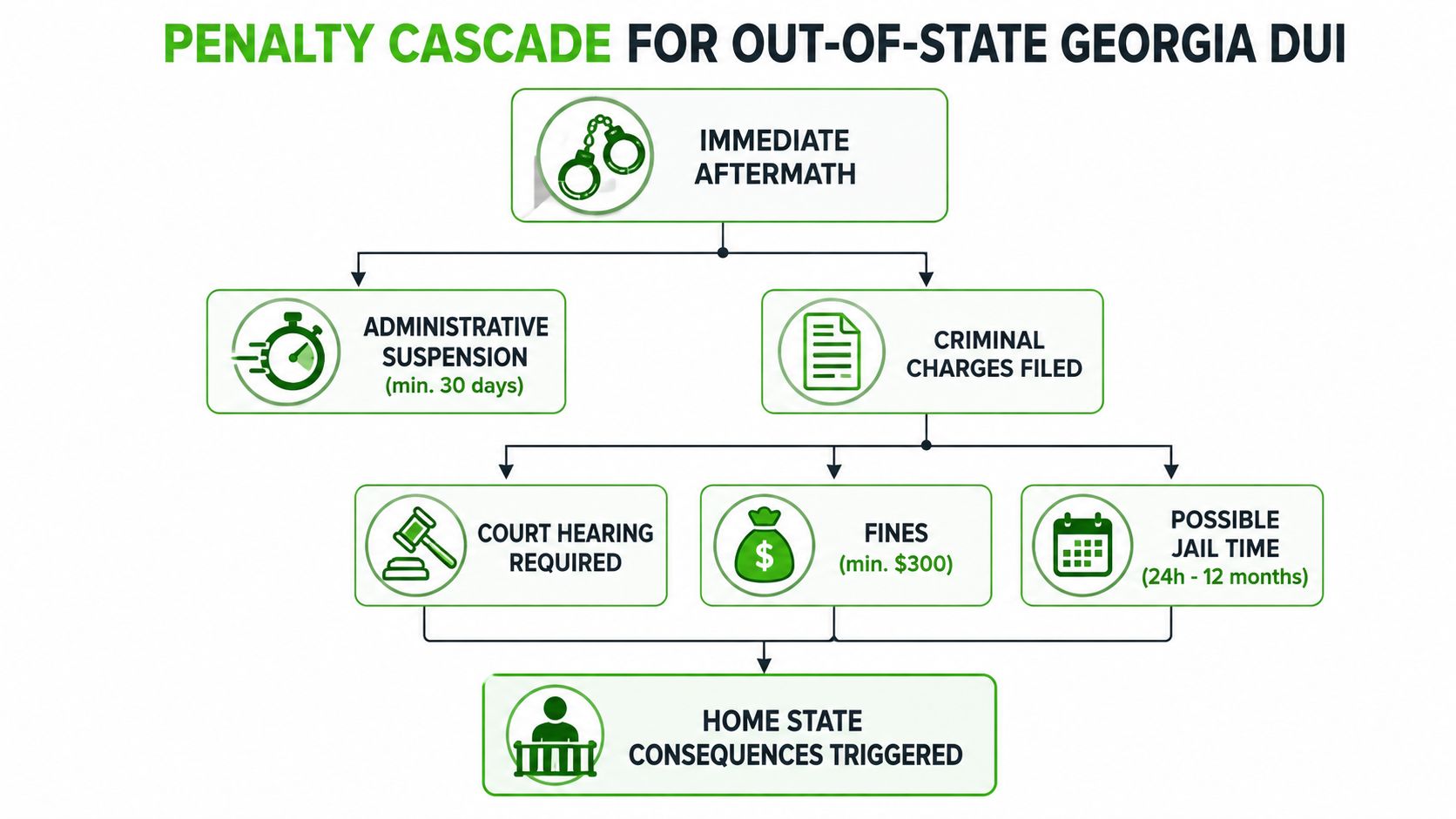
Georgia records the conviction and related license action, then the interstate reporting systems carry the result home. That's the mechanism. Once that happens, your home DMV may impose its own action even though the arrest happened here. If you're trying to protect your license, you need to respond to both systems, not just the one that booked you.
Administrative and Criminal Penalties You Will Face
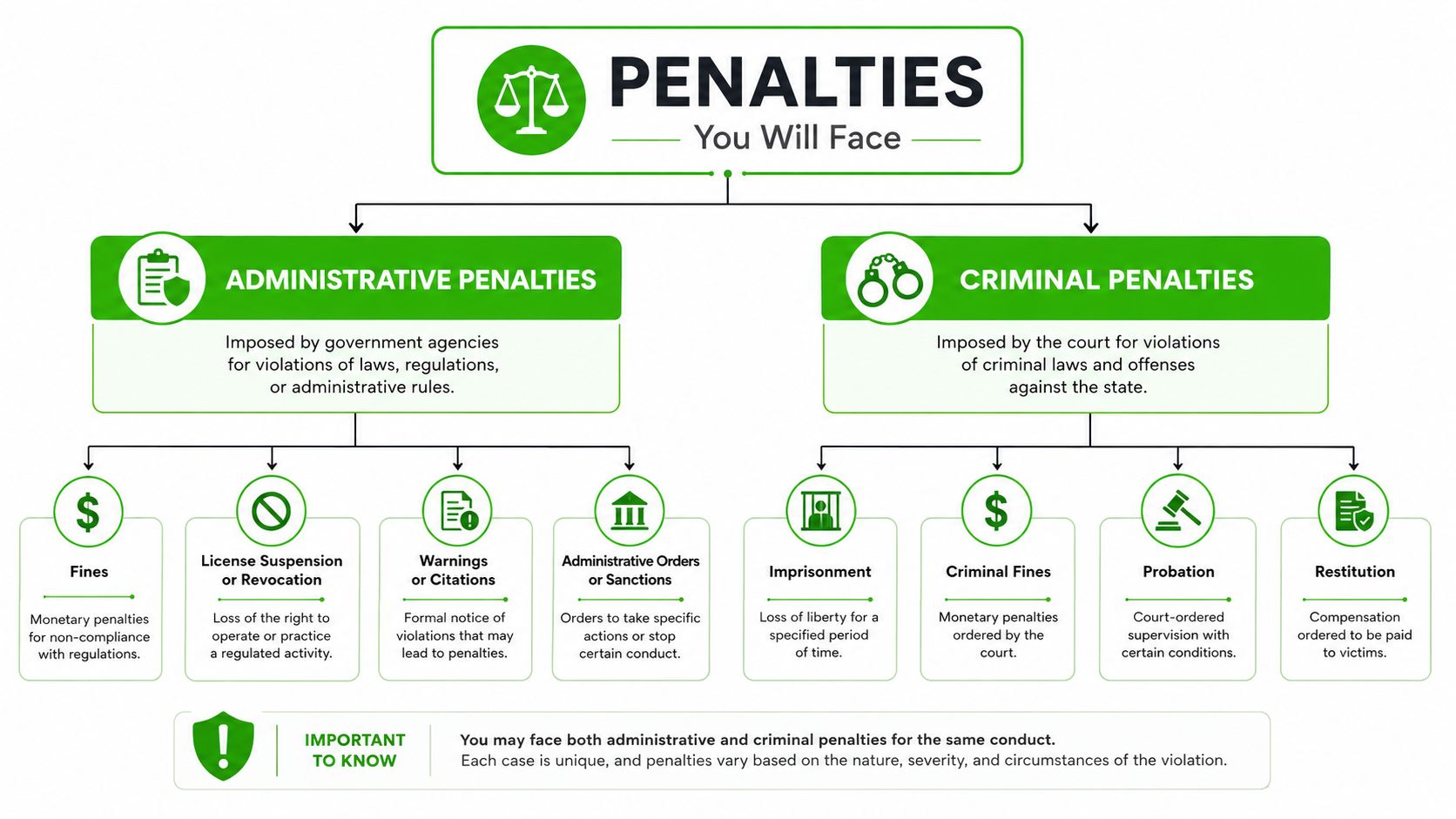
The first mistake out-of-state drivers make is treating the arrest like the penalty. It's not. Georgia can move against your driving privilege before your court date, and the criminal case can still add fines, jail exposure, and service requirements after that. You need to separate the administrative consequences from the criminal ones, because they don't move on the same timetable.
Administrative action hits first
Georgia's out-of-state DUI enforcement can suspend your privilege to drive in Georgia even though your home-state license itself remains physically issued by your home DMV. That distinction is important. You may still hold the card in your wallet, but you can't legally drive in Georgia until the state clears you.
Criminal penalties add the real pressure
For a first DUI offense in Georgia, the commonly cited penalties include a $300 to $1,000 fine, 10 days to 12 months in jail, and at least 40 hours of community service. If your BAC was over 0.08%, a mandatory 24-hour incarceration period applies even when the court trims other jail time. Georgia DUI penalties for out-of-state drivers
Those are not theoretical numbers. They're the kind of penalties that force people to rearrange work travel, family plans, and return trips to Georgia court. If you hold a commercial license or rely on frequent driving for work, the practical damage gets bigger fast.
For broader multi-state strategy, advice from Law Office of Bryan Fagan is useful because it frames the same core problem, a DUI arrest in one state can ripple into another state's licensing system. That's the right way to think about it. You are not just fighting a Georgia case, you're managing the fallout in your home state too.
If you're looking for insurance cleanup after the case, expect your carrier to care about the conviction record and the reinstatement paperwork. The exact premium impact depends on the carrier, but the practical reality is that DUI paperwork often follows the driver long after the court appearance ends.
The Dual Compliance Track Problem
Most drivers get trapped here. They think there's one checklist, one court, and one reinstatement process. There isn't. An out-of-state DUI in Georgia creates two separate compliance tracks, and the faster you accept that, the fewer mistakes you make.
| Requirement | Georgia DDS Track | Home State DMV Track |
|---|---|---|
| Reinstatement timing | 120-day waiting period before Georgia clearance can move forward | May have its own separate waiting timeline |
| Education program | Must complete a substantially similar 20-hour DUI intervention program | May require a different course or additional proof |
| Fee payment | Georgia reinstatement fee is required | Home state may charge its own fee |
| Clearance letter | Georgia requires a letter of clearance from the arresting state | Home state may ask for court records or disposition documents |
| Final proof | Georgia DDS wants documentation that satisfies its clearance workflow | Home DMV may still impose a separate suspension or review |
Georgia DDS is only one lane
For Georgia residents convicted of DUI in another state, Georgia DDS reinstatement is not a casual form submission. It's gated by a 120-day waiting period, completion of a substantially similar 20-hour DUI intervention program, payment of the reinstatement fee, and a clearance letter from the arresting state. That is a document-driven process, not a promise-driven one. Georgia reinstatement workflow for out-of-state DUI
Your home state may still want something different
Your home DMV can independently decide how to treat the Georgia conviction. That's why a certificate that looks fine to Georgia can still leave you stuck elsewhere. If you want a deeper explanation of the education side, the SAP program overview helps clarify how evaluations and treatment tracks can become part of the administrative maze.
Bottom line: if you satisfy only Georgia, you may still be blocked at home. If you satisfy only home-state paperwork, Georgia may still keep you off the road.
That's the trap. You need documentation that works in both places, and you need to confirm that each jurisdiction will accept what you've completed before you spend time and money on the wrong program.
Your Step by Step Reinstatement Checklist
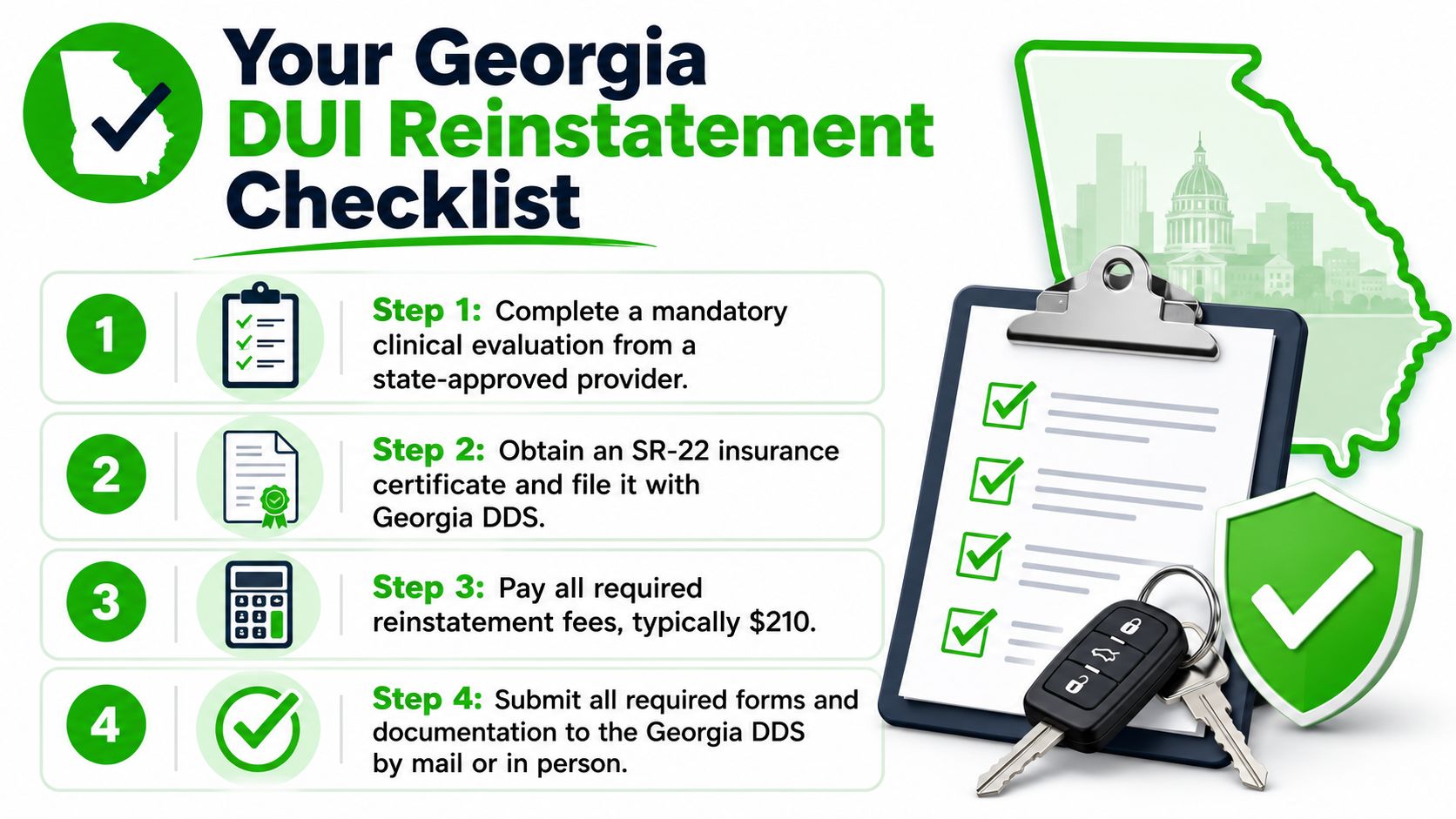
Start with the documents, not the optimism. Georgia reinstatement runs on proof, and proof means evaluation results, course certificates, clearance letters, and payment records that line up cleanly. If one item is missing or mismatched, the file stalls.
Step 1 is the clinical evaluation
Georgia's official guidance says a DUI conviction requires completion of a DDS-approved DUI Alcohol or Drug Use Risk Reduction Program and a clinical evaluation, with treatment added if the evaluation shows it's needed. That evaluation is not a formality. It decides whether your file stays as education-only or moves into a treatment requirement. Georgia impaired-driving laws and treatment requirements
Step 2 is the 20-hour risk reduction course
The state's DUI reinstatement path points to a DDS-approved DUI Alcohol or Drug Use Risk Reduction Program. For many drivers, this is the core class requirement that must be finished before reinstatement can move forward. Georgia DUI Schools offers that course, plus clinical services and Victim Impact Panels, which can keep the process under one roof instead of sending you to multiple providers.
Step 3 is the documentation stack
Bring together the clearance letter, the course completion certificate, the clinical evaluation results, and any additional treatment records that follow from the evaluation. If you're working from another state, the arresting state's paperwork matters just as much as the Georgia paperwork. A missing clearance letter can stop reinstatement cold.
Step 4 is timing and submission
One practical guide to reinstatement information is license reinstatement guidance in Georgia, but the rule is simple, start as soon as the case allows and don't wait until the end of your suspension to gather documents. Delays usually come from people who assume certificates will be mailed quickly or that one state will automatically share everything with the other.
Practical rule: before you pay for any class, confirm that your exact paperwork will satisfy the agency that actually has your driving privilege on hold.
Verify Course Acceptance Before You Enroll
This is the question people skip, and it's the one that wastes the most money. Will a Georgia DUI school certificate be accepted by the arresting state, or will you need a second program? Georgia DDS says drivers with an out-of-state DUI suspension should check the DUI School Guidelines for Other States and may need to call DDS before enrolling, which tells you everything you need to know. Acceptance is not automatic. Georgia DDS DUI FAQs
Ask the right agency the right questions
Call the Georgia DDS contact point and your home DMV before you enroll. Ask whether the program must be at least 20 hours, whether it must be state-approved in the arresting state, whether a clinical evaluation is required, and whether the certificate must name the state where the course was taken. Get the answer in writing if you can.
If you want a practical consumer-facing explanation of why treatment programs can vary, Paramount Recovery Centers' outpatient alcohol program guide gives a useful framework for understanding how education and treatment aren't interchangeable.
Don't buy the first convenient option
A local class that sounds easy can still fail a DMV review if the other state doesn't accept it. That leaves you paying twice and waiting longer than you should. The goal isn't just to finish a class, it's to produce cross-jurisdiction documentation that survives review by two agencies.
If you're not sure which provider fits your case, use this test. Will the certificate satisfy Georgia DDS, and will it also satisfy the arresting state without extra rework? If the answer is unclear, stop and verify before you enroll. That's the fastest way to avoid wasting a week, or a month, on the wrong paperwork.
Get Back on the Road with the Right Support
An out-of-state DUI in Georgia is fixable, but only if you stop treating it like a single-state problem. You're dealing with Georgia DDS, your home DMV, and the paper trail that connects them. Georgia DUI Schools serves drivers across the state with 18 convenient locations, flexible online options, and clinical services that include evaluations, ASAM Level 1 treatment, and Victim Impact Panels. The program history matters too, with 38 years of experience and over 100,000 participants guided through the state-required Risk Reduction course.
If you need a broader rehab reference while sorting out substance-use paperwork, My Safety Manager's SAP guide is a useful resource for understanding how professional evaluation and return-to-duty requirements work in a compliance setting. That said, your immediate focus is the Georgia DUI clearance path, because every delay there slows everything else down.
Take the problem seriously, verify the right course, and collect the right documents the first time. That's how you shorten the road back to a valid license instead of dragging the case out for months.
If you're dealing with an out of state DUI Georgia case, Georgia DUI Schools can help you line up the Risk Reduction course, clinical evaluation, and related compliance steps without guessing about the paperwork. Visit Georgia DUI Schools and start with the course path that matches your reinstatement requirements.