

DUI and DWI offenders referred by a court, probation officer, or state licensing agency are the people who usually have to attend a Victim Impact Panel in the U.S. In Georgia, that requirement often sits alongside the Risk Reduction Program, so the panel becomes one part of the larger path back to compliance.
You're probably reading this with paperwork open on the table, trying to figure out whether the panel is separate from DUI school, whether it has to be in person, and what proof the court expects. That confusion is normal, because a victim impact panel USA order can look simple on paper and still raise a lot of practical questions once you have to schedule it, attend it, and turn in the certificate.
What a Victim Impact Panel Really Is
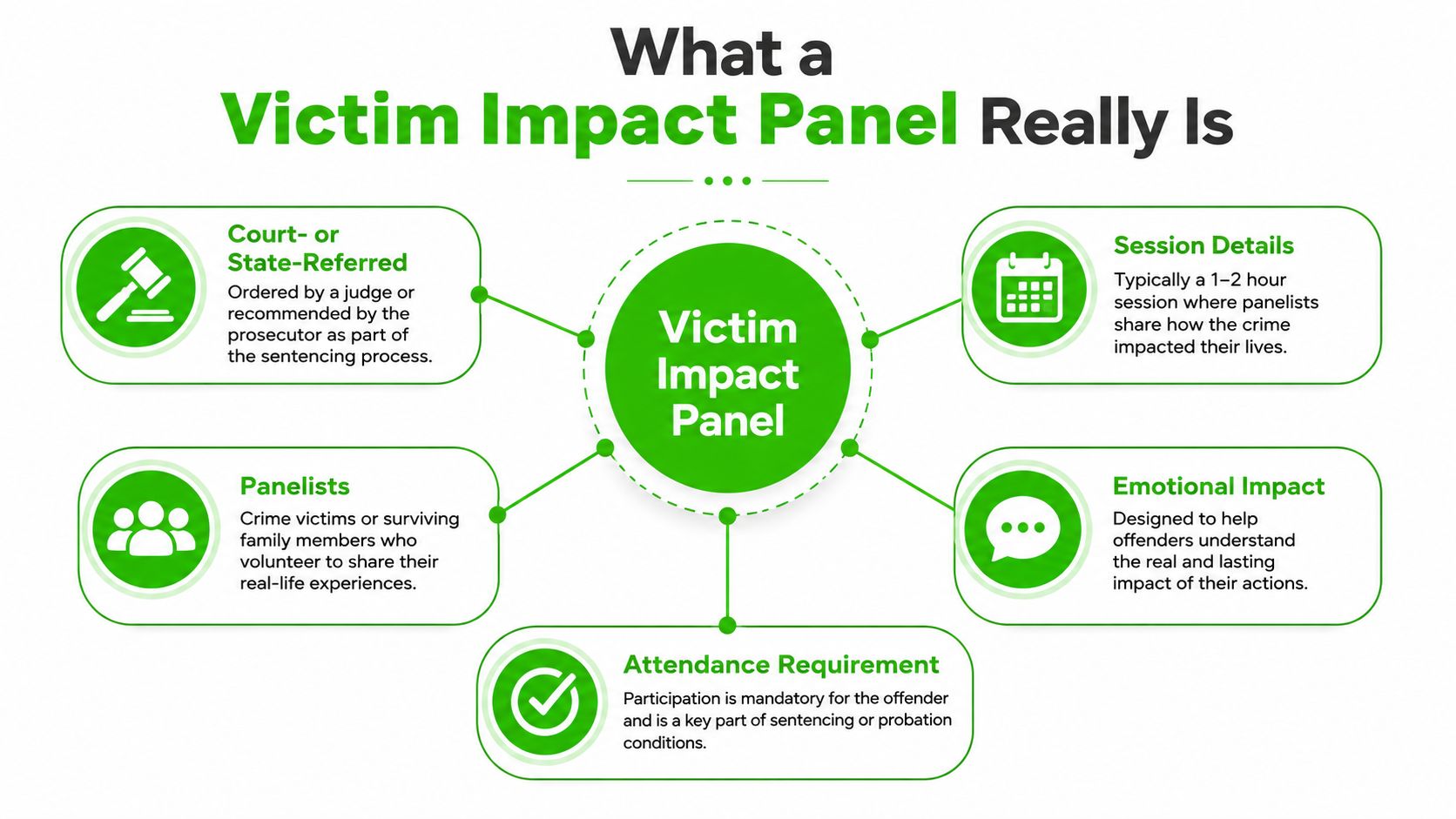
A Victim Impact Panel is a court- or state-referred session where people convicted of DUI or DWI hear directly from victims, survivors, or family members affected by impaired-driving crashes. If your paperwork mentions a panel, you're not being sent to another lecture that repeats DUI school. You're being sent to a session built around real testimony, with the goal of showing how impaired driving affects other people's lives.
Who gets sent and why it matters
People are commonly ordered to attend after a first offense, a repeat offense, or as a condition of probation. In Georgia, the panel can also appear as part of the broader Risk Reduction Program path, so it's not just emotional education, it's a compliance item that can affect whether your case is considered complete. That's why it helps to treat the referral seriously from the start.
The format is usually organized by MADD chapters or by approved providers, depending on the state and the court's rules. A panel is not a free-form discussion. It's a structured event with check-in, speakers, and attendance verification, and the point is to create accountability while giving victims a public voice.
If you're trying to understand how that fits into a larger DUI case, the legal consequences of impaired driving crashes are also explained in the context of civil and injury claims in Scher, Bassett & Hames on DUI accidents. That kind of overview can help you see why courts use panels as more than a symbolic add-on.
Practical rule: if your order says VIP, Victim Impact Panel, or a similar term, assume it's a required compliance step until someone with authority tells you otherwise.
Why Victim Impact Panels Were Created
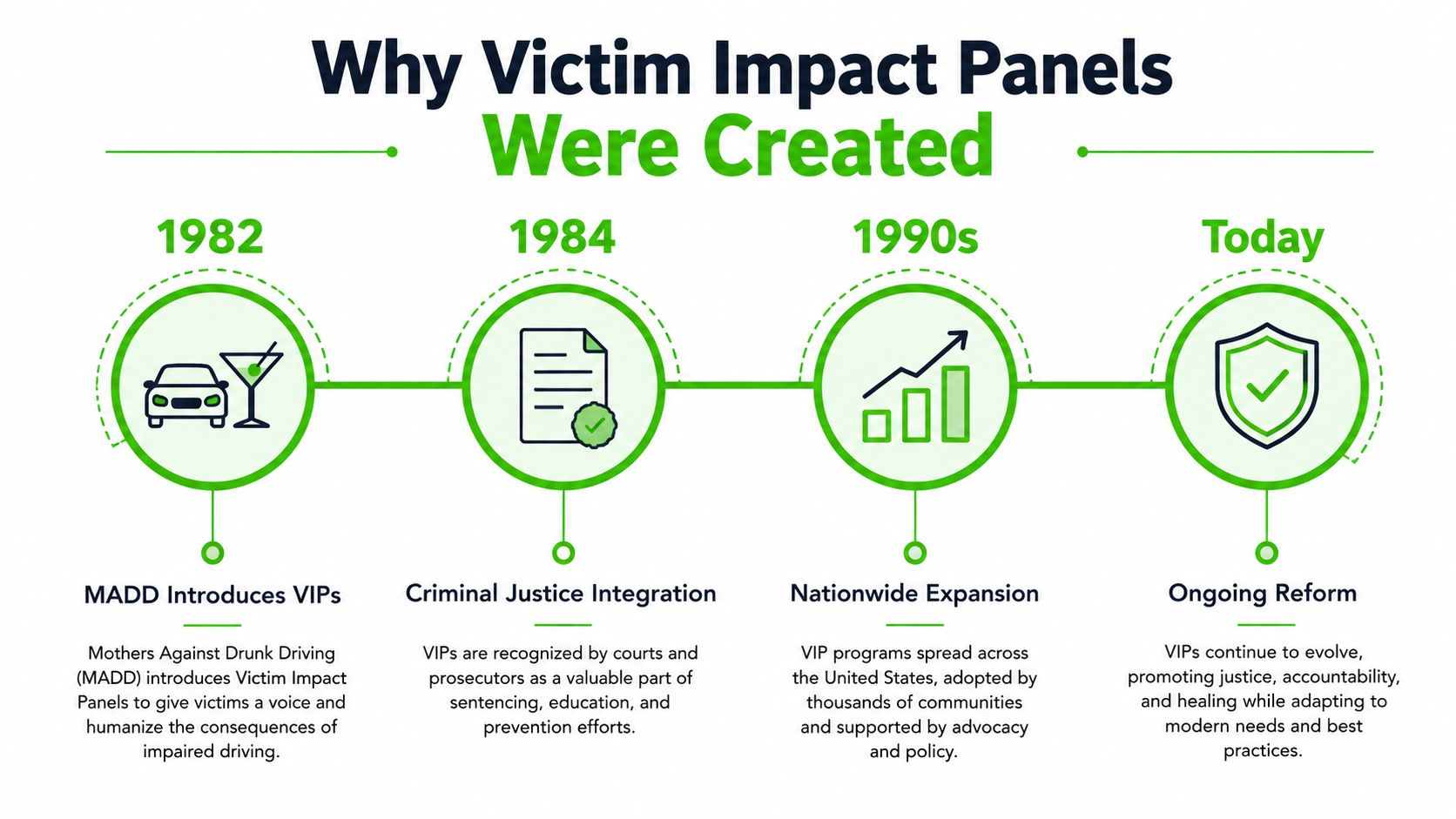
A Victim Impact Panel usually starts from a simple problem, people facing DUI consequences often hear rules first and consequences later. The panel was created to put lived experience in the room before the legal process feels abstract. Mothers Against Drunk Driving, or MADD, helped introduce Victim Impact Panels in 1982 Victim Impact Panels were introduced in 1982 by MADD. The goal was to give crime victims a structured place to speak and to make the impact of impaired driving harder to ignore.
Why the format uses multiple speakers
A single story can explain harm, but several stories show the pattern. That is why panels are usually built around more than one speaker. A Washington State Traffic Safety Commission overview notes that panels typically feature two to four victims, and a ROSA P report describes panels as involving three or four speakers who were seriously injured or lost a loved one in a DWI crash. Those descriptions point to the same design choice, the room is meant to hold more than one point of view so the harm does not sound like a one-off event ROSA P panel structure and evaluation findings.
The structure also helps explain why a panel feels different from a lecture. A lecture tells attendees what the law says. A panel shows what the law is responding to. That difference matters in a court-ordered setting, because the point is not just to hear about impaired driving in the abstract, but to understand how it reaches families, injury recovery, and day-to-day life.
For readers who want to see how victim-centered support fits into the broader justice response, supporting crime victims in Ventura County offers another example of that same idea in practice. The setting may change from state to state, but the basic purpose stays consistent, give victims a voice that is heard in a formal, practical setting.
What Happens Inside a Typical Panel Session
A first-time attendee usually finds the session begins with a simple routine. You check in, show the identification or paperwork the provider requested, and wait for the panel to start. The room is usually quiet and formal, and the staff explains the ground rules before anyone begins speaking.
The flow from arrival to dismissal
The speaker lineup sits at the center of the session. In many panels, you will hear from three or four speakers who were seriously injured in a crash or who lost a loved one to impaired driving. Their accounts are personal, specific, and hard to ignore. They describe what happened, how life changed, and what everyday recovery has looked like afterward.
Most sessions also build in time for silence, reflection, or a written response. There usually is no back-and-forth format, and many panels do not allow attendee questions. That is by design. The speaker keeps control of the room, and the attendee listens without trying to debate, explain, or interrupt.
Keep your phone away, stay seated, and do not turn the panel into a conversation. The fastest way to lose credit is to act like you are in a discussion when the room is set up for listening.
At the end, staff typically sign off on attendance or give you documentation to submit to the court or DDS. That proof matters as much as being present, because the legal system needs a record, not just your memory of the session. If you are planning your evening around a Georgia panel, arrive early enough for parking, sit through the full session, and leave only after the provider says you are dismissed.
What the Research Shows About Outcomes
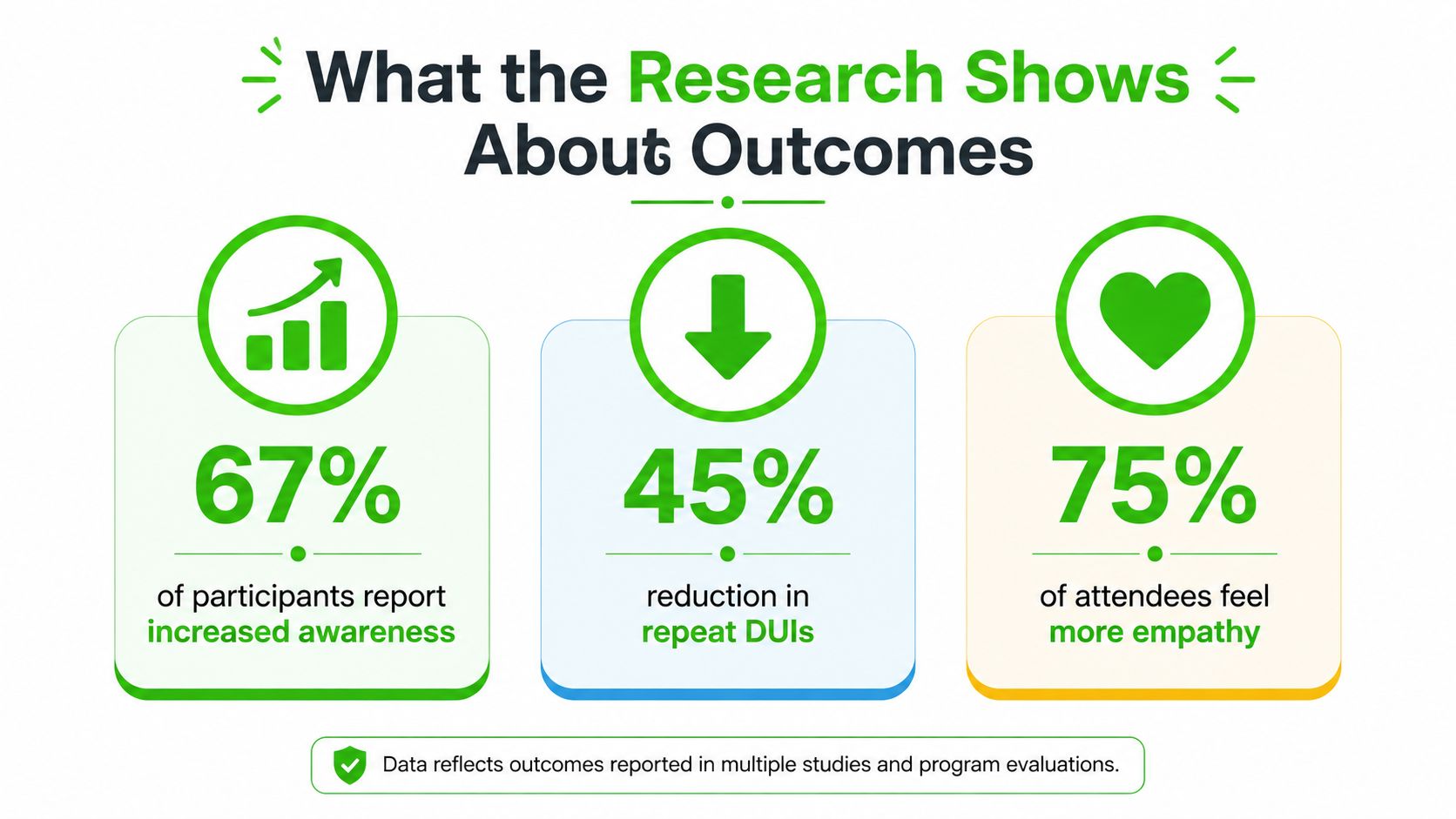
A Victim Impact Panel can feel straightforward in the room, yet the research behind it is less tidy. Courts keep using these panels because the findings do not point in one direction. Some studies report lower later DUI behavior after attendance, while others find little added benefit once a panel is added to an existing education program U.S. VIP research summary and mixed findings. For a first-time attendee in Georgia, that mixed record matters. The panel is a real compliance step, but it is not a cure-all.
Where the strongest findings appear
The clearer results tend to come from studies that compared people who attended with people who did not. In one Southeastern U.S. county study, researchers followed 404 offenders who attended a VIP and 431 comparison offenders who did not Southeastern county VIP study. They reported lower rearrest rates in the VIP group across the follow-up periods they examined, with the strongest effects among white men, people ages 26 to 35, and offenders with one prior DUI arrest Southeastern county VIP study. A separate long-term analysis also found that offenders who did not attend had 1.5 times higher odds of a later DUI at 5 years and 1.8 times higher odds at 8 years, which points to lower later DUI odds among attendees over time Long-term DUI recidivism analysis.
That pattern helps explain why many courts still require the panel. A VIP is not built to work like a lecture that fixes behavior on the spot. It works more like a pressure point in a larger accountability process, where the goal is to make the real-world consequences harder to ignore.
Where the evidence is weaker
The other side of the record is just as important. In a randomized New Mexico study of 813 first-time DWI offenders, adding a MADD panel to mandatory DWI school did not produce a statistically significant improvement in stage-of-change progression or 2-year recidivism New Mexico randomized study. That finding shows why researchers keep calling the evidence mixed. A panel can matter in one setting and show little measurable added effect in another.
The broader ROSA P review reached a similar mixed conclusion in the state data it summarized, with one state showing lower recidivism and the other showing no meaningful difference ROSA P study. So the most accurate takeaway is simple. A Victim Impact Panel can be a meaningful deterrent in some cases, especially when outcomes are tracked over longer periods, but it works best as one part of a larger DUI accountability process, not as a standalone fix.
Georgia Rules and How VIPs Fit the Risk Reduction Program
In Georgia, a Victim Impact Panel often appears as one component inside the DUI Risk Reduction Program, which is used in court cases and for license reinstatement. The key point is that the panel is not just a separate emotional event. For many drivers, it's part of the required compliance path that sits alongside other DUI-related obligations.
What Georgia drivers should verify
First, confirm that your panel is being delivered through a Georgia Department of Driver Services approved provider. That matters because Georgia courts and DDS don't treat every session the same way. Second, make sure your certificate identifies the panel clearly so your court, probation officer, and DDS can see that this specific requirement was completed.
If you're comparing providers or trying to understand how the panel fits into the state process, Georgia DUI Schools' own Victim Impact Panel information for Georgia drivers is one example of how approved programs present the requirement in practical terms. When a program is tied to Risk Reduction, the paperwork trail matters as much as the session itself.
Georgia also stands apart from states where a VIP may be optional, bundled differently, or handled as a separate MADD event. That's why you can't assume a certificate from another state will satisfy a Georgia order. Ask whether the provider is DDS-approved, whether the panel is part of the Risk Reduction structure, and whether the certificate will be accepted by the exact office handling your case.
For readers comparing education and recovery-style group formats, Nexus Recovery Centers group therapy resource is a useful reference point for how structured group sessions are often organized. The subject matter is different, but the idea of guided participation and documented attendance overlaps with what many DUI programs require.
How to Register and Prepare as an Attendee
Start with the paper in your hand, not with a search result. If your court order, probation terms, or DDS reinstatement letter names a Victim Impact Panel, that's the document that controls. From there, choose a Georgia DDS-approved provider, confirm that the panel format matches your requirement, and register under your legal name exactly as it appears on the court paperwork.
The practical checklist before you book
Bring these items with you, because most registration problems start with missing basics:
- Photo ID, because providers usually need to match you to the order.
- Court or DDS paperwork, so staff can verify the requirement.
- Referral letter, if probation, DDS, or the court gave you one.
- Payment details, if the provider requires fee collection at registration.
- A copy of your schedule, so you don't book a session you can't attend.
Most Georgia providers offer evening or weekend options, and metro Atlanta schedules are usually built around working adults. That flexibility helps, but it doesn't change the core rule, arrive on time and stay for the full session. If you show up late, some providers won't let you in. If you leave early, you may have to repeat the whole thing.
Wear normal, respectful clothing, not formal attire, and leave anything distracting in the car if possible. Don't bring friends who aren't part of the requirement, and don't assume you can step out and re-enter without asking first. If the provider allows rescheduling, do it as early as possible, because a missed session can complicate your court deadline.
Preparation note: parking, arrival time, and certificate pickup should be confirmed before the day of the panel. That keeps the session from turning into a last-minute scramble.
If you need a Georgia-focused scheduling page, the Georgia Victim Impact Panel course page is a straightforward place to check current availability and required documentation.
Accessibility and State-by-State Differences
A person who finishes a panel in Georgia may assume the same certificate will work anywhere in the U.S., but that is not how these programs are set up. Some states use stand-alone MADD chapter events, some permit virtual attendance only when a court approves it, and some fold the panel into treatment or education requirements for repeat-offense drivers. That patchwork is why people get confused when they move, change probation officers, or try to satisfy an order in another state.
What looks like a simple class can operate like three different systems depending on where you are. One state may treat the panel as a separate community session. Another may place it inside a broader DUI education track. A third may accept remote attendance for certain cases, while still requiring in-person participation for others.
What many programs leave unsaid
Federal victim-services guidance recommends that VIP volunteers include culturally diverse communities and bilingual speakers, with better outreach for victims facing language or cultural barriers Federal victim-services guidance on VIP volunteers and language access. That guidance helps explain why accessibility matters, but public-facing VIP descriptions often still leave out whether a specific panel offers interpreters, disability accommodations, or remote attendance. Readers often find those gaps too late, usually on the day they are supposed to attend.
That is why direct questions matter before registration. Ask whether the provider offers ADA accommodations, whether bilingual services are available, and whether remote attendance is allowed in your case. If the website does not answer those questions clearly, call the office and ask, because the responsibility for confirming the requirement still falls on you.
For a Georgia reader, the baseline expectation is usually a local in-person session tied to the court or DDS process. A Georgia DDS-approved provider fits into that process by giving you the panel option that matches the order you received, along with the attendance record you may need afterward. In another state, the same requirement may be handled differently, and a completed panel from elsewhere might count or might not, depending on the wording of the order and the state's acceptance rules. For a look at how Texas structures its panel programs, see the Texas Victim Impact Panel page. Do not guess on that point, because a rejected certificate can cost time and force you to repeat the session.
Common Outcomes and How to Move Forward
When you finish a Victim Impact Panel, the first result is usually a signed certificate of attendance. That paper trail goes to the court, probation officer, or DDS, depending on who required the panel in the first place. For Georgia drivers working through reinstatement, it can also be one more document connected to the Risk Reduction Program.
The questions people ask most
How long is the certificate valid? The answer depends on the court or licensing office handling your file, so the safest move is to submit it right away and keep a copy for yourself. Does a panel completed in another state count? Sometimes it does, sometimes it does not, and the deciding factor is whether the receiving authority accepts that provider and format. What happens if you miss attendance? You usually have to reschedule, and if your order has a deadline, missing the session can create compliance problems.
That is where the recidivism research matters for context. As noted earlier, analysts found that some attenders had better later DUI outcomes than non-attenders, which helps explain why courts keep using these panels as a structured accountability step. The point is not that a panel guarantees future behavior. It is that the requirement is meant to interrupt denial, force a real review of consequences, and give the court a clear checkpoint.
If you are in Georgia and want to finish this requirement without extra back-and-forth, schedule the session through a provider that matches your court order, keep your documents together, and submit proof as soon as you receive it. Treat the certificate like a key document in a filing cabinet, not a souvenir. If one office needs it and another office also needs it, keep copies ready so you do not have to chase the same paperwork twice.
Georgia DUI Schools offers Victim Impact Panel options as part of its DUI and Risk Reduction services, along with the documentation many drivers need for court and DDS compliance. If you still need to complete this requirement, visit Georgia DUI Schools to find the panel format that matches your order and get your attendance record started.