Georgia drivers usually mean one of two things when they search traffic school online DMV. If it's a ticket, they're usually looking at DDS-approved defensive driving for point reduction, or a court-ordered 20-hour DUI Risk Reduction Program when a judge or probation officer has already set the terms.
If you're staring at a citation or a DUI order right now, don't waste time on the wrong enrollment page. Georgia treats these as separate paths, and the rules you have to satisfy are not interchangeable.
Two Very Different Traffic School Paths in Georgia
A Georgia driver who just got a speeding ticket wants relief fast. A driver who has a DUI case wants compliance, paperwork, and a clean record of completion. Those are not the same job, and mixing them up is how people blow deadlines, lose fee money, and end up back in court.
The first lane is point reduction
Defensive driving is the path many mean when they talk about traffic school online DMV. In Georgia, that route is used to reduce points or help with insurance-related consequences, and it has to be DDS-approved if you want the paperwork to count. A generic traffic course on the internet doesn't help if it isn't accepted by the Georgia Department of Driver Services or by the court that gave you the deadline.
That's why approval matters more than marketing. The course has to fit the exact purpose you need, whether that's point reduction, an insurer discount, or a court condition attached to a citation.
The second lane is DUI compliance
A DUI Risk Reduction Program is different. It's not just a smarter way to do traffic school, it's a legal requirement in DUI-related cases, and it often has to be paired with other compliance steps like a clinical evaluation or a Victim Impact Panel when the court or probation office orders them. If you treat it like a normal defensive-driving class, you'll end up in the wrong program and the court won't care that the website looked convenient.
Practical rule: if the paper says DUI, stop looking at generic ticket classes. Read the order line by line before you enroll.
Georgia DUI Schools offers DDS-approved defensive driving and DUI/Risk Reduction options, plus related clinical services, through online and in-person formats. If you want to check one provider that keeps these tracks separate, the course page is here: Georgia-approved online driving course.
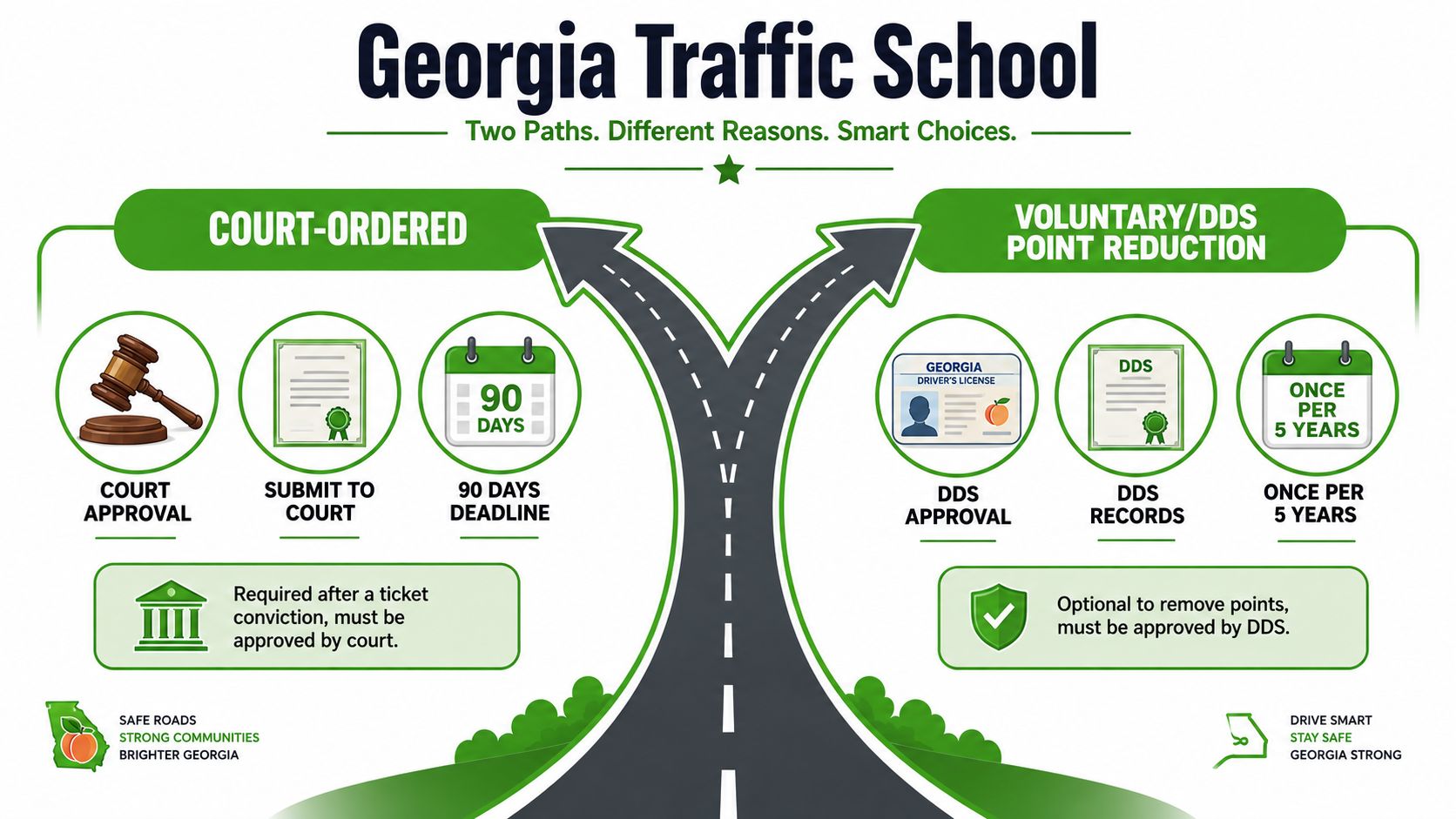
The fast way to make the right decision is simple, look at the document in your hand. If it mentions a ticket conviction, court deadline, or point reduction, you're in defensive driving territory. If it mentions DUI, alcohol, drugs, reinstatement, evaluation, or treatment, you're in Risk Reduction territory.
Who Qualifies and Who Gets Turned Away
Georgia eligibility rules are straightforward on paper and messy in real life. People usually assume they can enroll first and sort out the details later. That's backwards, and it's the main reason drivers get denied after they've already paid.
Defensive driving eligibility
For a DDS-approved defensive driving course, the driver needs a valid Georgia license and has to stay within the state's point-reduction rules. If there are pending DUI charges, that can change the picture fast, because a defensive-driving class is not a workaround for criminal DUI requirements. The court can also limit eligibility when a citation requires a mandatory appearance.
Drivers with commercial obligations or out-of-state complications should slow down and check the exact order they received. A class that works for a local commuter with a clean record may not be accepted for someone with a CDL, a suspended license, or a case already tied to a specific court hearing.
DUI Risk Reduction eligibility
The Risk Reduction Program is the right lane for DUI-related compliance, not voluntary point shaving. It's the program courts use when they want a driver to complete the state-required alcohol and drug education track. If you already have a court order, your first question isn't whether the course is convenient, it's whether the provider and format match the order.
My advice: don't guess with DUI paperwork. If the order mentions evaluation, treatment, or a Victim Impact Panel, build your plan around those items first.
A lot of people also miss the licensing side. If your record includes multiple violations, a Habitual Violator designation, or a suspension issue, you need to read the order carefully because a course alone won't fix everything. The same goes for drivers who think an out-of-state ticket can be handled like a Georgia local citation. It usually can't.
If you're unsure where you land, treat that as a stop sign, not a green light. One bad enrollment choice costs less than a wrong court filing, but it still wastes time you may not have.
Self-Paced Online, Live Virtual, or In-Person Classroom
Georgia drivers usually care about speed first, then accountability, then convenience. That's the right order. A good course format should fit the deadline you've got, not the other way around.
How the formats differ
Self-paced online works best for drivers who need flexibility. You can start after work, pause for dinner, and finish when you've got time. That format is the closest match to what many mean by traffic school online DMV, especially when they need to fit the class around a job, kids, or a short court deadline.
Live virtual is the better choice when a driver wants structure without driving to a classroom. It usually means a scheduled session with a real instructor and clearer accountability. That can help if the court wants a more formal setting, or if the driver knows they won't stay on track alone.
In-person classroom is the oldest format and still makes sense for drivers who want face-to-face instruction or don't trust themselves to finish online. It's the least flexible, but some people do better when they have to show up and sit down.
| Georgia Traffic School Format Comparison | Pacing | Instructor Interaction | Best Fit |
|---|---|---|---|
| Self-Paced Online | Start and stop on your schedule | Limited or none | Busy drivers, court deadlines, point reduction |
| Live Virtual | Scheduled sessions | Real-time instructor access | Drivers who need accountability |
| In-Person Classroom | Fixed class times | Direct in-room instruction | Drivers who prefer structure and attendance pressure |
What I recommend
If your case is routine and your deadline isn't breathing down your neck, self-paced online is the cleanest option. If you're dealing with DUI compliance, pick the format the court or provider accepts, not the one that sounds easiest. A class that fits your life but fails the order is a bad deal.
Use the format to solve your real problem. Don't pick it based on convenience alone.
From Enrollment to Submitted Certificate
Most drivers don't fail traffic school because the course was hard. They fail because they skipped one administrative step, missed one deadline, or sent the certificate to the wrong place. That's the part nobody brags about, but it's where cases get won or lost.
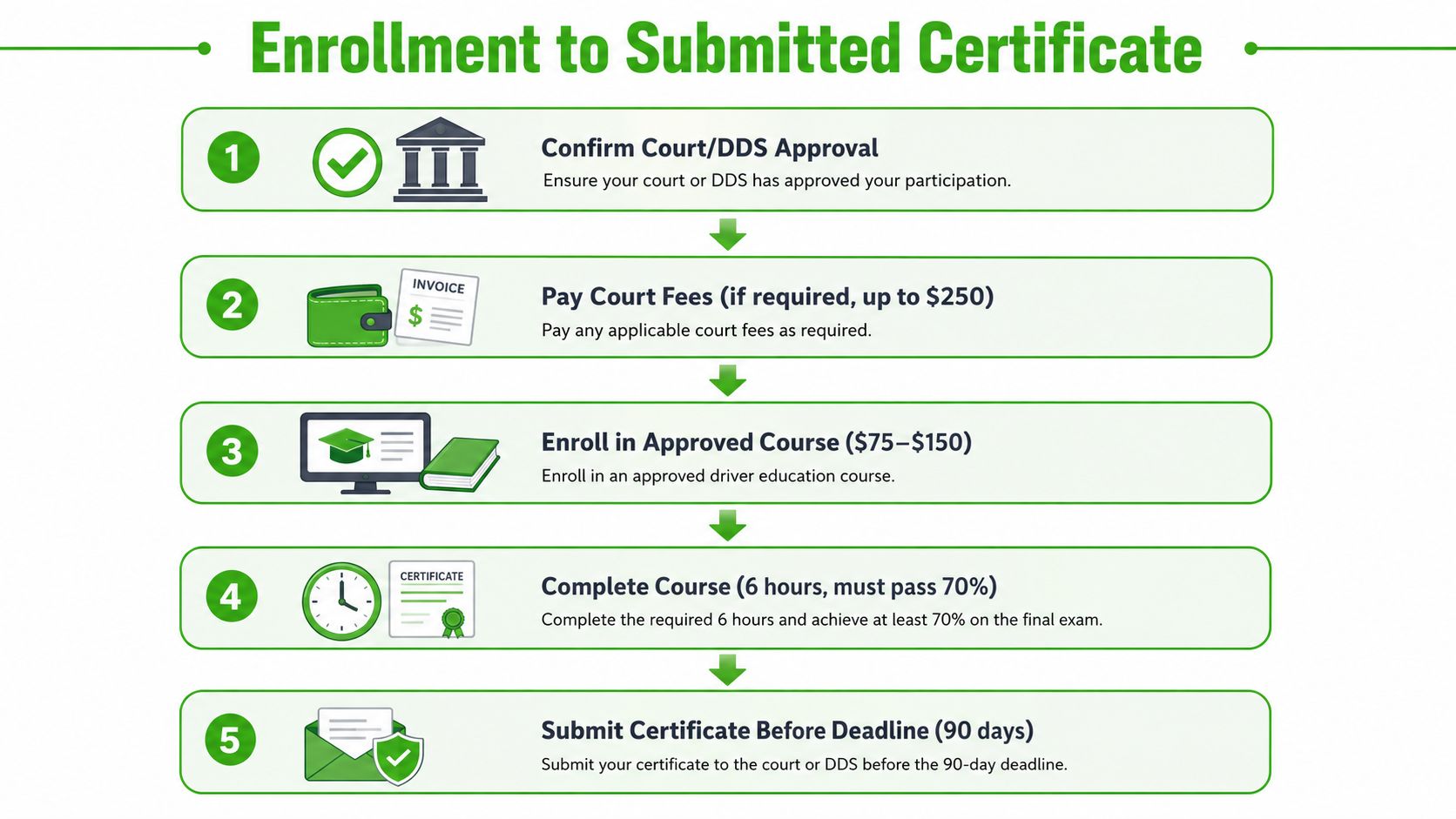
The order that actually works
Start by confirming whether the court or DDS wants the course at all. If the order is tied to a court case, check the deadline first, then verify the provider before you spend a dollar. If it's for point reduction, make sure the course is DDS-approved before you enroll.
Next, pay the required fee if the court or provider requires one, then complete the class at your own pace. Georgia drivers should not assume every certificate is handled the same way, because one path goes to the court, one goes to DDS, and some insurers want proof for a policy review. A certificate in your inbox isn't useful until it reaches the right desk.
If you need the documentation side handled cleanly, keep your completion records together and use the provider's certificate process. For drivers dealing with DUI compliance paperwork, this Georgia DUI Schools certificate resource is the kind of page that helps you keep the paper trail straight.
Where drivers mess this up
The most common mistake is enrolling before approval is confirmed. The second is missing the deadline by a day and assuming somebody will forgive it. The third is uploading proof to an insurer portal when the court still needs the certificate.
Do this instead: save the order, screenshot the deadline, and submit the certificate to the exact place named on the paperwork.
Finish the course, pass the final, and confirm that completion was transmitted or downloaded correctly. If the court, DDS, or insurer can't see it, the course might as well not exist.
Real Costs and the Payoff Drivers See
The tuition is only the visible part of the bill. Georgia drivers also pay the court side of the process, and DUI-related cases can add another layer through evaluations or related compliance steps. That is why people who shop only on course price end up underbudgeted.
The cost breakdown
Your first line item is the course itself. The second is whatever the court or DDS requires to process the case. The third shows up when the matter goes beyond a routine ticket and triggers clinical services, which can happen in DUI cases.
For insurance questions, the payoff only matters if the completion certificate is on file with the carrier. A course may help with eligibility for a discount or a better premium review, but the insurer has to accept the proof first. If you are comparing the money side of driving fines and coverage problems, My Policy Quote explains insurance fines gives drivers a clear look at the bigger financial picture.
The smart move is to compare the course price against the total consequence you are trying to avoid. A lower tuition that fails to satisfy the court is not saving money, it is just delaying a more expensive problem.
What I tell Georgia drivers
Budget for the paperwork, not just the class. If you are in a routine point-reduction case, a defensive-driving course can be a practical, contained expense. If you are in DUI territory, the bill may include evaluation and follow-up requirements that have nothing to do with the online class itself.
Georgia DUI Schools also offers a defensive driving course to lower insurance for drivers whose goal is record cleanup and policy relief rather than DUI compliance. That distinction matters because the right course keeps you from buying the wrong solution.
Bottom line: the cheapest course is not always the cheapest outcome.
How It Plays Out for Atlanta-Area Drivers
Atlanta drivers don't live in theory. They live in traffic, school pickups, commute windows, court dates, and paperwork stuffed into glove boxes. Three common scenarios show how this works in the metro area.
Gwinnett commuter with repeat tickets
A Gwinnett commuter who already has two tickets in 18 months usually wants the same thing, points off the record and no more premium pain. That driver is a good fit for a self-paced defensive-driving course if the DDS and court rules allow it. The schedule matters here, because people in this situation usually need to finish between work, family obligations, and a court deadline that doesn't care how busy Tuesday was.
What slows this case down is not the course itself. It's the driver waiting too long to confirm approval, then rushing the certificate process on the last day.
Fulton County first-offense DUI driver
A Fulton County driver with a first-offense DUI does not need generic traffic school. That person needs the 20-hour Risk Reduction Program, and in many cases the court also expects a clinical evaluation and a Victim Impact Panel. None of those items cancel the others out. They stack.
That means the driver has to coordinate appointments, course timing, and document submission in the right order. If the evaluation points to treatment, the process gets more serious, not less. People get tripped up by thinking a quick online class will clear the whole case.
Cobb County parent helping a teen
A Cobb County parent taking defensive driving for a teen policy issue usually has a different problem. The goal is often to keep the household policy clean, reduce points where allowed, and handle the admin without turning it into a family crisis. That parent usually wants quick access, a simple final exam, and a certificate that can be saved or forwarded without drama.
The timeline is shortest in this scenario, but the admin still matters. The wrong provider or the wrong completion format can stall the whole thing even when the underlying case is routine.
Answers to the Questions Georgia Drivers Actually Ask

Miss the court deadline by a day, and you're in trouble. Courts often treat deadlines as deadlines, not suggestions, so the right move is to contact the court immediately if you're close to the cutoff.
A lost completion certificate usually means you go back to the provider and request another copy or a verification record. Don't wait until the court asks for it.
If you're asking whether you can use the same course twice in a short period, check the exact eligibility rules before you rely on it. Repeat use is often restricted, and Habitual Violator situations can make the answer even tighter.
Out-of-state drivers on a Georgia license should not assume their home-state habits apply here. Georgia paperwork controls Georgia compliance, and if the license is tied to a court order, the order wins.
If a driver has a Habitual Violator designation, the course is only one piece of the puzzle. That label changes the stakes, and in many cases it means the driver needs legal advice before they enroll anywhere.
Georgia DUI Schools handles both defensive driving and DUI/Risk Reduction education, along with the paperwork and related clinical services drivers often need when a case gets serious. If you're sorting out a Georgia ticket, a DUI order, or a deadline you can't afford to miss, visit Georgia DUI Schools and choose the path that matches your actual court or DDS requirement.