
A Georgia family can reach the same frustrating point every year: their teenager has a learner's permit, the family has found a suitable driving school, and then the cost of the required training forces them to pause. The student is ready to move forward, but the funding rules feel harder to understand than the road signs.
That's where drivers ed scholarships can help. The important detail is that these awards usually aren't general cash assistance. They're more like a voucher connected to a specific course design, an approved provider, required documents, and an application window. If the scholarship pays for one training format but your student needs another, the award may not solve the actual problem.

Georgia offers one of the clearest examples of how public funding can connect directly to driver education requirements. The state program supports a defined combination of classroom and behind-the-wheel instruction, rather than giving families unrestricted money to spend however they choose. You can also review the broader benefits of driver education in Georgia before deciding which course structure makes sense.
This guide focuses on the practical questions families ask: who may qualify, where to look, how to apply before funds run out, and how to check whether a scholarship fits an in-person, online, weekend, or hybrid schedule. The same matching principle matters in other Georgia driving requirements too. A course must contain the right components, and completion must satisfy the rule that brought you there.
Introduction What Drivers Ed Scholarships Mean for Georgia Families
A Georgia family may find a course that fits a teenager's school schedule, then discover that the scholarship supports a different training format. The parent is comparing calendars, transportation, and household costs. The student is balancing school with classroom work and driving practice. Funding helps only when the award and the course line up.
Georgia's Driver's Education Grant Scholarship Program helps eligible students complete 30 hours of classroom instruction plus 6 hours of behind-the-wheel training. The award is attached to that course structure and to Joshua's Law completion, rather than being general money for any driving lesson. Families should read Georgia's program rule before applying, then confirm that the provider offers the required classroom and driving components.
That format requirement works like ordering a meal from a fixed menu. A scholarship may pay for the listed combination, while an online-only class, a separate practice package, or a different schedule may leave part of the cost uncovered. Before comparing awards, identify the exact course the student plans to take.
The program has helped many Georgia families, and its funding is limited to defined awards. An award may cover qualifying instruction without paying for every expense connected with licensing, transportation, or extra practice. The benefits of driver education in Georgia can help families weigh the broader value of training while they compare course formats.
Practical rule: Treat a scholarship as a reserved place in a qualifying training program, not as cash for any driving service.
A scholarship may be paid to an approved school instead of being handed to the student. Other programs may use competitive awards, deadlines, or limited application windows. Waiting to secure a permit, confirm enrollment, or gather documents can close off an otherwise suitable option.
Start with a matching question: “What training does this award pay for, and can our student complete that format?” An in-person weekday course, online classroom work, weekend instruction, and behind-the-wheel appointments create different scheduling needs. Matching those details before applying helps prevent a scholarship from looking helpful on paper but failing to fit the student's actual path to a Georgia license.
Understanding How Drivers Ed Scholarships Actually Work
A drivers ed scholarship works like a voucher with a recipe printed on it. The voucher identifies an approved use, the recipe defines the required instruction, and an authorized school must provide it. If any ingredient is missing, a family may have funding but no qualifying course.
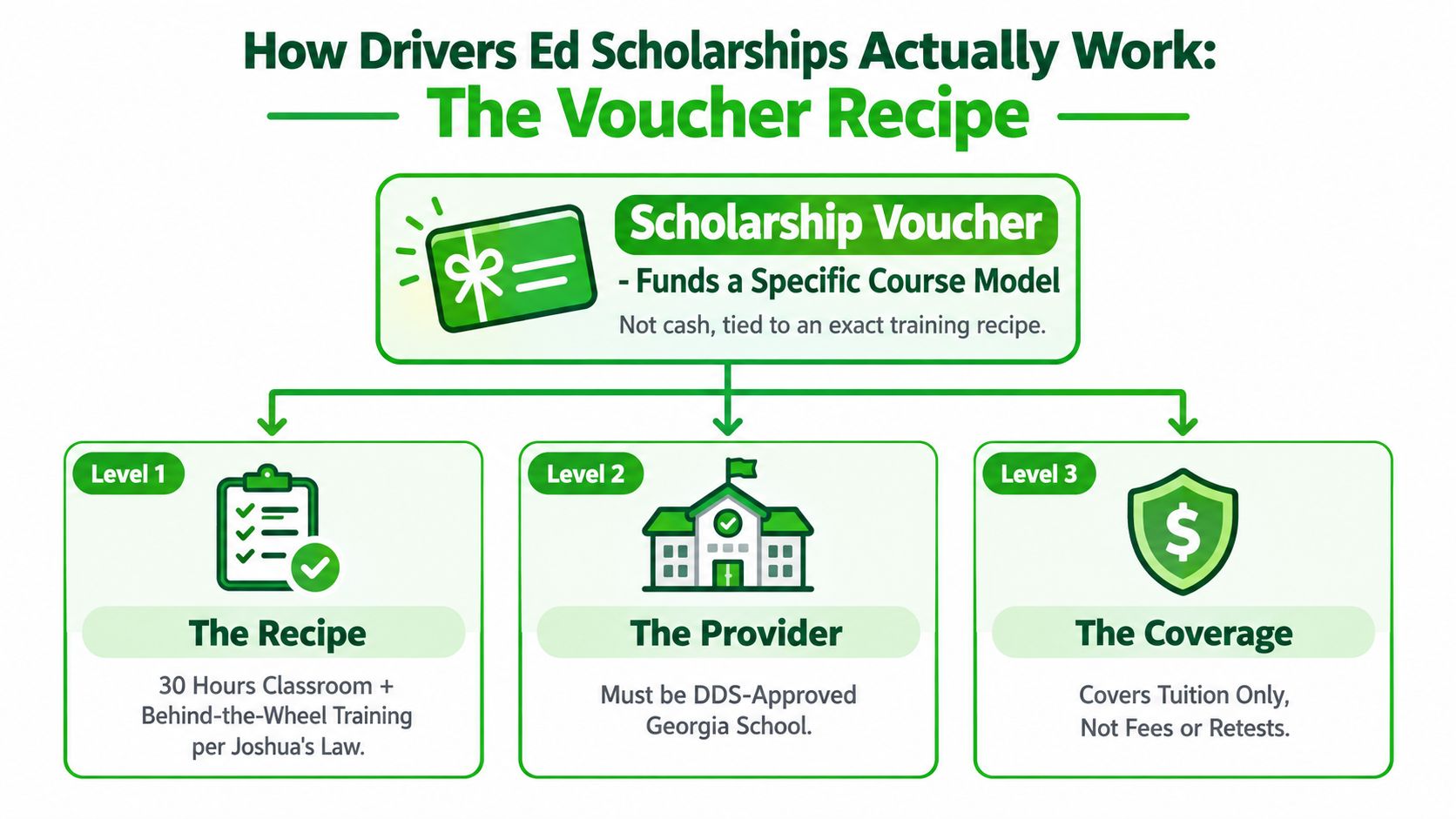
Georgia's statewide grant follows that format. It supports a 30-hour classroom course and 6 hours of behind-the-wheel training with an approved instructor. The award is tied to those training components, rather than being general money for any driving-related purchase. As noted earlier, Georgia's program rules define the qualifying course model and award terms.
The money follows the approved training
Many scholarship programs pay an approved school directly instead of reimbursing the student. That payment flow helps the administering agency confirm that funds support qualifying instruction. It also prevents a family from paying for an uncovered service and expecting repayment afterward.
The school's menu does not determine coverage. A provider might offer private lessons, test preparation, online education, or several course formats. The scholarship terms decide which of those services qualify.
Course format matters as much as the school's name. A voucher designed for classroom instruction and supervised driving practice may not cover a separate online package or extra lessons. Families should ask the provider to map each funded hour to the course requirements before enrolling.
Competitive awards and first-come funding work differently
A competitive program collects applications during a set period and selects recipients under its published process. First-come funding depends more heavily on timing. Applicants still need the correct documents, but available awards and provider choices may shrink as funds are assigned.
That difference changes how families prepare. For a competitive grant, missing information can weaken or delay an application. For first-come funding, waiting can reduce the options that still fit the student's schedule and required training format.
The fiscal year 2023 results, described in the Introduction, show the program's reach. Those figures provide context, not a guaranteed award for each applicant. Treat the published award structure as a guide for planning, then confirm the current amount, approved provider, and covered course before committing to enrollment.
Who Qualifies for Drivers Ed Scholarships and Why Requirements Vary
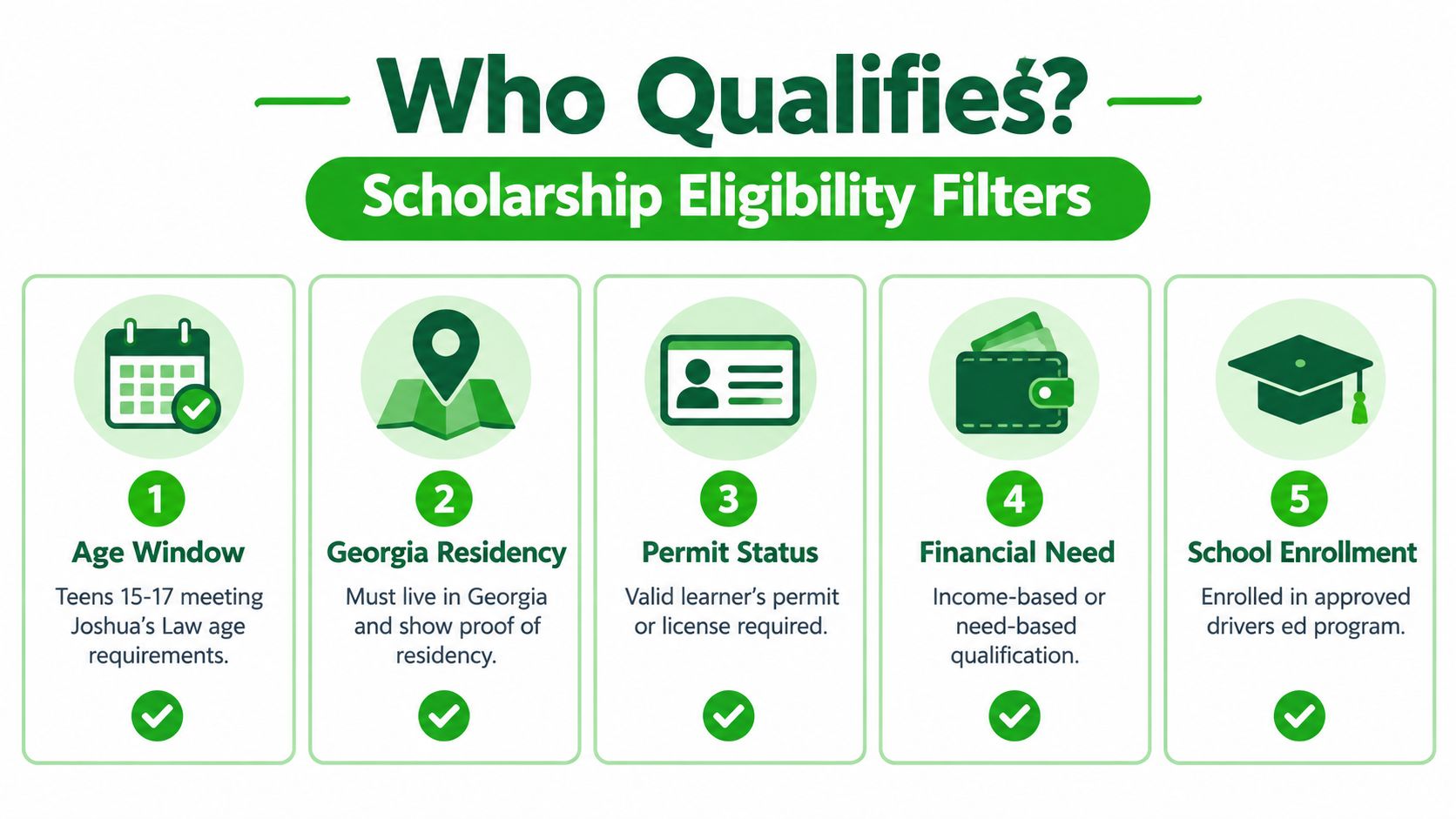
Eligibility works like a series of checkpoints, not one universal checklist. A student may appear to qualify at first glance, then fail a later filter involving the approved provider, course format, permit status, or financial documentation. The safest approach is to test each requirement in order and save proof as soon as it is confirmed.
For Georgia families, the statewide program is a competitive grant tied to Joshua's Law completion. Its eligibility rules and approved course conditions are outlined in the Georgia driver education scholarship resources. Read those details before comparing schools, because funding follows the program's defined training package rather than every service a driving school sells.
Use the filters in the right order
Begin with the student's basic eligibility, then confirm the documents that prove it. After that, check whether the student's permit or license status meets the application rules. A student who expects to receive a permit soon may need to wait before applying, even if the other conditions are already satisfied.
Next, match the scholarship to the exact course format. Confirm that the provider is approved and that its package contains every funded training component. A classroom-only product followed by separately booked driving lessons may not qualify in the same way as one approved package. The school's menu is not the coverage rule. The scholarship terms are.
Keep a copy of the provider's approval, enrollment details, and course description. These records make it easier to show that the selected class and driving instruction belong to the same qualifying plan.
Financial need may use program-specific proof
Some scholarships establish financial need through participation in listed public assistance programs instead of asking families to calculate eligibility from general income information. Ohio's Drive to Succeed program, for example, accepts documentation connected to SNAP, Medicaid, WIC, or Summer EBT within the past 12 months. It serves eligible residents ages 15 and a half through 20 who hold a valid temporary permit. Drive to Succeed's program information explains its documentation and provider rules.
That example shows why families should read each program's evidence list separately. One award may prioritize residency and provider approval. Another may require benefits documentation and use first-come allocation. The same student can fit one program while missing another because the filters are arranged differently.
A valid permit is often more than a driving milestone. It can be an application prerequisite.
Prepare the file before applications open. Keep identification, residency proof, permit information, school details, and need-based records together, with current copies available. When funds are limited, accurate documentation helps a family act quickly and avoid choosing a course that the scholarship cannot cover.
Where to Find Drivers Ed Scholarships From National Programs to Georgia Options
A scholarship search should follow the course format, not just the award amount. A Georgia family might find funding through a state agency, a county office, a community organization, or a private listing, yet each source may approve different classroom and driving arrangements. Treat the scholarship like a key cut for one lock. The student must match the approved provider, required training hours, age or permit rules, and application route before applying.
State programs usually offer a central page or agency contact. Local programs may place the application with a police department, sheriff's office, health department, school, or nonprofit partner. Private listings can involve essays, recurring cycles, or narrower eligibility rules. Start with the official program page, then look for an approved-provider directory, participating agency list, or local contact rather than searching only for a general tuition award.
Georgia's statewide program is a practical starting point because its course model and funding are documented in state records. Families can also review Georgia driver education options to compare schools and course formats before contacting an award administrator.
Ohio offers a useful comparison because its Drive to Succeed program connects state funding with local access. Ohio launched the program in 2022 to expand access for low-income families, with administration through the Ohio Traffic Safety Office and local agencies such as police departments, sheriffs' offices, and health departments. Ohio's launch announcement describes that community-based structure.
The useful lesson for Georgia families is how to search for the local entry point. If a program uses community partners, check the state agency's participating-provider or county list. Then contact the listed office and ask which schools accept the award, what format the scholarship covers, and whether the agency submits payment directly. Those questions can prevent an application for a class that does not match the funding rules.
Comparing Drivers Ed Scholarship Sources at a Glance
| Program Type | Who It Serves | Funding Scale and Format |
|---|---|---|
| Georgia statewide grant | Georgia residents ages 15–17 who meet the permit, course, and Joshua's Law conditions | Publicly documented statewide awards tied to 30 classroom hours and 6 behind-the-wheel hours |
| Ohio Drive to Succeed | Eligible Ohio teens and young adults who meet permit and need documentation rules | State and local distribution, with approved-school payment and community agency involvement |
| Local agency awards | Students served by a participating county, city, department, or community organization | Often tied to a local provider network and local application process |
| Private scholarship listings | Applicants who match each sponsor's criteria | Smaller, program-specific awards, including recurring or essay-based formats |
A private listing may fit when a statewide award does not match the student's schedule. Read the current terms carefully, confirm the application period, and compare the listed course design with the school's actual enrollment options before submitting anything.
How to Apply for Drivers Ed Scholarships Without Missing Your Window
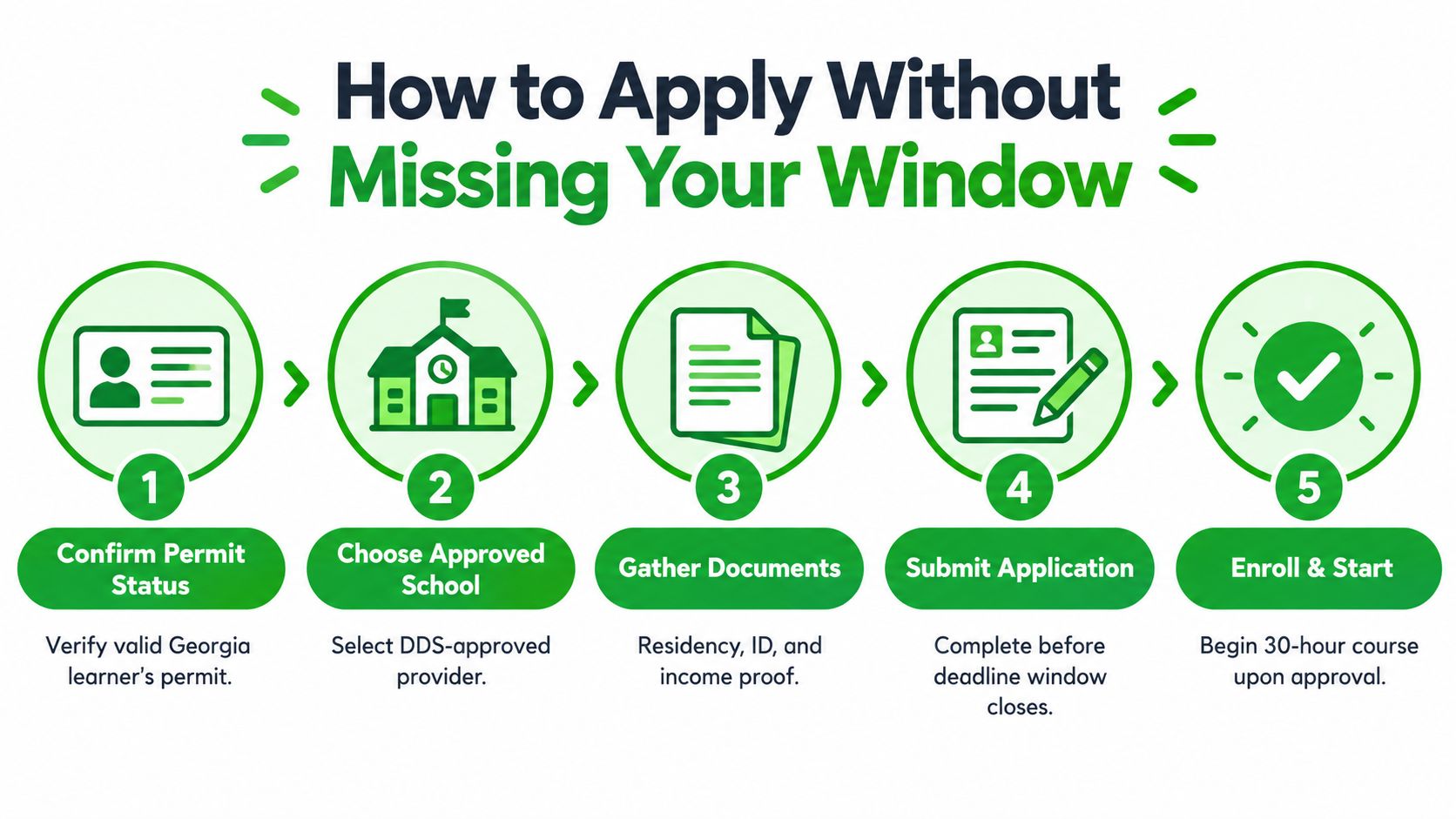
A student can meet every eligibility rule and still miss funding by submitting documents late or choosing a course the award does not cover. The application works like a trip with checkpoints: verify the student's status, match the course format and required hours, gather proof, then submit through the correct route.
A practical application sequence
Confirm the permit or license status. Check that the student holds the Georgia credential required by the program. A planned appointment or expected permit date may not satisfy the rule.
Identify an approved provider. Ask whether the school participates in that specific scholarship, not merely whether it offers driver education. Confirm that the course includes the required classroom and behind-the-wheel hours in the approved format.
Collect the documents. Prepare proof of Georgia residency, identification, permit or license status, school enrollment, and any financial-need records requested. Need-based programs may accept only proof connected to a specified public benefit.
Read the payment rules. Find out whether the program pays the school directly, prohibits reimbursement, or covers tuition only. A family should not pay first and then discover that repayment is unavailable.
Submit through the correct portal or agency. Use the official application route and save the confirmation. A completed form left in an email draft is not an application.
Georgia's program has an application deadline and a centralized state portal. Since awards are competitive, delays with permit records or school enrollment can close the funding window even when the student otherwise qualifies. Review the state's driver education scholarship resources before preparing the submission.
Before you apply, call the school and ask what happens after approval. Confirm how quickly enrollment must occur, which class dates qualify, and whether space remains.
Ohio's Drive to Succeed model shows why timing and payment instructions matter. It uses first-come, first-served allocation, pays approved schools directly, and does not reimburse students after payment. The program's official information also explains its need documentation and temporary permit requirements. Applicants should complete each step promptly and check the approved provider list before choosing a class.
Choosing the Right Scholarship for Your Learning Format and Schedule
A scholarship can look generous on paper and still fail a family's schedule. A student may qualify for funding but be unable to reach classroom sessions because of rural transportation, sports, work, family responsibilities, or limited local providers. Treat the course format like a key and the scholarship rules like its lock. Both must match.
Check these details before choosing a program:
- Classroom format: Does it require in-person attendance, allow live virtual instruction, or accept online coursework?
- Training hours: Does it fund the exact classroom and behind-the-wheel hours required?
- Provider choice: May you use a school near Atlanta, Athens, or in your county, or must you choose from an approved list?
- Payment limits: Does the award cover tuition only, and does the school receive payment directly?
A 2024 scholarship packet illustrates why the wording matters. It capped assistance at $450, required 30 hours of in-person class time plus 6 hours of behind-the-wheel training, prohibited virtual classes, and paid the school directly. The scholarship packet shows why families should examine format requirements instead of relying on the word “scholarship.”
Georgia's state grant follows its own 30-hour classroom and 6-hour behind-the-wheel model. That arrangement may work for a student who can attend scheduled sessions, while a student needing online or weekend-only instruction may need a different option. Families can compare flexible drivers ed online options in Georgia before applying, then confirm that the scholarship agency and provider both accept the selected format.
Course flexibility does not override funding rules. Match the award to the student's actual calendar, transportation, and required training hours first.
The same principle applies to Georgia's DUI Alcohol or Drug Use Risk Reduction Program. It requires an assessment and an intervention course, and both must be completed successfully before a certificate is issued. Georgia DDS explains the Risk Reduction requirements. Choose funding and enrollment based on the exact compliance pathway, not merely on a familiar course name.
Next Steps to Fund Your Training and Stay Compliant in Georgia
Begin with the student's eligibility and permit or license status. Then identify an approved provider and compare the scholarship's exact course format and training hours with the student's schedule. A scholarship works like a key cut for one lock. Even an approved award may not fit a course delivered in the wrong format. Apply through the correct portal early, save every document, and ask the school how enrollment and payment will work after approval.
A family may be funding teen driver education while also handling adult license-compliance requirements. A scholarship for a Joshua's Law course does not replace a court-ordered DUI assessment, Risk Reduction intervention course, clinical evaluation, Victim Impact Panel, or treatment when those requirements apply. As noted earlier, Risk Reduction follows its own required compliance pathway, so confirm the applicable steps before enrolling.
Georgia drivers with related license issues should read court and DDS notices carefully. The state's habitual violator framework applies when a person has been arrested and convicted three or more times within a five-year period for qualifying offenses such as DUI. Driving after notice of habitual-violator revocation is unlawful. Georgia's habitual violator guidance explains the framework.
Your next action can be specific: contact Georgia DUI Schools, describe the student's scholarship or license requirement, and ask which approved course format matches it. Georgia DUI Schools offers DDS-approved Risk Reduction and defensive driving programs, clinical services, Victim Impact Panels, online options, and classroom locations serving Atlanta, Athens, and communities across the state. Visit Georgia DUI Schools to review the available pathways, confirm enrollment requirements, and choose a course that fits the compliance obligation and schedule.