

You just got the notice, the judge said “assessment,” and now you're trying to figure out whether a laptop screen counts or whether you still need to sit across from a clinician in Atlanta traffic. That confusion is normal. In Georgia, an online drug and alcohol assessment is often the first step, but it's not always the final step, and the difference matters when a license, probation term, or court deadline is on the line.
A real Georgia case usually starts with a simple question, not a diagnosis. The question is whether your drinking or drug use looks low-risk, risky, or severe enough to need treatment beyond a basic class. That's why the modern process uses structured screening first, then a deeper interview if the answers point that way. For many drivers, that layered approach is the part nobody explained clearly the first time. what is a drug assessment
What an Online Drug and Alcohol Assessment Actually Is
A driver in Fulton County can click through a web form in the morning and still wonder by lunch if the court will treat it like a real evaluation. The short answer is yes, if the tool is validated and the next step is handled by a qualified clinician. The better question is what the assessment is doing behind the scenes.
Screening is not the same thing as diagnosis
A true online drug and alcohol assessment is a structured screening process that separates low-risk use from use that may need more review. In modern systems, that screen is usually built around validated tools, not casual opinion. The NIDA TAPS Tool uses a 4-item initial screen for tobacco, alcohol, illicit drugs, and non-medical prescription drug use, then automatically moves to TAPS-2 if the answer is anything other than “never” for a substance (NIDA TAPS).
That layered design matters because it mirrors the way Georgia evaluators think. A short screen can flag risk, but it does not by itself diagnose a disorder or choose treatment. A clinical evaluation is the formal interview where a licensed evaluator reviews the pattern, explains the result, and makes a recommendation.
Practical rule: A screen tells you whether more questions are needed. A clinical evaluation tells you what the answers mean.
Why Georgia drivers keep running into this term
People usually search for this after a DUI arrest, a DDS letter, or a probation condition. In Atlanta and the surrounding counties, the paperwork often uses different words for related tasks, which is why it feels messy. One form may ask for a screening summary, while another wants a signed evaluation and treatment recommendation.
That's where the modern workflow helps. It gives the court or DDS a standardized first look, then a clinician can review the results and decide whether the person belongs in education, outpatient care, or a higher level of treatment. Earlier web-based systems used the same logic, combining AUDIT and DUDIT screening with extended versions, feedback, and self-monitoring through electronic diaries (NIDA TAPS).
The key takeaway is simple. A laptop-based screen is a triage tool, not a throwaway quiz. The clinical evaluation is the formal decision point, and Georgia authorities may care about one, both, or the next step that follows.
How Modern Online Screening Tools Are Built
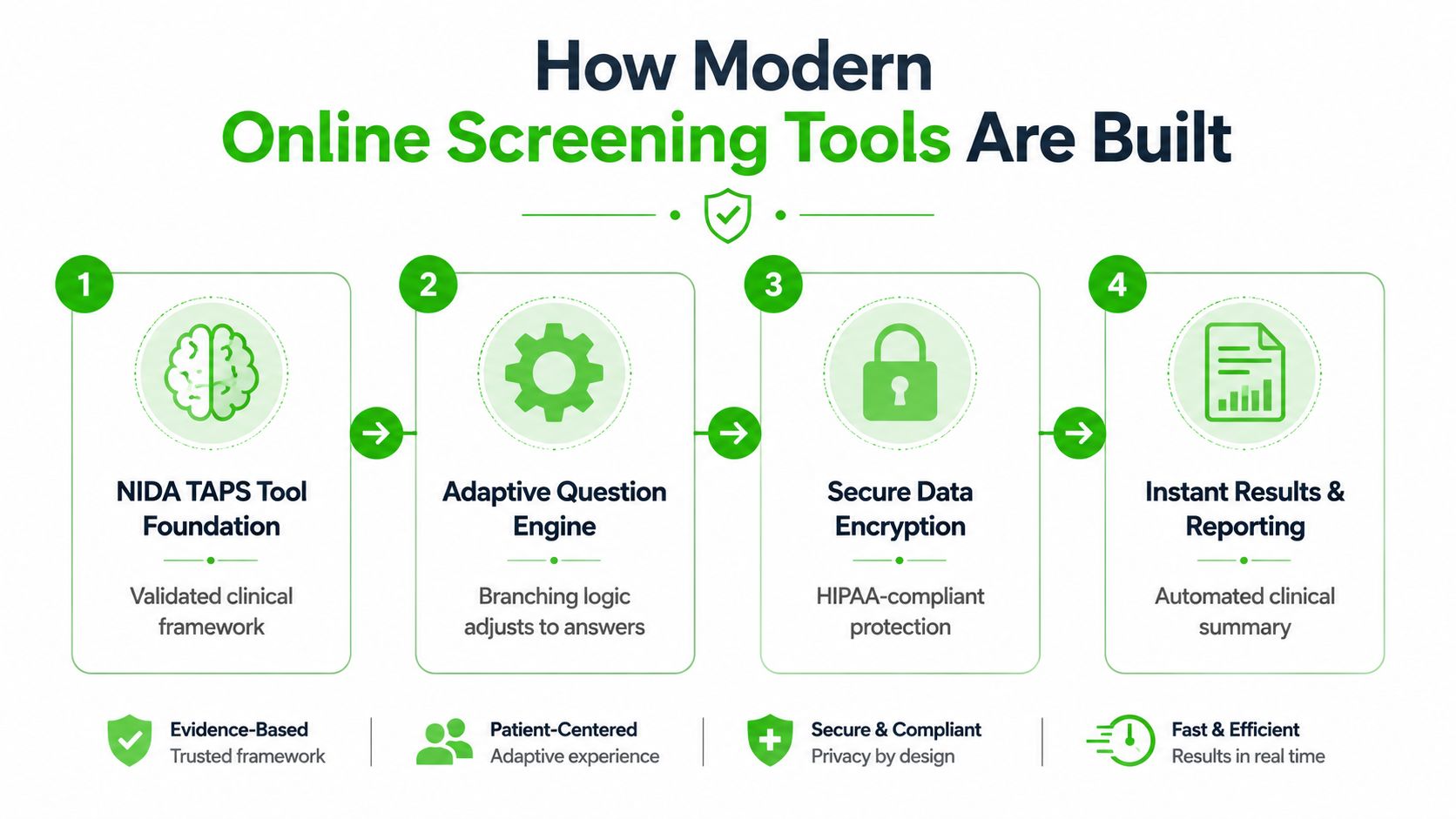
A good online assessment works like a branching intake form, with each answer sending the person to the next relevant question. That structure matters in a Georgia file because it separates a quick risk screen from a fuller clinical review. A driver who only drank occasionally needs a different path from someone with repeated consequences, failed tests, or a probation concern.
The first branch catches broad risk
The NIDA TAPS model begins with four quick questions about tobacco, alcohol, illicit drugs, and non-medical prescription drug use (NIDA TAPS). If the person answers “never” across the board, the process can stop at that first layer. If any answer points to use, the tool moves into a second layer that asks about the specific substances and sorts the risk more closely.
That setup fits the way a Georgia evaluator screens a file for court or DDS use. A judge in Atlanta Municipal Court may only need enough information to see whether the driver should be sent to a formal evaluation, while a DDS packet may need a clean screening trail before reinstatement can move forward. The online tool does the first sorting, then the evaluator decides whether the facts call for education, outpatient care, or a higher level of response.
AUDIT-C shows how a short screen can still be meaningful
The AUDIT-C is a 3-question alcohol screen scored from 0 to 12. A score of 4+ in men and 3+ in women is considered positive for hazardous drinking or active alcohol use disorders (RACGP AUDIT-C guidance). That score does not diagnose a disorder by itself. It tells the evaluator to look more closely at how often the person drinks, how much they drink, and whether there have been real-world consequences.
The same guidance notes that if all points come from the first drinking-frequency item alone, the person is likely below recommended limits (RACGP AUDIT-C guidance). In plain terms, that helps separate a one-off weekend pattern from the kind of drinking that raises concern in a Georgia DUI case. A driver in Athens who checks the top box only because of occasional social drinking does not get treated the same way as someone whose score reflects repeated heavy use.
A short screen works because the scoring rule is tied to known risk patterns, not a provider's guess.
Single-question screens still have a place
The NIAAA SASQ is a single-question screen, and MedlinePlus also lists AUDIT as 10 multiple-choice questions and CAGE as a standard alcohol screen where two or more “yes” answers may suggest AUD (MedlinePlus alcohol screening tests). These tools do different jobs. One may be enough to flag risk, while another gives a fuller picture of drinking behavior and consequences.
That is why an online form can be quick and still carry clinical weight. The questions are standardized, the scoring rules are known, and the next step depends on what the answers show. For a Georgia driver, that can mean the difference between a simple screening result and a referral for a formal clinical evaluation that a court or DDS reviewer will accept.
How Georgia Treats Online Drug and Alcohol Assessments
Georgia treats these results as part of a bigger workflow, not as a magic document that ends the case. That's where many drivers get tripped up. The Department of Driver Services, the court, and probation often want different pieces of the same picture.
DDS and the court are looking at different things
For DDS license reinstatement, the practical concern is whether the required evaluation and any needed treatment were completed in time and by an approved provider. For court or probation, the concern is whether the evaluator is recognized, the report is signed, and the recommendation matches the order. Those are related, but they are not identical.
An online screen can be a solid first step for both paths, but it usually has to feed into a properly credentialed clinical evaluation. That's true whether the case is in Atlanta Municipal Court, Athens-Clarke County, or a smaller rural county where the judge still expects a signed report and a clean paper trail.
Why Georgia drivers should care about the two-track setup
A person in Savannah may only think they need a course certificate. A person in DeKalb may hear “evaluation” and think it means one appointment. In reality, the paperwork often runs in layers, screen first, then evaluation, then placement if needed.
That layered process is why online assessment has become useful. It can start the file, sort risk, and send the person to the next required step instead of forcing a driver to guess. The strongest public-facing guidance also supports standardized self-administered questionnaires because people may answer more accurately online or through a portal, and the initial screen can be done efficiently before care (NIH screen and assess use guidance).
The value in Georgia is defensibility. A clean, standardized assessment gives the judge, DDS, or probation officer something more reliable than a vague conversation. It shows how the person moved from screening to the next decision point.
The Step-by-Step Online Assessment Process in Georgia
A worried driver usually wants the sequence, not the theory. That's fair. The process is easier to handle once you can see where the paperwork, the video call, and the signature fit together.
The online intake starts with identity and history
The first step is secure intake. The provider confirms who you are, collects the court or DDS reason for the referral, and gathers the basic history that shapes the screen. That can include prior arrests, prior treatment, current medications, and whether there are any safety concerns.
After that, the brief screen begins. Better Health Channel notes that tools such as Turning Point's Alcohol and Other Drug Screen take about five minutes and are only an initial assessment that can point someone toward help and referral rather than replace clinical evaluation (Better Health Channel). In practice, that's the part many people complete on their phone before the more detailed appointment.
The clinical interview fills in what the screen cannot
If the screen suggests risk, the next step is the clinician-led interview by video or phone. That interview is where the evaluator asks about pattern, consequences, prior attempts to cut down, and what the court or DDS needs documented. A full assessment typically takes longer than the screen because it has to connect the answers to a recommendation.
That written report is the deliverable people usually need for attorneys, probation officers, or DDS. It's also where the evaluator may recommend education, outpatient treatment, or a higher level of care if the presentation is more severe.
The output needs to match the next requirement
A Georgia driver shouldn't think of the assessment as the finish line. It's a gateway to whatever comes next, which may be the Risk Reduction Program, a treatment plan, or an ASAM placement. If the provider can't produce a signed report that matches the court order, the assessment won't do much good, no matter how convenient the video call was.
Screening vs Clinical Evaluation vs ASAM Level 1
A driver in Atlanta may finish an online alcohol screen, then get told the court still wants a full evaluation. That confusion usually comes from using one label for three different steps. Screening, clinical evaluation, and ASAM Level 1 are connected, but each one answers a different question.
| Tier | Purpose | Approx. Time | Who Delivers It | Typical Georgia Use |
|---|---|---|---|---|
| Screen | Quick risk check for alcohol or drug use | Minutes | Validated form or portal tool | Early intake, referral start, first review |
| Clinical evaluation | Clinician review with a documented recommendation | Longer than a screen | Credentialed clinician | DUI files, probation, DDS follow-up |
| ASAM Level 1 | Outpatient treatment placement and care plan | Determined after evaluation | Clinician or treatment provider | When the assessment points to outpatient care |
A screen helps sort low concern from higher concern. A clinical evaluation turns those answers into a written judgment a Georgia court, probation officer, or DDS reviewer can use. ASAM Level 1 comes after that and describes the kind of outpatient treatment that fits a lower-intensity clinical picture, not the screening step itself.
For a practical example, a driver in Athens who reports occasional drinking may only trigger a brief screen and a standard recommendation. A driver in Fulton County who reports blackouts, prior treatment, or repeated failed attempts to cut down is in a different category, because the evaluator has to document risk and match the recommendation to the case. That is why a score like AUDIT-C can start the process, but it does not decide the final outcome by itself.
MedlinePlus lists AUDIT as a 10-question screen, AUDIT-C as 3 questions, and CAGE as a standard alcohol screen where two or more “yes” answers may signal AUD (MedlinePlus alcohol screening tests). Those tools help identify risk. They do not replace the clinical judgment that decides whether ASAM Level 1 is enough or whether the person needs a higher level of care.
Georgia cases turn on the paper trail. A first offender moving through the Risk Reduction Program may only need a brief screen to begin, while a case with more concerning answers needs a full clinician write-up that shows how the recommendation was reached. If the report has to support treatment placement, the evaluator should be able to explain that placement in plain language and, when needed, protect PHI with transcription so the record stays accurate.
ASAM Level 1 treatment in Georgia
How to Choose a Compliant Online Provider in Georgia
The wrong provider can cost time, money, and a reinstatement window. A screen that looks fine to you may not satisfy DDS or the court, and that becomes a problem fast if you're already inside a deadline. Georgia drivers need a provider that can do the paperwork, not just the video call.
Check the credentials before you schedule
Start with approval and staff credentials. Look for a provider that can issue a report a Georgia court will recognize and that has licensed or certified clinicians who can sign the evaluation. If the provider cannot explain who reviews the file, that's a warning sign.
You also want a process that covers ASAM criteria and not just a general conversation. A valid assessment should lead to a recommendation that makes sense on paper, because the judge or probation officer may compare the report to the order. For readers comparing options, a local provider such as Georgia DUI Schools offers both assessment and related DUI services in one place, while a separate remote screening company may only handle part of the process.
Red flags are usually obvious once you know what to look for
If the provider cannot say how the report is used in Georgia, walk away. If the clinician's license or certification can't be verified, walk away. If the process ends with a score but no signed summary, walk away.
- No Georgia-specific reporting: The provider should know how local courts and DDS handle the paperwork.
- No clinician signature: A score sheet alone is not enough for most DUI files.
- No ASAM capability: Without placement logic, the file may stop at screening.
- No deadline planning: If the timeline is vague, your compliance risk goes up.
For readers who need their records handled carefully, protect PHI with transcription is a useful reminder that documentation workflows matter just as much as the interview itself. Georgia cases often turn on what was written, signed, and transmitted, not just what was said on a call.
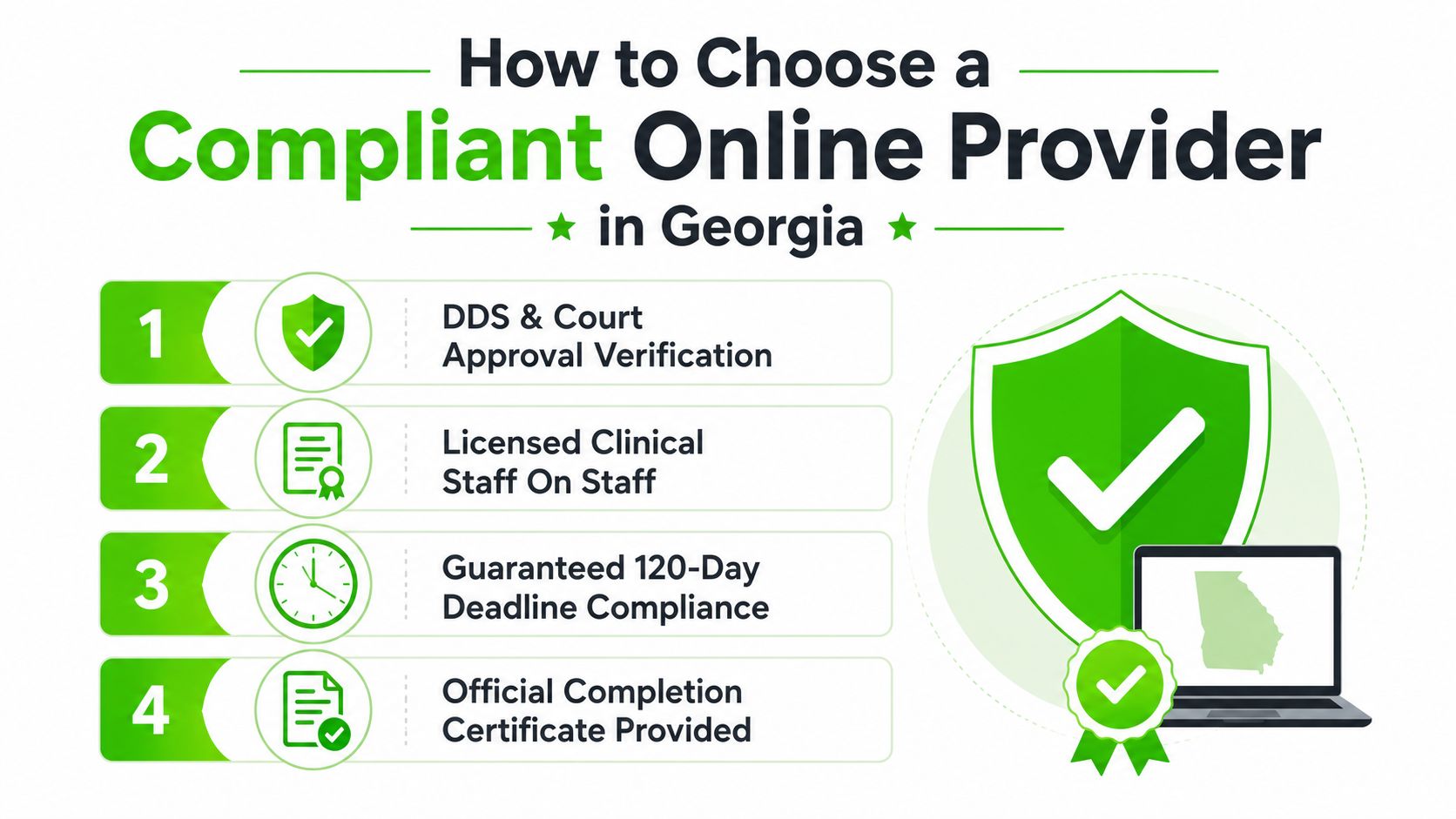
The safest choice is usually the one that can move from screen to signed report without confusion. If your case involves an Atlanta court, an Athens probation office, or DDS reinstatement paperwork, that continuity matters more than a slick landing page.
Cost, Documentation, and What to Expect After You Finish
Price matters, but only if the document works for the case. A cheap screen that doesn't satisfy DDS is not a bargain. A proper evaluation with a signed report is the thing really needed, because that's what gets attached to the file and sent to the right person.
Georgia DUI Schools lists its online drug and alcohol evaluation cost on its own site, and that kind of pricing usually reflects the difference between a brief screening component and a full clinical evaluation service (drug and alcohol evaluation cost). The important point is to compare what's included, not just the sticker price.
After you finish, you should leave with a written evaluation, an ASAM Level recommendation if one applies, and a completion certificate that can go to the attorney, probation officer, or DDS. If treatment is recommended, the report should also support the next step instead of leaving you to guess.
The practical sequence after assessment often includes the Risk Reduction Program and, when ordered, a Victim Impact Panel. If the evaluator says you need more than education, the court will usually want that addressed before it considers the case fully satisfied. The sooner the paperwork is clear, the less likely you are to get stuck waiting on a missing signature.
Georgia DUI Assessment Questions Answered
If your DUI arrest was recent, the first deadline to watch is the one attached to the clinical evaluation and any required treatment paperwork. Don't assume an online screen alone protects you. It can start the process, but it usually doesn't replace the signed evaluation DDS or the court expects.
If a judge asks for more than a screen, the answer is a formal evaluation with a credentialed clinician. A judge may accept a remote process if the report is complete and signed, but the judge still wants the right document, not just a quiz result. When the evaluation points to a higher ASAM level than the Risk Reduction Program, follow the recommendation, because that's the step that fits the risk pattern.
A Victim Impact Panel is separate from the assessment, but the evaluation often helps determine whether that and other DUI requirements must be completed. For readers comparing counseling and court follow-up requirements, the court-ordered counseling guide offers a broader view of how these obligations can fit together.
If you're stuck between a screen, an evaluation, and treatment, book the one that your paperwork names. That's the fastest way to keep a Georgia DUI case moving without creating another round of delays.
Georgia DUI Schools helps drivers work through the assessment side of DUI compliance, from online screening to clinical evaluations and the next required steps. If you need a Georgia-specific path for Risk Reduction, evaluation, or follow-up education, visit Georgia DUI Schools and choose the service that matches your court or DDS paperwork.