A lot of people first hear about telehealth substance abuse treatment in the middle of a stressful Georgia DUI case. Maybe you've got a DDS Risk Reduction notice in one hand, a court date on the calendar, and a clerk or probation officer telling you that you also need a clinical evaluation. If that's your situation, telehealth can feel vague at first, but it usually means something simple, a licensed professional meeting with you remotely to evaluate, counsel, document progress, and help you meet the treatment steps a Georgia court or DDS-related process may require.
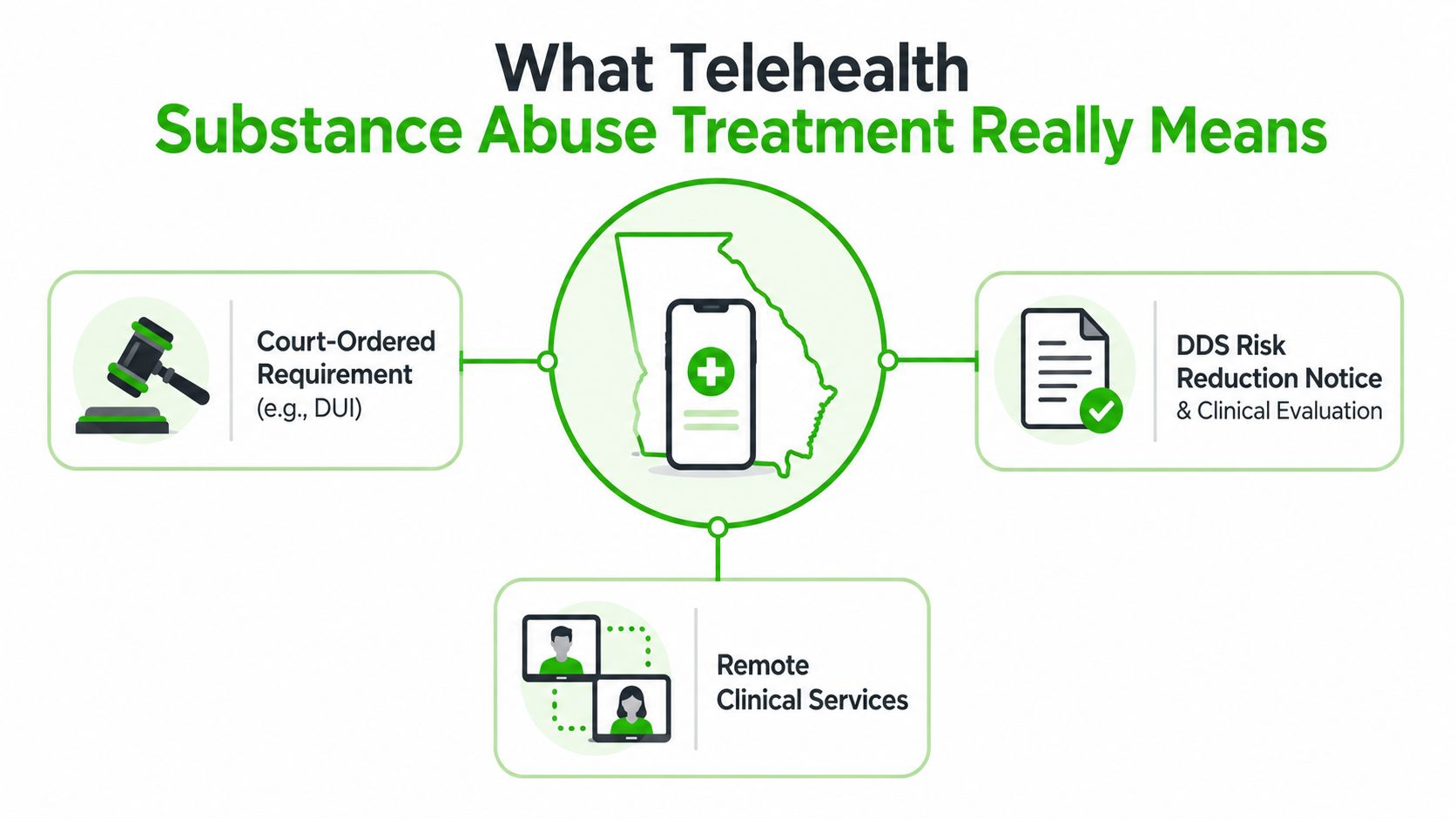
What Telehealth Substance Abuse Treatment Really Means
In plain English, telehealth substance abuse treatment means you get some or all of your counseling and assessment services by phone, video, or secure web tools instead of sitting in an office every time. For a Georgia driver, that matters because the treatment path can involve more than one piece, a clinical evaluation, possible ASAM Level 1 outpatient treatment, the 20-hour Risk Reduction Program, and sometimes a Victim Impact Panel. Telehealth can fit into that workflow without changing the basic clinical purpose.
The four common channels
The clinical world doesn't use one single telehealth format. In SUD care, common modes include web-based assessments, telephone-based recovery support, telephone-based therapy, and video-based therapy. In practice, that means the clinician may ask intake questions over a web form, meet with you on video for counseling, check in by phone between sessions, or send asynchronous recovery support materials you can review on your own time.
That's why a telehealth appointment can look different depending on the task. A screening might happen by phone, while a regular outpatient session might happen on video. In a Georgia DUI case, that flexibility can help a client keep up with court deadlines without losing the structure a judge or evaluator expects.
Practical rule: telehealth is not one product, it's a set of remote clinical tools that can support assessment, treatment, and follow-up.
If you're comparing options and you're also trying to find a therapist in another city while you're traveling, a local resource like finding a therapist in Vernon can help you understand how remote counseling is described in a normal outpatient setting.
How it fits the Georgia pathway
For most court-ordered clients, the primary question isn't whether telehealth sounds modern. It's whether the service is structured enough to satisfy the required paperwork and treatment plan. A compliant path usually starts with the evaluation, moves into the recommended level of care, and ends with documentation that shows attendance, progress, and completion.
That's the framework courts and DDS-related processes care about. The rest of this guide looks at whether telehealth does that job well, where Georgia rules still matter, and what your first session looks like. If you're new to the process, a court-related online substance abuse evaluation page can also help you visualize the setup before you sit down for your own appointment.
How Effective Telehealth Substance Abuse Treatment Is
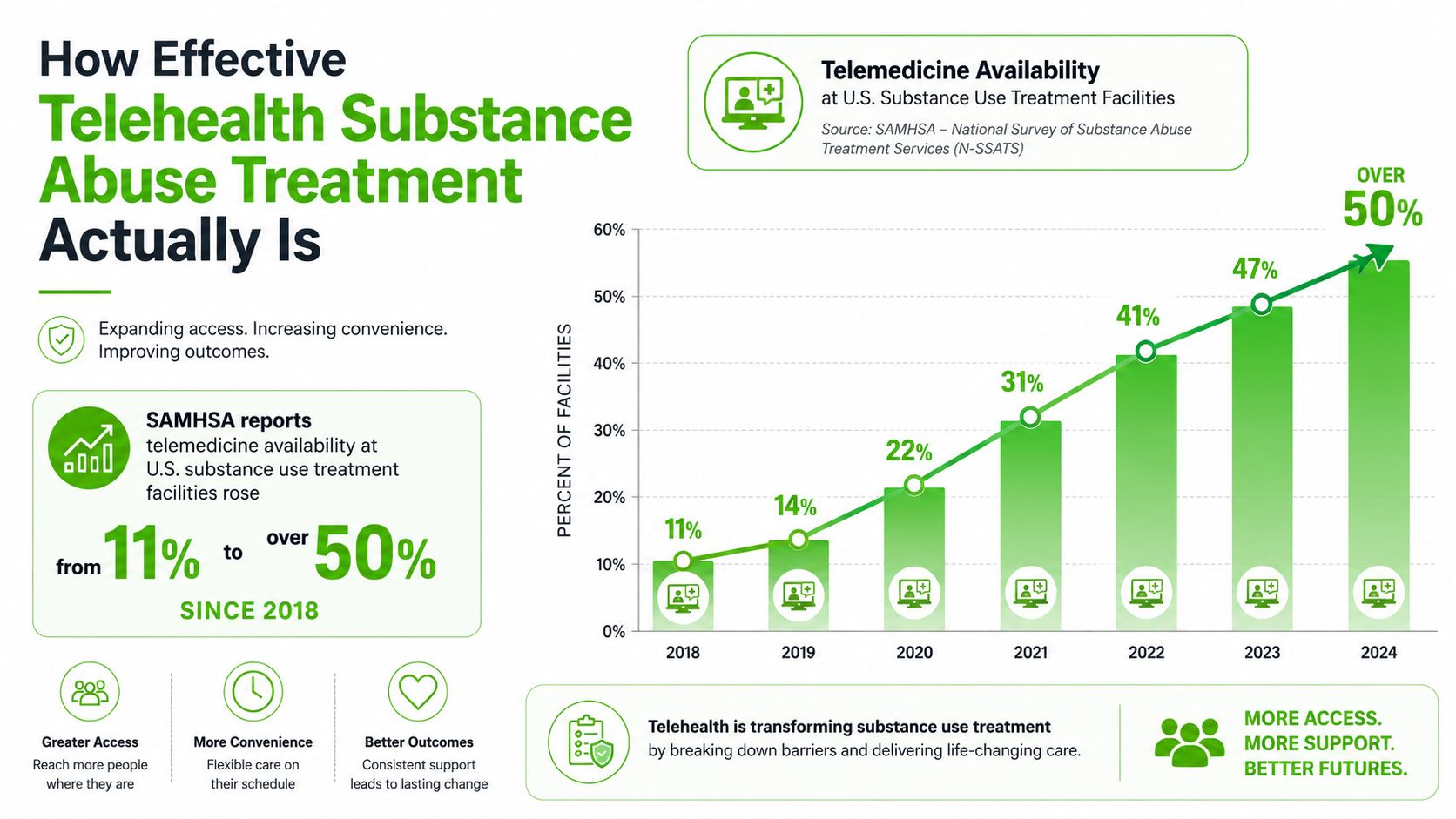
A Georgia client sitting in front of a laptop often wants one plain answer, can this count and can it help. The best place to start is with what changed once clinics began offering telemedicine more broadly. SAMHSA data show that the share of U.S. substance use treatment facilities offering telemedicine services rose from 25.7% in 2015 to 58.6% in 2020, with a sharp jump from 27.5% in 2019 to 58.6% in 2020. Mental health facilities moved too, from 22.2% in 2015 to 68.7% in 2020, which shows telehealth became part of mainstream behavioral health care instead of a side option. Those figures come from SAMHSA's telemedicine services report, which tracked the shift across the system (SAMHSA telemedicine services report).
What “as effective as in-person” means
The strongest evidence does not say telehealth is magic. It says it can do the core clinical job. A 2024 review found telemedicine-delivered substance use disorder treatment was as effective as in-person care for reducing substance use and retaining patients, and one included study reported 55% retention at 3 months (2024 review). A separate systematic review of 13 studies, including 7 randomized controlled trials, found no study reporting significantly worse substance use outcomes for telehealth compared with in-person treatment, and two studies reported better retention with telehealth (systematic review).
That matters because retention is often the first place people struggle. If a client stops showing up, even solid clinical guidance cannot help much. Telehealth can make attendance easier, especially for people balancing work, child care, transportation problems, or a license suspension. For someone trying to keep a Georgia court, probation officer, or hearing officer satisfied, the question is less about whether the care feels high-tech and more about whether it keeps the person engaged and documented.
The access gap is still real. The 2024 review noted that only 1 in 10 people with a substance use disorder receive evidence-based treatment, and about 35% of people with opioid use disorder receive any substance use treatment. Telehealth is one reason more people can reach care at all.
Usage has grown, but it is still not universal
SAMHSA's 2024 NSDUH gives a useful reality check. 1.3% of people age 12 or older, about 3.6 million people, received substance use treatment via telehealth in the past year, and 5.4% of people with a past-year substance use disorder, about 2.6 million people, got treatment via telehealth (SAMHSA 2024 NSDUH). That shows telehealth is real and used at scale, but it is still only one part of the treatment picture.
For a Georgia client, that should land as good news with a caveat. Telehealth can work well, but only if the provider uses it for the right task, documents it properly, and matches the level of care to the person sitting on the other side of the screen. If you want to see how that documentation piece shows up in a real court-ordered process, a Georgia DUI evaluation resource can help you understand the kind of paperwork people are usually trying to satisfy.
Telehealth vs In-Person Treatment for Georgia DUI Clients
For a Georgia DUI client, the comparison isn't abstract. It's whether you can get the evaluation done, keep up with treatment, and turn in the paperwork the court or DDS-related process expects. Telehealth usually wins on convenience, but in-person care still has a place when the case calls for more structure or closer supervision.
Where telehealth helps most
Telehealth is often easier to schedule if you work shifts, live far from Atlanta, Macon, Columbus, Savannah, or a smaller town with limited providers, or just can't miss much time from work. It also gives some privacy for people who don't want to sit in a waiting room where neighbors might recognize them.
That said, privacy only works if you can create it. A session from your parked car outside a store is still risky if the clinician can't hear you well or if someone can overhear your answers. In small-town Georgia, that practical detail matters as much as the technology.
Where in-person still holds an edge
In-person treatment can feel more structured for people who need stronger accountability. Some clients do better when they physically show up, hand over a screening sample, and meet a counselor face to face. If the case involves a higher acuity problem, telehealth may be part of the plan, but it shouldn't be used to water down the level of care.
A nationwide claims study found telehealth SUD treatment reduced rural-urban utilization disparities, but Medicaid-covered patients were still underrepresented in telehealth SUD care (nationwide claims study). Recent review work also found lower telehealth utilization among rural, older, and Black/African American populations, while some disadvantaged groups remain understudied (review brief). That means telehealth can open doors without automatically closing every gap.
Telehealth can get a client into care faster. It doesn't automatically solve transportation, payer, or trust barriers.
A Georgia rule of thumb
For ASAM Level 1 outpatient treatment tied to a Georgia Risk Reduction requirement, telehealth is usually a legitimate delivery channel when the provider documents it correctly and the court accepts it. For higher levels of care, or for someone who needs closer monitoring, in-person is still the safer default. If you're comparing local workflow options, this Georgia court-ordered evaluation page is a useful reference point for how evaluations are typically organized.
How Telehealth Fits Into ASAM Level 1 Care in Georgia
ASAM Level 1 is the outpatient level most Georgia DUI clients hear about first. It's the kind of care that fits people who need counseling, structure, and follow-through, but not round-the-clock supervision. Telehealth can deliver that kind of care when the provider keeps the plan organized and the documentation clean.
What the work usually looks like
A Level 1 plan often includes individual counseling, group sessions, recovery support, random screening, and progress notes. The important point is that the clinical content matters more than whether every contact happens in person. A video group can count as therapy time, a phone check-in can support recovery, and the provider can still document goals and attendance.
Short version: Level 1 is defined by clinical judgment, service content, and schedule, not by whether the client is sitting in a waiting room.
Some parts still work better face to face. An observed urine screen, for example, usually needs an in-person process. A group session might also stay in person if the provider believes the client needs stronger structure, but many routine outpatient contacts can happen by video or phone.
A simple hybrid schedule
| Service | Common Telehealth Channel | Typical Frequency |
|---|---|---|
| Individual counseling | Video | Weekly or as scheduled |
| Group treatment | Video or in person | Weekly or as scheduled |
| Recovery check-ins | Phone | Between sessions |
| Screening and testing | In person | As required by the provider |
| Progress review | Video or phone | Periodic |
That kind of hybrid structure is normal because telehealth is a tool, not a separate diagnosis. If a provider tries to sell you on a one-size-fits-all remote package without considering the evaluation results, that's a warning sign.
A good question to ask is simple. “Does this plan match my evaluation, my court order, and the treatment level I need?” If the answer is fuzzy, the plan probably is too. For a Georgia-specific treatment reference, the ASAM Level 1 treatment page can help you see how outpatient care is typically packaged.
Georgia Rules for Telehealth Substance Abuse Treatment
Georgia clients need more than a flexible platform. They need a provider who understands licensing, documentation, and what a judge or DDS hearing officer may ask for. Telehealth can fit into that world, but only when the clinician works inside the right legal and professional boundaries.
Who can provide it and what must be documented
In Georgia, telehealth SUD services should come from appropriately licensed clinicians working within their scope of practice. That usually means the provider can explain their Georgia license, the board that regulates it, and how they handle telehealth consent, privacy, and records. For court-related cases, the paper trail matters just as much as the session itself.
A compliant file usually includes a signed clinical evaluation, attendance and progress notes, a treatment plan, a discharge summary, and any drug-screen results. A Georgia DUI Risk Reduction completion certificate is separate from the clinical evaluation, and courts or DDS-related processes may want both files kept distinct.
Prescribing and controlled substances
If addiction medicine is part of the conversation, federal telemedicine rules also come into play. The Ryan Haight Act framework and the current federal telemedicine prescribing rules affect how controlled medications are prescribed, so a clinician can't just treat telehealth like a casual video chat. Georgia rules still apply, and medication decisions have to fit the prescriber's authority and the patient's clinical needs.
What to verify before you start
- License and board: Ask which Georgia board regulates the clinician and how telehealth is handled under that license.
- Documentation path: Confirm the provider will send records to the court, probation officer, or DDS contact when required.
- Evaluation format: Ask whether the court or hearing officer accepts a telehealth clinical evaluation for your case.
- Paper separation: Keep the Risk Reduction certificate and the clinical evaluation in different places, because they serve different functions.
- Acceptance check: Some Georgia courts accept telehealth for treatment but not for every step of the evaluation process.
That last point is the one people miss. A provider may be clinically sound and still not meet the exact rule in your county or courtroom. Always confirm with the specific judge, probation officer, or DDS contact before you start, especially if the order is narrow or written in exact terms.
What to Expect From Your First Telehealth Session
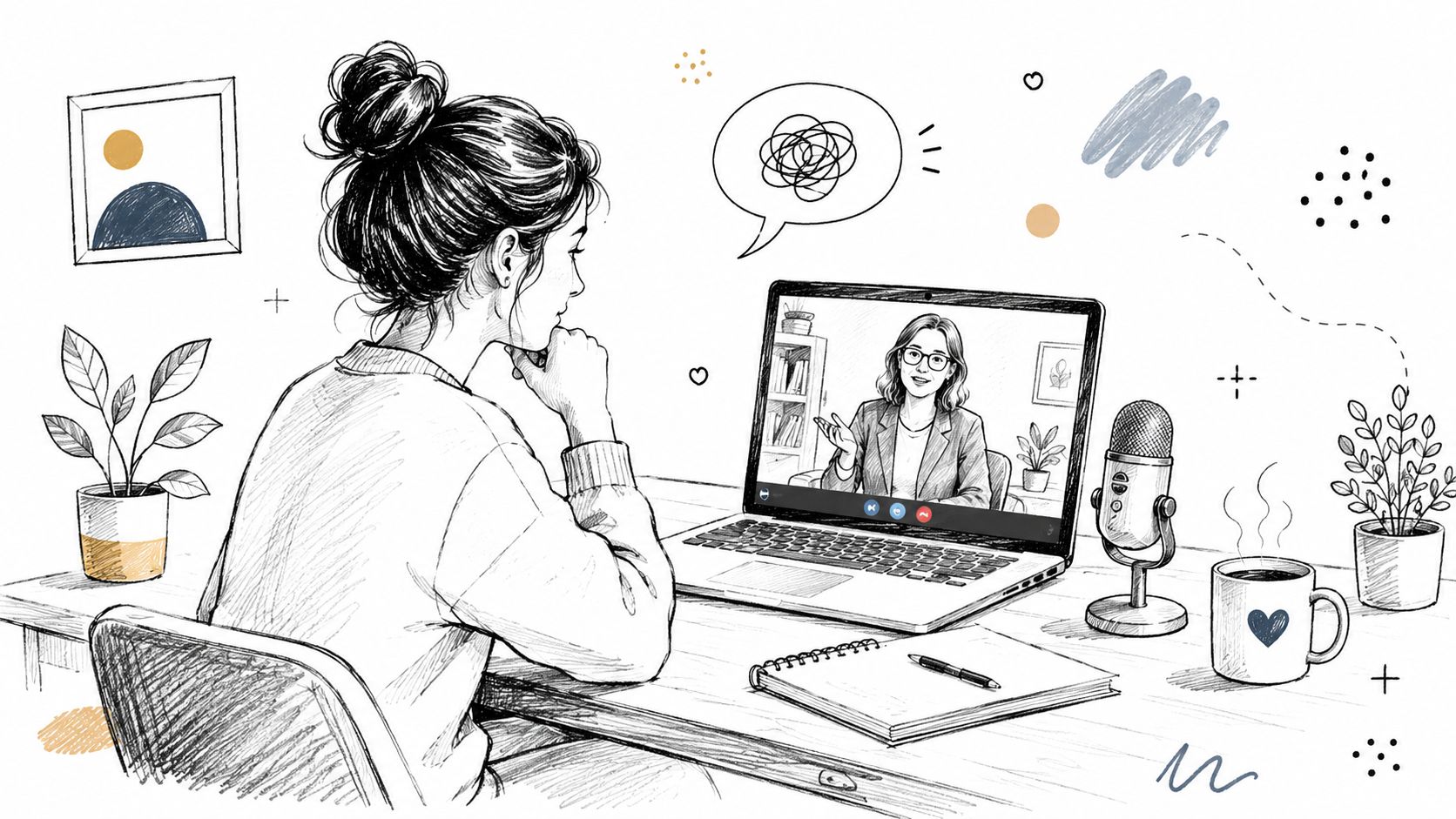
A first telehealth session usually feels more structured than stressful. You log in, confirm who you are, answer direct questions, and leave with a plan the clinician can document for treatment, court, or DDS review. The provider is not trying to trap you in legal language, they are trying to decide what level of help fits your situation and whether the paperwork will stand up where it needs to.
Before the appointment
Most clinics ask you to prepare the same way you would for a court call. You need a device with a camera and microphone, a private space, and a backup phone number in case the connection fails. Providers also send consent forms, telehealth privacy disclosures, and a release that lets them share records with the court or DDS-related contacts when that is required.
Identity checks are routine. A clinician may ask to see a government ID on camera, and some offices use an extra verification step before the session starts.
If you want a plain-language example of how a remote psychiatric appointment is usually introduced, the Refresh Psychiatry & Therapy online visit gives a useful picture of the first conversation.
During the session
The clinician usually starts with your substance use history, mental health history, medical background, work schedule, and legal situation. They may ask about the DUI date, any prior treatment, and what support you already have in place. From there, they build a treatment plan with the recommended frequency, goals, and next steps.
For Georgia clients, this part is where clarity matters. A telehealth evaluation or treatment visit has to generate the kind of documentation a judge, probation officer, or hearing officer can use, so the conversation is clinical and practical at the same time. If your case is tied to an online substance abuse evaluation in Georgia, the provider should be able to explain how that evaluation fits your order and what records can be shared.
If the internet drops, stay calm and tell the provider right away. Most clinics have a backup method, often a phone call or a quick reconnect, and they may ask you to note when the interruption happened. That keeps the record clean if anyone later reviews why the session ended early or restarted.
After the session
Good telehealth documentation is specific. The provider should record attendance, what was discussed, the level of care recommended, and the next appointment or follow-up plan. If you need those records for court, ask how they will be sent and whether you can keep a copy for your own file.
That is usually the point where people realize telehealth is not casual or vague. It works more like a charted office visit, only the office is online, and the paper trail still has to make sense to the person reviewing your case.
Choosing a Compliant Telehealth Provider in Georgia
A good provider makes the process easier, but a compliant provider protects your case. That's the difference between a session that helps and a session that leaves you scrambling for paperwork later. For a DUI client, the best choice is the one that can meet the clinical need and satisfy the court's expectations.
What to look for
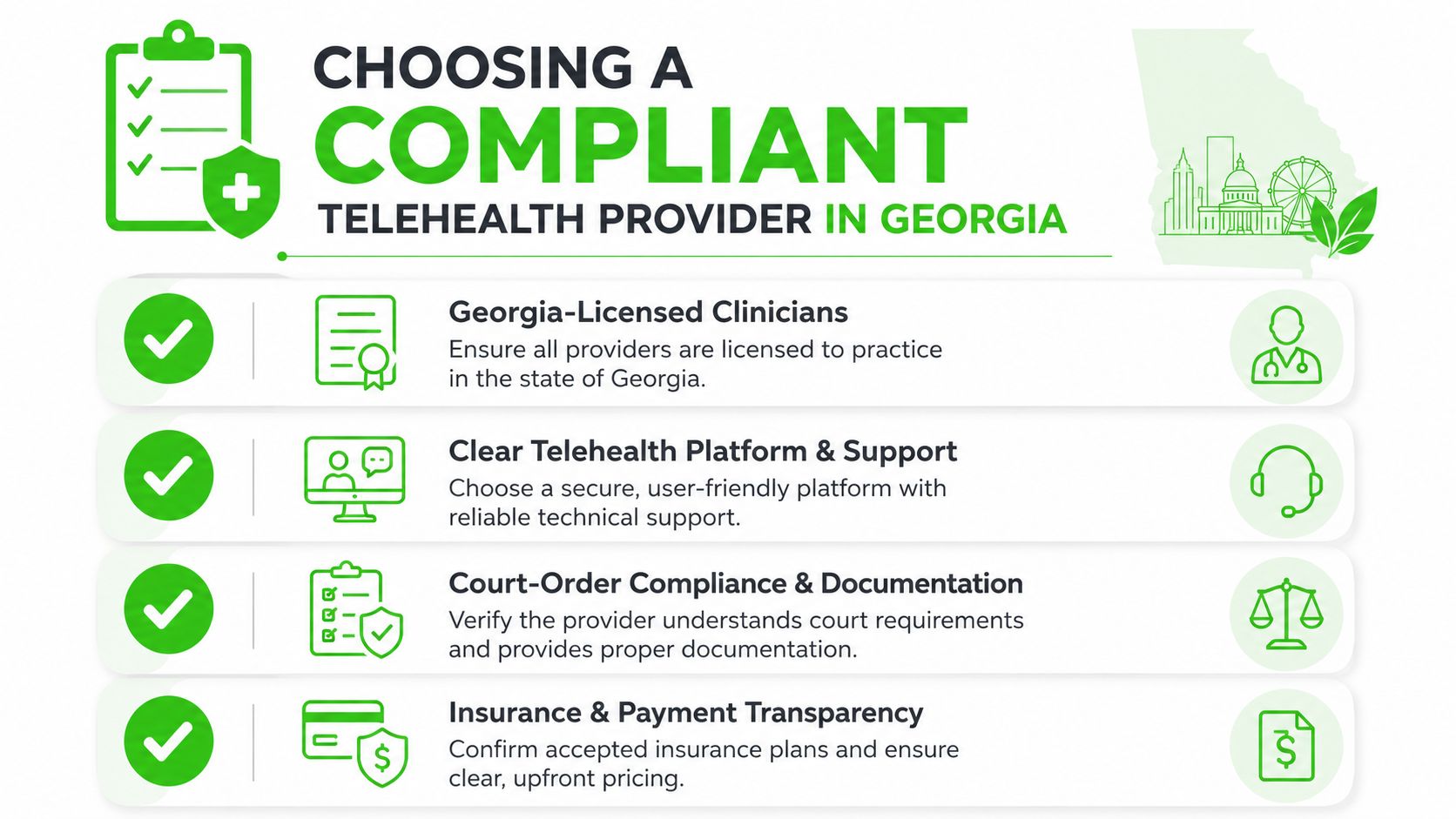
Start with the basics. The clinician should be Georgia-licensed, clear about the telehealth platform, and willing to explain how the evaluation, treatment notes, and discharge summary will be handled. They should also know whether they can provide ASAM Level 1 treatment if that's what the evaluation recommends.
You also want transparency. Ask about fees, session structure, and whether there's a long contract you can't get out of. A clear provider can explain the process without talking in circles.
If a provider can't explain how your records move from intake to court paperwork, keep shopping.
Red flags to avoid
- Vague licensing answers: If they can't name the Georgia board that regulates them, pause.
- Outcome promises: No honest clinician can guarantee what a court will do with your evaluation.
- Documentation reluctance: If they won't send records directly when required, that's a problem.
- Level mismatch: A provider pushing residential treatment when your evaluation points to outpatient care may not be the right fit.
- No clear telehealth process: Secure video, consent, and privacy should be basic, not improvised.
For a local reference point, Georgia DUI Schools offers risk reduction education, clinical evaluations, ASAM Level 1 treatment, Victim Impact Panels, and defensive driving options that can help tie the clinical side back to the DDS and court side of the process. If you're comparing online evaluation options, this online substance abuse evaluation page is a practical place to look at what a compliant workflow can include.
Common Questions and Your Next Step in Georgia
Can a Georgia court accept a telehealth clinical evaluation? Sometimes yes, sometimes no. The answer depends on the wording of the order, the county, and who is reviewing the paperwork, so it's smart to confirm before you book.
Does telehealth count toward Risk Reduction? The Risk Reduction course and a clinical evaluation are different requirements, so telehealth treatment doesn't replace the course itself. It may fit the treatment side of the case if the court or evaluator accepts it, but the DDS-related education requirement still stands on its own.
What if I travel across state lines? Tell the provider before the appointment. Licensing, documentation, and where you're physically located can all matter, especially if the session involves counseling or medication decisions.
What if my judge wants in-person services? Then in-person is the safer path, and you should follow the order exactly. A telehealth option is only useful if it matches the legal requirement, not if it creates a dispute later.
If you want a broader directory for browse substance abuse treatment options, that can help you compare formats before you commit.
Georgia DUI Schools can help you line up the pieces that usually trip people up, including Risk Reduction, clinical evaluations, Victim Impact Panels, defensive driving, and ASAM Level 1 treatment. If you need a Georgia-based path that fits court and DDS deadlines, visit Georgia DUI Schools to see the course and evaluation options that match your situation.