
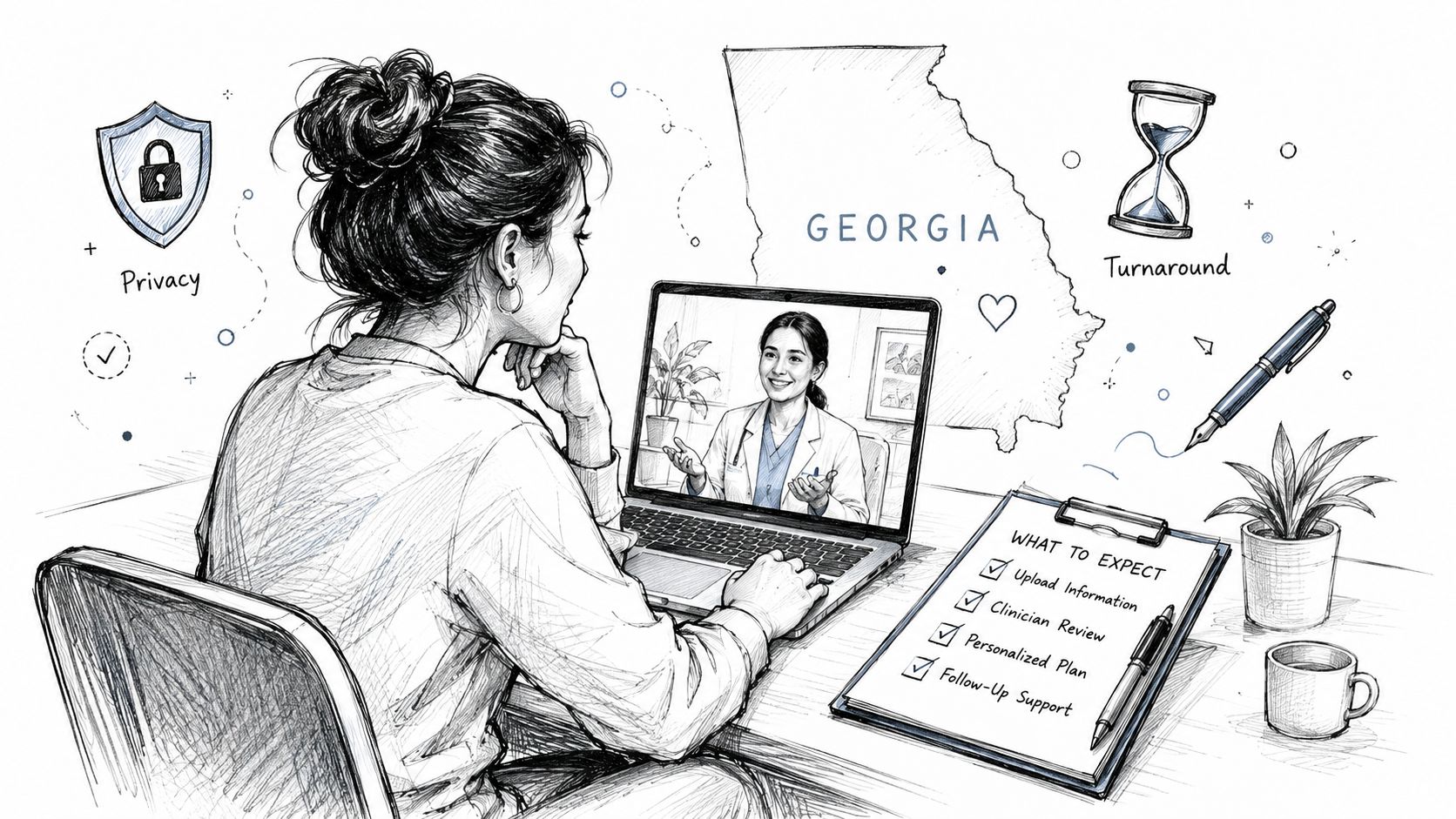
Needing a substance abuse evaluation online in Georgia often means you are under pressure. A court date is coming up, probation gave you a deadline, or DDS requirements are standing between you and your license. The biggest mistake people make at this point is assuming any online evaluator will work.
In Georgia, details matter. The format matters. The provider matters. The paperwork matters. If the evaluation doesn't match what the court, probation officer, or Georgia Department of Driver Services expects, you can lose time and end up paying for the process twice.
The good news is that online evaluations can be legitimate and useful when they're handled correctly. Telehealth has expanded access, especially for people in rural areas, people without transportation, and people trying to fit a legal requirement around work or family obligations. But Georgia has its own rules, and those rules are what decide whether your evaluation helps you move forward or creates another problem.
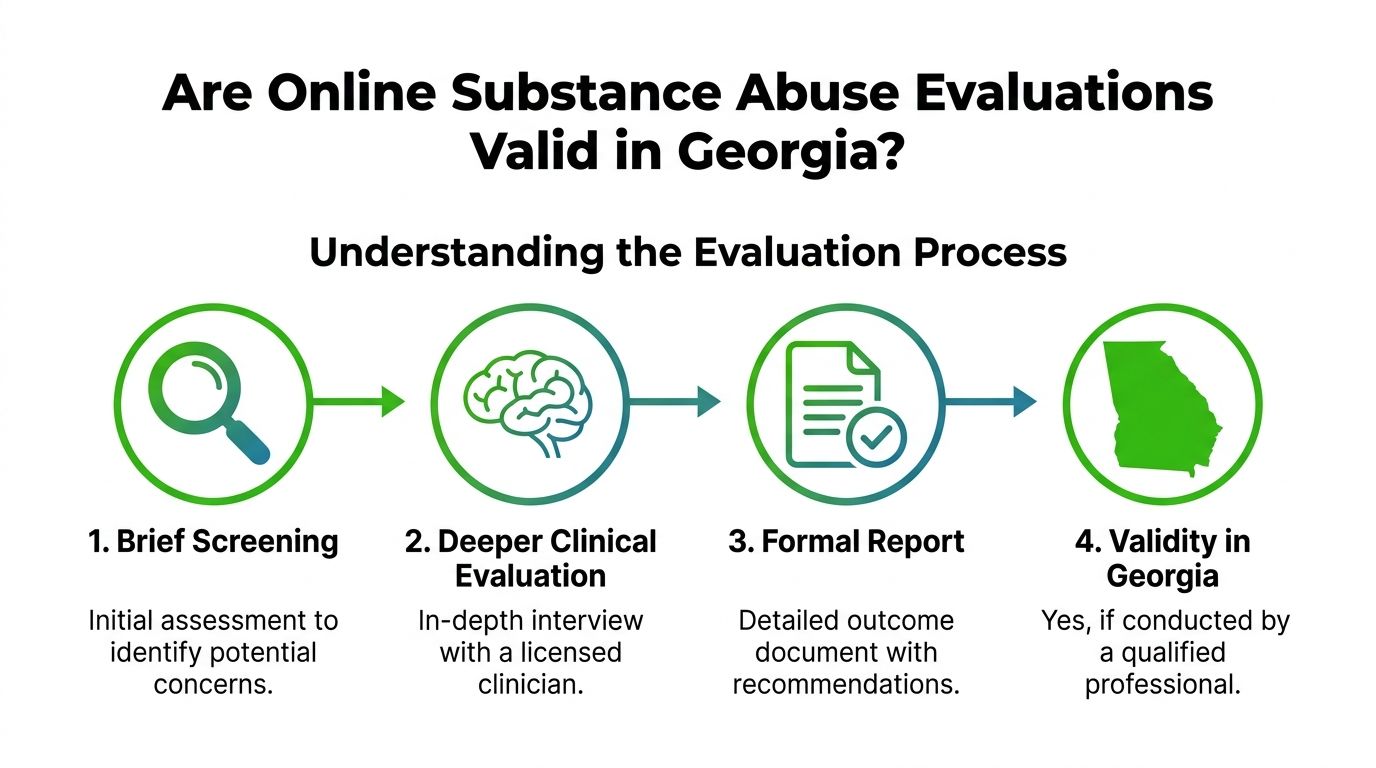
Are Online Substance Abuse Evaluations Valid in Georgia?
A clinical substance abuse evaluation isn't just a form you fill out. It has two parts. First comes a brief screening to flag possible alcohol or drug concerns. Then comes a deeper assessment, which looks at your use history, legal background, functioning, and whether treatment or education is recommended.
Nationally, online access has become part of the behavioral health system because demand is large. As of 2023, approximately 47.7 million Americans aged 12 and older were current illegal drug users, and 11% of U.S. adults had used online technology to address alcohol or drug problems, according to drug use and online treatment data. That helps explain why more people are looking for a substance abuse evaluation online instead of waiting for an in-person appointment.
What Georgia actually accepts
Yes, online evaluations can be valid in Georgia. But that answer has conditions attached.
For court, probation, DUI, or license reinstatement issues, the question isn't whether an evaluation happened on video. The question is whether the provider and process meet the legal standard attached to your case. Federal telehealth guidance often improves access, especially in rural treatment settings, but Georgia clients still run into a common problem. Court-accepted evaluations often require DDS-approved providers, not just a website offering assessments. That issue is discussed in federal telehealth guidance on mental health and substance use disorder access.
Practical rule: If the evaluation is tied to a DUI, probation, license reinstatement, or court order, don't book the first online service you find. Confirm acceptance before you pay.
A lot of national articles blur the line between an online screening tool and a court-ready clinical evaluation. Georgia doesn't treat those as the same thing. A self-paced questionnaire may be useful as a first step, but that alone usually won't satisfy a judge, probation officer, or DDS requirement.
The safe way to check before you schedule
Use a simple filter before you book:
- Ask who will perform it. You want a licensed clinician who handles court-related substance use evaluations.
- Ask whether the report is used for Georgia DUI or DDS matters. If the provider sounds vague, keep looking.
- Ask about telehealth format. Real-time video is very different from a self-guided online form.
- Ask whether additional in-person steps may still be required. Some cases involve testing, collateral verification, or local court conditions.
If you want a plain-language explanation of how these reports work, this guide on what a drug and alcohol evaluation is is a useful place to start.
What doesn't work well
The biggest failure point is convenience without compliance. A client sees "same-day online evaluation," pays quickly, completes a form, and gets a document that looks official. Then probation rejects it because the evaluator wasn't appropriate for the case, identity wasn't verified properly, or the format didn't meet local expectations.
That situation is avoidable. In Georgia, a valid online evaluation is less about speed and more about fit. If the service understands Georgia court and DDS requirements, telehealth can work well. If it doesn't, the low price and fast turnaround won't help you.
Preparing for Your Georgia Online Clinical Evaluation
People do better in these appointments when they prepare like they're going to court, not like they're joining a casual video call. The evaluator needs enough accurate information to write a report that makes sense to the party who ordered it. Missing documents lead to follow-up calls, corrections, and delays.
Start with identification and case paperwork. Have your government-issued photo ID ready before the session begins. If your matter involves DUI, probation, or a pending criminal case, gather every document you have, including the court order, referral sheet, probation instructions, and any paperwork showing deadlines or case numbers.
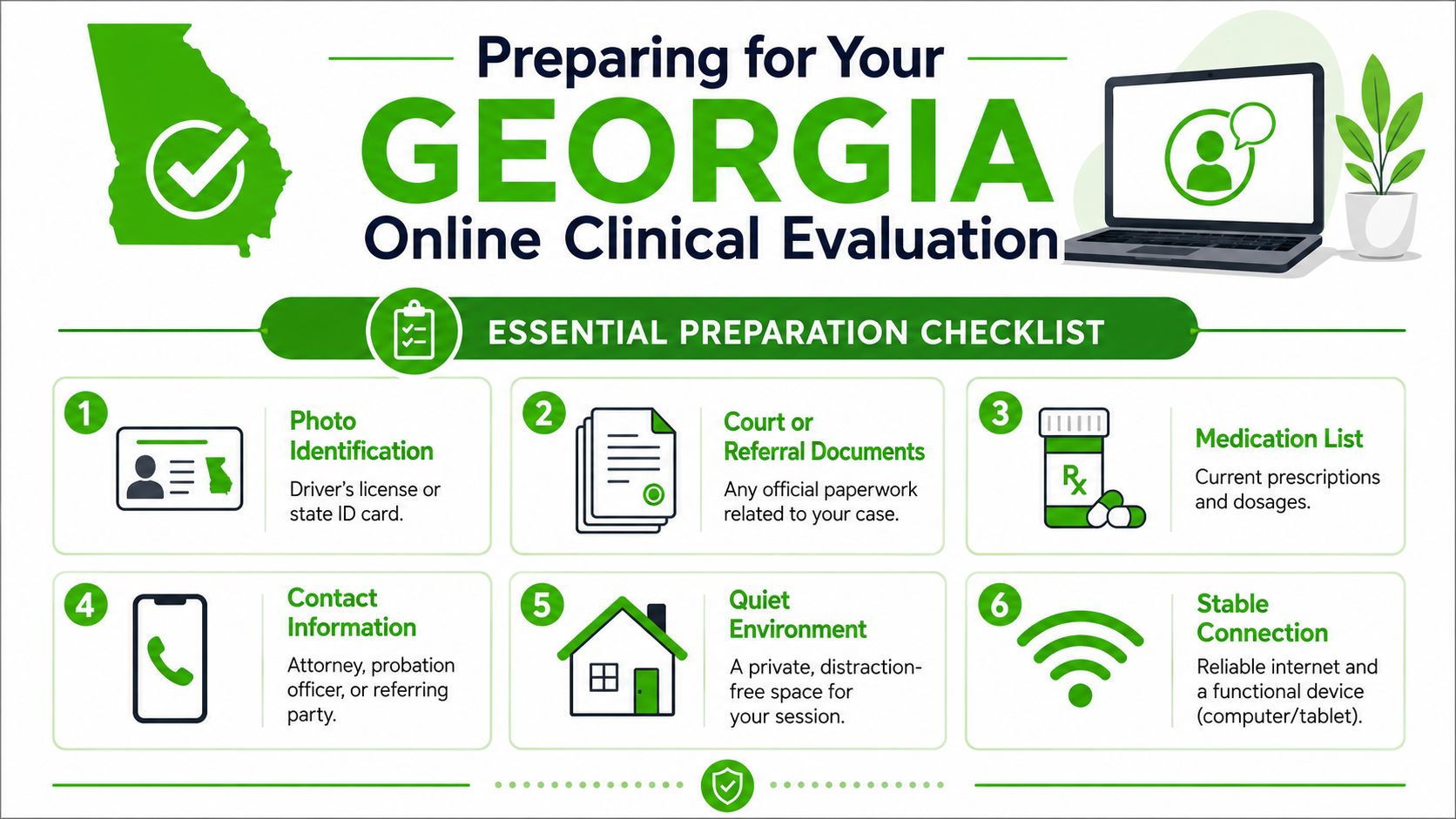
What to gather before the appointment
Bring more than the minimum. The strongest evaluations are based on records, not just memory.
- Photo ID: Driver's license, state ID, or another government-issued document used to verify identity.
- Court paperwork: Orders, probation instructions, bond conditions, referral letters, or attorney notes.
- Arrest documents: If you have the citation, incident report, or officer narrative, keep it nearby.
- DDS information: Your Georgia driving history can help clarify what requirement you're trying to satisfy.
- Medication list: Include current prescriptions and basic treatment history if relevant.
- Contacts: Attorney, probation officer, case manager, or referral source names and numbers.
Bring the paperwork even if you think the evaluator already has it. In Georgia cases, one missing page can change the recommendation path or delay the report.
Set up the call like it matters
The technology side is simple, but it still causes preventable problems. Use a private room where nobody else can hear you. Don't take the session from a parked car unless the provider specifically says that's acceptable. Courts and clinicians take privacy seriously, and your answers are usually more accurate when you aren't worried about who may be listening.
Use a device with a working camera and microphone. Log in early enough to test both. If you have weak internet at home, borrow a better connection before the appointment rather than risking a dropped session halfway through a sensitive interview.
A few practical habits help:
- Charge your device fully or keep it plugged in.
- Close other apps that may interfere with audio or video.
- Keep documents beside you so you aren't leaving the screen to search for them.
- Silence notifications to avoid interruptions during questions about your history.
How to avoid the most common self-inflicted delays
An online evaluation goes smoother when your answers are consistent and your records match what you say. That doesn't mean your life has to look perfect. It means dates, charges, prior treatment, and current requirements should be as accurate as possible.
If you're worried about what the evaluator is looking for, this article on how to pass a drug and alcohol evaluation gives practical guidance. The short version is simple. Don't try to sound good. Try to be clear, honest, and prepared.
Financial questions also come up often. Court-related evaluations are commonly handled outside normal medical insurance structures, so ask about payment terms before the appointment. If cost is a concern, ask whether the provider offers staged payment or scheduling options. It's better to ask directly than to miss an appointment because you assumed something would be covered.
What to Expect During Your Telehealth Evaluation
Individuals often relax once the call starts, because the process is more structured and less confrontational than they expected. A proper telehealth evaluation feels like a clinical interview, not an interrogation. The clinician's job is to gather enough information to make a supportable recommendation.
How the appointment usually starts
The first few minutes are administrative. The clinician verifies your identity, confirms why you were referred, and checks whether the evaluation is for court, probation, personal use, or a Georgia DUI-related requirement. That matters because the report has to answer a different question depending on who asked for it.
After that, expect a formal screening process. In Georgia DUI cases, one required part of the process is the 130-question NEEDS Assessment, which must be completed before the 20-hour Intervention Component. Georgia DDS states this clearly in its DUI FAQs on the NEEDS Assessment and Intervention Component.
What the clinician asks about
The interview itself usually moves through a few predictable areas. One person may spend more time discussing alcohol patterns. Another may spend more time on legal history, prescription medication use, or prior treatment.
You should expect questions about:
- Substance use history: What you used, how often, when it started, and whether patterns changed over time.
- The incident itself: DUI arrest, drug possession, underage alcohol offense, or another referral reason.
- Daily life impact: Work attendance, school performance, family conflict, finances, and driving behavior.
- Mental health: Anxiety, depression, trauma history, sleep, and any counseling or psychiatric treatment.
- Past services: Prior education classes, counseling, rehab, detox, or support groups.
- Legal background: Prior charges, probation history, compliance issues, and open cases.
Honesty helps more than image management. An evaluator can work with a complicated history. It's much harder to work with an incomplete one.
What the session feels like
A lot of clients expect trick questions. That's usually not what happens. The clinician is looking for patterns, severity, risk, and whether your current requirement points toward education, outpatient treatment, or something more intensive.
Some online evaluations follow a two-phase pattern used in broader clinical practice. They start with validated tools such as DAST-10 or AUDIT, then move into a longer interview. One description of the process notes a 30 to 60 minute clinical interview, a total process of about 2 hours, and a written report within 5 days, while also stressing the need for identity verification, secure video, and drug testing procedures in legally sensitive cases. That framework is outlined in this overview of what to expect in a substance abuse evaluation.
The best way to approach the call is to answer directly, ask for clarification when you don't understand a question, and avoid minimizing obvious facts that appear in your paperwork. The report should reflect your real situation. That's what gives it value.
Understanding Your Evaluation Results and Next Steps
Once the interview is finished, the next question is usually the one people care about most. What happens now?
The result is typically a written clinical report. That report doesn't just summarize what you said. It gives a recommendation tied to the legal or administrative issue behind the referral. In Georgia DUI and DDS cases, the recommendation often affects whether you move into education only, outpatient treatment, or another layer of compliance.

What the report is deciding
For Georgia Risk Reduction matters, the clinical evaluation determines whether someone needs ASAM Level 1 treatment or additional substance abuse treatment based on the initial screening results. Georgia DDS also makes clear that both the Assessment and Intervention components must be completed successfully for the Certificate of Completion to be valid. That's spelled out in the Georgia DDS Risk Reduction Program requirements.
In plain terms, the report is answering questions like these:
| Issue | What the recommendation may address |
|---|---|
| Education only | Whether the person can satisfy the requirement through the Risk Reduction path |
| Outpatient treatment | Whether ASAM Level 1 counseling is needed |
| Additional follow-up | Whether more clinical review, testing, or documentation is necessary |
| Legal compliance | What must be completed before the court, probation office, or DDS will treat the requirement as satisfied |
Common next steps in Georgia cases
A recommendation usually turns into action quickly. In practice, Georgia clients often end up on one of these tracks:
- Risk Reduction enrollment: If your case requires the DUI intervention route, you may need to complete the state-required class component attached to the evaluation process.
- ASAM Level 1 outpatient treatment: This is a common recommendation when the screening and interview show a pattern that goes beyond a one-time education response.
- Victim-focused programming: Some courts add a Victim Impact Panel requirement on top of the basic course structure.
- Ongoing court supervision: Repeat-offender and accountability court cases may involve stricter monitoring and phased treatment expectations.
If your recommendation includes treatment and you're trying to understand how virtual support can fit into recovery, this overview of telepsychiatry for addiction help gives a practical look at how remote psychiatric care can complement counseling and compliance work.
What helps after the report arrives
Read the recommendation carefully before you send it anywhere. Don't assume every court or probation office wants the same thing. Some want the full report. Others want proof of enrollment in the next required program. Your lawyer may also want to review it first.
A few habits keep cases moving:
- Confirm where the report must go. Court clerk, attorney, probation officer, or DDS-related program provider.
- Book the next required service immediately. Waiting is how deadlines get missed.
- Save every completion record. Keep digital and printed copies.
- Ask questions when the wording is unclear. Terms like ASAM Level 1 or intervention component should translate into specific actions.
A recommendation isn't the finish line. It's a roadmap. The case moves forward when you complete the steps attached to that recommendation.
In Georgia, one option that handles the evaluation side as a secure video appointment is Georgia DUI Schools, which offers online drug and alcohol evaluations as part of its broader DUI and clinical services. That's useful when you need the evaluation and the follow-up requirements to line up without unnecessary confusion.
Georgia Online Evaluation FAQs for Court and Probation
The practical questions usually show up after business hours, when you're rereading your paperwork and trying to figure out what counts. These are the questions I hear most often from people dealing with Georgia courts, probation, and DDS-related deadlines.
Will the court accept an online evaluation?
Sometimes yes. Sometimes no. The deciding factor is whether the provider and format match the requirement in your case.
If your court order, attorney, or probation officer wants a specific type of provider, you need to follow that instruction. In Georgia DUI and license matters, state approval and local expectations matter more than whether the session happened online or in person. If nobody can tell you clearly that the evaluation fits your county or DDS requirement, don't assume it will be accepted.
Can I do the whole thing online from start to finish?
Not always. That's one of the biggest misunderstandings people have.
A telehealth evaluation can be a legitimate part of the process, but some cases still require extra steps that aren't purely online. Broader clinical guidance also recognizes that not all evaluations can be completed fully remotely, especially when legal requirements involve drug testing, identity protocols, or court-specific rules. It also distinguishes screening from assessment, noting that deeper assessments may involve interviews, medical history, and biological testing. That distinction is explained in this discussion of where to get a substance abuse evaluation and what it includes.
Is a self-paced online test enough?
No. That's a common trap.
A questionnaire by itself is not the same as a clinical evaluation. Court and probation cases usually require an interview and a written report prepared by a qualified clinician. Georgia clients get in trouble when they buy a cheap online test and assume the printout will carry legal weight.
What if I'm in Cherokee, Gwinnett, Cobb, or another accountability court setting?
Expect more structure, not less. Georgia courts often add requirements beyond the core evaluation and course path.
According to the Georgia-focused DUI guidance linked below, courts frequently assign a MADD Victim Impact Panel, and repeat offenders or people in Accountability Courts in places such as Cherokee, Gwinnett, or Cobb counties may be placed in a Phase system where Phase 1 lasts at least 90 days. That local reality is outlined in Georgia DUI school and court program guidance.
How should I send paperwork to the evaluator or probation office?
Use whatever secure method the provider instructs. That may be a client portal, encrypted email, secure upload, or fax. If you're handling sensitive court and health documents and want a plain explanation of privacy expectations, this guide to HIPAA compliant faxing for healthcare is a helpful reference for understanding why ordinary document handling isn't always enough.
What if my probation officer rejects the report?
Ask why before you panic. Rejections usually happen for one of a few reasons:
- Wrong provider type: The evaluator wasn't acceptable for the legal purpose.
- Missing records: The report didn't address the referral question or lacked key documents.
- Wrong format: The court expected a different process.
- Local rule mismatch: County practice differed from what a general online service assumed.
Get the rejection reason in writing if possible. Then send that information back to the evaluator or schedule a corrected evaluation with a provider who handles Georgia court work regularly.
Will the evaluator tell the court everything I say?
The report is meant to answer the referral question, not publish your whole life story. Still, you should assume the information relevant to the case may appear in the report. That's why honesty matters, but so does clarity. Rambling, exaggerating, and contradicting your records usually create more problems than they solve.
How quickly should I schedule?
As soon as you know you need one. Waiting creates avoidable risk. If your evaluation leads to more steps such as treatment, a Victim Impact Panel, or course enrollment, the timeline expands fast.
What if I don't know exactly what I'm required to complete?
That happens all the time. Court paperwork isn't always written in plain English, and one county may phrase things differently than another. If you're unsure, get the order, referral sheet, or probation instructions in front of you and ask for a direct reading of the requirement.
For a Georgia-specific option focused on this issue, start with a court ordered substance abuse evaluation in Georgia. It gives you a concrete next step when you're trying to sort out whether your requirement is for court, probation, or DDS compliance.
If you need a Georgia-compliant next step, contact Georgia DUI Schools and schedule the course or clinical service that matches your requirement. For most readers dealing with DDS or court issues, the most practical move is to book the specific program tied to your case instead of guessing from the homepage.