
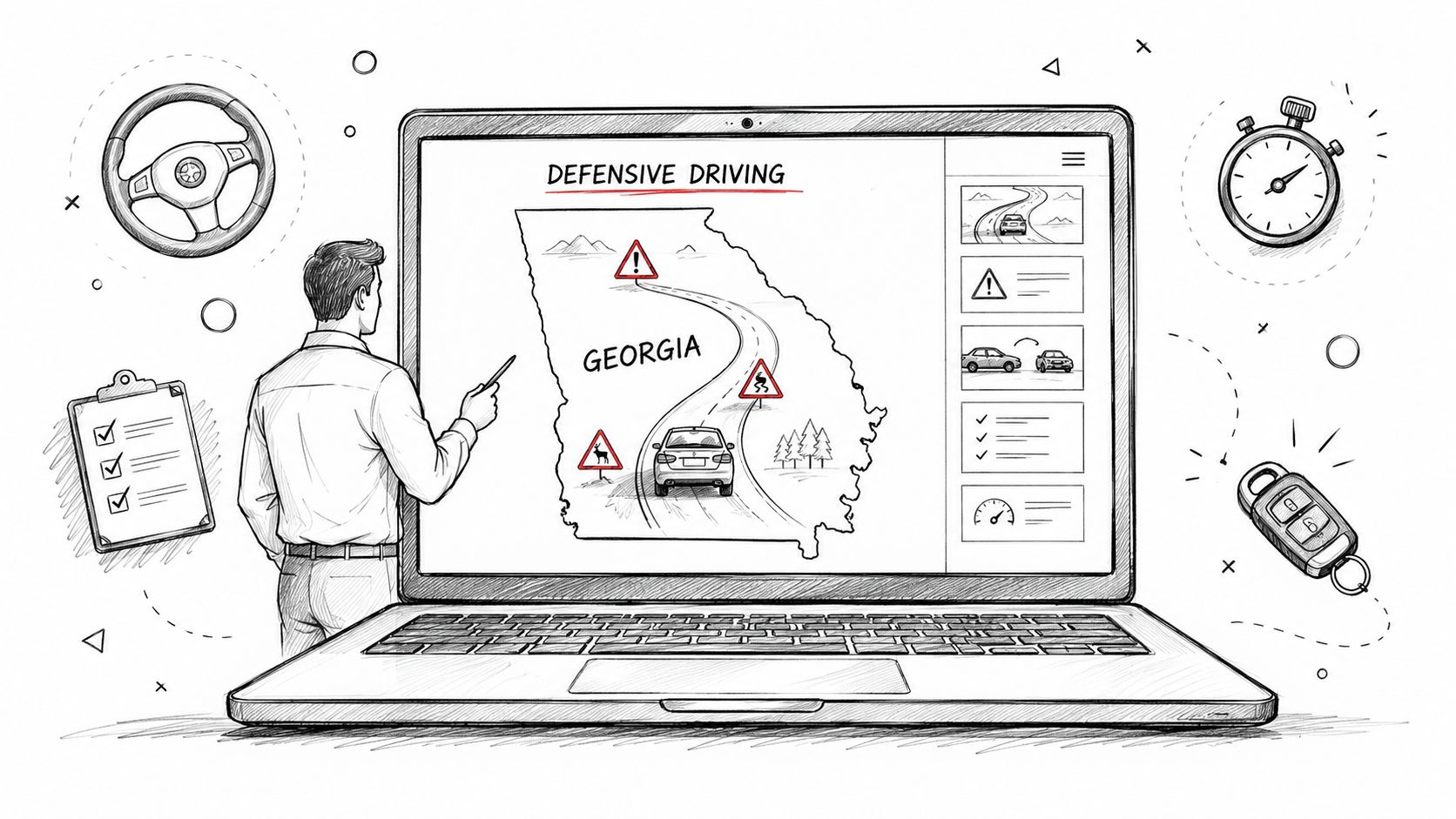
You're probably staring at a blank slide deck right now, with Georgia DDS requirements on one side, court expectations on the other, and a room full of drivers you know will tune out if the presentation feels like a recycled safety lecture. That's the primary challenge with a Defensive Driving PowerPoint in Georgia. It has to be compliant, useful, and strong enough to hold attention for the full class.
A good deck doesn't start with clip art, animations, or a generic “safe driving tips” template. It starts with the course type, the legal purpose, and the behavior you're trying to change. In Georgia, that matters more than most instructors realize, because the 6-hour Defensive Driving course and the 20-hour DUI/Risk Reduction Program serve different legal functions and require different instructional choices.
From Blank Slide to Compliant Course
Most instructors make the same early mistake. They open PowerPoint first and start building slides before they've locked the course objective. That's backwards.
Start with the classroom reality. Are you teaching a Georgia driver who wants point reduction? A court-referred participant with a traffic issue? Or someone dealing with DUI consequences, clinical evaluation questions, or license reinstatement steps? Your presentation changes depending on that answer.
The cleanest way to avoid a scattered deck is to outline before designing. I like to sketch the opening, the legal anchors, the discussion points, and the scenario slides before I build visuals. If you want a practical framework for that process, Encelade's presentation outline advice is useful because it pushes you to organize the flow before you touch formatting.
Practical rule: If your first ten slides could fit in any state, your presentation probably isn't Georgia-compliant yet.
A Georgia-ready defensive driving power point needs local references, plain explanations, and a teaching rhythm that works in a live room. Drivers in Atlanta, Lawrenceville, Marietta, Athens, or on I-285 don't respond to abstract examples. They respond to situations they encounter, like merging onto the Downtown Connector in heavy traffic, dealing with aggressive lane changes on GA 400, or deciding whether they're fit to drive after taking prescribed medication.
The strongest decks do three things well:
- Define the course correctly: They make clear whether the class is the 6-hour Driver Improvement Program or a DUI-related program.
- Teach for behavior, not memorization: They focus on hazard recognition, judgment, and decision-making.
- Keep the room engaged: They break up long lecture stretches with scenarios, questions, and discussion.
That's the standard. If the slides only look polished but don't hold up legally or instructionally, they fail where it counts.
Building Your Presentation on a Compliant Foundation
A Georgia instructor can lose a room in the first five minutes by naming the wrong course. A student walks in expecting a 6 hour point reduction class, then sees slides about DUI reinstatement, clinical evaluations, and intervention hours. From that point on, attention drops, trust drops, and the presentation is already off course.
Know which course you are actually teaching
Start with the legal identity of the class, not the slide design.
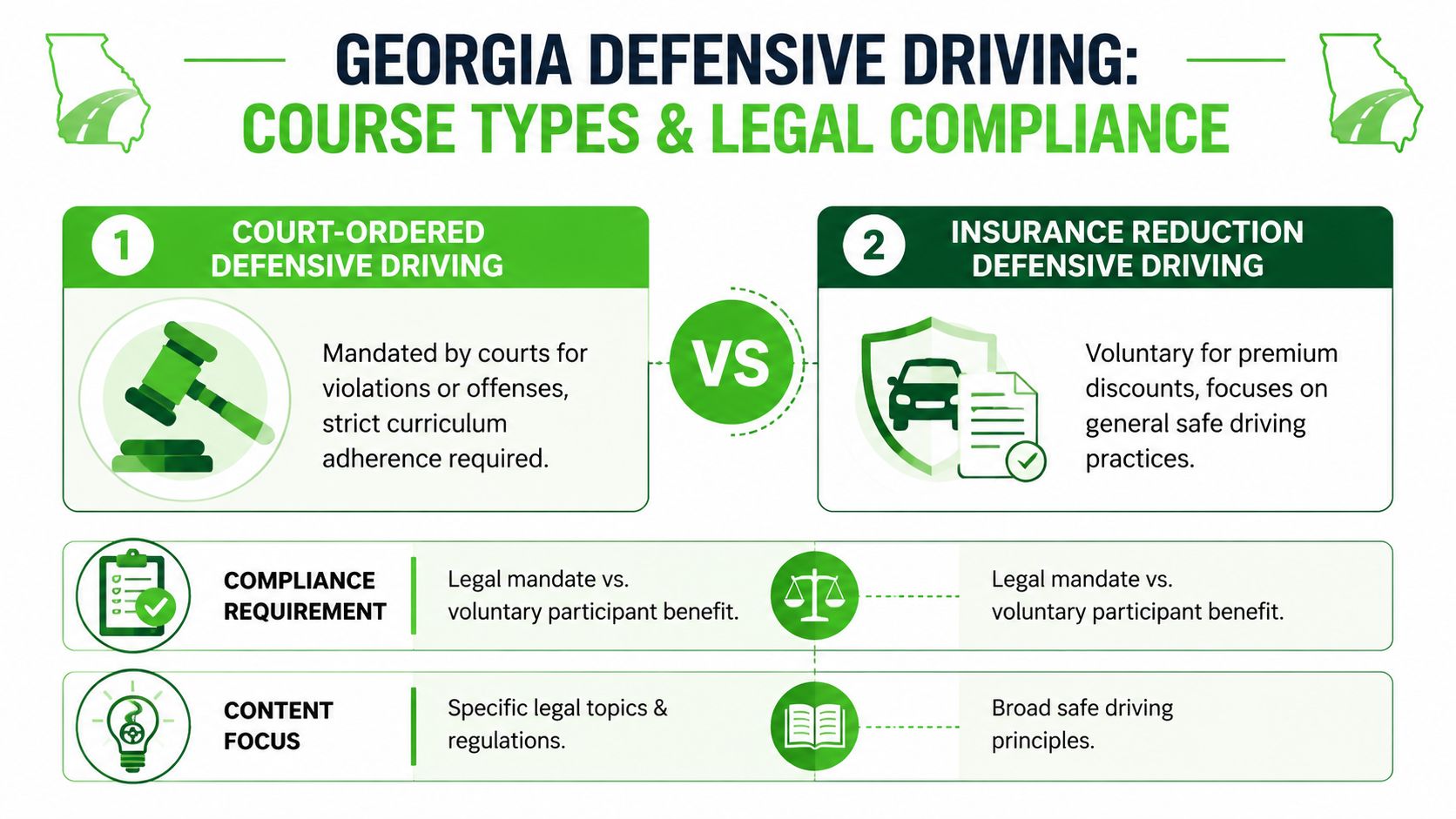
In Georgia, the course many drivers call "defensive driving" is the Driver Improvement Program, a 6-hour course used for point reduction, court referrals, and driver behavior improvement. Under O.C.G.A. § 40-5-86, eligible drivers may remove up to 7 points from their record once every 5 years, according to Georgia defensive driving point reduction rules.
That distinction controls your content choices. A compliant 6 hour deck should stay centered on traffic law review, risk awareness, driver attitude, judgment, and safer choices behind the wheel in everyday Georgia driving conditions.
The Risk Reduction Program is a different course with a different purpose. Georgia treats it as the DUI program, and DDS ties it to offenses such as DUI and drug possession, along with license reinstatement requirements. The program includes a total of 20 hours and a state-set fee structure of $360.00, made up of a $100 assessment, $235 intervention fee, and $25 workbook, as listed in the Georgia DDS DUI FAQs.
Why this distinction changes your slides
I tell new instructors to test every slide with one question. "Does this belong in a 6 hour Driver Improvement class, or am I drifting into Risk Reduction content?"
That test catches weak decks fast.
A Defensive Driving PowerPoint for Georgia should cover topics such as:
- Georgia traffic law review
- Hazard recognition
- Speed, space, and following distance
- Attitude, distractions, and decision-making
- Driver responsibility and consequences
- Practical crash-prevention habits
A Risk Reduction presentation has a different teaching job. It has to support the state-required educational and intervention format, including impairment-related content and structured participant involvement. That changes your pacing, your discussion prompts, and the amount of time you can spend on any one lecture block.
The trade-off is simple. A generic deck is easier to build, but harder to defend if your program is reviewed. A course-specific deck takes more planning up front and causes fewer compliance problems later.
If the same presentation could serve both a Driver Improvement class and a DUI Risk Reduction class with only the title slide changed, the course design is too loose for Georgia instruction.
Build from legal purpose, not visual style
Good instructors care about visuals. Compliance comes first.
The cleanest way to plan the deck is to match the course purpose to the presentation emphasis from the start:
| Course | Core purpose | Presentation emphasis |
|---|---|---|
| 6-hour Defensive Driving | Point reduction, driver improvement, traffic law review | Georgia driving choices, hazard perception, defensive habits, legal responsibilities |
| 20-hour Risk Reduction | DUI-related education tied to court and reinstatement requirements | Impairment education, intervention content, structured discussion, compliance documentation |
That table may look simple, but it saves hours of revision. It also prevents a common mistake. Instructors often overbuild the 6 hour class with alcohol and drug content that belongs in a Risk Reduction setting, then rush through hazard recognition and everyday collision prevention. For the Driver Improvement Program, your strongest slides usually involve lane use, following distance, speed management, distractions, fatigue, aggressive driving, and real Georgia roadway decisions.
The practical takeaway for instructors
Weak decks usually fail before slide one. The instructor has not fixed the course purpose, so the presentation starts mixing insurance language, court language, DUI language, and broad safety advice that does not clearly serve the assigned program.
Build your deck in this order:
- Name the exact Georgia course
- Set the legal and instructional purpose
- Remove content that belongs to a different program
- Use examples a Georgia driver will recognize
- Check that every slide earns its place
That is the foundation I use. It keeps the presentation clear for students, cleaner for auditors, and easier to teach for six full hours.
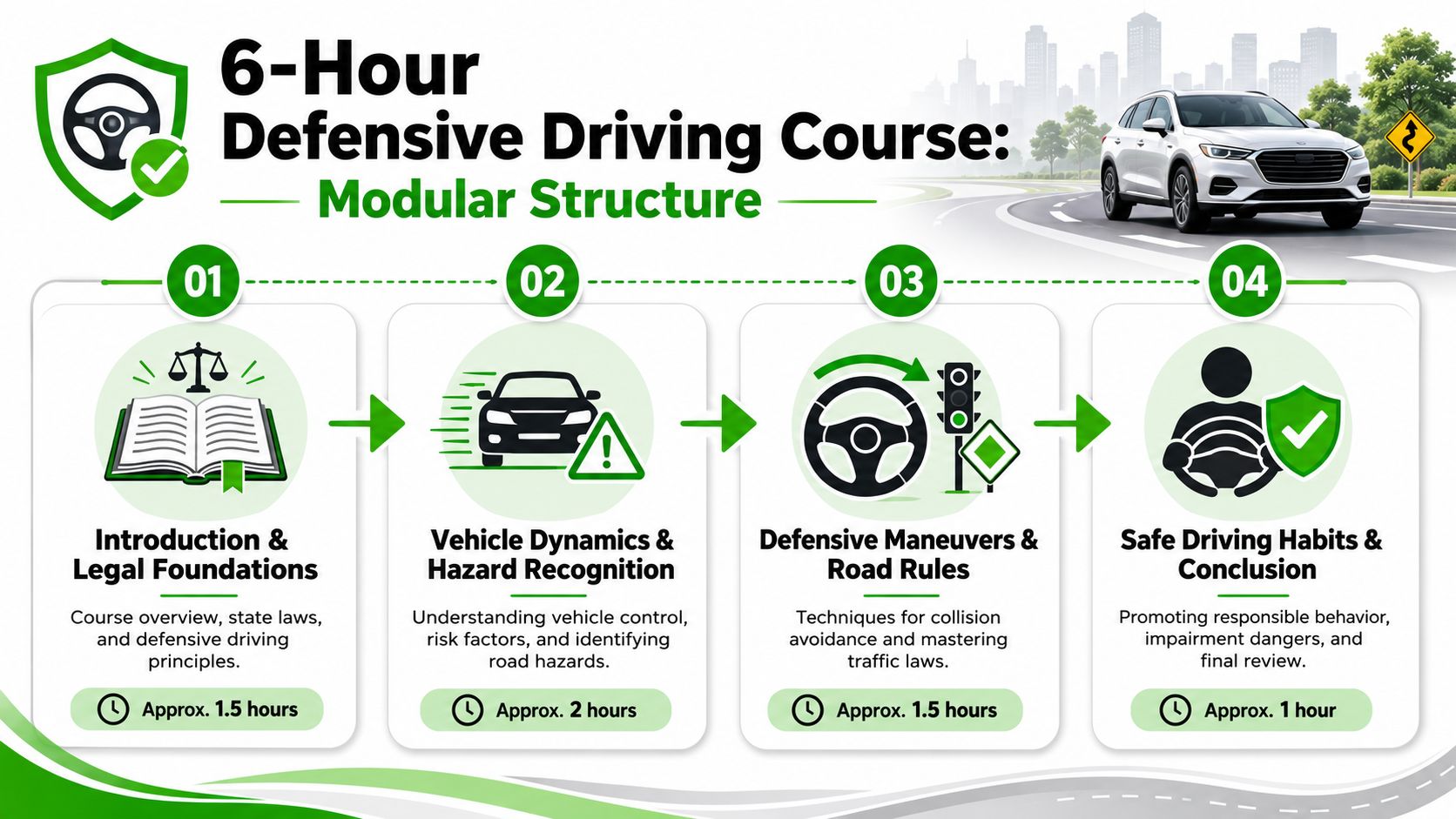
The Slide-by-Slide Structure for a 6-Hour Course
Once the foundation is right, structure becomes easier. A strong Defensive Driving PowerPoint for Georgia should feel deliberate from the first slide to the last. The room should know where the course is going, and you should know how to keep the pace without rushing the important discussions.
Research matters here. Effective defensive driving curriculum should focus on hazard recognition, not just car control, because 77% of all crashes involve driver error, which makes hazard anticipation the most important skill to teach for real-world crash reduction, according to defensive driving hazard recognition research.
Module 1 Opening and legal ground rules
Open with orientation, but keep it tight. Participants need to know what the class is, what it is not, and what they'll be expected to do.
Use your first slides for:
- Course identity: Explain that this is the Georgia 6-hour Driver Improvement Program.
- Administrative expectations: attendance, participation, breaks, certificate process.
- Reason for the class: safer driving behavior, not just box-checking.
- Georgia frame: why local traffic habits and local law examples matter.
Then move quickly into a short discussion prompt. Ask what situations make people feel most at risk on Georgia roads. In Atlanta-area rooms, people usually mention I-285 lane changes, merging traffic on the Connector, and distracted drivers at major intersections. That gets them talking early.
Module 2 Driver mindset and risk factors
This part is where many decks become preachy. Don't lecture about attitude in the abstract. Tie it to decisions drivers make.
Build slides around common judgment failures:
- driving angry after a confrontation
- rushing to beat a yellow light
- assuming another driver will yield
- underestimating fatigue
- treating familiar roads as “safe” enough to stop scanning
A local example works better than a generic one. A driver leaving an event near Peachtree Street may face congestion, pedestrians, rideshare stops, and sudden turns. The issue isn't just “pay attention.” It's divided attention under predictable pressure.
A good slide asks the room to make a decision. A weak slide only tells the room what to think.
You can also use a simple two-column slide:
| Unsafe assumption | Defensive replacement |
|---|---|
| “They see me” | “I need to confirm they're yielding” |
| “I know this road” | “Familiar roads still produce surprise hazards” |
| “I'm only a little distracted” | “Any distraction delays hazard response” |
Module 3 Georgia laws and signs
This module needs clarity, not clutter. Don't dump entire statute text onto slides. Use short prompts, then teach verbally.
Cover:
- right-of-way principles
- following distance
- lane use and passing basics
- signal and sign interpretation
- school zones and pedestrian awareness
- work zone attention
- what defensive driving means when others break the rules
Use local illustrations. A roundabout example may fit some Georgia communities, while urban participants may respond more to multilane turn issues or reversible traffic flow confusion during heavy commuting periods.
A useful format here is “law plus application.” One slide gives the rule in plain language. The next gives a Georgia scenario.
Module 4 Hazard recognition and the IPDE approach
This is the heart of the course. If your deck does one thing well, it should do this well.
Use a sequence that teaches drivers to:
- Identify possible hazards early
- Predict how the situation can change
- Decide on the safest response
- Execute that response smoothly
Don't present this as a memorization exercise. Present it as a road-reading habit.
Examples that work in Georgia classrooms:
- entering GA 400 with fast-moving traffic already packed into the right lanes
- approaching a green light with cross traffic that may not stop cleanly
- seeing a delivery van block your sightline near a busy commercial strip
- passing parked cars near a school pickup zone where a child may step out suddenly
Make one slide image-heavy, with no readable text in the graphic itself. Then use speaker notes or verbal delivery to guide the room through the hazard sequence.
Module 5 Space management and time management
Old presentations frequently rely too much on slogans. The better approach is to connect space to choices.
Use slides on:
- front cushion
- side escape options
- rear pressure management
- speed adjustment for conditions
- why delayed reactions create chain problems
A practical classroom exercise is to show a roadway image and ask participants where they still have an “out” if the lead vehicle brakes hard. That turns space management from theory into strategy.
Module 6 Impairment distraction and closeout
Finish with what most directly undermines defensive habits. This includes obvious issues like alcohol and illegal drug use, but it also includes fatigue, phone distraction, emotional overload, and poor self-assessment.
For the standard 6-hour course, keep the closeout focused on daily driving choices and application. End with a short review, not a long recap. Participants should leave with a few clear habits they can use on the drive home.
A reliable final slide sequence looks like this:
- Top hazards Georgia drivers overlook
- Three defensive habits to use immediately
- Questions and real-world scenarios
- Certificate and completion reminders
If the class remembers only one thing, let it be this: defensive driving isn't advanced car control. It's disciplined hazard anticipation.
Integrating Activities That Drive the Message Home
The fastest way to lose a room is to read slides at people for hours. Drivers don't change behavior because an instructor stacked enough bullet points on a screen. They change when the material feels personal, local, and hard to dismiss.

Use activities that force judgment calls
Passive lecturing creates polite silence. Interactive teaching creates decisions, disagreement, and memory. That's what you want.
Try these low-prep activities in a Georgia defensive driving power point:
- Local scenario debate: Put up a slide about heavy traffic on the Downtown Connector or a fast merge onto GA 400. Ask what the first defensive choice should be, then let the room compare answers.
- Hand-raise polls: Ask whether drivers trust turn signals, assume right-of-way will be respected, or leave more space in rain. Quick polling wakes up the room.
- What-if sequences: Show a roadway scene and reveal one changing condition at a time, such as brake lights ahead, a pedestrian at the curb, or a driver drifting across lanes.
- Partner discussion: Give pairs a prompt about the last close call they experienced and what they would do differently now.
These don't require elaborate production. They require good timing and good questions.
Address impairment with more precision
One topic that standard slide decks often miss is medication-related impairment. That's a mistake, especially in Georgia programs connected to DUI issues, court orders, or clinical evaluations. Standard presentations often overlook how prescription drugs can affect driving, even though prescription medications can alter reaction times by up to 40% compared to alcohol, according to this discussion of medication-induced driving deficits.
That doesn't mean every participant is misusing medication. It means many drivers don't understand that legal use and safe driving aren't always the same thing.
Don't ask only, “Are you under the influence?” Ask, “Are you fully able to drive right now?”
That question opens a better discussion. It also connects to the participants who may later need a clinical evaluation or additional DUI-related services, even if the current class is not the Risk Reduction Program itself.
Break up content with purposeful tools
If you're teaching online, mix in short checks instead of waiting until the end for engagement. If you need a practical example of how course questions can be framed for participant retention, reviewing a Georgia defensive driving online test format can help you reverse-engineer stronger knowledge checks inside the presentation.
Here are activity formats that work well without overcomplicating the deck:
| Activity | Best use |
|---|---|
| Scenario slide | Judgment and discussion |
| Poll | Quick engagement reset |
| Short video clip without readable text | Attention reset and analysis |
| Small-group discussion | Application and reflection |
Keep every activity tied to a driving decision. If it doesn't lead back to real road behavior, it's filler.
Designing for Accessibility Handouts and Delivery
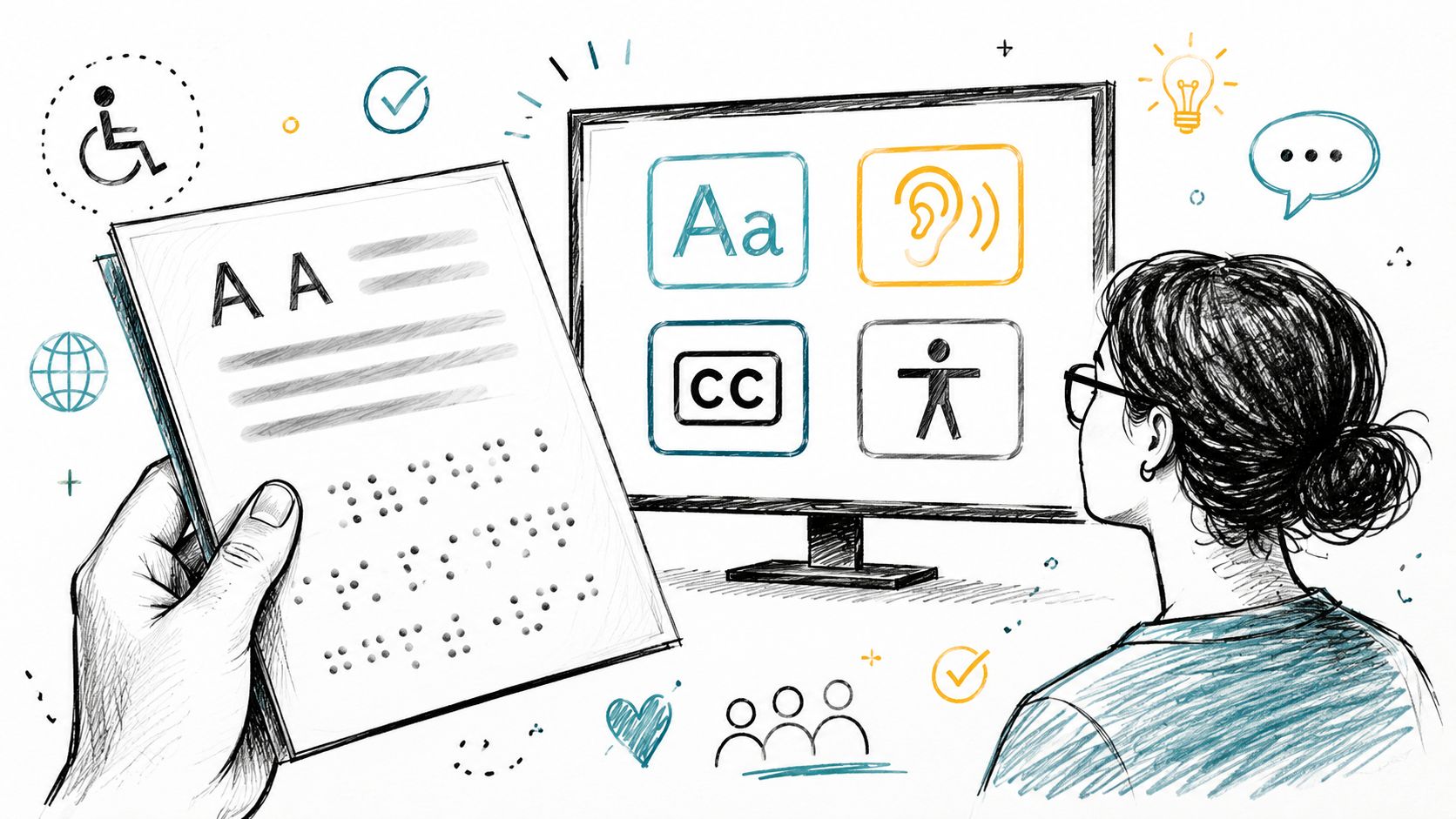
A participant walks in after a full workday, forgot their reading glasses, and sits in the back row. If your slide deck uses small text, weak contrast, or crowded visuals, that driver misses half the class before the first discussion starts. I treat accessibility as part of course control, not decoration, because a DDS-approved topic only works if people can take it in and use it.
Build slides people can actually use
Readable slides reduce friction in both in-person and virtual classes. They also help instructors stay on pace, because participants spend less time squinting and more time responding.
Use large sans-serif fonts, high contrast, and short lines. A plain slide with one roadway image and three clear bullets usually teaches better than a busy layout packed with legal text.
Keep these standards in your deck:
- Limit text per slide: Put the explanation in your delivery, not in dense paragraphs on screen.
- Use readable fonts: Arial, Calibri, Helvetica, and similar fonts hold up well on projectors and laptops.
- Choose contrast that survives the room: Dark text on a light background is the safest choice across classrooms.
- Avoid text-heavy graphics: If an image contains small printed wording, it often becomes unreadable and distracting.
- Use icons only when they guide attention: Road signs, mirrors, lane markings, and warning symbols work better than generic clip art.
One more instructor rule matters here. Don't read the slide word for word. Participants tune out fast when the screen and the speaker compete.
Handouts should carry the lesson after class
Printed slides are weak handouts. Participants rarely keep them, and they are hard to use later in the car or at the kitchen table.
A better handout set does a separate job:
- A one-page Georgia law refresher: plain-language reminders on following distance, yielding, speed choice, and common judgment errors
- A hazard scan checklist: what to check ahead, to the sides, and behind before a lane change, turn, or merge
- A personal readiness sheet: prompts on fatigue, distraction, stress, and medication effects before driving
- A senior-driver discussion page: practical planning points on visibility, route timing, and comfort, similar to the concerns covered in a defensive driving course for seniors
This is also where instructors need to keep Georgia course types straight. A 6-hour Defensive Driving class can include self-check tools and prevention reminders. It should not drift into presenting itself like a 20-hour DUI Risk Reduction intervention. Handouts need to match the purpose of the class you are approved to teach.
Delivery has to match the room and the course type
Good delivery starts before the first slide. Check sight lines, audio, seating, and whether every participant can see examples without strain. In virtual settings, check camera framing, screen-share readability, and whether discussion prompts are visible long enough for people to answer.
For instructors who teach both Defensive Driving and DUI-related programs, delivery standards also change with the program. As noted earlier, Georgia treats remote DUI Risk Reduction instruction differently from a simple self-paced format. That distinction matters because it affects how you design the deck. A presentation built only for one-way narration leaves no room for live checks, guided discussion, or participant response.
Build in pauses. Ask short, specific questions. Leave white space on the slide so the class can focus on the decision you want them to make.
If participants can read it, hear it, discuss it, and apply it, the material has a real chance of changing what happens on Georgia roads tomorrow morning.
Your Path to Safer Georgia Roads
A Georgia driver walks into class after a citation, a near miss on I-75, or a court referral. By the end of six hours, that driver should leave with better judgment, a clearer grasp of risk, and no confusion about what course they completed. That standard starts with the instructor.
The strongest Defensive Driving PowerPoint is built for Georgia DDS expectations, not generic road-safety advice. It keeps the 6-hour Defensive Driving course in its lane and keeps the 20-hour DUI Risk Reduction program in its own. Instructors who blur those lines create compliance problems, confuse participants, and weaken the message.
That distinction matters in the room. A Defensive Driving class should sharpen hazard recognition, space management, speed control, and decision-making in everyday traffic. DUI Risk Reduction serves a different legal and educational purpose. As noted earlier, Georgia treats them as separate programs, and your presentation should make that separation clear from the title slide to the final handout.
Before teaching, I use one simple test. If a slide does not help a Georgia driver spot risk sooner, choose a safer response, or understand the purpose of the class they enrolled in, it does not stay in the deck.
Final Checklist for Your Georgia Defensive Driving PowerPoint
| Check Item | Status |
|---|---|
| Correct course type identified before slide creation | ☐ |
| Georgia-specific driving scenarios included | ☐ |
| Hazard recognition receives the strongest emphasis | ☐ |
| Slides use readable fonts and high contrast | ☐ |
| Graphics avoid legible embedded text | ☐ |
| Activities require participant judgment, not passive viewing | ☐ |
| Handouts support application after class | ☐ |
| Remote delivery plan supports live interaction where required | ☐ |
| DUI and Risk Reduction content kept separate from standard 6-hour material unless legally relevant | ☐ |
| Participant takeaway focuses on safer daily driving behavior | ☐ |
For a practical summary of why these classes matter to drivers beyond the classroom, review the Georgia defensive driving course benefits.
A compliant presentation does its job after class ends. Drivers remember one or two decisions they can apply the next morning in Atlanta traffic, on two-lane rural roads, or during a wet commute home. That is the mark of a course that meets the requirement and earns attention.