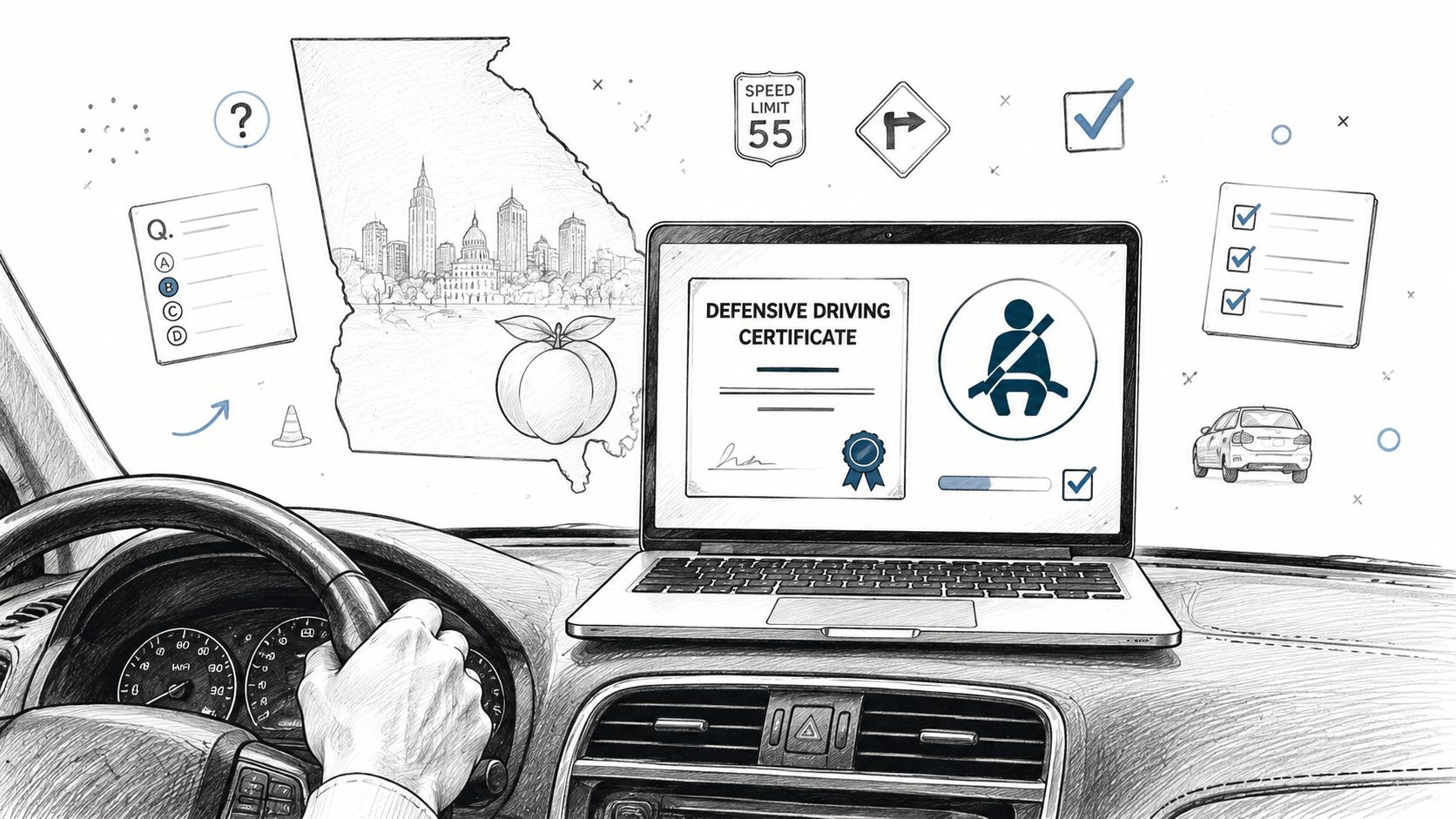
You got a ticket, your insurance bill jumped, or someone at court told you to “take defensive driving,” and now you're staring at a search page full of online options that all sound the same. That's where Georgia drivers get burned. The phrase defensive driving online test sounds simple, but in Georgia the right answer depends entirely on why you need the course.
If your goal is an insurance discount, an online option may fit. If your goal is court compliance, point reduction, or anything tied to the Georgia Department of Driver Services, the wrong course can waste your time and money. I've seen that confusion create stress for drivers who were already trying to fix a problem quickly.
Your Guide to the Defensive Driving Online Test in Georgia
A defensive driving course is a real safety tool, not just a box to check. The National Safety Council pioneered the nation's first Defensive Driving Course and has trained over 80 million drivers since its inception, and it states that online defensive driving formats deliver relevant, leading-edge content that motivates and educates employees to be safe, responsible drivers. That history matters because it tells you the online format itself can be legitimate when it's used for the right purpose.
Georgia is where the details matter.
A lot of national websites talk as if every online defensive driving test works for every state, every ticket, and every court. That isn't how it works here. In Georgia, you need to separate two very different goals:
- Insurance savings
- Court or DDS compliance
If you mix those up, you can finish a course, print a certificate, and still find out it doesn't satisfy what the court or DDS wanted.
What drivers usually want
Those searching this topic are trying to do one of three things:
- Lower insurance costs: You want a certificate you can send to your insurer and ask whether it qualifies for a discount.
- Handle a traffic issue: You got a citation and want to keep the damage as small as possible.
- Get back into compliance: You're dealing with a court order, point concerns, or a license problem and need the right class the first time.
Practical rule: Before you register for any defensive driving online test, answer one question in plain language: “Am I doing this for insurance, or because a court or DDS requires it?”
That single question prevents most mistakes.
What works and what doesn't
What works is matching the course format to the goal. What doesn't work is assuming “online” always means “approved everywhere.” In Georgia, that assumption causes more trouble than the test itself.
If you only remember one thing from this guide, remember this: the online format is not the problem. Using the wrong format for the wrong legal purpose is the problem.
Is a Georgia Online Test Right for Your Situation
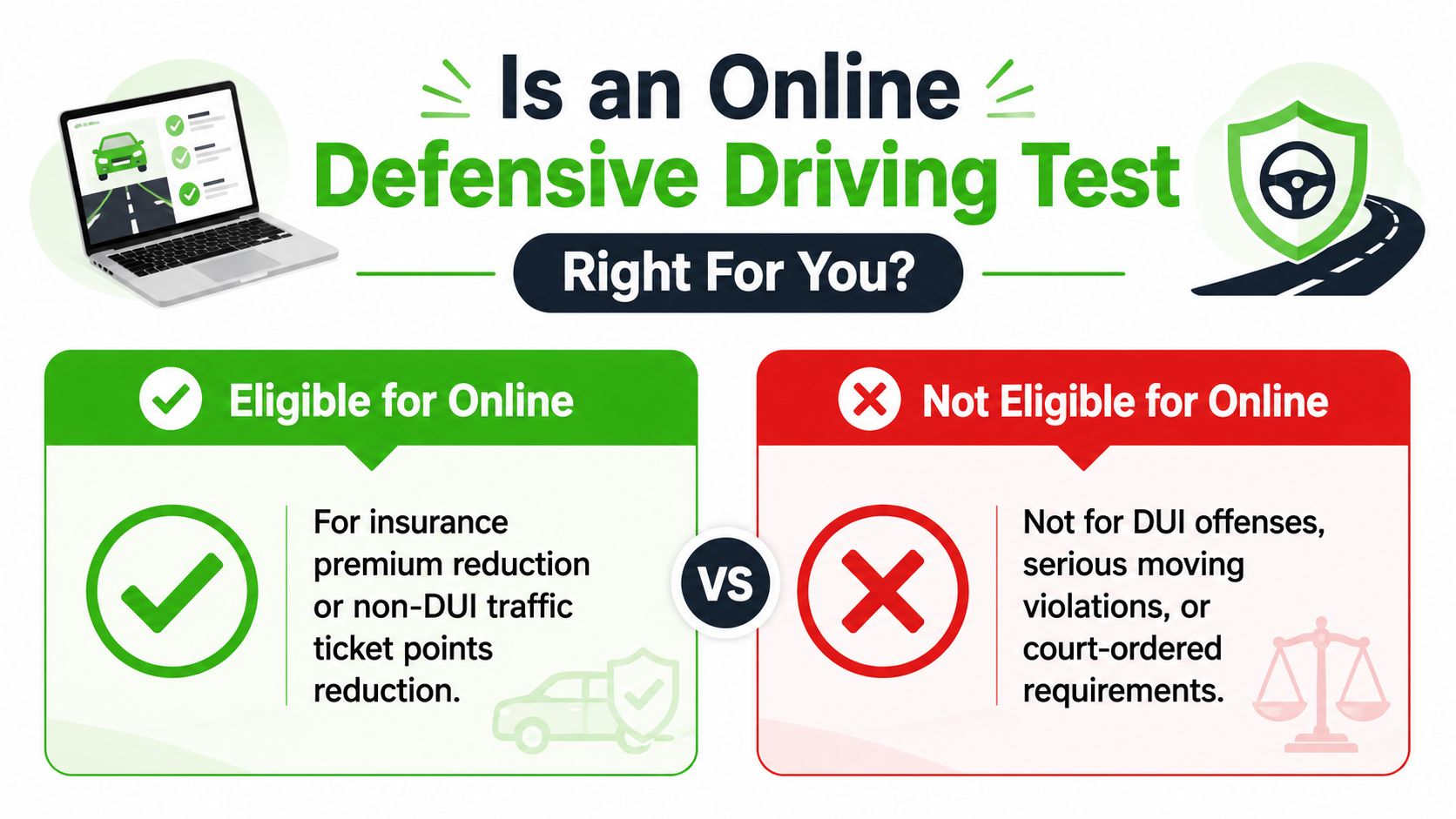
The cleanest way to decide is to sort your situation into one of two lanes.
When online makes sense
If you're taking a defensive driving course voluntarily for insurance purposes, an online course is often the practical choice. It fits around work, childcare, commuting, and everything else that makes a classroom hard to schedule.
That's usually the right lane if:
| Situation | Online course fit |
|---|---|
| You want to ask your insurer about a premium reduction | Strong fit |
| You want a general safe-driving refresher | Strong fit |
| You're not under a Georgia court or DDS requirement | Usually a good fit |
If your goal is insurance-related, it helps to review why drivers take a defensive driving course before enrolling, because the reason you take it affects what you should expect from the certificate.
When online is the wrong choice
Georgia is strict here. The Georgia Department of Driver Services does not recognize online Driver Improvement courses for license reinstatement, points reduction, or court purposes, and Georgia drivers who need legal compliance must complete a 6-hour in-person or live virtual course according to the Georgia DDS Defensive Driving Program FAQs.
That means an online defensive driving test is not your answer if:
- A court ordered the class: The judge, clerk, or probation instructions control.
- You need DDS recognition: That includes situations involving license status or official points issues.
- You're trying to satisfy a legal requirement after a serious driving matter: Don't assume a national site's generic promise applies in Georgia.
If a website says its online course works “nationwide,” treat that as marketing until you verify your Georgia requirement.
The fast decision test
Use this simple check before you pay:
- Read your paperwork exactly as written. Look for “court ordered,” “DDS approved,” “driver improvement,” or “live virtual.”
- Call the court if anything is unclear. Don't guess.
- If the requirement is official, choose in-person or live virtual.
- If the goal is insurance only, online can be appropriate.
The trade-off is convenience versus compliance. Online is easier to fit into daily life. But convenience doesn't help if the certificate won't be accepted where you need it.
Registering for Your Online Defensive Driving Course
A lot of Georgia drivers get tripped up right here. They know they want a defensive driving course, they find a registration page, and they assume every option solves the same problem. It does not. At registration, your job is simple. Match the course format to your goal before you pay.
If your reason is an insurance discount, personal education, or a refresher after a close call on the road, online registration usually makes sense. If your reason is court, DDS, or license-related, stop and confirm the requirement before entering payment information. That one check can save you time, money, and a certificate you cannot use.
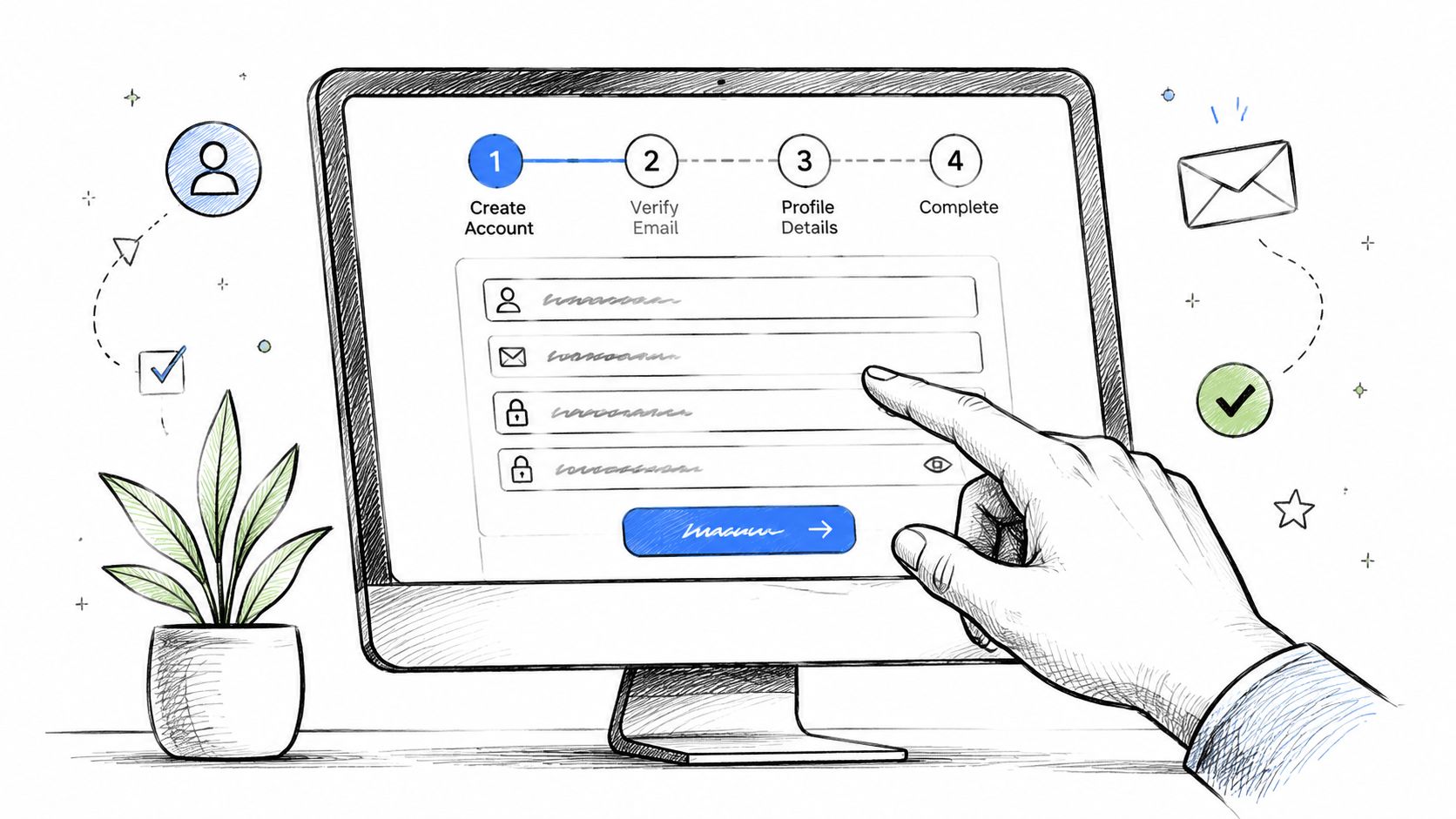
What to have ready
Registration goes faster when you gather a few basics first:
- Your legal name: Enter it the way you want it to appear on your completion record.
- A working email address: Course access, receipts, and completion details usually go there.
- A device you can comfortably read on: A phone can work, but a laptop or tablet is often easier for longer sessions.
- Your reason for taking the course: Insurance discount, voluntary skill review, or general education.
That last item matters more than drivers expect.
A straightforward way to enroll
If you already confirmed that online fits your situation, use the Georgia online defensive driving course registration page and complete the setup in one sitting. That reduces small mistakes, like mistyping your email or leaving the account half-finished.
The best registration process is plain and quick. You create your account, confirm your details, and get access to the course. After that, most drivers see a short orientation screen and then begin the first lesson.
Set aside a quiet hour for the start. I tell students this all the time because it works. Drivers who begin while answering texts, cooking dinner, or bouncing between tabs usually end up restarting sections they barely remember.
Registration mistakes that cause problems later
The biggest mistake is choosing online because it is convenient, without checking whether convenience is allowed for your situation. In Georgia, that is where drivers lose money. They register for an online course, finish it, and then learn they needed an approved in-person or live virtual option for an official requirement.
A few other problems show up often:
- Using a name that does not match your records: This can create issues with your completion certificate.
- Entering an email you rarely check: Access instructions or follow-up messages get missed.
- Starting late at night when you are exhausted: The material goes faster when you are alert.
- Treating sign-up like the hard part: Registration is easy. Finishing the course depends on pace and attention.
Online courses give you flexibility. Use it well. Short, focused sessions usually work better than trying to rush through the entire course while distracted.
Navigating and Passing the Online Test with Confidence

The test feels intimidating until you understand how it's built. In practice, most online defensive driving platforms are designed to teach first and test second. That matters, because drivers often assume they're walking into one big high-pressure exam. Usually, they aren't.
The standard flow uses a three-stage verification loop: Pre-test Court Authorization, Modular Instruction and Quiz Integration, and The Post-Test Retake Protocol. In that structure, the course is divided into 5 distinct modules with embedded quizzes, and you must reach a 100% pass rate before moving on. The final exam includes infinite retakes without additional fees until you achieve a perfect score, according to the verified course methodology provided for online defensive driving testing.
How the course usually unfolds
A typical experience looks like this:
- You confirm eligibility first. If a court is involved, you verify that before treating the course as a solution.
- You work through the modules. Each one covers a core topic, such as risk perception, space cushions, or emergency response.
- You answer quizzes as you go. The quizzes aren't there to trap you. They force you to pay attention before the material stacks up.
- You take the final exam. If you miss something, the retake system lets you correct it rather than starting your whole course life over.
That structure is one reason people do better when they slow down and treat each module as preparation, not as an obstacle.
What the test is actually checking
Most questions are practical. They focus on spacing, awareness, hazard recognition, and decisions you make in ordinary traffic. One common knowledge point is the two-second rule for space cushioning. Drivers miss it because they read too fast, not because it's advanced.
A simple way to think about it is this: pick a fixed object ahead, watch the vehicle in front of you pass it, and count the time until you pass the same object. If your timing is too short for the conditions, you're following too closely.
Keep this in mind: The test is easier when you answer from safe-driving habits, not from what impatient traffic around Atlanta or Athens pressures people to do in real life.
Why the retake feature matters
Many drivers get stuck mentally on the word “test.” They picture one shot, one score, and one bad outcome. Online defensive driving platforms often work differently.
The retake protocol is built to let you review, correct, and resubmit. If the platform shows where you missed a response, use that feedback. Don't click past it in a hurry. The review step is part of passing.
Here are the habits that work best:
- Read the full question: Don't jump to the first answer that sounds familiar.
- Watch for absolutes: Words like “always” and “never” can signal a wrong choice in driving scenarios.
- Use the feedback loop: If the platform lets you edit and resubmit, take advantage of it.
- Finish one module cleanly: Don't half-complete several sections and then try to remember what you learned days later.
Managing test anxiety like a working adult
The drivers who struggle most aren't usually the least capable. They're the most rushed. They're answering questions between errands, after a long shift, or while worrying about what happens if the course doesn't count.
That's why a calm setup helps:
| Better approach | Worse approach |
|---|---|
| Quiet room, focused session | TV on, phone in hand |
| One module at a time | Racing to finish all at once |
| Using retakes and review tools | Guessing and moving on |
| Thinking about safety logic | Thinking about “trick questions” |
The test becomes manageable when you stop treating it like a courtroom event and start treating it like guided instruction.
What to Do After You Pass Your Online Test
Passing feels good, but don't stop at the score screen. The final steps are where people lose the benefit they just earned.
Some platforms require a final questionnaire or course wrap-up before the certificate is released. Complete every last prompt, then make sure you download your Certificate of Completion and save it somewhere you can find it again. Verified technical guidance for online defensive driving tests also warns about two common pitfalls: failing to finish within the 3-month window from registration and forgetting the final certificate download, which is essential for insurance submission.
Your post-pass checklist
Use a simple closeout routine:
- Download the certificate immediately: Don't assume you'll come back later.
- Save two copies: Keep one on your device and one in your email or cloud storage.
- Check the name on the certificate: Fix errors while the course details are still fresh.
- Contact your insurance company: Ask exactly how they want the certificate submitted.
A simple message to send your insurance agent
You don't need a formal letter. A plain email works:
Hello, I completed a defensive driving course and would like to know whether it qualifies for any insurance discount on my policy. I've attached my certificate of completion. Please let me know if you need any additional information.
That message is clean and easy for an agent to process.
For a practical next step after completion, review how a defensive driving course may help lower insurance so you know what to ask and what paperwork to keep.
One last thing drivers forget
The course may be self-paced, but it still has boundaries. If registration starts a completion clock, don't leave the class sitting unfinished until the deadline sneaks up on you.
Also, if you saw the two-second rule during the course and stumbled on it, don't shrug it off once the test is over. That concept matters because following distance is one of the first habits to slip when traffic gets tense.
Clearing Up Georgia Driver Confusion
The biggest misunderstanding in Georgia is thinking that defensive driving and DUI/Risk Reduction are interchangeable. They are not.
An online defensive driving test may help with insurance-related goals, but it does not automatically solve a DUI-related requirement. Verified guidance on this issue notes that there is no clear, publicly available data showing that completing an online defensive driving test reduces points from a DUI-related violation or satisfies a court's separate 6-hour course requirement, which is why drivers end up making the wrong enrollment choice when trying to interpret DUI and Risk Reduction obligations in Georgia through sources discussing that confusion on Georgia DUI course guidance.
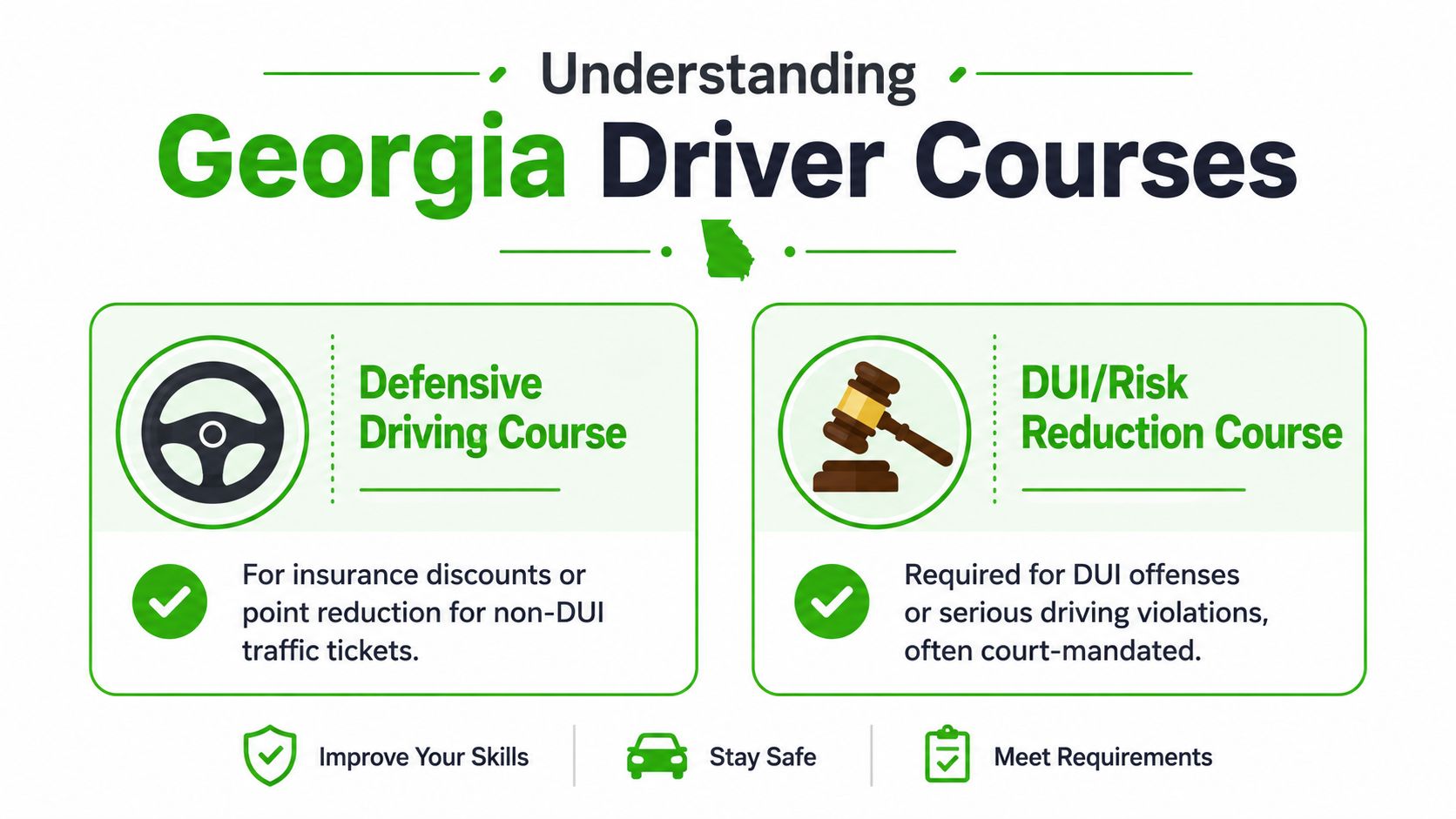
Defensive driving versus Risk Reduction
Use this distinction:
- Defensive Driving Course: Best thought of as a driver improvement and insurance-related course.
- DUI/Risk Reduction Course: A separate legal requirement tied to DUI cases and license reinstatement issues.
- Clinical evaluations and related services: These come into play when the court, probation, or DDS requires more than a basic driver improvement class.
If your case involves DUI, don't substitute assumptions for instructions. Georgia also treats related requirements seriously, including evaluations, intervention steps, and court-ordered follow-through.
For drivers who also need better vehicle fit and restraint awareness, it's worth reviewing these important extender safety details, because comfort solutions only help when they're used safely and appropriately.
A few quick answers
If the paperwork says DUI, Risk Reduction, court-ordered, or DDS-related, stop and verify the exact course type before you register.
How long is my certificate good for?
Use it promptly. Acceptance depends on who requested it and why you took the course.
What if I have technical issues during the test?
Stop, document the issue, and contact the provider before guessing your way through a broken session.
Can an online defensive driving test fix a DUI problem?
Don't assume that. DUI and Risk Reduction requirements follow a separate path in Georgia.
What if I'm in Atlanta or Athens and the instructions are vague?
Call the court, clerk, probation office, or DDS-related contact listed on your paperwork. Verbal reassurance from a generic website won't protect you if the course is rejected.
If you need the right Georgia course without the guesswork, Georgia DUI Schools offers the most relevant path based on your goal. For drivers who need a compliant online option for insurance-related purposes, start with the online defensive driving course.