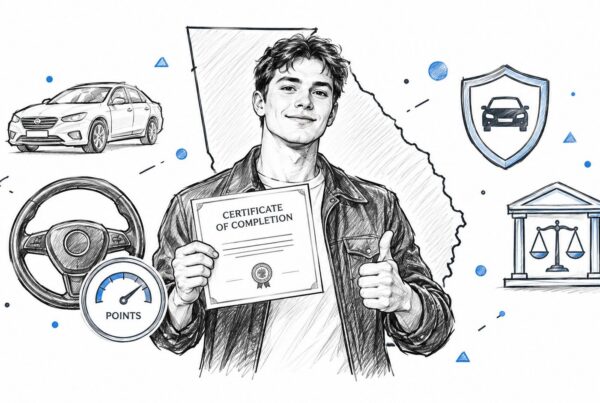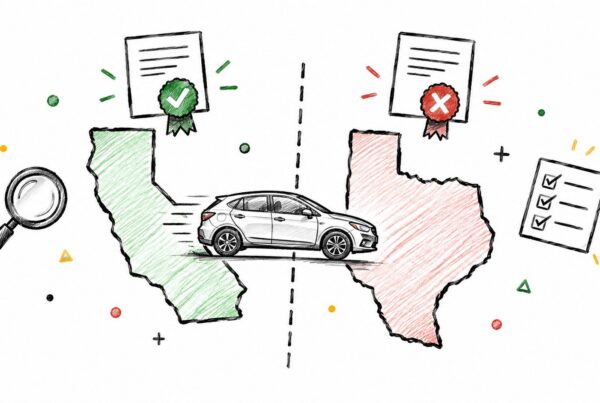
Rush hour in metro Atlanta has a way of exposing every weak driving habit you've got. You're easing toward a crowded turn lane near a busy interchange, somebody dives across two lanes without signaling, the light changes fast, and the driver behind you is already on the horn. For a lot of people, that's the moment they realize they don't just need more confidence. They need better skill, better judgment, and in some cases, a state-approved course to keep or restore their license.
This is the starting point for how to improve driving skills in Georgia. It isn't about collecting random tips off the internet. It's about fixing the habits that cause trouble in the first place, then matching your next step to your legal situation. Some drivers need a Defensive Driving course to reduce points. Others are dealing with a DUI, a court order, or a license suspension and need a Risk Reduction course, a clinical evaluation, or more.
Your Journey to Becoming a Safer Driver
Atlanta traffic doesn't forgive hesitation. On roads like I-285, Memorial Drive, or the Downtown Connector, drivers who freeze at the wrong second create problems for themselves and everybody around them.
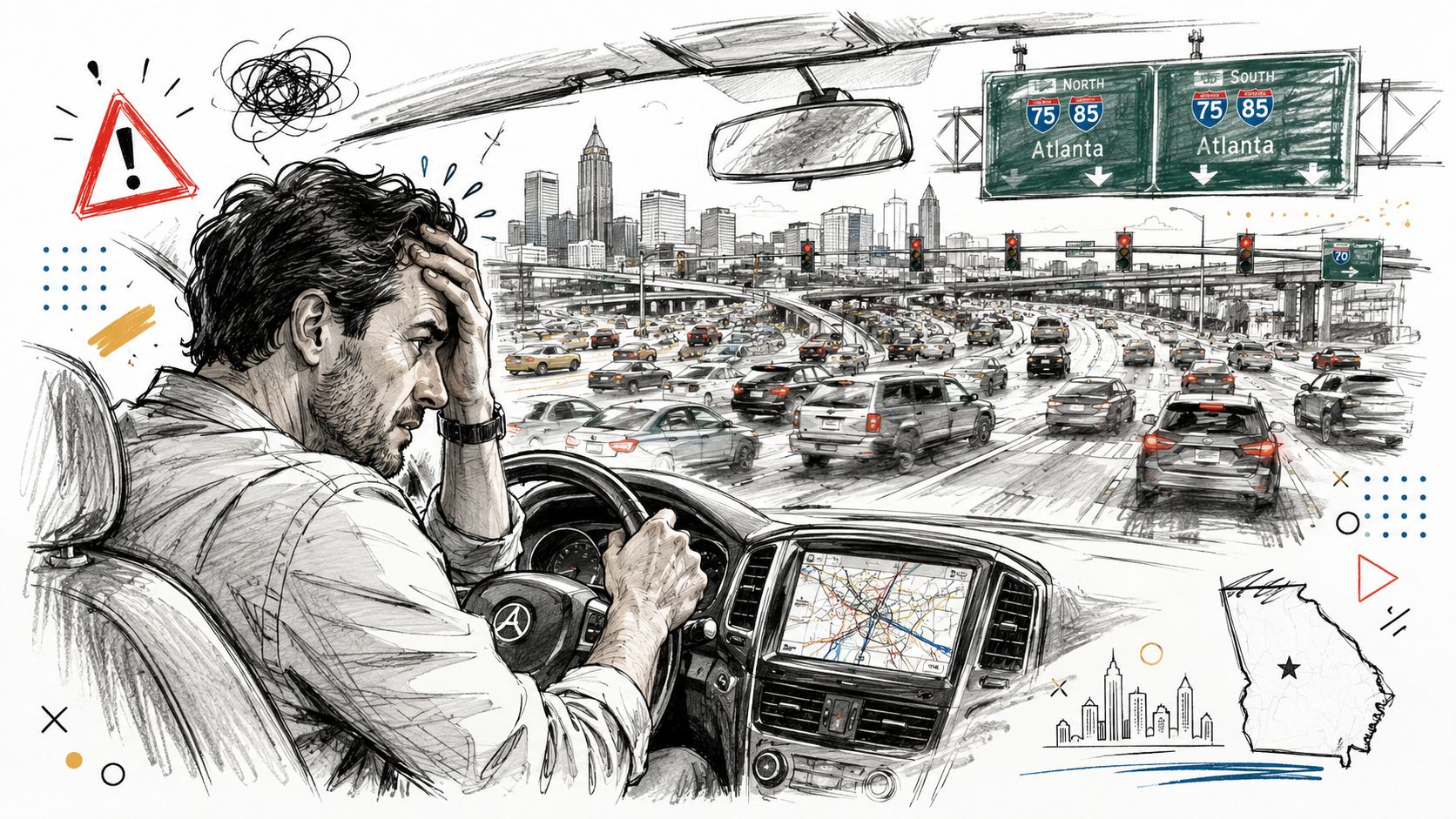
That's one reason this topic matters so much. Recent 2025 research from the University of Michigan Transportation Research Institute shows that anxiety-driven driving, including hesitation and freezing in traffic, increases rear-end collision risk by 40% compared to calm assertiveness. That's a hard reminder that stress management is part of driver training, not something separate from it.
Stress shows up before the crash
Most drivers don't walk into a classroom saying, “I want to become more precise with vehicle control.” They come in after something happened. A close call in Buckhead. A ticket in Gwinnett County. A DUI arrest. A judge's order. A license problem that suddenly turns daily life into a mess.
The common thread is this. Good driving isn't luck. It's a process.
You don't fix bad driving by hoping to “be more careful.” You fix it by building repeatable habits under pressure.
Some people need to rebuild from the ground up. Others already know the rules but haven't practiced them correctly in years. Many have picked up shortcuts that feel normal until they fail at the worst possible moment, especially in heavy traffic, rain, nighttime driving, or aggressive merge situations.
Skill and compliance go together
In Georgia, “improving driving skills” can mean two very different things depending on where you stand. It might mean learning cleaner braking, better scanning, and stronger lane discipline so you don't get another citation. It can also mean completing a required program to satisfy the Department of Driver Services and move toward reinstatement.
That's why formal education matters. A DDS-approved course isn't just a box to check. It gives structure to what most drivers never practice on their own:
- Vehicle control: smoother acceleration, braking, and steering
- Situational awareness: seeing trouble before it develops
- Decision-making: reacting without panic
- Legal compliance: meeting court and DDS requirements when the state requires it
If you're serious about how to improve driving skills, start with the truth about your current habits. Then get the right training for your situation.
Beyond the Basics Foundational Skills for Every Drive
A lot of drivers think foundational skills are beginner stuff. They're wrong. The basics are where control starts, and weak basics show up fast when the road gets slick, crowded, or unpredictable.
Fix the hands and feet first
If your inputs are abrupt, the car will feel unstable no matter how experienced you think you are. The first correction is simple. Be smooth.
According to guidance summarized in a high-speed control training reference, drivers should practice accelerating by squeezing the throttle rather than snapping it, which helps prevent traction loss associated with 35% of acceleration-related skids. The same reference notes that maintaining a 3-and-9 hand grip reduces over-rotation errors by 28%.
That matters in everyday Georgia driving more than people realize. If you leave a red light in Decatur and stab the gas while your wheels are still slightly turned, or if you jerk the wheel to correct late on a wet curve outside Athens, you're asking the tires to do too much at once.
Try this sequence instead:
- Set your hands at 3 and 9. That allows for more effective steering and keeps your shoulders relaxed.
- Roll into the gas. Don't punch the pedal.
- Brake early and progressively. Most rough stops start because the driver waited too long.
- Let steering stay clean. One smooth input beats three frantic corrections.
Visibility is part of control
Drivers talk a lot about reflexes and not enough about what they can see. If your mirrors are poorly set or your vision is strained, your timing gets worse before you even touch the wheel.
For drivers who struggle with changing light, glare, or long commutes, it helps to review options for clear vision with progressive driving lenses so you're not fighting your own eyesight while trying to judge speed and lane position.
Practical rule: If you have to lean forward, tilt your head, or guess at what's beside you, your setup is wrong before the drive even begins.
A proper mirror and seating setup should let you scan naturally without hunting for information. That reduces fatigue and cuts down on the little delays that turn into missed openings and bad lane changes.
Fundamentals are what defensive driving builds on
Defensive driving only works if the car goes where you intend without drama. That's why the best point-reduction courses focus on hazard recognition, speed management, and space management instead of treating driving as a memory test. If you want a practical look at how those habits help everyday motorists, this breakdown of the benefits of defensive driving is worth reading.
What doesn't work is pretending experience alone fixes sloppy technique. Plenty of people have driven for years with bad braking habits, poor steering discipline, and weak observation. Time behind the wheel doesn't automatically build skill. Deliberate correction does.
How to Scan Predict and React Like a Pro
Once the car is under control, the next job is reading the road before it forces your hand. Most crashes I've seen weren't caused by drivers who knew nothing. They were caused by drivers who noticed the danger too late.
Scan farther than feels natural
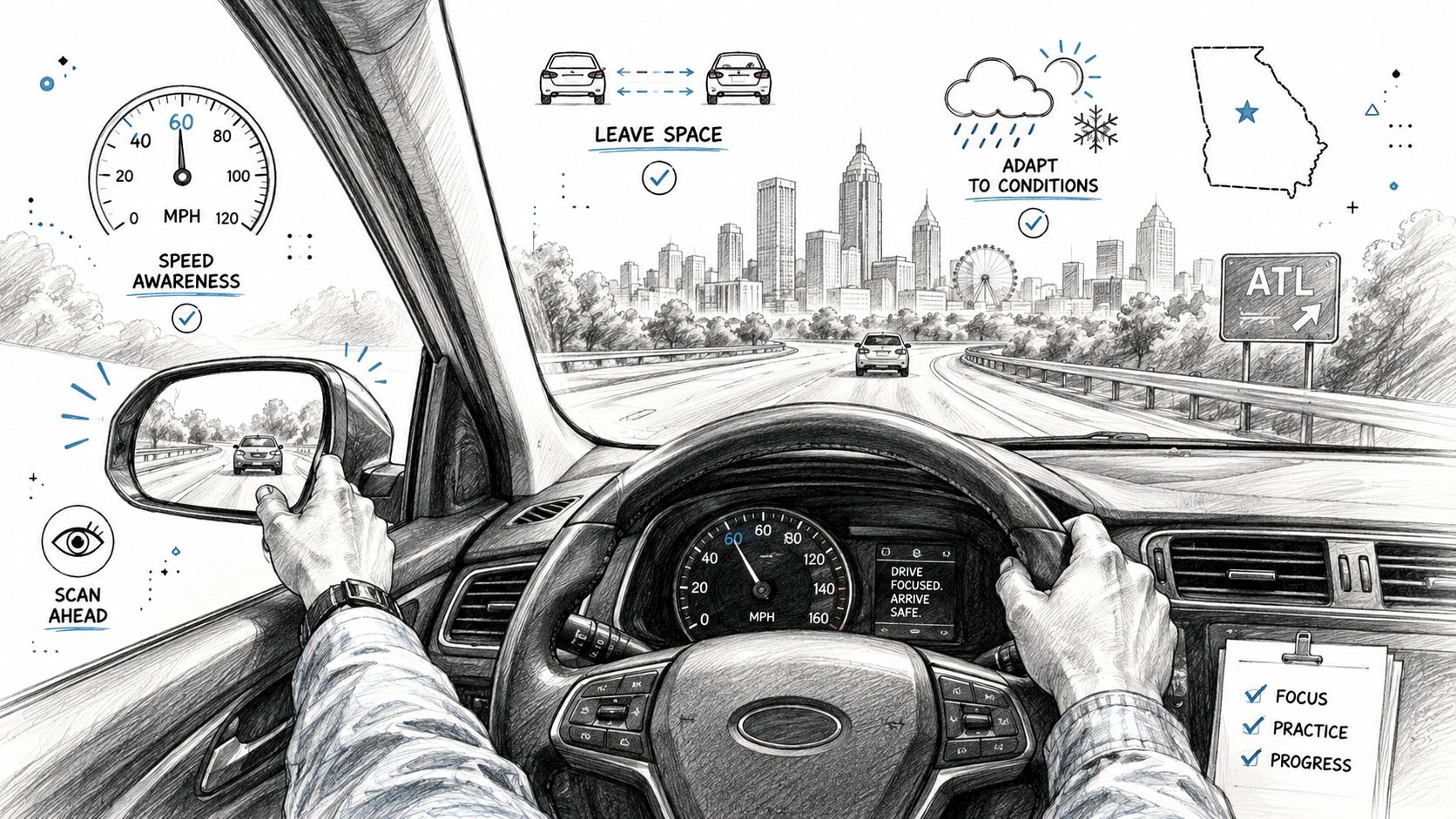
A skilled driver doesn't stare at the bumper ahead. A skilled driver works the whole scene. That means checking mirrors, reading brake lights several vehicles ahead, and watching the edges of the road where trouble often begins.
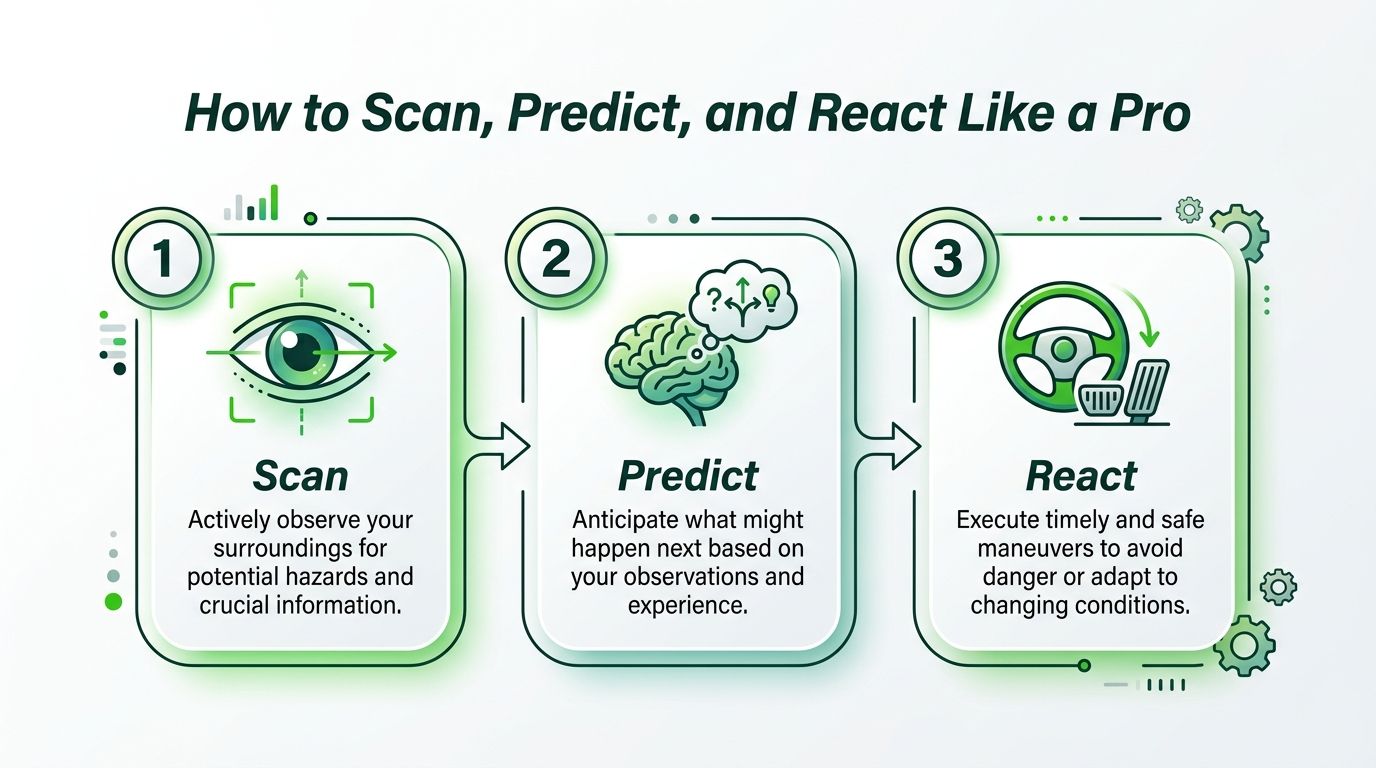
A defensive driving reference from Fleet Safety International explains that scanning 12 to 15 seconds ahead allows advanced drivers to react 0.8 seconds faster than average, while maintaining a safe following distance of at least 4 seconds reduces sudden-stop collisions by 45% in its overview of driving skills from basics to expert maneuvers.
That's why good drivers seem calmer. They aren't calmer by accident. They've given themselves time.
Build a space cushion you can actually use
If you drive in urban Georgia, you already know that somebody will eventually jump into your lane. That doesn't mean following too closely is justified. It means your buffer matters even more.
Use this simple framework:
- In city traffic: Leave enough following distance that you can stop without diving onto the brake pedal.
- At higher speeds: Increase that gap early, not after conditions get bad.
- In rain or at night: Expand your cushion further and avoid driving boxed in between vehicles.
- Near ramps and merges: Expect sudden lane changes and bad decisions from other drivers.
A lot of people mistake aggressive tailing for confidence. It isn't confidence. It's a lack of margin.
Predict the mistake before it happens
On Georgia roads, prediction is often more important than reaction speed. Watch for the driver who keeps drifting near the lane line, the left-turn car inching too far forward, or the SUV approaching a merge with no obvious plan. In dense areas like Midtown or perimeter exits near Sandy Springs, these clues matter.
A useful way to think about it is this:
| What you see | What it may mean | What you should do |
|---|---|---|
| Brake lights several cars ahead | Traffic is compressing | Ease off early |
| A vehicle creeping at a side street | Possible pull-out | Cover the brake and shift lane position if safe |
| Driver looking away at an intersection | Delayed or erratic move | Don't assume they've seen you |
Scan for movement, not just objects. Cars that are about to cause trouble usually tell you before they do it.
Defensive driving courses earn their value by training your eyes and your judgment together. That's a different skill from merely passing a written test.
Georgia Driving Courses for Point Reduction and License Reinstatement
A lot of confusion starts because drivers use the wrong course for the wrong problem. In Georgia, that can waste time and leave you out of compliance.
Defensive Driving and Risk Reduction are not the same
Here's the cleanest way to separate them.
| Course type | Usual reason for taking it | Key result |
|---|---|---|
| Defensive Driving | Point reduction, insurance benefit, skill improvement | Helps improve driving behavior and may reduce points if eligible |
| DUI Risk Reduction | DUI-related legal requirement | Required for many reinstatement situations after DUI |
The Georgia DDS states that completing a DDS-approved 8-hour Defensive Driving course can reduce up to 3 points from a driver's license if completed within 18 months of the violation, and the provider must submit the certificate directly to DDS. If your goal is to understand that process, review this guide on how to remove points from your driving record.
That point reduction helps many drivers, but it doesn't erase the underlying ticket from the record. That distinction matters.
Which course fits your situation
Take Defensive Driving if your issue looks like this:
- You got a traffic ticket: You want to reduce points and protect your driving status.
- You want to improve habits: You know your scanning, spacing, or speed judgment needs work.
- You're trying to qualify for an insurance discount: Some drivers take the class for that reason.
Take DUI Risk Reduction if your issue looks like this:
- You were convicted of DUI: The state requires specific steps before reinstatement.
- The court ordered a program: You need a course recognized by DDS.
- You're dealing with a suspended license: General skill training won't substitute for the required program.
Format matters less than approval
Drivers often ask whether online, live virtual, or classroom is “better.” The honest answer is that the format only matters if it fits your schedule and is accepted for your situation. What matters first is DDS approval.
A provider such as Georgia DUI Schools offers DDS-approved options for defensive driving and DUI-related education in online, virtual, and classroom formats across metro Atlanta, Athens, and surrounding communities. The important point isn't branding. The important point is choosing a provider whose completion records and program structure satisfy state requirements.
If the provider isn't DDS-approved for the course you need, the time you spend there may not help your license at all.
That's the trade-off drivers need to understand. Convenience is useful. Compliance is essential.
The Georgia DUI Course Explained Clinical Evaluations and Reinstatement
Once a DUI is involved, the conversation changes. This isn't about optional improvement anymore. It's about satisfying Georgia law, understanding the required components, and avoiding delays that keep you off the road longer.
What Georgia requires after a DUI
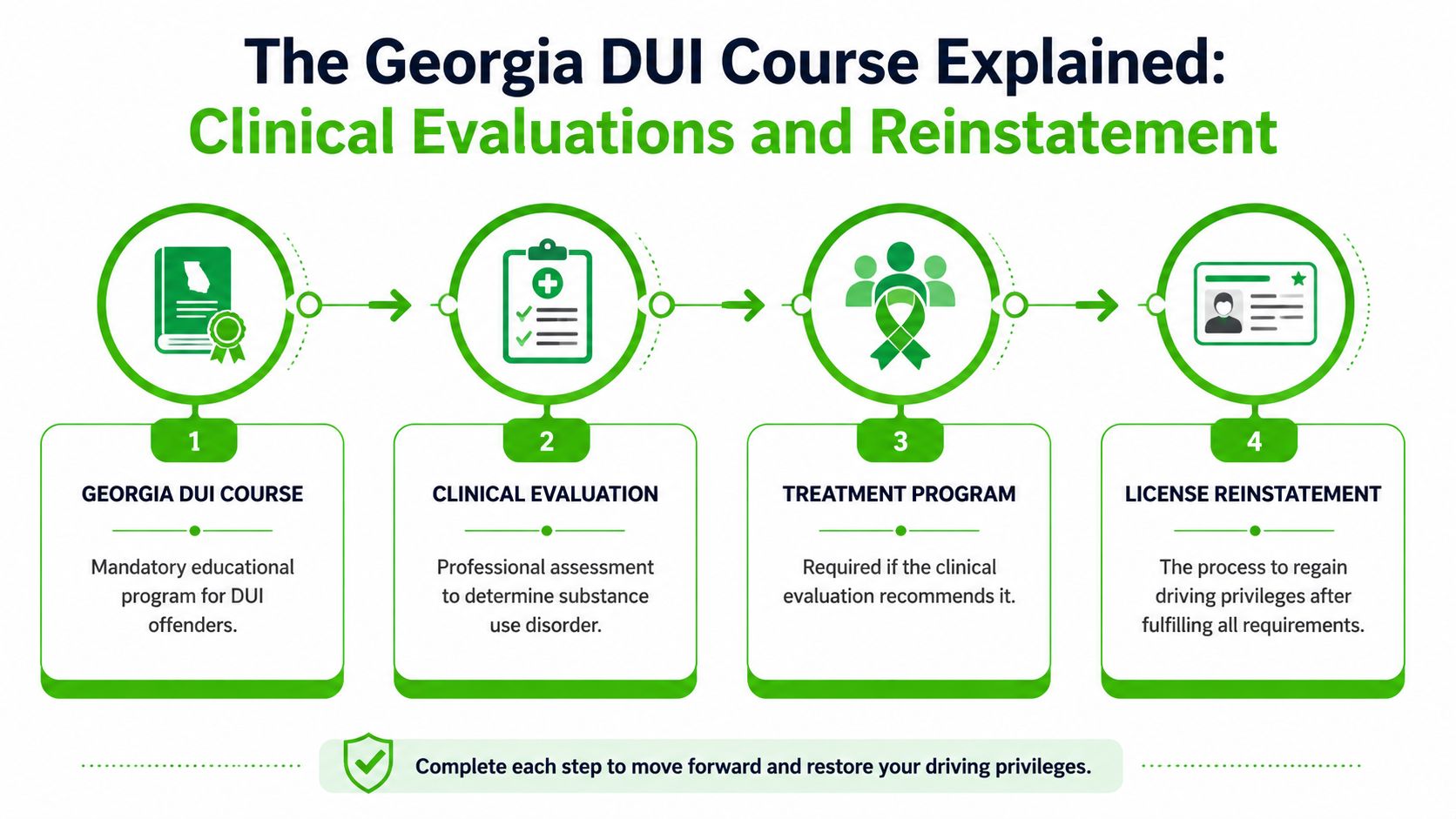
In Georgia, drivers convicted of DUI are legally required to complete a 24-hour Risk Reduction course, including a clinical evaluation and a Victim Impact Panel, within 120 days of conviction to reinstate driving privileges under O.C.G.A. §40-5-75.
That requirement trips people up because they think the class alone is enough. It often isn't. The state process is broader than sitting through instruction.
Here's the basic structure:
Assessment component
This includes the required evaluation piece that helps determine substance use risk and next steps.Intervention component
This is the education portion aimed at behavior, judgment, and consequences.Clinical evaluation
A licensed professional evaluates the offender using the required protocol.Victim Impact Panel
This component exposes offenders to the human cost of impaired driving.
Why the clinical evaluation matters
A lot of drivers get nervous when they hear “clinical evaluation,” but the key is to treat it seriously and complete it through the proper channel. In Georgia, these evaluations must be conducted by a licensed professional and use the state's protocol tied to ASAM Level 1 treatment criteria when applicable.
That evaluation can affect what comes next. If further treatment is recommended, ignoring it can create a reinstatement problem. This is one of the biggest mistakes people make. They focus on the classroom date and overlook the clinical side.
For drivers dealing with related court supervision issues, it can also help to understand other monitoring conditions that sometimes show up in DUI cases, such as an alcohol ankle monitor, because those conditions often exist alongside education and treatment requirements.
Missing one required component can stall the whole reinstatement process, even if you completed the class itself.
Habitual offender consequences are severe
If a driver moves into habitual offender territory, the stakes rise fast. Georgia's habitual offender laws under O.C.G.A. §40-5-130 include a 33-month suspension for a second DUI within five years, and reinstatement requires completion of a state-approved Risk Reduction course with a clinical evaluation.
That's why people shouldn't treat a DUI course like routine paperwork. It sits inside a larger legal framework involving DDS rules, treatment recommendations, and reinstatement timing.
A clear explanation of the course itself is available in this page on what the Georgia Risk Reduction program involves. Read it carefully before enrolling so you understand what the state is asking you to complete.
Long-Term Strategies for Safe Driving in Georgia
Drivers improve fastest when they stop treating mistakes as random. Every hard stop, late lane change, or rushed merge has a cause. If you identify that cause, you can correct it. If you excuse it, you'll repeat it.
Use reflection, not ego
A study published in Accident Analysis & Prevention found that structured education combined with reflective practice, where drivers analyzed their own mistakes, was the single most significant predictor of long-term safety improvement, reducing crashes by 31% over three years.
That finding matches what experienced instructors see all the time. The drivers who improve aren't always the most naturally confident. They're the ones willing to review what went wrong and why.
A few practical ways to do that:
- Review recent drives: Think about where you braked late, rushed a gap, or missed a sign.
- Use a dashcam if you have one: Watching your own footage can expose habits you don't notice in the moment.
- Keep a short pre-drive checklist: Seat, mirrors, route, weather, mindset.
- Notice emotional triggers: If traffic pressure makes you speed up, tailgate, or freeze, that's a training issue.
Keep skill maintenance tied to your record
In Georgia, safe driving and license protection go hand in hand. If you've already had a citation, point issue, or DUI-related problem, staying sharp isn't optional anymore. It's how you avoid another round with DDS, the court, or your insurer.
The safest drivers I've known weren't perfect. They were coachable, consistent, and honest about their weak spots.
That's the answer to how to improve driving skills over the long run. Clean up the fundamentals. Train your eyes. Respect the legal side of the process. Then keep practicing like the skill can fade, because it can.
Frequently Asked Questions About Georgia Driving Courses
A driver gets stopped in Georgia, pays the ticket, and assumes a quick class will wipe the slate clean. Then DDS, the court, or a reinstatement notice says otherwise. That mix-up happens all the time, and it costs drivers time, money, and sometimes more time off the road.
What is the difference between a Defensive Driving course and a DUI Risk Reduction course
A Defensive Driving course is usually taken to improve driving habits, qualify for point reduction if eligible, or pursue an insurance discount. A DUI Risk Reduction course serves a different purpose. It is tied to DUI-related legal requirements and is often part of the process for getting driving privileges back.
The mistake I see most often is drivers enrolling in the wrong class first. A basic defensive driving class will not satisfy a DUI-related requirement.
Can I take a Defensive Driving course in Georgia to remove a ticket from my record
No. A Defensive Driving course in Georgia does not erase the ticket or the violation from your driving record.
What it may do, if you qualify, is reduce points and help you correct the habits that led to the citation in the first place. That matters because the goal is not just paperwork. The goal is keeping your license and avoiding the next stop.
What happens if I am designated a Habitual Offender in Georgia
The consequences are severe, and the fix is not a voluntary driving class. If the state classifies you as a Habitual Offender, you may face a long suspension period and added reinstatement requirements, including a state-approved Risk Reduction course and a clinical evaluation, depending on the case.
That is where drivers get in trouble by guessing. Habitual Offender cases, DUI cases, and point issues can overlap, but they are not handled the same way.
How do I find a DDS-approved course provider
Start with the Georgia Department of Driver Services list of approved providers. Then verify the exact course title before you register.
That detail matters. Defensive Driving and Risk Reduction courses do different jobs under Georgia law. A good provider should also explain scheduling, class format, fees, and whether related requirements such as clinical evaluations or Victim Impact Panels are available through the same process.
If you need a Georgia course, choose the one that matches your legal situation, not the one that sounds closest. If you are dealing with DUI-related requirements, court orders, or reinstatement questions, Georgia DUI Schools can help you determine the right next step through its main site.