
You've opened a court summons at the kitchen table, checked an insurance renewal letter, or read a DDS notice that makes your driving record suddenly feel urgent. Somewhere in the paperwork, or during a phone call, someone mentions an Atlanta defensive driving class. Your next question is probably practical: Which class counts, and what do I do with the certificate afterward?
The answer starts with your reason for enrolling. Georgia recognizes a driver-improvement program that can serve different purposes, but completing a class doesn't automatically resolve a court case, update a driving record, or change an insurance bill. Match the course to your requirement before you pay, and the process becomes much easier to manage.
Why Atlanta Drivers End Up in a Defensive Driving Class
Consider a Midtown professional sorting through traffic paperwork after a stressful stretch of commuting. There might be a camera-enforcement notice in the pile alongside other citations, but the driver shouldn't assume every notice has the same consequences. The useful starting point is the actual DDS record and the wording of each document, not a guess about which ticket added points.
Across town, a Sandy Springs driver opens an insurance renewal and wonders whether a defensive driving certificate could help. That driver isn't necessarily facing a court date or a licensing problem. The concern is whether an approved course qualifies for a discount on the policy.
A College Park resident has a different problem: a court order says to complete a driving class. That driver needs to know the correct program name, the accepted format, and where to deliver proof of completion.
These are illustrative situations, not accounts of particular students. They show why people arrive at the same search with very different questions.
Start with the document in your hand
Your first job isn't to choose the nearest classroom. It's to identify who needs something from you.
- Court paperwork: Look for the exact course name, completion deadline, and certificate-submission instructions.
- Insurance correspondence: Ask the insurer whether you qualify for a defensive-driving discount and which documentation it requires.
- DDS correspondence: Confirm your licensing status and whether driver improvement is appropriate for the issue described.
That distinction matters because you can finish the right class and still send the certificate to the wrong place. A court clerk, an insurance representative, and a DDS employee handle different requests. Don't expect a conversation with one office to settle the requirements of another.
Practical rule: Keep the paperwork that brought you to class beside you when you register. The wording on that document matters more than an advertisement's promise.
Separate the problem from the promise
It's understandable to want a single purchase that takes care of everything. An approved class can be relevant to several needs, but each office still makes its own determination. Treat any promise of automatic ticket dismissal, guaranteed savings, or immediate licensing relief cautiously.
The same separation helps with other Atlanta driving concerns. If you're also worried about protecting a vehicle where you park, CARLOCK's resource on car security for high-theft areas addresses a different question from driver improvement. Vehicle security doesn't replace safer-driving education, and neither substitutes for handling court or DDS paperwork.
You don't need to understand every Georgia driving rule before enrolling. You need a clear answer to a smaller question: What am I asking this class to accomplish? Once you can say that plainly, you can ask a provider focused questions instead of buying whichever course appears first.
What Georgia Calls a Defensive Driving Class
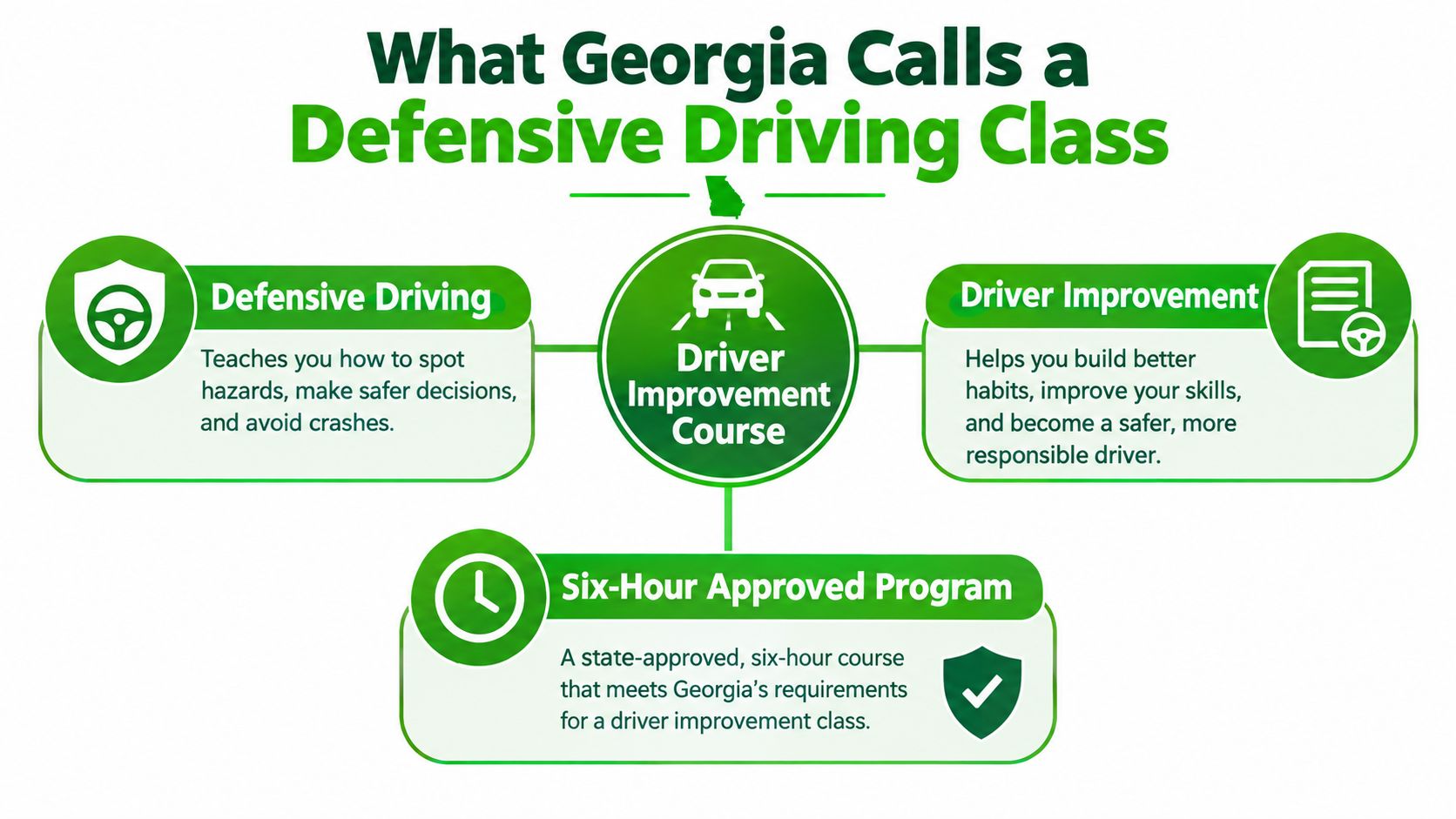
Defensive driving and driver improvement mean the same thing in Georgia's DDS terminology. DDS describes the recognized class as a six-hour program focused on safer driving attitudes and behaviors, and its approval framework is central to certificates used for court, licensing, and insurance purposes, as explained in the Georgia DDS defensive-driving FAQs.
That vocabulary can spare you considerable confusion. A court document may say driver improvement while a school's registration page says defensive driving. Those names can refer to the same program, rather than competing types of education.
Recognize the program, not just the marketing
Think of the course name as the label on the correct folder. Before choosing a schedule, make sure you're opening the folder your court, DDS, or insurer needs.
A website might advertise traffic school, a safe-driving course, an insurance course, or an online certificate. Those descriptions alone don't establish that the offering meets your requirement. Ask specifically whether the course is Georgia DDS-approved driver improvement, then verify whether its delivery format is accepted for your purpose.
A provider's approval also shouldn't be treated as blanket acceptance of everything it sells. If a school offers different programs, identify the particular class you're purchasing.
Useful questions include:
- Program identity: Is this driver improvement, rather than DUI/Risk Reduction or another program?
- Approval status: Can the provider explain how this specific offering meets Georgia's driver-improvement requirements?
- Intended use: Does the school understand whether you're enrolling for court, DDS, insurance, or personal education?
- Certificate handling: How will you receive the completion document, and what should you do if an office needs the original?
Keep other driving programs separate
Ordinary driver's education for someone learning to drive isn't the same enrollment decision as driver improvement. Likewise, paperwork naming a juvenile traffic program deserves its own confirmation rather than an assumption that an adult defensive driving class will substitute.
DUI/Risk Reduction is a separate program, not another name for defensive driving. If your order mentions alcohol or drug use, don't shorten that language to traffic school when you call a provider. Read the program name exactly as it appears.
For insurance purposes, qualifying programs recognized by the insurance statute require separate attention, too. Don't assume every safety course offered by a familiar organization satisfies a DDS licensing requirement.
The practical lesson is simple: use the official program name when speaking with the school and the office requesting completion. Precise language helps everyone confirm the same course before you spend time or money.
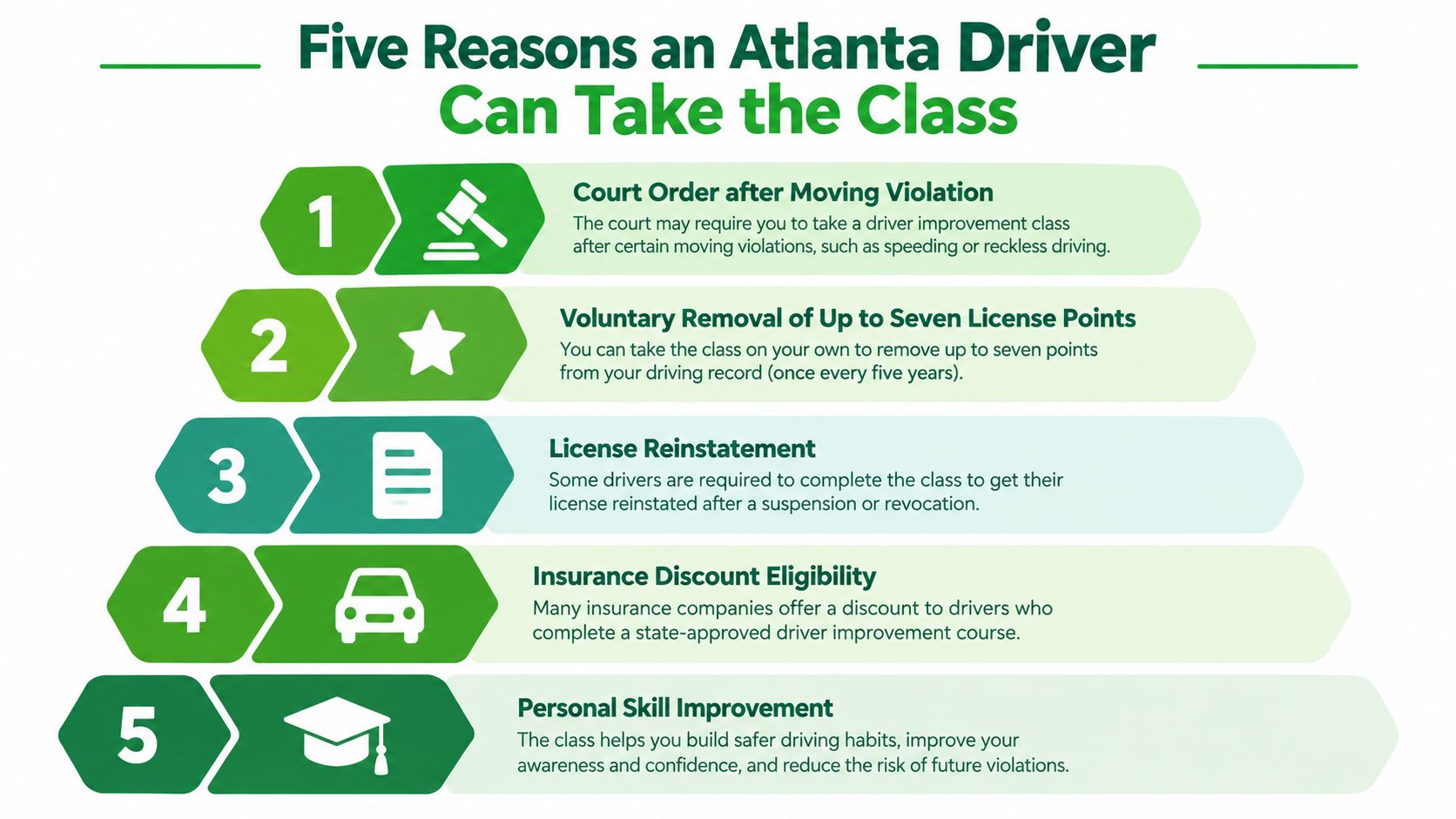
The Five Reasons an Atlanta Driver Can Take the Class
The class has several legitimate uses, but they aren't interchangeable outcomes. A driver seeking court compliance needs a different confirmation from someone hoping to lower an insurance premium. Choose your enrollment purpose deliberately rather than selecting whichever option sounds most favorable.
Court orders and licensing needs
Court compliance begins with the order itself. A College Park driver told to complete driver improvement should ask the clerk or their attorney about the accepted course and format. Taking a class voluntarily isn't the same as receiving confirmation that it satisfies a particular order.
Voluntary point reduction is an administrative use of driver improvement. It has eligibility limits, so check whether you can request the benefit before you enroll specifically for that purpose. The guide to removing points from a Georgia driving record can help you prepare questions, while DDS remains the authority on your eligibility.
License reinstatement requires careful reading of the individual reinstatement instructions. If driver improvement appears among your requirements, completing it addresses that requirement. Don't treat the certificate as proof that every other licensing condition has been resolved.
Insurance eligibility deserves its own phone call
Georgia Code § 33-9-42 requires a premium reduction of at least 10% on specified private-passenger coverages, including liability, first-party medical, and collision, when the statutory conditions are met; named drivers at least 25 years old generally need no traffic offenses or at-fault claims during the preceding three years and completion of a qualifying course lasting at least six hours, under the Georgia defensive-driving insurance-discount statute.
That's an eligibility rule, not a promise that every student's entire premium will drop. The law also recognizes qualifying programs administered by organizations such as AARP, AAA, and the National Safety Council, alongside qualifying DDS-approved clinics or driving schools.
Before registering, ask your insurer:
- Eligibility: Does my driving and claims history meet the applicable conditions?
- Course recognition: Will you accept this particular course and format?
- Covered charges: Which portions of my policy would receive the reduction?
- Documentation: What proof do you need, and how should I submit it?
For the Sandy Springs driver concerned about renewal, this conversation should happen before class, not after.
Personal education is a valid reason
You don't need a summons to want better driving habits. An older driver rebuilding confidence, someone returning to regular commuting, or a motorist unsettled by an uncomfortable traffic encounter may choose driver improvement for personal education.
In that situation, the learning experience matters more than a hoped-for administrative result. Tell the instructor what feels difficult, whether it's merging, managing space, or staying calm around impatient drivers.
The same recognized course can support different purposes, but the benefits depend on the driver's circumstances. Enrolling for court compliance doesn't automatically establish insurance eligibility, and wanting a discount doesn't establish eligibility for a DDS points request.
Online, Live Virtual, and Classroom Formats Compared
The best format is the one you can complete properly and use for your intended purpose. Convenience matters, but acceptance comes first. Before comparing schedules, ask the office requesting the course whether it places conditions on how you attend.
Providers may offer self-paced online learning, live virtual instruction through Zoom, or an in-person classroom. Don't assume those options are interchangeable merely because they appear on the same registration website.
Defensive Driving Format Comparison for Atlanta Drivers
| Format | Schedule | Court Acceptance | Best For |
|---|---|---|---|
| Self-paced online | Work through material within the provider's completion rules | Confirm the specific course and format with the court before purchasing | Drivers seeking flexibility who have verified acceptance |
| Live virtual through Zoom | Attend scheduled instructor-led sessions remotely | Confirm that the court accepts live remote instruction | Drivers who want questions answered without classroom travel |
| In-person classroom | Attend at a physical location on a set schedule | Confirm that the course meets the wording of the order | Drivers who prefer face-to-face help or have limited internet access |
Choose around your actual routine
Self-paced learning can fit an unpredictable workday, but it requires you to manage your own progress. Ask whether the course has timing rules, technical requirements, or restrictions that affect completion. Don't assume that online means you can rush through the material whenever you like.
A live Zoom class offers direct access to an instructor without the trip to a classroom. You'll still need a dependable connection, an appropriate device, and a setting where you can participate without interruptions. Ask the school about camera, audio, attendance, and participation expectations before the session.
An in-person class can be a sensible choice if technology is frustrating or your home isn't a quiet learning space. For an Atlanta driver, include travel, parking, and the return trip in your scheduling decision. A class that looks convenient on a calendar may be difficult to attend reliably from the other side of the metro.
- Unpredictable schedule: Compare self-paced options, but verify acceptance and completion rules first.
- Questions you want answered: Consider live instruction, either remotely or in a classroom.
- Limited internet or device comfort: Ask about a classroom option rather than struggling through an unsuitable format.
Get acceptance confirmed before paying
If you have a court order, ask the clerk directly whether the proposed format satisfies it. You don't need to guess which Georgia courts might prefer instructor-led attendance. You need an answer for the court handling your case.
The explanation of whether online defensive driving courses are legitimate is a useful starting point for comparing online offerings. Still, a general explanation can't replace confirmation about your particular order or licensing purpose.
Online describes where you learn. It doesn't, by itself, tell you who will accept the certificate.
What Actually Happens Inside the Six-Hour Class
You don't need to arrive knowing the answers. The purpose is to examine driving decisions and practice recognizing situations before they become harder to manage. Ask the provider for its course outline and assessment expectations, because the precise presentation can vary.
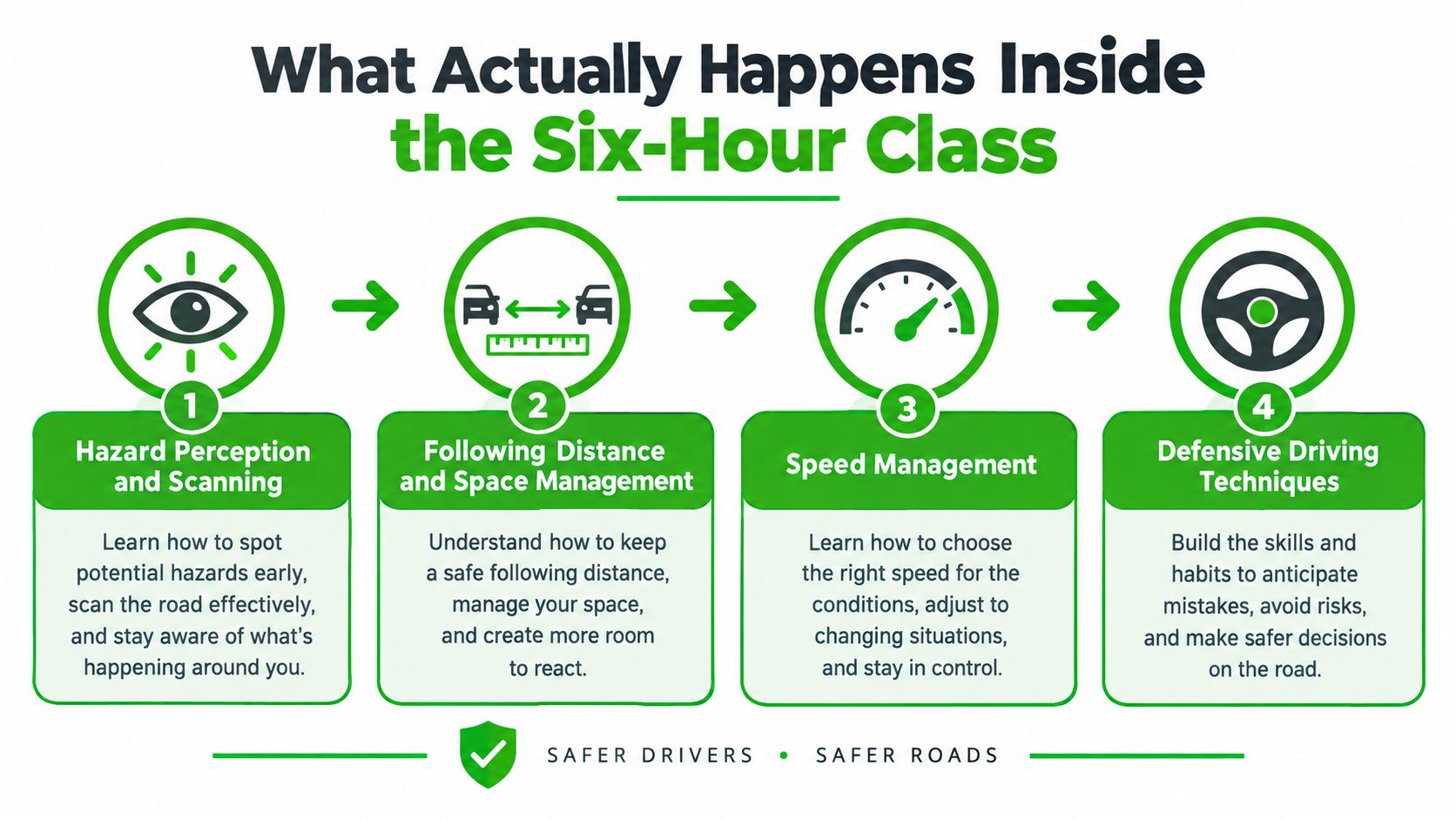
The topics below are practical examples of defensive-driving instruction, not a promise that every approved provider uses identical modules or exercises. They illustrate how safer attitudes and behaviors translate into everyday Atlanta traffic.
Read the situation before reacting
Hazard perception and scanning mean looking beyond the vehicle immediately ahead. In a Midtown example, you might consider a pedestrian approaching the curb, a vehicle preparing to leave a parking space, and brake lights farther along the street. The question is what you can notice early enough to make a calm decision.
Following distance and space management concern the room available around your vehicle. An instructor might ask what happens to your options when you crowd the car ahead or drive beside another vehicle without an easy way to change position. The useful habit is to think about available space before you need it.
Speed management connects those observations to your choices. For example, a discussion could examine whether the speed you've chosen leaves room to respond when traffic compresses or visibility changes. This is more useful than treating driving as a contest to keep pace with everyone nearby.
Discuss decisions without embarrassment
Impairment discussions can address alcohol, drugs, prescription medications, and fatigue as considerations in deciding whether to drive. If you have a medication question, ask a qualified healthcare professional rather than expecting an instructor to assess your prescription.
Other useful scenarios include responding to an aggressive driver, noticing an emergency vehicle, and considering the legal or insurance consequences of a serious violation. You can work through those situations without pretending you've always made perfect decisions.
A provider may use quizzes, discussion prompts, or interactive checks. Ask what its course requires instead of worrying about an unspecified test. If a question confuses you, that's a reason to ask for clarification, not to stay quiet.
Understand what proves completion
The class ends with an administrative responsibility as well as a learning outcome. For point reduction, an eligible licensed Georgia resident may request removal of up to seven points once every five years after successful completion and must submit the original completion certificate to DDS by mail or at a customer service center, according to the Georgia DDS Driver Improvement Program requirements.
That limit is why you should verify eligibility before enrolling for points. Taking another class doesn't create an additional reduction outside the state's rules.
Keep a copy for your records before sending the original where required. For court or insurance use, follow that office's documentation instructions rather than assuming the DDS submission also reaches everyone else.
How to Register and Submit Your Certificate
Registration should begin with the requirement and end with proof that the correct office received your documentation. Booking the class is only part of the job. Keep your deadline, course confirmation, and certificate instructions together so you're not reconstructing them afterward.
For a court-related requirement, the explanation of a court-ordered driving class can help you prepare for the enrollment conversation. Have the order available when you call, especially if it names a particular program or delivery format.

Before you book
Use this checklist to avoid paying for a course that doesn't match your needs:
- Confirm the program: Read the exact requirement to the school and clarify any unfamiliar wording.
- Verify the provider: Check DDS approval for the particular driver-improvement offering you're considering.
- Confirm the format: Obtain acceptance guidance from the court, DDS, or insurer when applicable.
- Compare workable schedules: Ask about current weekday, evening, weekend, classroom, and remote options rather than assuming availability.
- Check certificate timing: Tell the provider your deadline and ask when and how completion documentation will be issued.
For classroom attendance, choose a location you can reach without an unrealistic travel plan. Drivers comparing Atlanta, Athens, or surrounding metro options should consider where they will be before class, not which location is nearest home.
For remote instruction, ask whether your device and connection meet the provider's requirements. Test the setup beforehand if the school supplies instructions.
Register with the correct details
Use the provider's available registration method, whether online or by phone. Enter your name and other requested identifying information carefully, and ask how those details will appear on the certificate.
Confirm what to bring or have available. That may include identification, your enrollment confirmation, or relevant paperwork, depending on the school's instructions. Don't assume another student's checklist applies to your session.
Leave room between course completion and your submission deadline. Ask about the actual certificate process rather than relying on an expectation of immediate delivery.
Before class: Make a note of who needs the certificate, how they want it delivered, and what confirmation you'll retain.
Finish the submission, not just the attendance
For a points request, follow the original-certificate DDS process described earlier. For reinstatement, use your individual DDS instructions and confirm whether anything else remains outstanding.
For court compliance, submit proof as directed by the court. For an insurance discount, send the documentation through the insurer's requested channel and ask for confirmation that it has been reviewed.
Keep copies of your certificate and submission records together. If someone later asks whether you completed the requirement, you'll have a clear record instead of only a memory of attending.
Common Mistakes Atlanta Drivers Make With This Class
The most expensive mistake is often choosing a course by its familiar-sounding name. Traffic school, defensive driving, and DUI education aren't labels you can freely substitute. The wording on your order determines which question you need to ask.
Choosing defensive driving for a Risk Reduction requirement
Georgia's DUI Alcohol or Drug Use Risk Reduction program requires a 130-question Assessment Component, commonly called the NEEDS assessment, and a 20-hour Intervention Component; participants must finish both to receive a Certificate of Completion, according to the Georgia DDS DUI program FAQs.
The assessment evaluates alcohol and drug use and its effect on driving, while the intervention uses therapeutic education and peer-group counseling. The program applies to people convicted of DUI, illegal-drug possession, underage alcohol possession while operating a motor vehicle, or boating under the influence.
DDS lists its standard total cost as $360, comprising $100 for assessment, $235 for intervention, and $25 for the required workbook, in that same FAQ.
Those are Risk Reduction requirements, not the price or structure of defensive driving. If your paperwork names DUI/Risk Reduction, don't purchase driver improvement as a substitute.
Assuming completion guarantees every benefit
A certificate demonstrates completion of a course. It doesn't establish that you qualify for every possible use of that course.
Watch for these assumptions:
- Repeat points requests: Retaking the class doesn't override the eligibility interval or maximum reduction already described.
- Automatic insurance savings: The statutory conditions still matter, including driving and claims history.
- Universal online acceptance: A certificate from an uncertified offering doesn't become acceptable because the website calls it traffic school.
- Out-of-state equivalence: Don't assume another state's approval establishes recognition for your Georgia requirement.
- Automatic submission: Confirm what you must deliver yourself rather than assuming the school handles every office.
Sending the wrong document or stopping too soon
For a DDS points request, don't substitute a photocopy for the required original. Keep your own copy, then follow the official submission instructions.
Likewise, don't mistake classroom completion for confirmation that the court has recorded compliance or that an insurer has applied an eligible discount. Ask the receiving office what happens next and retain its response.
You can prevent most of these problems with a short conversation before enrollment. Bring the paperwork, name the purpose, confirm the format, and find out where the certificate belongs. That's a manageable process, even when the notice that started it felt overwhelming.
Georgia DUI Schools offers defensive driving and DUI/Risk Reduction education, with classroom and online options to discuss against your specific requirement. Visit to ask about an Atlanta defensive driving class, have your court, DDS, or insurance paperwork ready, and confirm the correct course and format before registering.