

You paid the court, finished probation, and assumed your Georgia driver's license would come back automatically. Then you checked your record and saw the same suspension. That situation is common because suspended license reinstatement isn't a single DDS filing. It's a chain of clearances involving courts, insurance companies, treatment providers, and the Georgia Department of Driver Services.
The right approach is to identify the exact suspension trigger, find every unresolved hold, complete only the programs DDS and the court will accept, and submit proof in the order the agencies can verify it. A missing certificate, unpaid balance, or insurance filing sent to the wrong agency can stop an otherwise complete application.
Why Georgia Drivers Lose Their License in the First Place
A driver in Atlanta might miss a Super Speeder notice after moving, accumulate enough points through repeated traffic violations, or refuse a breath test after a DUI arrest. The suspension letter arrives from DDS, but DDS may not be the only agency involved. A court can hold a case open, the Department of Revenue can track insurance compliance, and child-support or failure-to-appear records can create separate barriers.
That's why the first question isn't “Which fee do I pay?” It's “What caused this suspension, and which clock is running?”
A DUI-related administrative suspension can follow a per se alcohol case or an implied-consent refusal. Under O.C.G.A. 40-5-67.1, the relevant withdrawal period can be a 12-month hard suspension, depending on the facts and applicable law. A first Super Speeder violation involving a speed of 75 or more miles per hour carries a 120-day suspension when the required fee isn't handled properly. Point suspensions apply when a driver reaches 15 points within 24 months.
Other suspensions come from failing to appear in court, unpaid obligations, or child-support enforcement. Those cases may not require the same DUI course or clinical documentation, but they still need the underlying hold released before DDS can restore driving privileges.
| Suspension Trigger | Withdrawal Period | Statute |
|---|---|---|
| DUI per se or implied-consent refusal | 12-month hard suspension in applicable cases | O.C.G.A. 40-5-67.1 |
| First Super Speeder violation at 75 or more miles per hour | 120 days | Georgia DDS rules and notice |
| Accumulated points | Triggered at 15 points within 24 months | Georgia DDS points framework |
| Failure to appear | Until the court releases the hold | Court and DDS procedures |
| Child-support suspension | Until the responsible agency releases the hold | Georgia DDS and child-support procedures |
The fee path also depends on the case. Georgia uses a $200 reinstatement fee in some situations, while another path can require a $210 reinstatement and license fee. Don't assume the amount on one notice applies to every suspension.
For comparison, drivers dealing with a different legal system can review this Ontario DUI penalty guide to see how impaired-driving consequences vary by jurisdiction. The lesson is useful in Georgia too: reinstatement rules depend on the event, the agency involved, and the exact status of the driver record.
The Georgia DDS Reinstatement Process From Start to Finish
A paid fine alone will not put you back behind the wheel. Treat reinstatement as a multi-agency checklist. Georgia DDS generally restores the privilege only after every condition tied to the suspension is cleared and each supporting record matches your driver file.
Start with the court record
Contact the court connected to the suspension first. Confirm that fines, probation terms, required appearances, and case obligations are complete. Ask how the court sends its release or clearance to DDS, then keep a receipt or certified document even if the clerk says the release is electronic.
A zero court balance does not guarantee that DDS has updated its separate record. Give the agencies time to exchange information, and verify the status before paying a reinstatement fee.
Complete the accepted education requirement
For a DUI, drug, or alcohol-related case, use a DDS-certified Risk Reduction provider. The provider issues the completion certificate and submits the completion information through the required process. An uncertified class can leave you holding paperwork DDS will reject.
Use this Georgia DDS license reinstatement resource to organize the required documents and steps.
Clear insurance and treatment conditions
Insurance clearance runs separately from education. If Georgia requires an SR-22 or another financial-responsibility filing, instruct your insurer to submit the correct document to the appropriate state system. Confirm that the filing is active and associated with the correct driver record.
A clinical evaluation or treatment-completion document may also apply, especially in repeat-DUI cases. Confirm that requirement before submitting your reinstatement packet. Missing clinical paperwork is a common reason a file remains incomplete.
Pay after confirming the amount
Verify the current fee and eligibility status through DDS before submitting payment. The amount can depend on the suspension path, and payment made before another hold is released will not restore driving privileges.
Other states use different agencies and documents. For comparison, drivers can review how to get your Michigan drivers license back after a DUI.
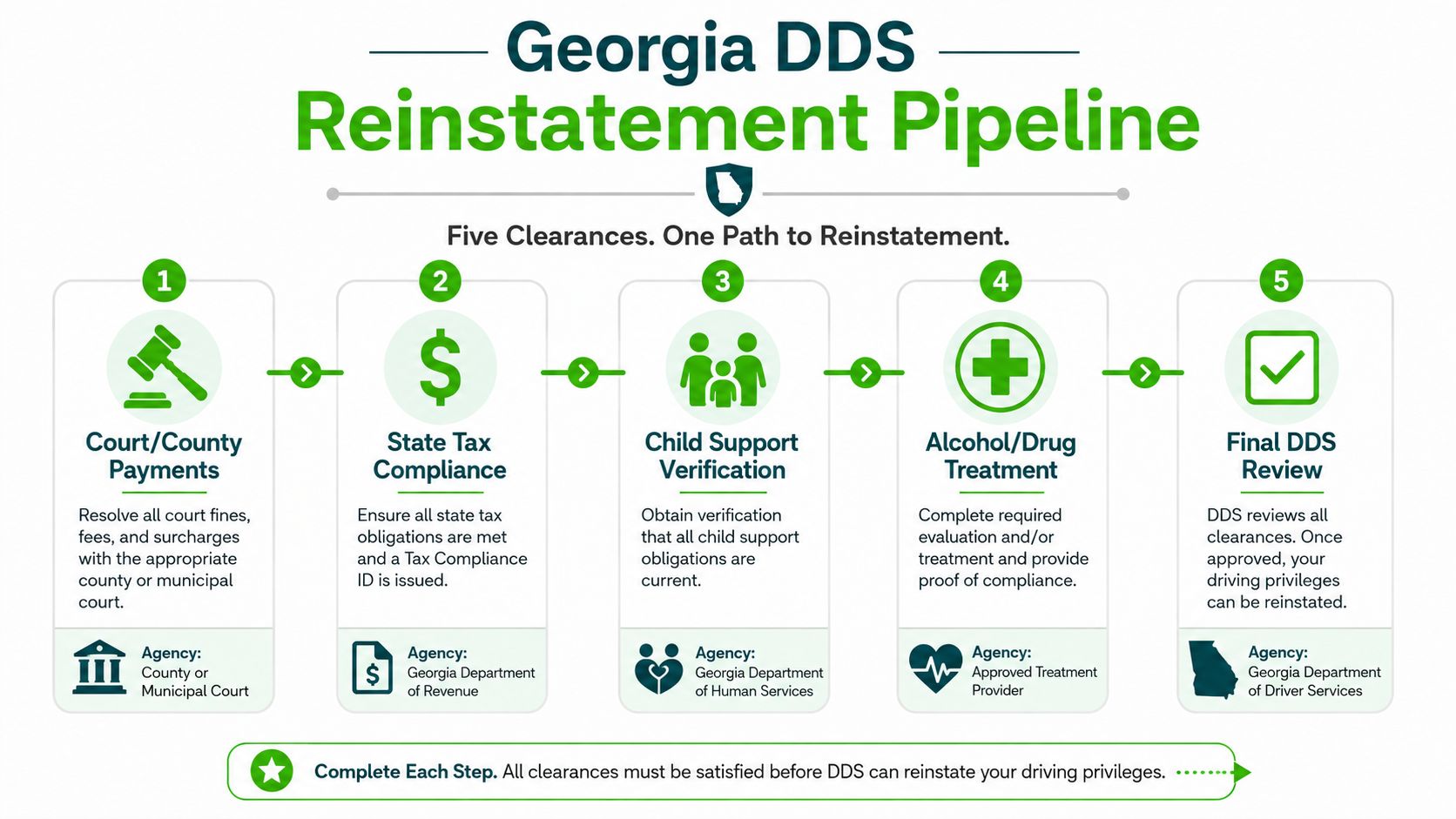
Practical rule: Completing one requirement does not authorize driving. Drive only after DDS confirms restoration or you receive lawful restricted driving authority.
DUI Risk Reduction and Defensive Driving Classes That Count
Georgia's Risk Reduction Program is not the same as defensive driving. For a DUI-related reinstatement, the accepted course follows Georgia's required structure under Administrative Rule 375-3-.03. The program contains 20 hours, made up of 17 hours of classroom instruction and 3 hours for an assessment or evaluation session. The instruction must come from a DDS-certified provider and must be delivered in an accepted in-person or live-virtual format.
That distinction matters because many internet courses use similar language but don't satisfy Georgia's licensing or court requirement. Georgia DDS states that classes from uncertified schools won't be accepted for licensing, reinstatement, or court purposes. In Georgia, certification is a compliance requirement, not a marketing detail.
Risk Reduction is the DUI requirement
A DUI, drug, or alcohol-related conviction affecting driving privileges under O.C.G.A. 40-5-63 can trigger the Risk Reduction requirement. The provider's certificate should identify the participant, the certified school, the completed program, and the completion information DDS needs to match the record.
Keep the original or official copy in your personal file. Don't rely only on an email attachment or assume the court's copy will automatically resolve the DDS record.
Defensive driving serves a different purpose
Georgia's defensive driving option under O.C.G.A. 40-5-82 can address points when the driver meets the applicable requirements. DDS says a certified Driver Improvement course can reduce up to 7 points once every 5 years, and the original certificate must be presented to DDS in person or mailed for the reduction to apply. That course may help with a point record, but it doesn't substitute for Risk Reduction after a DUI-related suspension.
Do not substitute a point-reduction course for a DUI requirement. The names sound similar, but DDS treats them as different programs with different legal purposes.
Before enrolling, verify the provider's DDS certification, the delivery format, and whether the court has imposed additional requirements such as a victim impact panel. Finish the accepted course first, then confirm that the completion record and certificate are available before you file for reinstatement.
SR-22 Insurance and Proof of Financial Responsibility
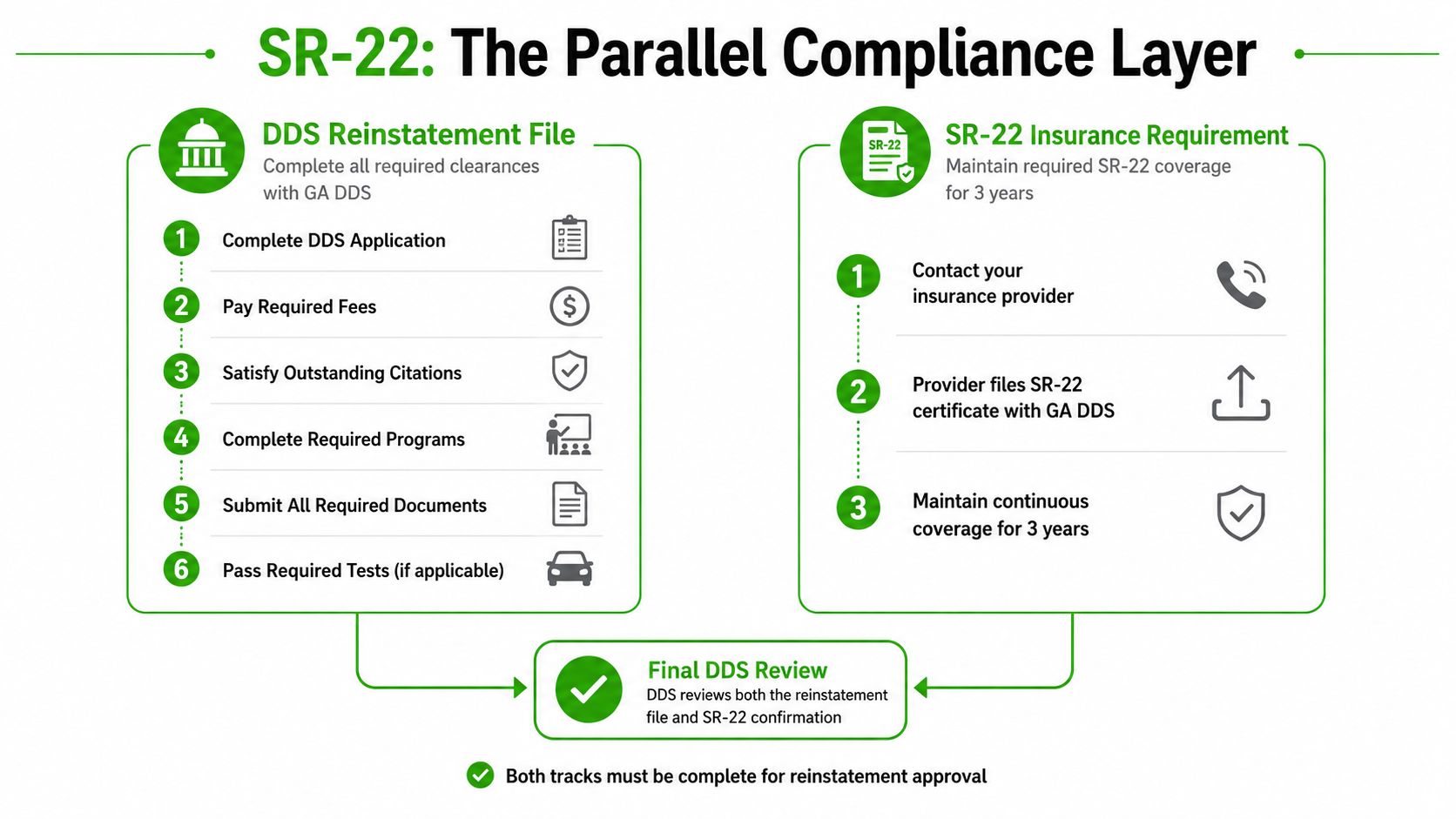
An SR-22 serves as an insurance compliance layer. Your insurer files the certificate electronically with the state system, confirming that you carry the required financial responsibility. DDS must be able to match that active filing to the correct driver record before the reinstatement file can move ahead.
Contact an insurance carrier licensed in Georgia and ask whether it will file an SR-22 for your specific suspension. Vehicle owners may need an owner filing. Drivers without a vehicle should ask about a non-owner SR-22. Give the insurer the exact suspension information, including your legal name and current address, rather than requesting a generic policy change.
Keep the policy active for the period required in your case. A lapse can create another compliance problem, while an outdated name or address can prevent the certificate from matching your DDS record. Confirm the filing status with the insurer before submitting your reinstatement documents.
Your file may also require ignition-interlock compliance. The conviction, court order, and applicable Georgia rules determine whether an interlock applies. If required, use an approved provider, retain installation and service records, and follow every reporting condition. DDS can delay approval when an interlock problem appears after the suspension period has ended.
Treat reinstatement as a multi-agency checklist. DDS, your insurer, the court, and any interlock provider may each control a different document or status. Prepare your payment receipt, insurance confirmation, court clearance, Risk Reduction certificate, required clinical documents, and identification before the appointment or online submission. Verify the DDS form for your suspension type because filing requirements vary.
Drivers comparing coverage can find high risk auto insurance. Review the Georgia license reinstatement fee information before submitting payment, then confirm that your insurer's SR-22 filing is active.
Clinical Evaluations and ASAM Level 1 Treatment Requirements
The requirement drivers overlook most often in repeat-DUI cases is the clinical evaluation. Georgia DDS requires documented proof of a state-approved evaluation when reinstatement follows a suspension tied to two or more DUI convictions within the past 10 years. The evaluation forms part of the reinstatement file, so the DDS packet cannot be complete without it.
Use a qualified clinical provider accepted by DDS and the court. Confirm the provider's credentials before scheduling. The evaluator reviews substance-use history and related factors, then decides whether the evaluation alone meets the recommendation or whether treatment must follow.
Evaluation and treatment aren't interchangeable
Some drivers need only the evaluation documents. Others receive a recommendation for ASAM Level 1 outpatient treatment. That treatment must be completed before the provider can issue the required completion paperwork. Georgia DUI Schools provides information about ASAM Level 1 treatment in Georgia for drivers reviewing how this clinical requirement fits into reinstatement.
Schedules depend on the case and provider. Several attended sessions may not satisfy the requirement. DDS or the court may require a formal completion or discharge document showing the correct name, dates, signatures, provider information, and recommendation status.
Audit the paperwork before filing
A missing signature, incomplete treatment record, or document from an unaccepted provider can lead to rejection. Out-of-state treatment may not transfer automatically. Get written confirmation from DDS or the court before relying on those records.
Keep the evaluation letter, treatment completion record, attendance proof, and payment receipt. If the provider sends records directly, request transmission confirmation and retain your own copy. Check every page before submitting the reinstatement file.
Filing Your Reinstatement With Georgia DDS
Begin with eligibility, not payment. Obtain a certified driving record or use the Georgia DDS online services available through dds.georgia.gov to identify the active suspension, end date, holds, and documents still missing. A driver can be eligible by date but still blocked by a court, insurance, treatment, or out-of-state record.
Create one file with the documents that match the suspension:
- Driving record: Confirm the suspension type, eligibility date, and active holds.
- Court proof: Include paid-fine receipts, release letters, or probation documentation when applicable.
- Risk Reduction certificate: Submit the certificate from a DDS-certified provider.
- Clinical documentation: Include the evaluation, treatment recommendation, and discharge or completion record when required.
- Insurance confirmation: Verify that the SR-22 or other financial-responsibility filing is active and matches your legal name.
- DDS application materials: Use the standard reinstatement form or any hardship-related form DDS specifically requires for your case.
A hardship request isn't the same as full reinstatement. Don't submit a hardship form when your case requires a standard reinstatement application, and don't assume a hardship approval removes the underlying suspension conditions.
Confirm the fee before you pay
The verified Georgia fee paths include a $200 reinstatement fee in applicable cases and a $210 reinstatement and license fee for another category of reinstatement. Georgia's fee structure can also vary by suspension type, so rely on the amount displayed for your record or confirmed directly by DDS. Don't use an old receipt from a different suspension as your guide.
| Suspension Type | DDS Fee | Typical Processing Time |
|---|---|---|
| Fee-based reinstatement | $200 where applicable | Verify with DDS |
| Reinstatement plus license fee | $210 where applicable | Verify with DDS |
| Point suspension | Confirm the amount shown for the record | Verify with DDS |
| DUI-related suspension | Confirm the case-specific fee and conditions | Verify with DDS |
Submit online when your case is eligible for electronic processing. Use an in-person service center appointment when DDS directs you to appear, original documents are required, or the record contains a hold that online services can't resolve.
The most common filing failures are practical: a name mismatch, an expired certificate, an unsigned form, an insurance filing that hasn't posted, or a hold from another state. Check every page before submission, save digital copies, and retain confirmation numbers and receipts.
Timelines, Common Pitfalls, and Getting Back on the Road
The suspension period and the reinstatement timeline are different clocks. A driver may finish the withdrawal period and still need to complete court clearance, education, insurance, clinical, interlock, and payment requirements. A Florida administrative study found that 77.12% of suspensions issued in 2016 remained in effect at the end of 2018, showing how long unresolved reinstatement cases can remain open rather than clearing automatically (Florida suspension study).
DUI cases often take longer because each requirement depends on a different record holder. Research summarized in the same case study found that 42% of first offenders and 55% of multiple DUI offenders delayed reinstatement for more than one year, while one-third had no recorded reinstatement within five years of becoming eligible. The practical lesson is simple: start the checklist early and verify each clearance instead of waiting for agencies to update one another.
Use a written timeline
Set up a case log with the date, agency, person contacted, document sent, confirmation number, and next action. Send important documents through a trackable method when mailing is required. Keep screenshots of online submissions and copies of every certificate.
| Common Pitfall | Concrete Fix |
|---|---|
| Court says the balance is paid, but DDS still shows a hold | Request written release confirmation and verify the DDS record |
| Risk Reduction certificate is complete but not matched to the record | Confirm the provider transmitted completion and keep the official certificate |
| SR-22 is filed under an old name or address | Update the insurer and request confirmation using the exact DDS record information |
| Clinical evaluation is incomplete or not accepted | Confirm evaluator credentials and required documentation before filing |
| Interlock compliance creates a late problem | Keep service, calibration, and compliance records throughout the restriction |
| Another state has an unreleased hold | Contact the originating state and obtain proof of release |
A PubMed-indexed study found that only about 54% of eligible first offenders and 36% of eligible second offenders had fully reinstated driving privileges 3.8 to 4.8 years after arrest, where full reinstatement required completed programs, financial responsibility, paid DMV fees, and no remaining record stops (California DMV reinstatement research). The barrier is cumulative. A finished class won't overcome unpaid fees, missing insurance, or an unresolved hold.
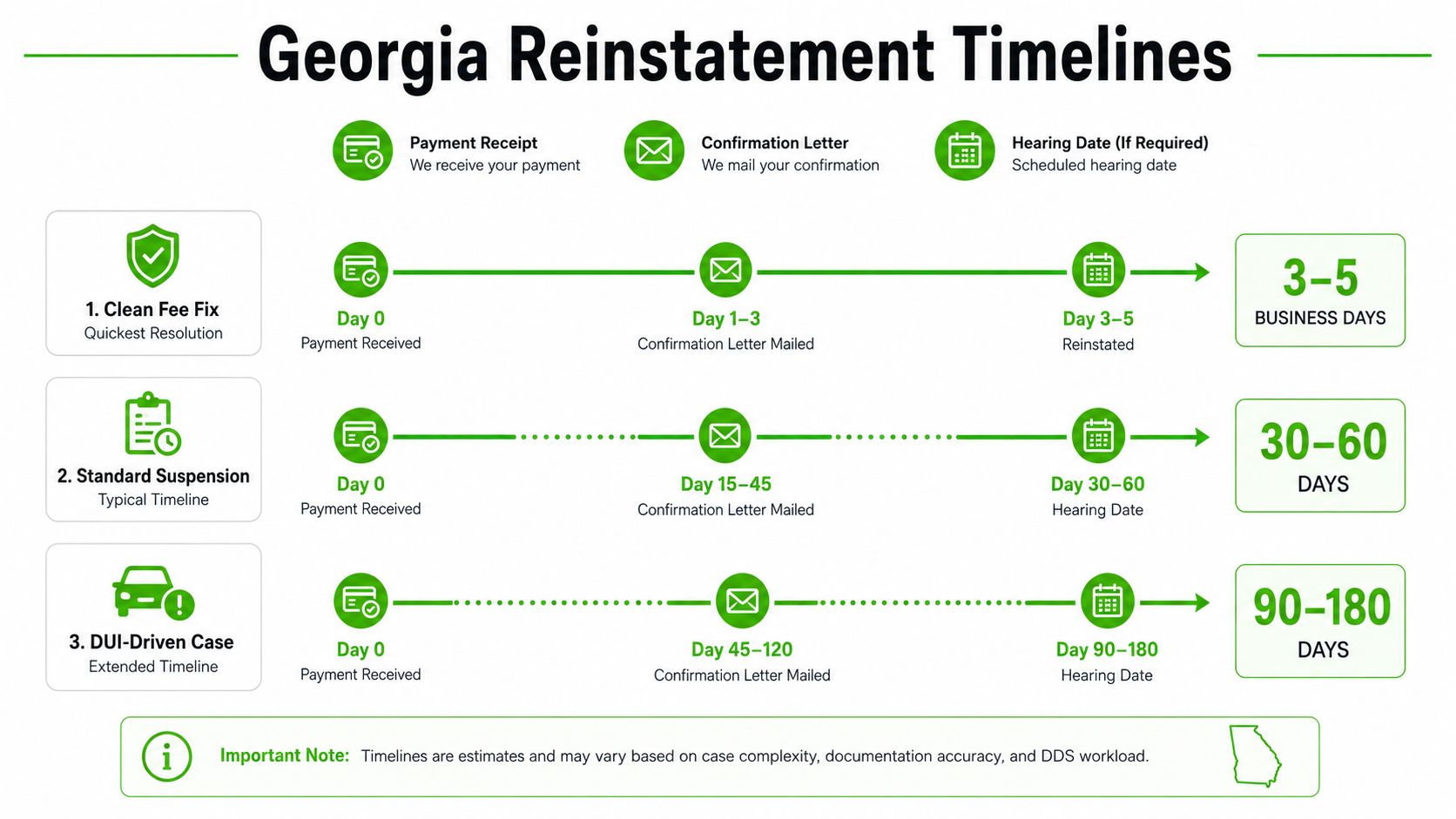
Start your first 30 days with discipline:
- Days 1 through 5: Pull the driving record, identify the suspension trigger, and list every hold.
- Days 6 through 15: Contact the court, insurer, treatment provider, and DDS as applicable.
- Days 16 through 25: Complete accepted Risk Reduction or clinical requirements and collect formal proof.
- Days 26 through 30: Audit the file, confirm insurance posting, verify payment instructions, and submit only when the record is eligible.
Georgia DUI Schools offers DDS-approved Risk Reduction, defensive driving, clinical evaluations, ASAM Level 1 treatment, and Victim Impact Panels through in-person and online options for Georgia drivers. If your reinstatement checklist includes the DUI education or clinical steps, visit Georgia DUI Schools to review the appropriate program and enroll in a format that fits your schedule.