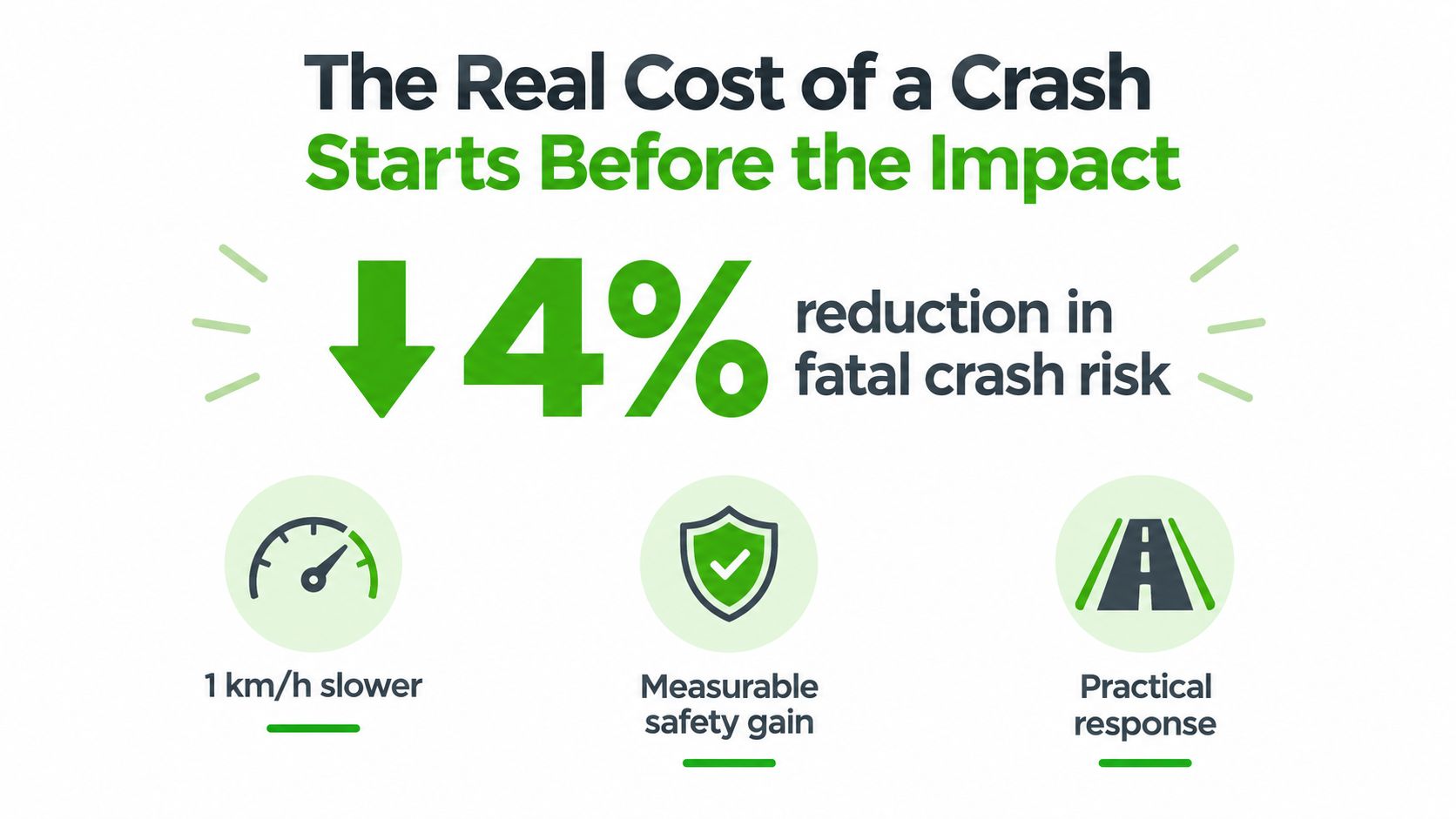
A 1% increase in average speed raises fatal-crash risk by about 4%, according to the OECD International Transport Forum's road-safety analysis. That finding changes the way Georgia drivers should view defensive driving. It isn't a box to check after receiving a citation. It's a practical method for controlling speed, recognizing hazards, creating space, and protecting your license before a routine drive becomes a medical, financial, or legal problem.
For drivers in Atlanta, Savannah, Athens, and throughout Georgia, the lesson applies on crowded city streets as much as it does on I-85 or I-285. Defensive driving connects the physics of stopping with the state's rules for points, court compliance, DUI education, and license reinstatement.
The Real Cost of a Crash Starts Before the Impact
The OECD analysis provides a useful starting point because it shows how small speed changes can carry serious consequences. A 1% increase in average speed leads to about a 2% increase in injury crashes, a 3% increase in severe crashes, and a 4% increase in fatal crashes, according to the OECD road-safety report. The same analysis says inappropriate speed contributes to 20% to 30% of fatal road crashes.
That's why the cost of a crash begins before the vehicles touch. A driver who accelerates aggressively, follows too closely, or ignores changing traffic conditions creates exposure first. The consequences may later include medical expenses, vehicle repairs, missed work, a traffic citation, attorney involvement, and an insurance claim. If the driver caused the collision, the financial effect can continue through higher premiums and reduced coverage options.
A decision with consequences
At the wheel, defensive driving means making several small decisions early:
- Choose a safe speed: Stay within the posted limit, then reduce speed when rain, congestion, construction, darkness, or limited visibility requires more time.
- Scan beyond the vehicle ahead: Look for brake lights, merging traffic, stopped vehicles, pedestrians, animals, and lane changes before they become immediate threats.
- Preserve an escape route: Avoid driving beside another vehicle for long stretches and leave room to move if the driver ahead brakes suddenly.
- Control emotion: A late arrival or an aggressive driver behind you doesn't justify tailgating, racing, or abrupt lane changes.
The course fee and time involved in defensive driving are limited compared with the possible consequences of a collision. A crash can affect your health, employment, transportation, record, and insurance relationship at the same time. Completing education before a pattern of violations develops is often a simpler response than trying to repair a damaged record later.
Practical rule: Slow down before a hazard becomes obvious to everyone else. Early speed control gives you options that emergency braking may not.
The reason this works becomes clearer through stopping-distance physics. Speed doesn't increase risk in a simple, linear way. It affects how far the vehicle travels while you react and how much distance the vehicle needs to stop once braking begins.
How Speed and Stopping Distance Quietly Drive Risk
A vehicle at higher speed covers more ground during the driver's reaction time, and braking distance grows sharply as speed rises. NHTSA notes that when speed doubles, stopping distance quadruples, while the vehicle also travels farther during the first critical 1.5 seconds of reaction time. The technical explanation is straightforward. Kinetic energy increases with the square of velocity, so a modest speed increase can create a much larger braking demand.
For a driver on I-85, 70 mph may feel stable when traffic is flowing. The calculation changes when a deer enters the lane, a vehicle stops near a work zone, or traffic suddenly compresses. Your eyes may identify the problem before your foot reaches the brake, and the car continues moving during that interval.
The stopping-distance picture
The figures below illustrate the principle using rounded instructional values. Actual stopping distance varies with road surface, tires, brakes, vehicle weight, grade, weather, visibility, and driver condition. The underlying relationship between speed and stopping distance is documented in NHTSA's technical discussion of speed and stopping distance.
| Speed (mph) | Perception-Reaction (ft) | Braking Distance (ft) | Total (ft) |
|---|---|---|---|
| 20 | 44 | 20 | 64 |
| 30 | 66 | 45 | 111 |
| 40 | 88 | 80 | 168 |
| 50 | 110 | 125 | 235 |
| 60 | 132 | 180 | 312 |
| 70 | 154 | 245 | 399 |
These values aren't a promise about what every vehicle will do. They're a way to understand why speed control matters. At highway speed, the driver can travel a substantial distance before braking even starts. A three-second following cushion gives you more time to see a developing problem, decide whether to brake or change lanes, and avoid forcing the driver behind you into an emergency maneuver.
Defensive driving courses turn that physics into habits. You learn to look farther ahead, ease off the accelerator before traffic tightens, and avoid treating the posted limit as a target under every condition. A Georgia defensive driving course focused on braking and risk reduction can also help connect classroom principles with the decisions drivers make during ordinary commutes.
Small speed increases matter because they reduce both reaction space and braking margin. That's also why a citation can have consequences beyond the immediate fine. A risky choice may affect the driving record, insurance review, and, for drivers with multiple convictions, the possibility of a much more serious licensing action.
Protecting Your License and Staying Off the Habitual Violator List
Georgia drivers often think of a ticket as a single event. The state treats a driving record as a pattern. Points from separate violations can accumulate, and a driver who keeps repeating high-risk behavior may face restrictions that are far more disruptive than the original citation.
Georgia identifies a driver as a habitual violator after a third qualifying conviction within five years. DDS states that the license is revoked for five years, after which the person may seek a probationary license or reinstatement only if the applicable requirements are met, as explained in the Georgia DDS habitual violator guidance.
How a record becomes harder to repair
The practical warning is simple. Don't wait until reinstatement becomes the only plan.
A driver who receives a speeding citation should first confirm how the violation will affect the record and whether a court permits an approved defensive driving course. The court, not the course provider, controls the disposition of the citation. A course may support point reduction or another permitted outcome, but the driver must follow the court's instructions and submit the correct certificate.
A DUI conviction follows a separate legal and administrative path. Georgia's impaired-driving guidance requires a DUI Alcohol or Drug Use Risk Reduction Program and a clinical evaluation for DUI convictions, with treatment required if the evaluation indicates it, according to the Georgia Highway Safety Office's impaired-driving information. That process may also involve probation conditions, a victim impact panel, treatment documentation, and reinstatement paperwork.
For people declared habitual violators because of DUI-related convictions, Georgia rules require completion of a DDS-approved DUI Alcohol or Drug Use Risk Reduction Program. The Georgia Courts traffic reference manual reflects how education becomes part of the reinstatement process rather than an optional add-on.
A defensive driving course can help address an eligible citation before the record becomes more serious, but it can't erase every type of violation or replace legal advice. Read the order, ask the court clerk what documentation is required, and use Georgia guidance on reducing license points to understand the administrative side before enrolling.
The safest record is built before the third qualifying conviction. Better speed management, greater following distance, and earlier hazard recognition reduce the conduct that creates both crash exposure and repeat citations.
The Financial Payoff in Insurance and Out-of-Pocket Costs
A crash creates two separate financial problems. The first is the immediate bill, which may include repairs, medical care, towing, rental transportation, lost wages, and legal assistance. The second is the continuing cost of a damaged driving and insurance history.
Drivers should also understand the claims process before an accident occurs. A practical guide to steps to file a car insurance claim can help you organize photographs, incident details, police information, and insurer communications if a collision happens.
Compare the consequences
The table below keeps the comparison qualitative because the cost of a crash depends on the injuries, vehicles, coverage, liability, and court outcome.
| Cost Category | After At-Fault Crash | After DDS-Approved Course |
|---|---|---|
| Vehicle expense | Repairs, towing, rental needs, and possible deductible | Course cost and time commitment |
| Medical exposure | Treatment bills and possible lost income | No crash-related medical expense created by the course |
| Insurance review | Possible premium increase or coverage changes | Possible insurer discount, subject to policy rules |
| Driving record | Citation, points, or court consequences may follow | May support an eligible point-reduction process |
| Time burden | Claims, repairs, appointments, and court obligations | Coursework and certificate submission |
The course doesn't guarantee a particular insurance result. Each insurer sets its own eligibility rules, discount amount, documentation requirements, and renewal procedures. Ask your carrier whether it recognizes the exact DDS-approved course, how long the discount lasts, and when you must submit the certificate.
That conversation matters because a certificate can have separate value for the driving record and insurance policy. The court may require one document, while the insurer may request another copy or a specific completion date. Keep the original certificate, confirm delivery, and save written confirmation.
Georgia drivers can review the practical relationship between approved education and insurance documentation through this resource on a defensive driving course to lower insurance costs. The important distinction is between potential savings and guaranteed savings. A course can improve your options, but it can't promise that every insurer will apply the same benefit.
Defensive driving is financially valuable even when no discount applies. Avoiding a crash protects cash flow, transportation, work attendance, and the ability to shop for insurance without an adverse event dominating the conversation.
Why DDS-Approved Status Matters for Court and State Compliance
A certificate only helps if the organization issuing it is authorized for the purpose you need. Georgia DDS says only DDS-certified driving schools are approved to provide Driver Education, Defensive Driving, and DUI programs. Classes from uncertified schools won't be accepted for licensing, reinstatement, or court requirements, according to the Georgia DDS regulated-program guidance.
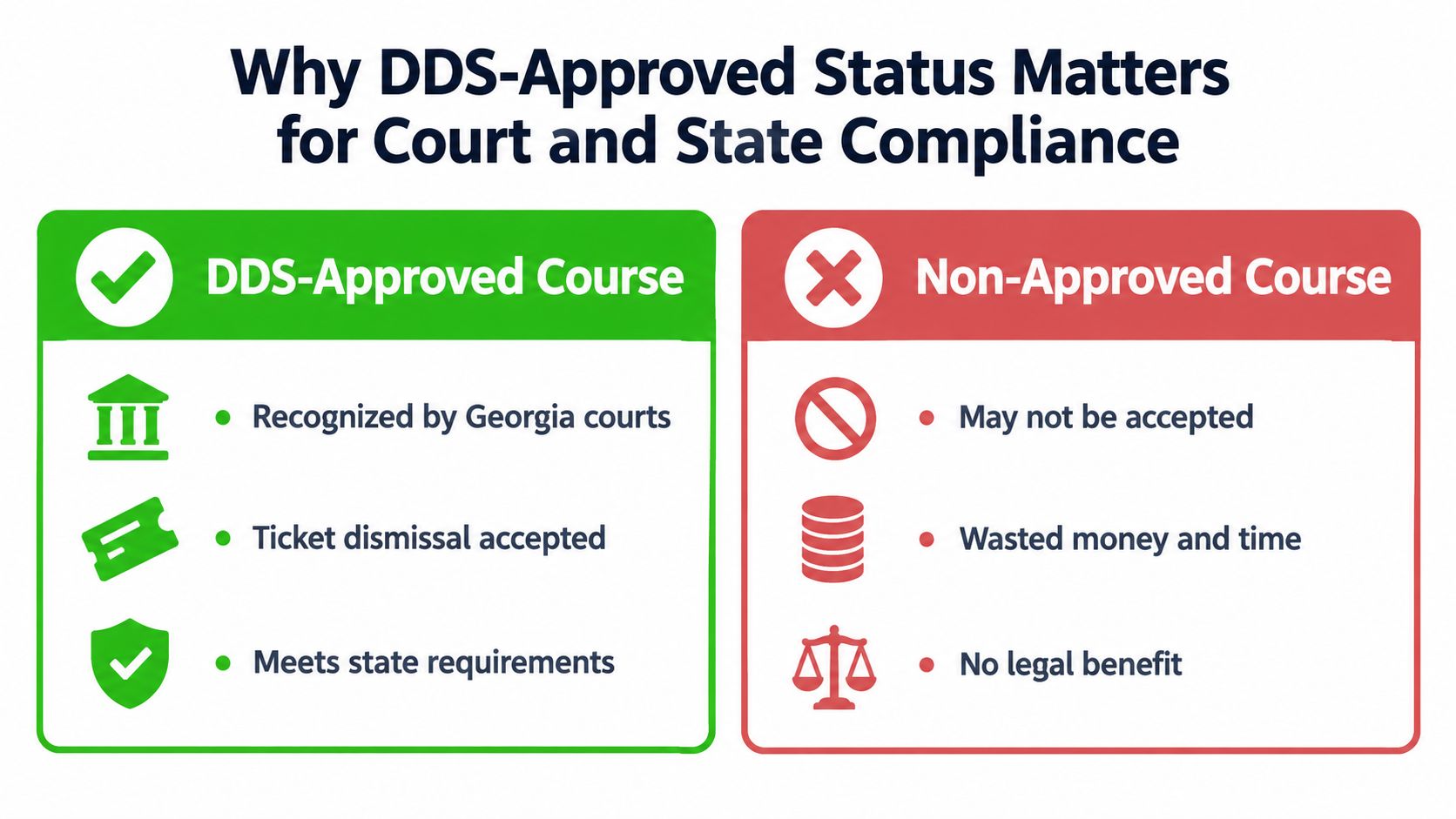
That rule prevents a common and expensive mistake. A driver sees an inexpensive online class, completes it quickly, and assumes the certificate will satisfy the judge, DDS, or insurer. If the provider lacks the required approval, the driver may have to enroll again while the original deadline continues approaching.
Know which course matches the case
Georgia drivers commonly confuse two different programs:
- DUI Alcohol or Drug Use Risk Reduction Program: This is the state-required program associated with DUI-related requirements. It's commonly called the Risk Reduction Program, and its required duration and conditions should be confirmed with DDS, the court, or counsel.
- Defensive driving course: This is used for eligible point-reduction, court, or insurance purposes. The court or insurer determines whether it fits the specific situation.
Don't assume that a defensive driving class satisfies a DUI order. A DUI case may require Risk Reduction, a clinical evaluation, treatment when indicated, and a victim impact panel. Those components address different legal and safety needs.
Check before paying
Before enrollment, verify the provider's DDS status, the exact program name, delivery format, completion rules, and certificate process. Ask whether the program is accepted for your court, citation, reinstatement matter, or insurance request.
The approval information on the completion certificate is more than a design element. It is the administrative evidence that connects your coursework to the agency or court requirement. Keep copies and submit them through the channel named in your order.
An approved course can still fail to produce the result you want if you choose the wrong program or miss a deadline. Verification before payment is faster than correcting an invalid certificate afterward.
What Defensive Driving Actually Teaches You Behind the Wheel
A useful defensive driving class doesn't ask you to memorize traffic laws. It trains you to see a developing problem, choose a response, and act while you still have room to maneuver.
The session often begins with hazard scanning. Keep your eyes moving, check mirrors, and look well beyond the vehicle directly ahead. Some instructors teach a 12-second eye-lead-time technique, which encourages drivers to identify traffic changes before they arrive at the immediate braking zone.
From observation to action
On Atlanta's I-285, the hazard may be a driver drifting across lanes while checking a phone. On a Savannah road, it may be a pedestrian near an access point or a vehicle entering from a side street. On a rural Georgia highway, it may be a deer, a tractor, standing water, or a blind curve.
The response follows the observation:
- Create space: Increase the gap ahead instead of matching an unsafe driver's pace.
- Protect an escape path: Identify an open lane or shoulder area without making a sudden move.
- Adjust for weather: Rain requires smoother controls, more room, and earlier braking.
- Read driver behavior: A weaving, drowsy, impaired, or aggressive driver deserves distance, not confrontation.
- Remove your own distraction: Put the phone away before the vehicle moves, and don't interact with it at a stoplight if the situation could change before you're ready.
A three-second following cushion is a useful baseline, but it isn't a fixed answer for every Georgia road. Rain, darkness, heavy traffic, worn tires, and interstate speeds can require more space. The correct gap is the one that gives you time to recognize a hazard and respond without panic.
Behind the wheel: Don't try to teach an aggressive driver a lesson. Let that driver move away from you, then restore your space.
Controlled evidence deserves careful interpretation. A PubMed review of 14 studies found that stronger tests showed defensive driving courses reduced traffic violations by about 10%, even though crash reductions weren't consistent across the studies, as summarized in the review of defensive driving course outcomes. That distinction matters. Fewer violations mean fewer unsafe maneuvers and less exposure to the behaviors that can precede a collision, but no course can promise that crashes will disappear.
For additional practical guidance, drivers who operate larger vehicles or spend long hours on the road can review resources about cutting accidents with defensive driving. The same core habits apply to a commuter in Atlanta, a student in Athens, or a commercial driver crossing the state.
A Simple Next Step for Georgia Drivers
Defensive driving has four connected benefits. It reduces exposure to crashes, may support an insurance discount when the carrier permits it, can help with an eligible point-reduction process, and provides documentation when a DDS-approved course is required. The right next step depends on whether you're responding to a citation, preparing for reinstatement, satisfying a court order, or seeking voluntary education.
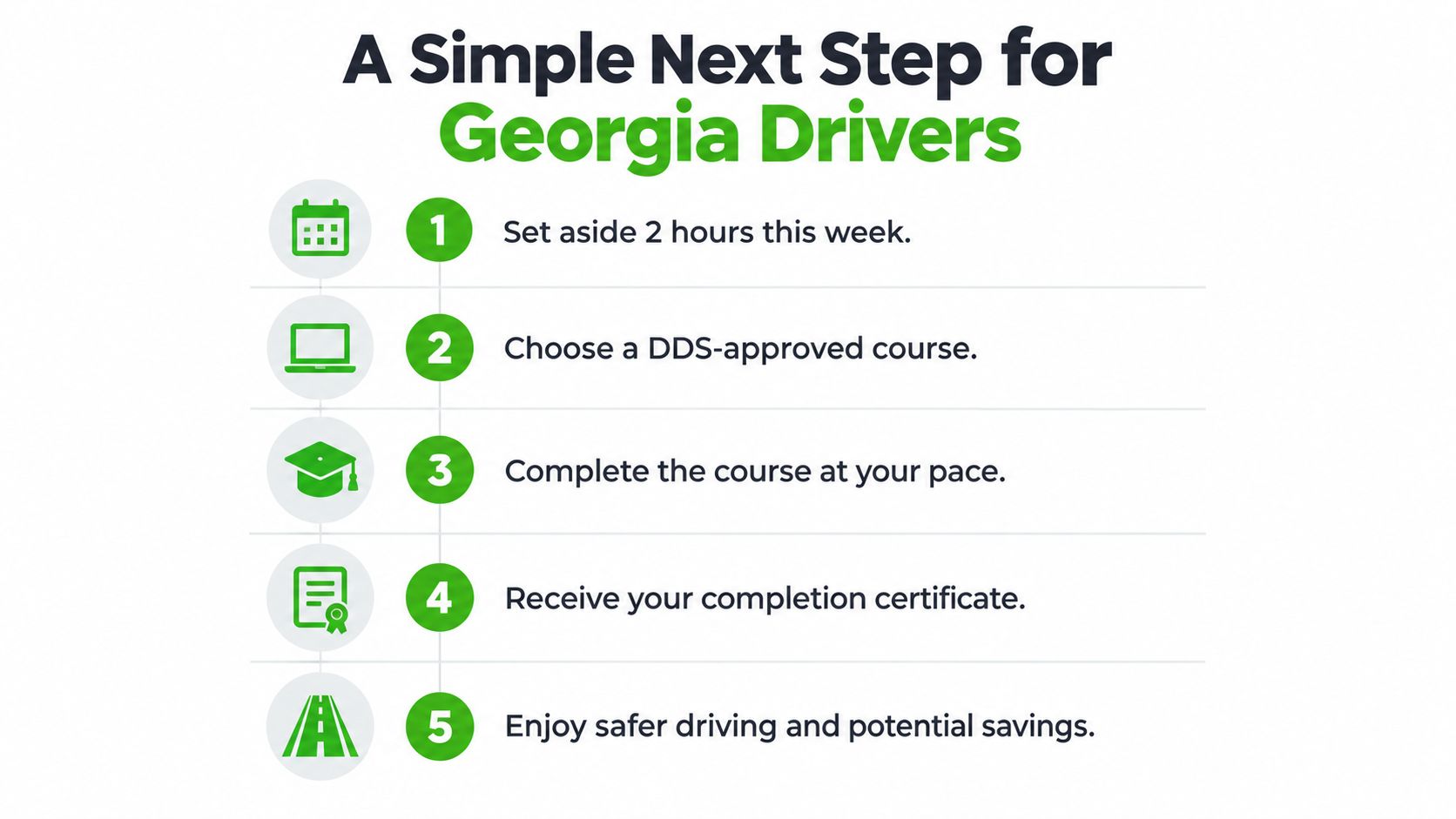
Use this checklist during the week:
- Review your record: Access your Georgia DDS information through the official online portal or another approved record-request method. Confirm the current status, points, suspensions, and any deadlines.
- Read the citation or order: Identify exactly what the court, DDS, probation officer, or insurer requires. Don't assume a general defensive driving course satisfies a DUI-related order.
- Choose the matching approved program: A defensive driving course may fit an eligible point-reduction or insurance purpose. A DUI-related requirement may call for the DDS-approved DUI Alcohol or Drug Use Risk Reduction Program, clinical evaluation, treatment when indicated, and other ordered components.
- Finish before the deadline: Online, live virtual, and classroom formats can offer different scheduling advantages, but completion still has to occur within the time allowed by the court or agency.
- Submit and preserve the certificate: Send the DDS-issued completion certificate to the court, DDS, insurer, or attorney according to the stated instructions. Keep a copy, receipt, and confirmation for your records.
If a crash has already occurred, organize your documentation carefully, and consult qualified repair or vehicle-safety professionals when needed. Resources such as Safety Restore repair specialists may help drivers understand repair-related issues, but course compliance and legal deadlines still belong with the court, DDS, or an attorney.
Georgia DUI Schools offers DDS-approved defensive driving education through self-paced online, live virtual, and traditional classroom formats, along with DUI/Risk Reduction and related clinical services. Review your case requirements, choose the course that matches them, and use this week to begin through Georgia DUI Schools.