
Obtaining a court order for a mental health evaluation can feel unsettling quickly. Many people read the paperwork once, then again, and still are not sure what it means. If you're dealing with a DUI case, probation terms, or another court requirement in Georgia, the uncertainty is often the hardest part.
The good news is that this process is usually more structured than it first appears. A court ordered mental health evaluation is not random, and it isn't the same as regular counseling. It is a formal legal step used to help a judge, court, or supervision agency make decisions. Once you understand what the evaluation is, why it was ordered, and what happens next, the process becomes easier to manage.
Understanding a Court Ordered Mental Health Evaluation
A court ordered mental health evaluation is a formal assessment completed by a licensed professional for the court. The evaluator reviews mental health and behavioral history to help the legal system make decisions about issues such as competency, treatment, sentencing, and public safety, as described in this forensic mental health overview.
That distinction matters. This is not ordinary therapy. In treatment, the focus is your care. In a court ordered evaluation, the focus is a legal question.
What the evaluation is really for
Courts use these evaluations to gather organized, professional information. A judge may need help deciding whether someone needs treatment, whether a substance issue should be addressed as part of sentencing, or whether mental health concerns affect the case in a practical way.
In plain language, the evaluator is being asked something like:
- Can this person understand and participate in the legal process
- Does this person show signs of a mental health or substance-related issue that affects safety or compliance
- Would treatment, supervision, or further services make sense
If you want a simple background explanation of how psychologists define and use evaluations more broadly, PPA's guide to psychological assessments is a useful primer.
Practical rule: Treat the evaluation like a legal appointment with clinical parts, not like a private therapy session.
Why people often get confused
The confusion usually comes from the word "mental health." People hear that phrase and assume the court thinks they're unstable, dangerous, or being punished for having emotions. Often, that isn't the point.
Courts have long used formal evaluations in both criminal and civil matters. In many cases, the order means the court wants a professional opinion before deciding what to require next. For someone in Georgia dealing with a DUI or related substance issue, that can be one part of the path toward compliance.
Why Courts Order These Evaluations
Courts don't order these evaluations for just one reason. They order them when a case raises a question the judge can't answer alone. The evaluation gives the court a structured way to gather information from a licensed professional.
Common legal situations
A court ordered mental health evaluation may come up in cases involving:
- DUI or substance-related offenses where the court wants to know whether treatment, education, or monitoring should be part of the sentence
- Competency concerns when someone may struggle to understand the charges or help with their defense
- Probation or parole supervision if behavior suggests a need for closer assessment
- Custody or family court disputes when mental health questions affect parenting or safety
- Public safety concerns when a court needs more information before setting conditions
In Georgia, this often feels very concrete in DUI cases. A person may think the issue is only driving, but the court may be looking at a larger pattern. Was the incident isolated, or does it point to a substance issue that needs follow-up? The evaluation helps the court sort that out.
Why judges rely on formal assessments
A formal evaluation is useful because it goes beyond surface impressions. Instead of making decisions based only on courtroom behavior or police reports, the court can review a professional assessment built around records, interviews, and sometimes testing.
That broader approach has become more common in problem-solving courts. One evaluation of the Brooklyn Mental Health Court reported 576 referrals and 262 enrollments, with enrollment rising to about 78 new participants per year in the more recent two-year period studied, according to the Brooklyn Mental Health Court evaluation. The same evaluation noted treatment mandates ranging from 12 months for misdemeanor offenders to 18 to 24 months for predicate felony offenders. A statewide evaluation cited in that same source found that 95% of participants received mental health treatment during the court program, while 64% did so after discharge, and the share needing high-intensity treatment dropped from 31% pre-program to 15% post-program.
Courts use evaluations because they need more than a charge on paper. They need information that can support a workable order.
What this means for you
Being ordered to complete an evaluation doesn't automatically mean the court has reached a harsh conclusion about you. It usually means the court wants a clearer basis for deciding what happens next. In a DUI-related case, that can affect education requirements, treatment recommendations, supervision terms, or reinstatement steps.
The Evaluation Process What to Expect
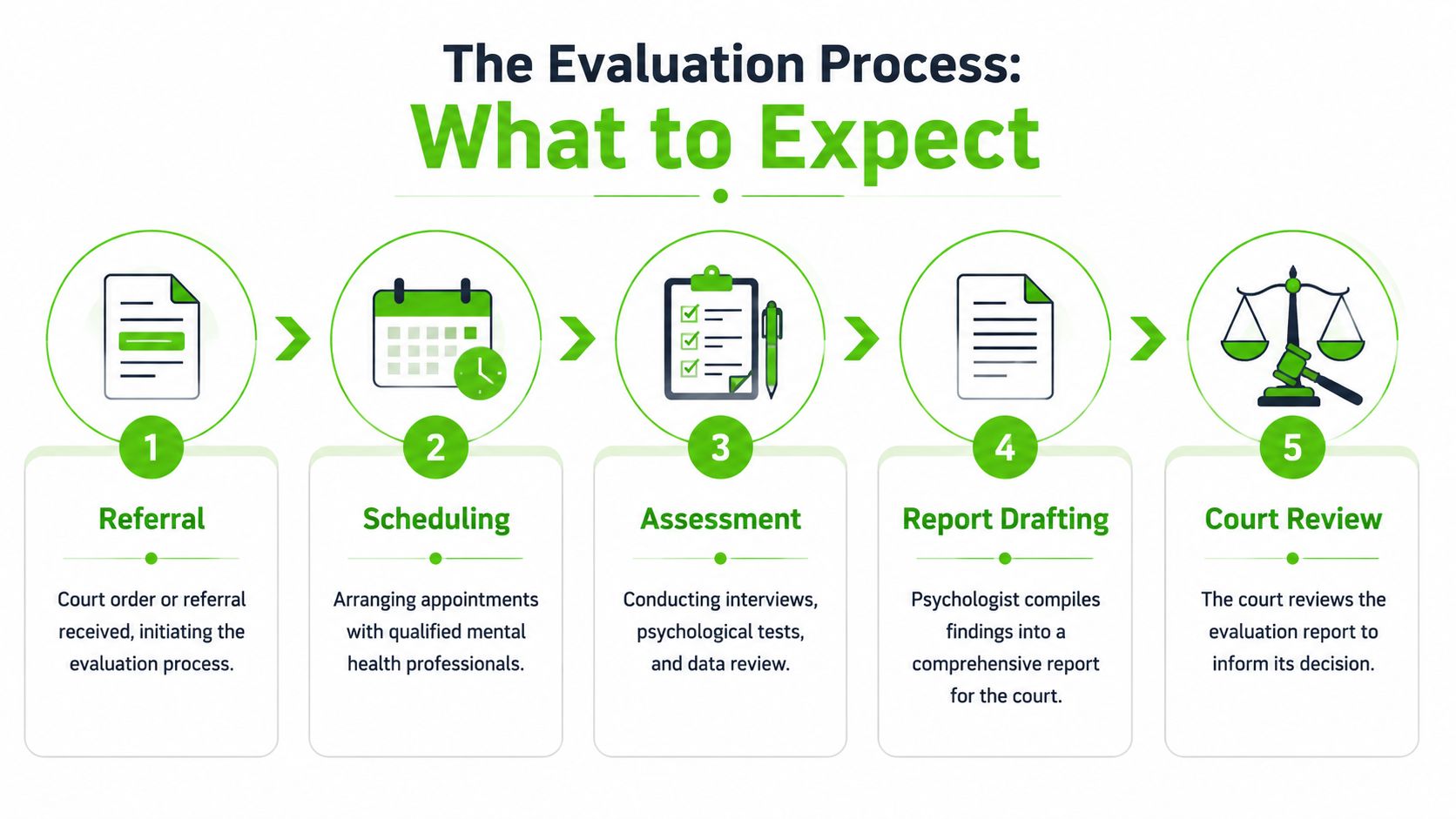
Individuals often feel better once they understand the order of events. A court ordered evaluation usually follows a clear forensic workflow. The evaluator reviews legal documents, conducts a clinical interview, may use psychological testing, and then prepares a formal report for the court, as outlined by the Oklahoma Forensic Center evaluation process.
Step by step from referral to report
You receive the order or referral
The paperwork may come from a judge, probation officer, attorney, or another court-connected source. Read it closely. Look for deadlines, approved provider rules, and whether the court wants a general mental health evaluation or a substance-related clinical evaluation.You schedule the appointment
In some cases, the court names a provider. In others, you must choose an approved evaluator yourself. If your matter involves DUI or alcohol and drug concerns, some people complete a drug and alcohol evaluation online when that format is accepted for their situation.The evaluator gathers background material
The evaluator may review charging documents, court orders, prior treatment records, school records, medical records, or probation information. This can surprise people who expect the process to be based only on one interview.
What happens during the appointment
The interview is usually the core part of the evaluation. Expect questions about:
- Current legal issue
- Mental health history
- Alcohol or drug use
- Medical background
- Family and social history
- Work or school functioning
- Past treatment
- Stress, trauma, or major life events
Some evaluations are completed in one session. Others involve more than one meeting, especially if testing or collateral records are needed.
Bring your court paperwork, identification, any referral forms, and contact information for other professionals involved in your case.
Testing and observation
The evaluator may also use standardized tools. Not everyone gets the same testing. It depends on the legal question being asked and whether the evaluator needs more objective information.
A short comparison helps:
| Part of process | What it usually involves | Why it matters |
|---|---|---|
| Record review | Court papers, prior records, referral documents | Gives legal and historical context |
| Clinical interview | Questions about history, symptoms, behavior, and functioning | Builds the main narrative of the evaluation |
| Testing if needed | Standardized psychological measures | Adds objective data |
| Behavioral observation | How you present, communicate, and respond | Helps the evaluator assess consistency |
| Written report | Findings and recommendations for the court | Becomes the court-facing product |
After the appointment
The evaluator prepares a report for the court or referring authority. In some jurisdictions, the evaluator may also testify. The report isn't just a summary of feelings. It is written to answer legal questions in a format the court can use.
That means the process may feel clinical, but its purpose is legal. Knowing that ahead of time helps you show up prepared and steady.
Your Rights and How to Prepare

You still have rights in a court ordered process. The biggest mistake people make is assuming they have none, or assuming they have the same privacy protections they would have in therapy. Neither assumption is safe.
Know the confidentiality limits
A court ordered evaluation often operates under different confidentiality rules than voluntary treatment. Information gathered may be shared with the court because that is the purpose of the evaluation. Before the appointment starts, pay attention to consent forms and disclosure notices.
If you want a plain-language example of how privacy notices are written in treatment settings, you can review our patient confidentiality guidelines from Maverick Behavioral Health. The details in your forensic evaluation may differ, but reading a clear privacy notice helps you understand what questions to ask.
Ask directly:
- Who receives the report
- Whether your attorney gets a copy
- Whether the court order limits what can be shared
- Whether family members or outside records will be contacted
How to prepare without overthinking it
Preparation helps, but trying to "game" the process usually backfires. Evaluators are trained to notice inconsistency, exaggeration, and selective storytelling.
A practical way to prepare is to organize facts, not a speech.
Bring the right information
Useful items may include:
- Court paperwork so the evaluator can see the exact referral issue
- Medication list if you take anything for mental or physical health
- Treatment records or provider names if you've had counseling, rehab, or psychiatric care
- Timeline notes for major events if your memory gets scrambled under stress
Answer carefully and honestly
You don't need dramatic language. You don't need to defend every detail. You do need to be accurate.
Helpful habits include:
- Listen fully before answering
- Say when you don't remember
- Correct mistakes politely
- Avoid minimizing obvious problems
- Avoid adding details you can't support
The evaluator's role is to assess, not to act as your therapist or your advocate.
What to know about testing
Psychological testing is a common part of some court ordered evaluations. Tools may include the MMPI-2 or PAI, along with measures related to IQ, personality, or trauma, according to this overview of psychological testing in court-ordered evaluations. These tools help evaluators assess functional impairment and consider appropriate interventions for the court.
People often worry they can fail a personality test. That's not the right way to think about it. The better approach is simple: read carefully, answer consistently, and don't try to outsmart the process.
A short preparation checklist
| Before the appointment | Why it helps |
|---|---|
| Sleep if you can | Fatigue makes concentration harder |
| Arrive early | Rushing raises stress and affects focus |
| Bring documents | Missing paperwork can delay the process |
| Dress normally | You don't need to perform a role |
| Stay direct | Clear answers are easier to evaluate |
Understanding the Outcomes and Court Use
The report matters because it can influence what the court does next. A court ordered mental health evaluation can affect sentencing, rehabilitation requirements, supervision terms, and other case decisions, as explained in this discussion of how behavioral health evaluations affect case outcomes.
That doesn't mean the report decides the case by itself. The judge still decides. But the report can shape the options the judge sees as reasonable.
What courts may do with the report
A court may use the evaluation to support decisions such as:
- Sentencing conditions tied to treatment, education, or monitoring
- Probation terms that require follow-through with counseling or substance services
- Rehabilitation planning when the court wants a structured path instead of a purely punitive one
- Custody or family court decisions if parenting capacity or safety is at issue
For Georgia readers dealing with DUI-related issues, this often translates into concrete next steps. The court may look at whether the person should complete a Risk Reduction course, a substance abuse evaluation, follow-up counseling, or a higher level of care if indicated.
Can the evaluation make things worse
This is one of the most common fears, and the honest answer is that it can lead to added conditions. If the evaluation identifies concerns, the court may require more than you expected.
That doesn't always mean a worse outcome overall. It may mean a more structured outcome. For example, instead of leaving the court with vague concerns hanging over the case, the judge may issue a specific set of steps that can be completed and documented.
A clear recommendation can feel demanding, but it can also give you a defined path toward compliance.
How to think about the result
Try not to frame the report as "good" or "bad." A more useful question is, what does this report require me to do now?
That mindset helps in three ways:
- It keeps you focused on compliance instead of panic
- It helps you coordinate with your attorney, probation officer, or court contact
- It turns the report into an action list
If part of the report points toward education, treatment, or substance-related services, acting quickly usually helps. Delay tends to create more stress, not less.
Navigating Evaluations in Georgia A Local Guide
Georgia cases often involve a practical overlap between court requirements, DDS rules, and substance-related services. That is especially true after a DUI, a reduced DUI-related charge, or a probation condition tied to alcohol or drugs.
How this shows up in real Georgia cases
In many Georgia DUI situations, people aren't just dealing with one item. They may need to complete a sequence of requirements that can include a clinical evaluation, a Risk Reduction course, treatment if recommended, and proof of completion for court or license purposes.
That can be confusing because different people use different terms. One office may call it a clinical evaluation. Another may say substance abuse assessment. Another may refer to a court ordered mental health evaluation even when the practical focus is alcohol, drugs, behavior, and readiness for treatment.
What to verify before you book
Before scheduling, confirm these points:
- Who ordered it. Judge, probation, attorney recommendation, or DDS-related requirement.
- What kind of evaluation is required. General mental health, substance abuse, or both.
- Who must receive the completed report. Court, attorney, probation, or another agency.
- Whether the provider must meet state or court approval rules.
For a broader outside look at how legal systems use specialized evaluators, this guide to mental health legal expertise gives a useful overview of the medico-legal role.
Choosing a Georgia provider
In Georgia, it helps to choose a provider that regularly works with DUI and court compliance issues, not just general counseling. One option people use is the court ordered substance abuse evaluation page from Georgia DUI Schools, which relates to DUI and substance-related requirements in the state.
When you call any provider, ask practical questions:
| Question to ask | Why it matters |
|---|---|
| Do you handle court-related evaluations regularly | Court paperwork has specific formatting and compliance needs |
| Can you explain what documents I need | Missing records can slow submission |
| Do you understand Georgia DUI and Risk Reduction requirements | Local familiarity reduces confusion |
| How is the report delivered | You need to know who gets it and when |
The local advantage is simple. Georgia procedures often involve coordination among courts, probation, DDS-related obligations, and treatment providers. The more familiar a provider is with that system, the easier it is to move from order to completion.
Your Next Step with Georgia DUI Schools
If your court paperwork requires an evaluation, the most useful next step is to stop guessing and confirm exactly what the order requires. Make sure you know the type of evaluation, the deadline, and who must receive the results.

If your case also involves workplace return-to-duty issues or federally regulated employment questions, you may also want to understand how related compliance programs work. A useful starting point is this overview of what the SAP program is.
The main point is simple. A court ordered mental health evaluation is manageable when you treat it like a compliance process, prepare carefully, and respond to the findings quickly. Clear steps reduce a lot of avoidable stress.
Frequently Asked Questions
Do I have to complete a court ordered mental health evaluation
If the court has ordered it, you should treat it as mandatory unless your attorney tells you the order has been changed or withdrawn. Ignoring it can create additional legal problems, including delays, violations, or missed compliance deadlines.
Is a court ordered evaluation the same as therapy
No. Therapy is meant to help you heal and work on personal goals. A court ordered evaluation is a forensic assessment used to answer legal questions for the court.
Will what I say stay private
Not in the same way it would in regular counseling. In a court ordered setting, information may be included in a report sent to the court or another authorized party. Ask about confidentiality limits before the interview begins.
What if my case is DUI-related and not a mental health case
That occurs frequently. Courts sometimes use broad language even when the primary concern is alcohol use, drug use, decision-making, treatment need, or supervision planning. Read the order carefully and confirm what kind of assessment is required.
What kinds of questions will I be asked
Expect questions about your legal situation, mental health background, substance use history, medical issues, past treatment, family situation, work or school functioning, and major stressors. The evaluator may also review records and use testing if needed.
Can I bring documents with me
Yes, and that usually helps. Bring your court order, identification, referral paperwork, medication list, and any treatment or discharge records you already have access to.
Can the evaluation lead to more requirements
Yes. A report may lead the court to order education, counseling, substance treatment, supervision conditions, or other steps. That can feel frustrating, but it also gives you a clearer compliance path.
Who pays for the evaluation
That depends on the case, the court, and the provider. In many situations, the person being evaluated is responsible for the cost. Ask before scheduling so you understand the fee process and any payment expectations.
How long does the process take
The answer varies. Some evaluations are straightforward. Others take longer because the evaluator needs records, testing, or collateral information. The safest approach is to schedule as soon as you receive the order.
If you need to complete a Georgia court or DUI-related requirement, Georgia DUI Schools can help you identify the right next step and move from confusion to compliance with the appropriate course or evaluation service.