

You're sitting in a Georgia courtroom after a DUI or drug-related case. The judge says you must complete a cognitive program, and the phrase sounds vague, serious, and possibly unrelated to the 20-hour DUI Risk Reduction course you've already heard about. You may be wondering whether you're being sent to counseling, a support group, or another driving class.
The Thinking for a Change program, often called T4C, is different. It's a structured cognitive-behavioral curriculum that teaches participants to notice the thinking and choices that come before harmful behavior, communicate more effectively, and solve problems before situations escalate. For a Georgia participant, T4C may appear alongside court supervision, probation requirements, a clinical evaluation, or the state's separate DUI education process.
What the Thinking for a Change Program Actually Is
A judge or probation officer might tell you to complete a cognitive program without explaining what happens inside the room. In practical terms, Thinking for a Change is a 22-session cognitive-behavioral curriculum designed to help participants examine the connection between thoughts, feelings, and behavior, then practice safer responses. The program was authored by Jack Bush, Barry Glick, and Juliana Taymans under a cooperative agreement with the National Institute of Corrections in 1997, first released to the corrections field in 1998, and later revised as T4C 4.0 in 2016. The National Institute of Corrections provides the program's history and introductory information.
The program grew out of NIC's earlier training work during the 1990s on cognitive approaches to changing offender behavior. That background matters because T4C wasn't designed as a casual discussion group. It became a foundational correctional cognitive-behavioral model, with structured lessons, group exercises, practice, and homework.
T4C isn't traditional therapy. A therapist may focus on diagnosis, trauma, symptoms, or individual treatment goals. T4C focuses more directly on learning and rehearsing skills in a group setting. It also isn't a 12-step group, and it isn't the same as Georgia's state-mandated DUI Alcohol or Drug Use Risk Reduction Program.
A DUI case can involve several separate requirements. For broader context on court-connected responses and restorative options, the Georgia RJ programs guide can help explain how restorative justice programs may fit into a larger legal plan. Your probation paperwork or court order should control what you personally must complete.
The rest of this guide follows the participant's path: the three skills T4C teaches, the structure of its sessions, the way it differs from Georgia Risk Reduction, what the evidence says, who may benefit, and how to check enrollment details before committing.
The Three Core Ideas That Drive the Program
T4C brings three connected skill areas together. You can think of them like learning to drive with a checklist. You identify what's happening, respond appropriately to other people, and make a safer decision before moving forward.
First, notice the thought before the action
The cognitive self-change work teaches a simple sequence: thoughts influence feelings, and feelings can influence behavior. That doesn't mean every thought is accurate or that emotions are a problem. It means participants learn to slow down and identify the internal steps that appeared before an argument, risky decision, violation, or offense.
A Georgia example might look like this: someone leaves a DUI-related court hearing feeling embarrassed and angry. A family member asks what happened. The first thought might be, “They're judging me.” That thought can produce defensiveness, which can lead to an argument or walking out of the conversation. T4C helps the participant examine the sequence rather than treating the final argument as an isolated event.
This process resembles a household budget. You can't change spending habits if you only look at the empty account at the end of the month. You first track what happened, then identify the decisions that produced the result.
Next, rehearse social skills
The social skills component gives participants practical ways to handle pressure, criticism, requests, and conflict. Someone might practice declining a drink at a Georgia barbecue, responding to a supervisor's correction, or telling a friend that they can't provide a ride after drinking.
The point isn't to memorize a perfect speech. It's to rehearse a response before stress makes improvisation difficult, much like practicing turns before a driving test. Group members may take different roles, try a response, receive feedback, and repeat the exercise with a calmer tone or clearer wording.
Participants who want a plain-language explanation of rigid, all-or-nothing thought patterns can review these black and white thinking examples from Refresh Psychiatry & Therapy. The examples can make it easier to recognize why a person may interpret one mistake as total failure or one disagreement as personal rejection.
Finally, use a problem-solving routine
T4C teaches problem solving as a repeatable sequence: stop, think, plan, do.
- Stop: Pause before reacting.
- Think: Define the actual problem and consider the choices available.
- Plan: Select a response and anticipate possible obstacles.
- Do: Carry out the plan, then evaluate what happened.
Suppose a participant's family keeps pressuring them to “just move on” after a DUI conviction. The problem may not be the family's existence or every comment they make. The practical problem may be how to respond without starting another fight. Stopping creates space, thinking clarifies the desired outcome, planning produces a sentence or boundary, and doing means using it.
Practical rule: T4C turns good intentions into practiced actions. Participants don't just discuss what they should have done. They rehearse what they can do next time.
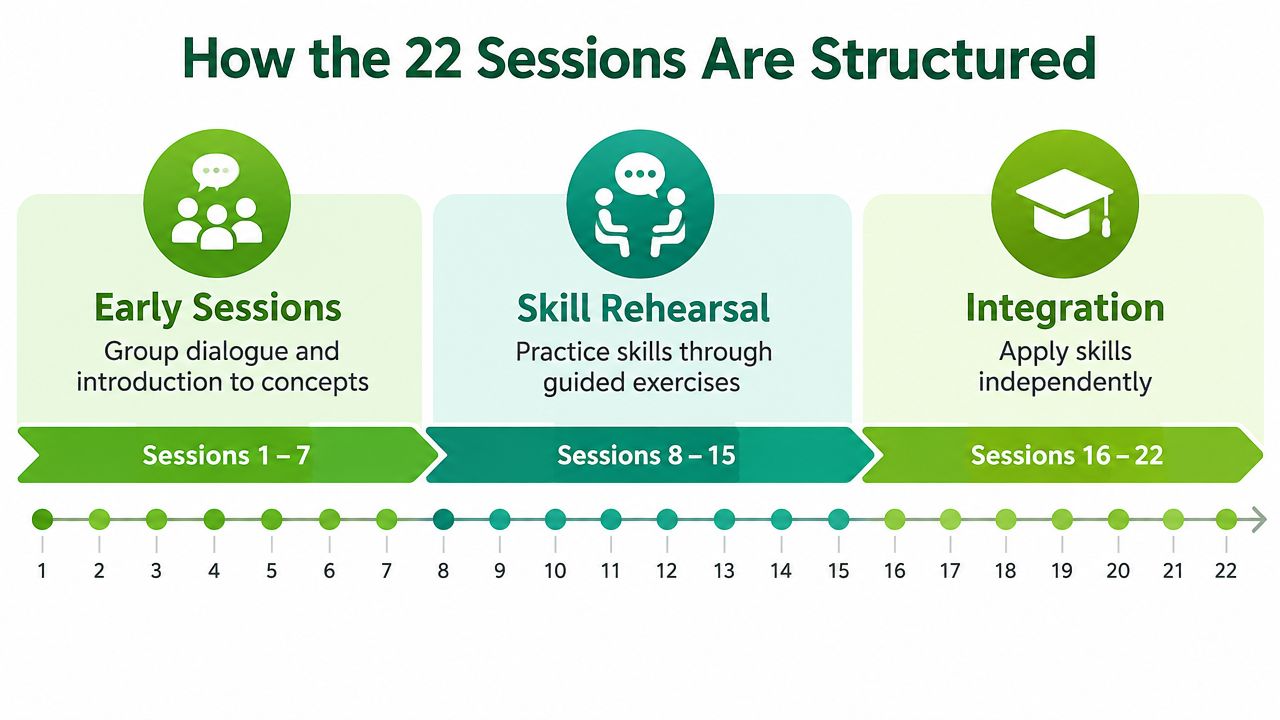
How the 22 Sessions Are Structured
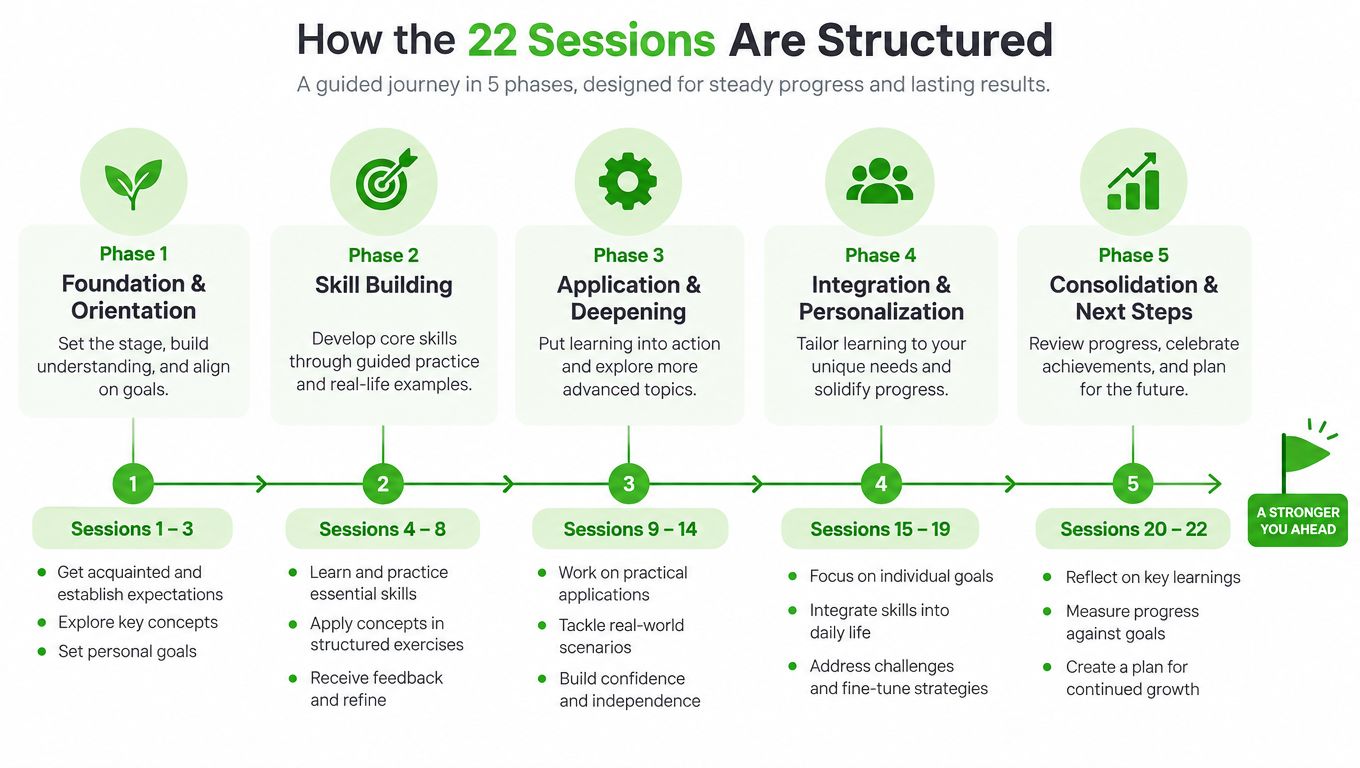
The 22-session format gives T4C a progression. Participants generally begin by examining their own thinking, add communication and social skills, and then combine those skills in problem-solving exercises. The exact schedule can vary by provider, but a group may meet once or twice each week, depending on the program's policies and the participant's court timeline.
The early work identifies patterns
Early sessions typically use small-group discussion to introduce the core ideas. Participants learn to connect a specific behavior to the thoughts and feelings that came before it. The group setting matters because members hear how other people describe pressure, anger, embarrassment, or impulsive decisions.
A participant manual supports the lessons. Homework worksheets ask people to apply the material between meetings instead of leaving it in the classroom. One useful exercise is a behavior chain, which traces a decision backward to the choices, thoughts, feelings, and circumstances that led to it.
That backward review works like checking a route after missing a turn. You don't only say, “I ended up in the wrong place.” You identify the earlier decision where a different direction was still available.
Middle sessions make the skills usable
The middle portion commonly emphasizes guided exercises, role-play, and social skills practice. A participant may rehearse how to respond to an accusation, refuse an invitation connected to alcohol or drugs, or ask for help without becoming confrontational.
A typical session may include:
- Check-in: The facilitator asks about attendance, current concerns, and homework.
- Teach-back: Participants explain or demonstrate a skill from the previous lesson.
- New content: The facilitator introduces the next concept.
- Practice: Members role-play a realistic situation and receive feedback.
- Homework: The group receives a worksheet or real-life practice assignment.
The familiar structure helps nervous participants know what to expect. It also gives the facilitator repeated opportunities to correct misunderstandings before the group moves on.
Later sessions integrate the pieces
The later sessions combine thinking awareness, social responses, and problem solving. Participants may work through a more complicated situation, identify the first warning sign, select a communication strategy, and create a plan that reduces the chance of another harmful outcome.
The curriculum is therefore more like supervised skills training than a lecture. Attendance alone may not show whether someone has understood the material. Participation, practice, and completed homework give the facilitator a clearer view of progress.
Where T4C Fits Next to Georgia's DUI Risk Reduction Program
The easiest way to avoid confusion is to treat T4C and Georgia's DUI Risk Reduction Program as separate tracks.
Georgia's DUI Alcohol or Drug Use Risk Reduction Program is state-mandated for people convicted of DUI, possession of illegal drugs, underage possession of alcohol while operating a motor vehicle, or boating under the influence. It has two required parts, an assessment and an intervention, and both must be completed to receive a certificate. Georgia DDS explains the program's required components and its listed $360 total cost.
The intervention portion must total 20 hours, according to Georgia's program policies. The state also requires each program instructor to complete at least 32 hours of continuing education every four years, including at least 16 hours in Department-designated refresher courses tied to program components. The Georgia DDS policies and procedures guide describes these requirements.
T4C addresses a different question. Instead of concentrating mainly on alcohol and drug education within Georgia's licensing framework, it focuses on the thinking, social responses, and problem-solving skills that may contribute to criminal behavior or violations. A court can order both programs when it wants the participant to satisfy the DUI requirement and complete a broader behavioral intervention.
| Feature | Thinking for a Change (T4C) | Georgia DUI Risk Reduction (DSRS) |
|---|---|---|
| Primary purpose | Build cognitive, social, and problem-solving skills | Meet Georgia's regulated DUI education requirement |
| Format | Structured cognitive-behavioral group curriculum | Assessment plus intervention components |
| Length | 22 sessions | 20-hour intervention component |
| Typical setting | Court, corrections, probation, or approved behavioral provider | DDS-certified driving school |
| Main legal connection | Probation, diversion, parole, or court order | DUI-related licensing and court requirements |
| Can it stand alone? | Sometimes, when ordered for a non-DUI case | Required when applicable to the qualifying conviction |
A judge may order T4C for a DUI or drug case, but T4C doesn't replace the Risk Reduction certificate when Georgia requires that certificate for reinstatement or another legal purpose. You can also review what Risk Reduction means in Georgia before registering.
Because requirements can overlap, people often look for practical DUI information while arranging classes, assessments, and court paperwork. The DUI classes tag archive from 24-7 Best Bonding is another local-oriented resource, though your court order and DDS rules remain the controlling sources.
What the Evidence on Recidivism Really Shows
T4C has a meaningful evidence base, but the evidence shouldn't be described as universal proof. One key evaluation found that 23% of participants recidivated, compared with 36% of the control group, a statistically significant difference. That is a 13 percentage-point difference, or about a 36% relative decrease, calculated from the reported comparison. The evaluation summary in CrimeSolutions.gov reports the 23% and 36% findings.
The same Office of Justice Programs material also includes other reported results from evaluations of the curriculum. One independent summary reported 28% recidivism for participants versus 42% for controls, while the OJP abstract noted a 33% reduction in new offense rates among program completers in a separate assessment. Those findings support T4C as a promising cognitive-behavioral intervention, not as a guaranteed outcome for every participant or provider.
What “Promising” means
CrimeSolutions.gov rates T4C as “Promising.” That rating signals that the available research shows encouraging effects, but it isn't the same as a definitive finding that the program works equally well in every population, location, and implementation model.
Implementation can change the result. Washington State's correctional research summary reported mixed outcomes across cohorts, including 29% versus 32% three-year return-to-prison rates for one treated group and 28% versus 30% for another. Those smaller differences show why a program's delivery, participant population, attendance, facilitator quality, and follow-up period matter. The Washington State correctional research summary discusses these mixed findings.
T4C is best understood as an evidence-informed skills program with stronger support in adult justice settings and less certain support in other populations.
The evidence is also uneven for juveniles and school-based use. A Georgia CJCC FAQ notes that, despite extensive support for cognitive-behavioral programming generally, studies have not established T4C with juveniles as the study population to date, and CrimeSolutions continues to use the “Promising” category rather than a definitive rating. The Georgia CJCC FAQ explains these limits and the question of population fit.
Who the Program Is Designed For and Who It Is Not
T4C is most naturally suited to adults involved with the justice system who can participate in a structured group and practice skills between sessions. That may include people on probation or parole, participants in pre-trial diversion, and adults whose DUI or drug-possession case includes a court order for cognitive-behavioral programming.
A participant generally needs enough stability to listen, speak, complete worksheets, and respond to feedback. Basic literacy can matter because the curriculum uses a participant manual and homework. A person doesn't need to arrive with perfect insight, but they do need enough willingness to examine choices rather than just attend for a signature.
Situations that may call for another step first
T4C isn't a substitute for medical care, psychiatric stabilization, substance-use treatment, or crisis intervention. Someone experiencing acute substance intoxication or withdrawal may need immediate clinical attention before group-based skills work can be productive. Severe mental-health instability or cognitive impairment may also make the standard format unsuitable without accommodations or a different level of care.
Juvenile and school-based applications require particular caution. The strongest support described in the available material is connected to adult correctional settings, while evidence for juveniles is less established. That doesn't prove the program can never help a young person. It means a court, parent, clinician, or school should avoid assuming that adult results transfer automatically.
Anger, impulsivity, and communication problems may also require an assessment rather than a quick enrollment decision. Georgia participants can review the anger management assessment as one example of a service that may help clarify whether skills training, clinical treatment, or both are appropriate.
The best fit often looks like this:
- Adult justice involvement: The person has a probation, parole, diversion, or court-related requirement.
- Group readiness: The person can remain sober and stable enough to participate.
- Practice willingness: The person will try role-play, complete homework, and accept feedback.
- Clear referral purpose: The court or clinician can explain what T4C is meant to address.
How to Enroll Through a Georgia-Approved Provider
Start with the paperwork, not the first available class date. Read the court order, probation instructions, or referral carefully and identify whether it requires T4C, a clinical evaluation, Risk Reduction, a victim impact panel, treatment, or several of these. A DUI participant may need to complete the state's separate Risk Reduction process even when the court also orders cognitive-behavioral programming.
Build the right referral path
Ask your probation officer, attorney, or case manager whether the court has approved a specific T4C provider or facilitator. If the order is unclear, request written clarification before paying a fee. You can then look for a provider that offers T4C or coordinates with a qualified facilitator, while separately confirming that any Risk Reduction school is currently DDS-certified.
Georgia DDS states that only DDS-certified driving schools are approved for Driver Education, Defensive Driving, and DUI programs. Classes taken through an uncertified school won't be accepted for licensing, reinstatement, or court requirements. DDS explains how approval affects acceptance of these programs.
Bring documents that help the intake team match the course to your case:
- Photo identification: Bring a current government-issued ID.
- Court paperwork: Include the order, probation instructions, or diversion agreement.
- Case details: Have the case number and relevant conviction information available.
- Assessment records: Bring prior clinical or substance-use assessments if requested.
- Payment information: Ask whether the provider uses a set fee, payment plan, or sliding-scale process.
Expect an intake before the first lesson
An intake may include orientation, a review of attendance rules, questions about your referral, and a baseline discussion of current skills. The provider should tell you whether sessions meet in person, online, or through a combination of formats, and whether the court accepts that delivery method.
Ask specific questions before enrolling:
- What happens if you miss a session?
- Can you make up missed work?
- How is homework submitted?
- Who receives the completion certificate?
- Are fees charged per session or for the full program?
- Does the facilitator communicate attendance directly to probation?
- Is the provider's current approval status documented?
Don't assume that T4C and Risk Reduction share one certificate. Georgia Risk Reduction requires completion of both its assessment and intervention components to receive its certificate, while T4C may use separate attendance or completion documentation for the referring court.
For people balancing work, court appointments, and transportation, Georgia DUI Schools' available program options can be one place to ask about Georgia DUI education, related services, and scheduling. Confirm directly whether the specific T4C service you need is available and accepted for your order, because provider offerings and court conditions can change.
Deciding If T4C Is the Right Step for You
T4C may fit when your case involves repeated impulsive decisions, conflict, pressure from other people, or weak problem-solving under stress. Its three-part approach asks you to notice the thought before the action, practice a better social response, and use a stop, think, plan, do routine when a situation becomes difficult.
It also requires a real commitment. The curriculum contains 22 sessions, uses homework, and depends on active participation rather than passive attendance. CrimeSolutions.gov's “Promising” rating supports a careful decision, especially for adults in justice settings, but it doesn't mean the program is proven equally for every age group or environment.
Use this self-check:
- What does the order require? T4C, Risk Reduction, treatment, a clinical evaluation, or more than one?
- What problem needs attention? T4C may address thinking and behavior patterns, while clinical treatment may be more appropriate for addiction, trauma, or psychiatric symptoms.
- Can you participate consistently? Consider work, transportation, sobriety, technology, homework, and group discussion.
- What will completion prove? Ask the provider and probation officer how attendance and completion will be documented.
- Would another service come first? Acute withdrawal, severe instability, or significant cognitive limitations may require clinical support before group skills work.
T4C isn't the same as Alcoholics Anonymous or Narcotics Anonymous, and it isn't a replacement for treatment when treatment is needed. It also isn't the same as Georgia's standalone DUI Risk Reduction course. A practical first step is to call a DDS-approved school, ask your probation officer for the approved referral list, or request a clinical evaluation that can clarify the right sequence.
Georgia DUI Schools offers DDS-approved DUI Risk Reduction education, related clinical services, and flexible scheduling options for Georgia participants who need a clear path through court or licensing requirements. Visit Georgia DUI Schools to ask about the program that matches your order, confirm current course availability, and take the next step toward documented completion.