

You're sitting in a truck stop parking lot, staring at an email that says you're removed from safety-sensitive duty. Your employer has told you to contact a Substance Abuse Professional, but nobody has explained what happens next, how long it will take, or which parts of the process involve your CDL and which involve your Georgia driver's license.
A return to duty drug testing case isn't cleared by waiting, taking an ordinary screening, or promising that the violation won't happen again. Federal rules require a documented clinical process, prescribed education or treatment, a directly observed return-to-duty test, and continuing follow-up testing. The fastest path is a disciplined one. Start immediately, keep every document, and treat each requirement as part of one connected compliance file.
The Reality of Returning to Safety-Sensitive Work
A commercial driver who receives a verified positive, refuses a required test, or otherwise violates DOT drug and alcohol rules is removed from safety-sensitive work. That means the driver can't just move the truck to another carrier and hope the problem disappears. For an FMCSA-regulated driver, the violation can also affect eligibility in the FMCSA Clearinghouse.
The federal roadmap is demanding by design. A worker must complete a Substance Abuse Professional evaluation, finish the education or treatment the SAP prescribes, and produce a verified negative return-to-duty result before resuming safety-sensitive work. Federal guidance also requires at least 6 unannounced follow-up tests during the first 12 months, with testing potentially continuing for as long as 60 months under the applicable framework. The FMCSA safety planner guidance explains the regulatory structure that transportation employers must follow.

Why waiting creates a second problem
The practical bottleneck is often not the laboratory test. It's the period between the violation and the first meaningful appointment. One recent workplace-drug-testing analysis estimated that about 159,000 drivers had not started the return-to-duty process. That figure is cited in the FTA employee handbook on substance use and return-to-duty requirements, and it shows why delaying the SAP evaluation can leave a driver stuck in prohibited status while other requirements remain untouched.
Quest Diagnostics reported return-to-duty positivity of 8.4% in 2024 and 7.9% in 2025. Its longer-run tables show return-to-duty positivity around 4.7% to 5.2% in 2026 tabulations, compared with 3.4% in 2019. These figures don't predict an individual result, but they do show that post-violation testing remains a meaningful risk-control measure. Quest Diagnostics' Drug Testing Index report provides the published testing data.
Practical rule: Don't wait for your employer to solve the case for you. Ask for the SAP process information, schedule an evaluation, and identify every Georgia court or DDS requirement at the same time.
The federal process is separate from employment reinstatement. Completing the required steps can restore eligibility, but it doesn't force a carrier to rehire you or place you back in the same position. For a plain-language explanation of the testing rules, review DOT drug test regulations for Georgia drivers. If you work for an organization outside the United States, a broader resource on compliances in HR for UK and EU can also help clarify how employment compliance frameworks differ across jurisdictions.
Navigating the SAP Evaluation and Treatment Phase
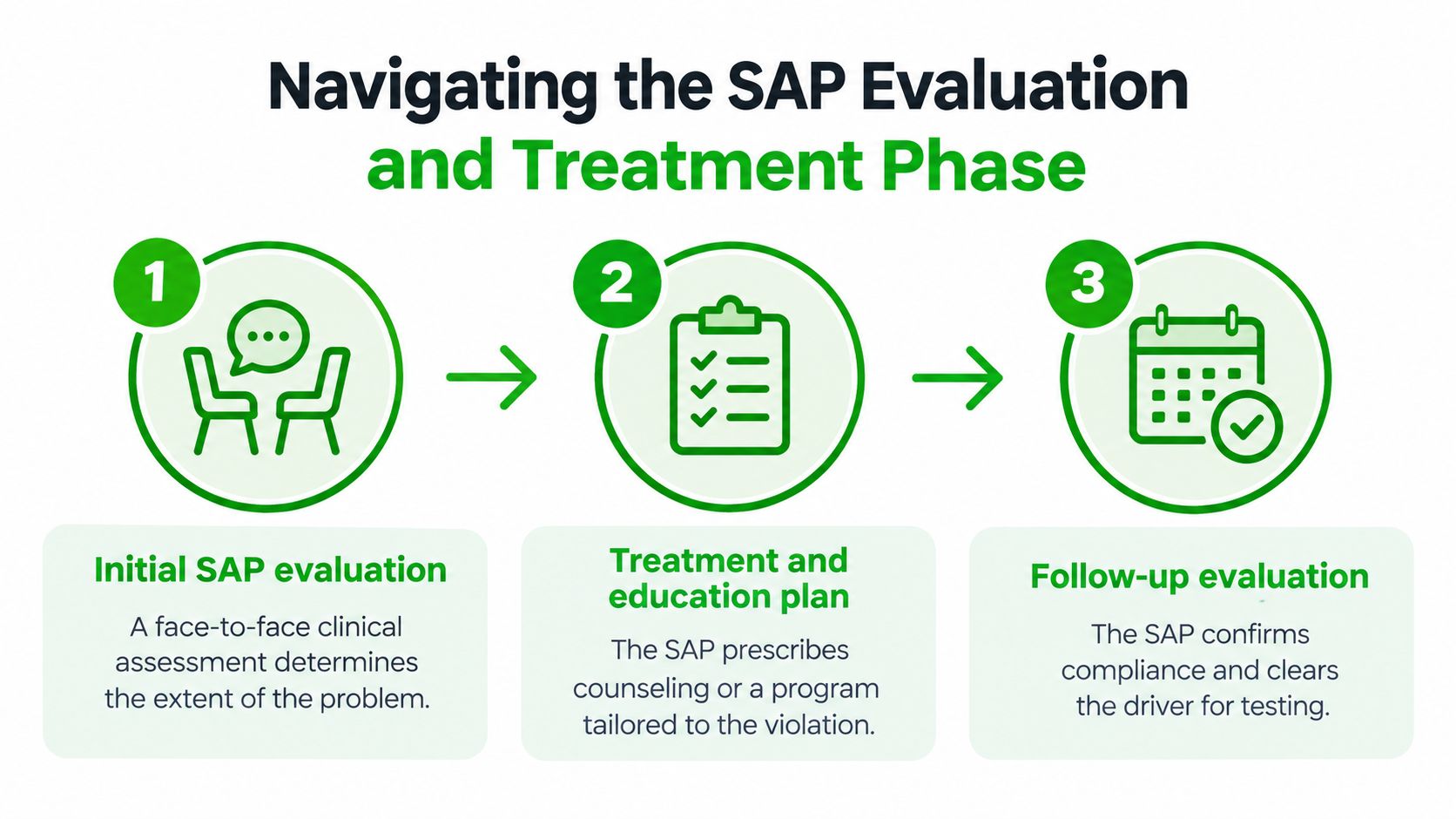
The SAP evaluation is the clinical decision point in the process. It isn't a quick appointment designed to rubber-stamp your return. A qualified SAP evaluates the circumstances, discusses substance use history, reviews the violation, and determines whether you need education, counseling, treatment, or a combination of services.
The SAP's recommendation controls what you must complete before testing. A driver may receive an education requirement, while another driver may be directed to counseling or a more intensive treatment program. You can explain your circumstances and provide relevant records, but you can't substitute a shorter course just because it's more convenient.
Prepare for the evaluation properly
Bring the documents that allow the SAP to make an informed assessment:
- Violation records: Bring the employer notice, MRO communication, refusal documentation, or other records describing what occurred.
- Treatment history: Include prior evaluations, discharge summaries, prescriptions, and relevant counseling records.
- Court paperwork: If a DUI arrest or conviction is involved, bring the citation, sentencing order, probation instructions, and any DDS correspondence.
- Contact information: Provide accurate details for the employer, treatment provider, probation officer, attorney, and court when those contacts are relevant.
Answer questions directly. Trying to minimize the event or hide prior treatment can create contradictions that complicate the clinical assessment. The SAP isn't deciding whether you're a good person. The SAP is determining what intervention is appropriate for safe, compliant work.
For Georgia residents, the federal SAP process may overlap with a state or court-directed clinical evaluation. Those are related but not interchangeable. A Georgia DDS requirement, a probation condition, and a DOT SAP recommendation can each have separate completion standards. The provider you choose should understand the distinction rather than treating every requirement as one generic DUI class.
Complete the recommendation, then return to the SAP
Enrollment isn't completion. You must finish the education or treatment the SAP prescribed and obtain documentation showing that you completed it. If the provider identifies missing sessions, incomplete paperwork, or an unresolved clinical need, the SAP may require additional action before authorizing the return-to-duty test.
After completion, the SAP conducts a follow-up evaluation. The SAP determines whether you complied with the recommendation and whether you're eligible to proceed to testing. A provider's certificate alone doesn't replace the SAP's follow-up determination. Drivers who need a Georgia-focused explanation can review what the SAP program involves before selecting services.
The practical recommendation is simple. Ask the SAP, in writing, what must be completed, which provider records are required, and what event makes you eligible for the return-to-duty test. Keep copies of every certificate, attendance record, assessment, and discharge document.
Executing the Direct Observation Collection
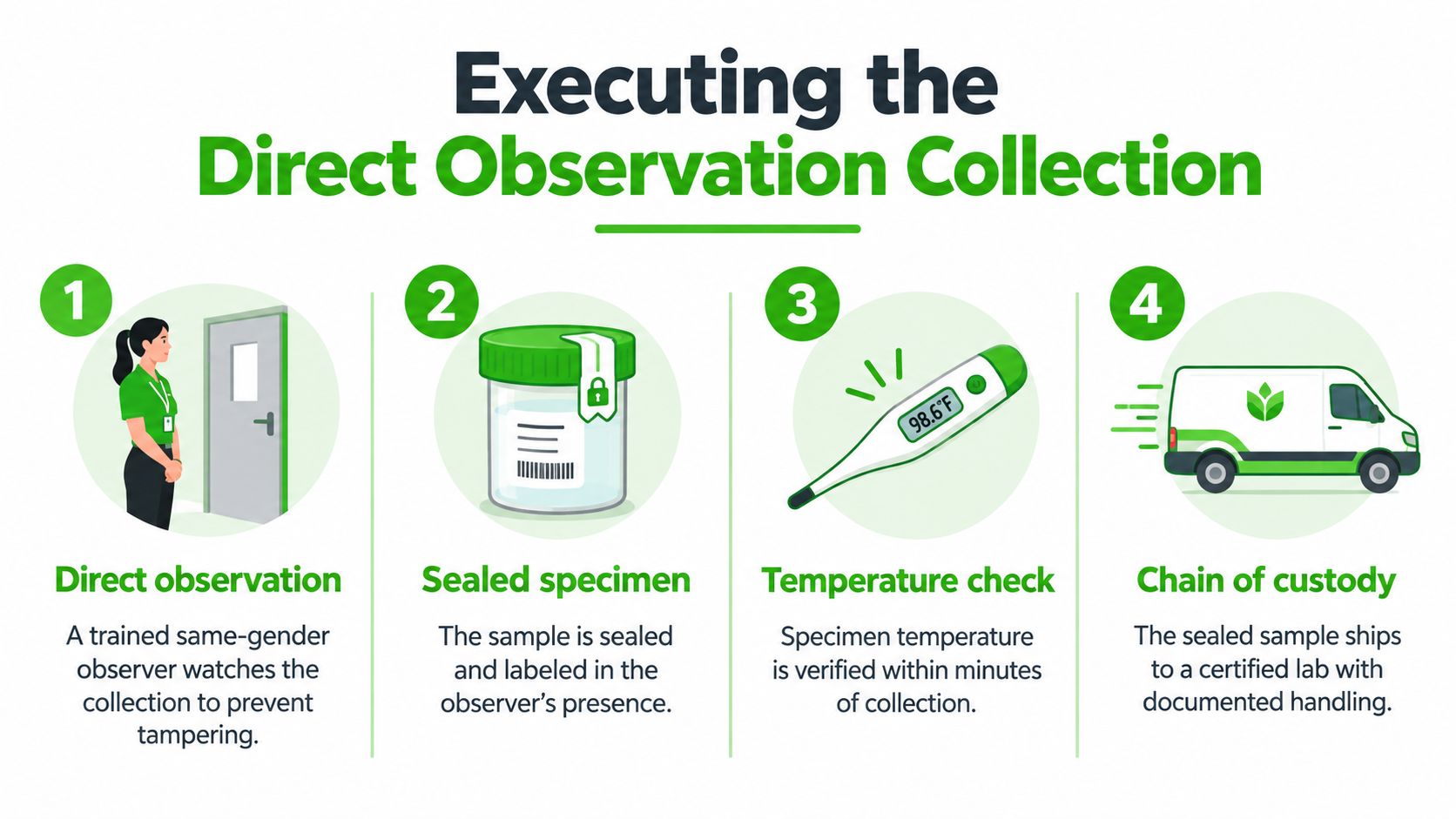
The return-to-duty test is not an ordinary employment screen. For a DOT drug violation, the collection uses direct observation, the specimen is sent to an HHS-certified laboratory, and the result is reviewed by a Medical Review Officer. The employer must receive a verified negative result before you resume safety-sensitive work.
What happens at the collection site
The collector verifies your identity, completes the required custody paperwork, and provides the collection instructions. The direct observer must be the same gender as the employee and watches the urine enter the collection container. This procedure exists to prevent substitution or tampering, so the experience is more controlled than a typical pre-employment collection.
The specimen is then sealed and labeled in the required manner. The collection site documents the chain of custody before the sample travels to the certified laboratory. The MRO reviews the laboratory result and handles the verification process, including consideration of a legitimate medical explanation when applicable.
Federal rules prohibit instant-result devices for DOT return-to-duty testing. A clinic that offers an instant cup as the complete DOT RTD process is not following the required laboratory procedure. The DOT Part 40 return-to-duty testing requirements describe the required collection and laboratory controls.
The test must be compliant from collection through MRO review. A negative-looking cup at a clinic isn't the same thing as a valid DOT return-to-duty result.
Avoid preventable collection problems
Drivers often focus on what the laboratory may detect and overlook the paperwork and collection procedure. That's a mistake. Confirm that the clinic knows you're there for a DOT return-to-duty test, not a non-DOT screen, a court test, or an employer's internal test.
Don't overhydrate before arriving. Don't bring someone else's medication or paperwork and assume the MRO will sort everything out automatically. If you take a legitimate prescription that may be relevant, disclose it accurately when the MRO contacts you and follow the MRO's verification instructions.
A dilute or otherwise problematic specimen can trigger additional procedures, and a verified positive result remains a violation even when the driver believes the sample should have been interpreted differently. The program needs a defensible chain of custody, accurate paperwork, and MRO review. Drivers dealing with a court-directed collection should keep that separate from the DOT process and can compare the requirements in this court-ordered drug test procedure guide.
Before leaving, ask how the result will be transmitted to the employer and, for an FMCSA driver, how the return-to-duty completion will be recorded in the Clearinghouse. You're responsible for confirming that the administrative handoff has occurred. A test can be successfully completed while the driver's work status remains unresolved because the right party hasn't received or recorded the result.
Managing Follow-Up Testing and Georgia Course Requirements
Passing the return-to-duty test is a gate, not the end of supervision. The SAP creates a written follow-up testing plan, and the employer must carry it out as written. The plan requires at least 6 unannounced tests in the first 12 months after the driver returns to safety-sensitive work. Depending on the SAP's plan, testing can continue for up to 48 additional months. These requirements appear in DOT follow-up testing rule 40.307.
The employer controls the scheduling and collection process, but the driver must remain reachable. Keep your phone number, email address, home address, and work contact information current. A missed unannounced test can create another compliance problem, especially when the driver assumes that a predictable schedule or a recent negative result provides protection.
Federal and Georgia requirements are separate tracks
A Georgia driver dealing with a DUI-related license matter may have to satisfy state or court requirements in addition to the federal SAP process. Georgia's DUI Alcohol or Drug Use Risk Reduction Program has two required parts, a 130-question assessment and a 20-hour intervention course, and both must be completed to receive the certificate of completion. The Georgia Department of Driver Services describes those components in its DUI Risk Reduction frequently asked questions.
The state course doesn't replace the SAP evaluation or the DOT return-to-duty test. Likewise, a negative federal test doesn't automatically reinstate a Georgia license that remains suspended because of a DUI case. Treat the employer, FMCSA Clearinghouse, court, probation, and DDS as separate destinations for separate records.
| Requirement Type | Federal DOT Mandate | Georgia DDS Mandate |
|---|---|---|
| Clinical assessment | Complete a SAP evaluation after a qualifying violation | Complete a state or court-directed evaluation when required by the driver's case |
| Education or treatment | Finish the education or treatment prescribed by the SAP | Complete the required state program when license reinstatement requires it |
| Return-to-duty clearance | Produce a verified negative drug result before resuming safety-sensitive work | Satisfy DDS reinstatement conditions, which may include the Risk Reduction certificate |
| Continuing monitoring | Follow the SAP's written plan, including at least 6 unannounced tests in the first 12 months and any additional testing prescribed | Follow court, probation, or DDS conditions separately |
| Records | Ensure the employer and applicable Clearinghouse records reflect completion | Submit the certificate and other documents required for license reinstatement |
Build one calendar, not five separate reminders
Put the SAP follow-up plan, employer testing instructions, court dates, probation appointments, and DDS deadlines on one calendar. Ask the SAP how employer changes or a break in employment affect the remaining testing plan. Federal guidance recognizes that follow-up obligations can continue across employers or service breaks, so changing carriers doesn't erase the plan.
For alcohol violations, the return-to-duty result must be less than 0.02 BAC. For drug violations, the employer needs a verified negative result, as described in DOT rule 40.305. Don't confuse the different standards or assume that completing a Georgia course changes the federal testing threshold.
Adapting to Evolving Drug Panels and Detection Windows
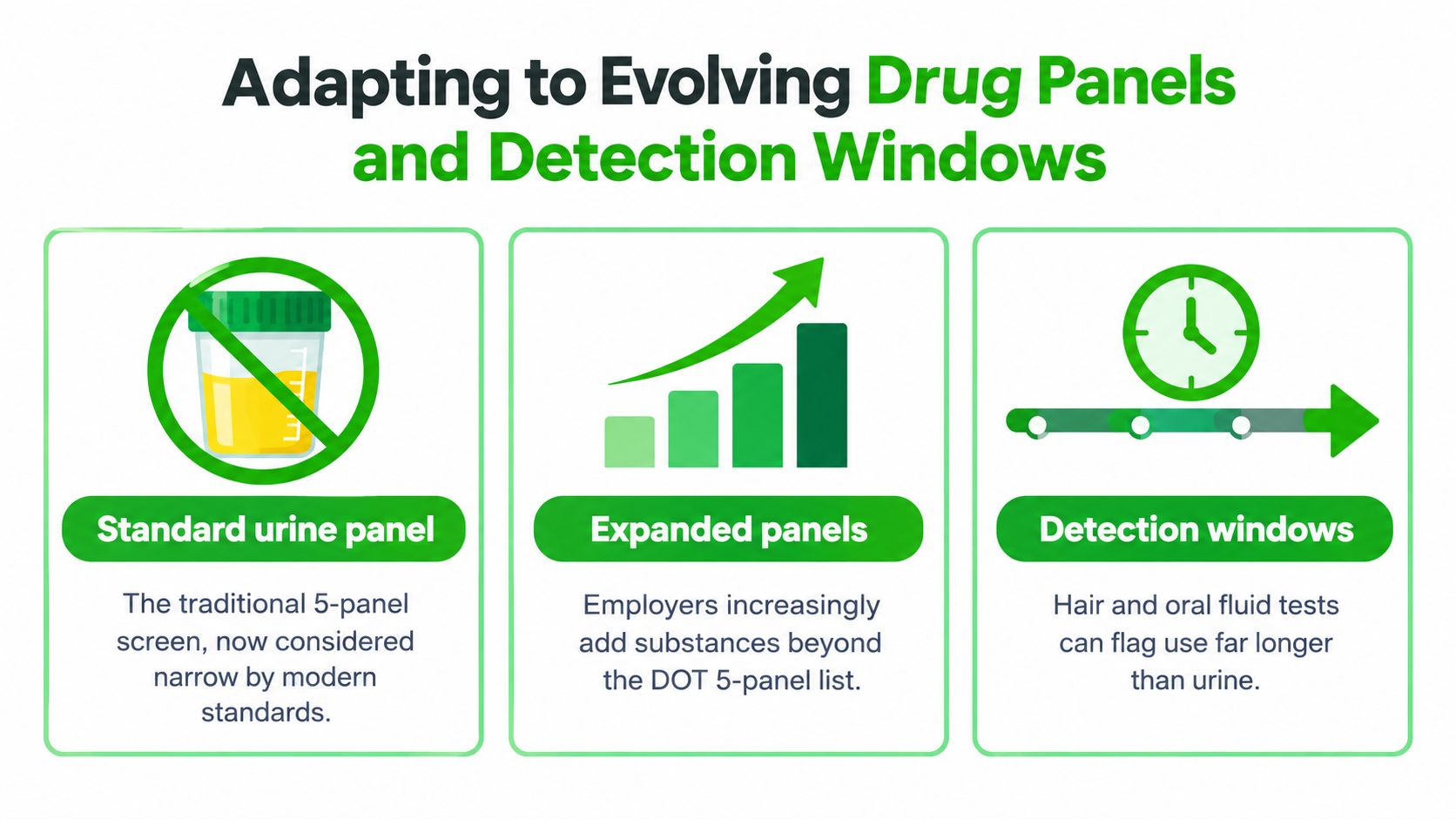
A “clean” result answers a narrow question about a particular specimen, collection method, panel, and laboratory process. It doesn't prove that every possible substance was tested or that the test reflects every instance of recent use.
Federal workplace testing data show that substance patterns continue to shift. SAMHSA's 2024 federal data reported marijuana positives at 0.88%, amphetamines at 0.79%, opioids at 0.42%, and rejected or tampered specimens at 0.43%. Those figures describe broader federal workplace testing, not an individual driver's return-to-duty result. SAMHSA's DOT program update provides the cited panel information.
Don't confuse test selection with DOT compliance
For a DOT-regulated return-to-duty test, the employer must use the federally required process. An employer can't replace that process with a preferred test because it believes hair, oral fluid, or an expanded panel gives more useful information.
Oral fluid testing is receiving attention because it can reflect more recent use than some other methods. Federal workplace panels are also evolving around substances such as fentanyl and norfentanyl. That creates legitimate questions about detection windows and test interpretation, but it doesn't give a driver permission to shop for a more favorable test.
The right question is, “Which test is required for this violation and this employer?” Ask the SAP and employer whether additional, non-DOT testing is part of the treatment or workplace program. Keep that separate from the federally mandated RTD test.
Handle medications through the MRO
Over-the-counter products and prescriptions can complicate a result. Don't guess whether a medication matters, and don't wait until an employer sees an unexplained result. Maintain a current medication list and respond promptly if the MRO requests information.
The MRO, not the collection-site clerk, determines whether a legitimate medical explanation affects verification. Give the MRO accurate prescription details and supporting information through the approved process. Do not attempt to negotiate with the collector or ask a clinic to change the test panel.
Employers reviewing broader workplace policies may also benefit from a practical Georgia workers comp drug test guide from Morgan & Morgan Attorneys at Law P.C. It can help separate workplace testing questions from the specific federal rules that govern a DOT return-to-duty collection.
A negative result is evidence from one compliant test. It isn't a lifetime determination of fitness, and it doesn't cancel the follow-up plan.
Securing Your Documentation and Next Steps
Your records should tell the complete story without requiring anyone to reconstruct it from memory. Create a secure folder, both digital and paper, containing:
- Initial SAP evaluation: Keep the evaluation record and the date of the assessment.
- Education or treatment proof: Save enrollment records, attendance documentation, completion certificates, and the discharge summary.
- Return-to-duty evidence: Retain the test documentation and verified negative result provided through the employer's process.
- Follow-up plan: Keep the SAP's written testing schedule and all follow-up test records.
- Georgia records: Add the Risk Reduction certificate, clinical evaluation records, court paperwork, and DDS correspondence when those requirements apply.
Never assume that the employer, SAP, court, probation officer, and DDS share one file. They don't. Ask each party what it needs, where the document must be sent, and whether you should retain the original. For employers managing multiple jurisdictions, an overview of screening compliance responsibilities can provide useful background, but DOT-specific requirements still control the transportation file.
The driver's best move is to begin the SAP evaluation now, identify any Georgia DUI or license conditions, and build the documentation folder before the first appointment. Georgia DUI Schools offers Georgia DDS-approved Risk Reduction courses, clinical evaluations, ASAM Level 1 treatment, and Victim Impact Panels, with in-person and online options available for applicable state and court requirements. Visit Georgia DUI Schools to review the available services and schedule the requirement that matches your case.