

You've just left a Georgia court hearing with a DUI citation, a reinstatement notice, or a probation checklist that seems to grow every time you read it. One line mentions a Risk Reduction course. Another may point to an assessment, clinical documentation, defensive driving, or a Victim Impact Panel. You're not necessarily looking for the cheapest class. You're looking for someone who can help you understand what comes first, which certificate DDS will accept, and what your court still needs.
That's why the phrase all in one driving school matters. Properly understood, it describes a coordinated compliance path, not just a school that places several course names on one webpage. The right provider can help you connect education, assessment, clinical services, paperwork, and scheduling without treating each requirement as an isolated purchase. For a broader example of how separate functions can be organized in one system, see Pebb's unified workplace solution.

Introduction to the All in One Driving School Idea
Why the search usually starts with confusion
A first-time DUI student in Atlanta may be trying to handle a court date, a suspended license, work transportation, and a required class. A driver in Athens may already have completed an assessment but still not know whether the next step is the intervention program or a clinical evaluation. Someone seeking defensive driving may have a completely different goal, such as point reduction or an insurance-related benefit.
Those situations look similar in a search engine, but they don't always have the same legal path. A school that offers only a general defensive driving course may not provide the DUI assessment or clinical documentation connected to reinstatement. A provider that offers an online course may still have limitations depending on the exact program and how DDS treats its completion certificate.
What this guide helps you decide
The safest way to evaluate an all-in-one provider is to begin with your obligation, not with the word “convenient.” You'll want to identify the program, confirm the required sequence, ask whether the provider is approved for the purpose you need, and verify how the completion record will be handled.
This guide covers:
- DUI Risk Reduction: The assessment and intervention components that form Georgia's required program.
- Defensive driving: A separate education option for drivers addressing points, behavior, or insurance concerns.
- Clinical support: Services that may be required in broader reinstatement or court matters.
- Delivery formats: Self-paced online, live virtual, and traditional classroom options.
- Provider screening: Questions to ask before paying or committing to a schedule.
Practical rule: Treat your court order and DDS instructions like a route map. A school can help you follow the route, but it shouldn't replace confirmation of what your specific case requires.
The process becomes more manageable when one qualified provider can explain the relationship between each step. That's the core value of “all in one.” It's coordination, documentation, and clear next actions.
What an All in One Driving School Means in Georgia
An all-in-one driving school in Georgia is best understood as a compliance provider for DUI, Risk Reduction, defensive driving, and related reinstatement needs. It isn't just a place where anyone can take a generic driving lesson. The provider should understand how education connects with DDS, court orders, probation instructions, and, when applicable, clinical requirements.
Think of the arrangement like a medical clinic. A patient may need an examination, treatment, paperwork, and follow-up. Visiting separate offices can work, but every handoff creates another opportunity for a missed record or an incorrect sequence. A coordinated provider gives you one place to ask, “What do I complete first, and what document should I receive afterward?”
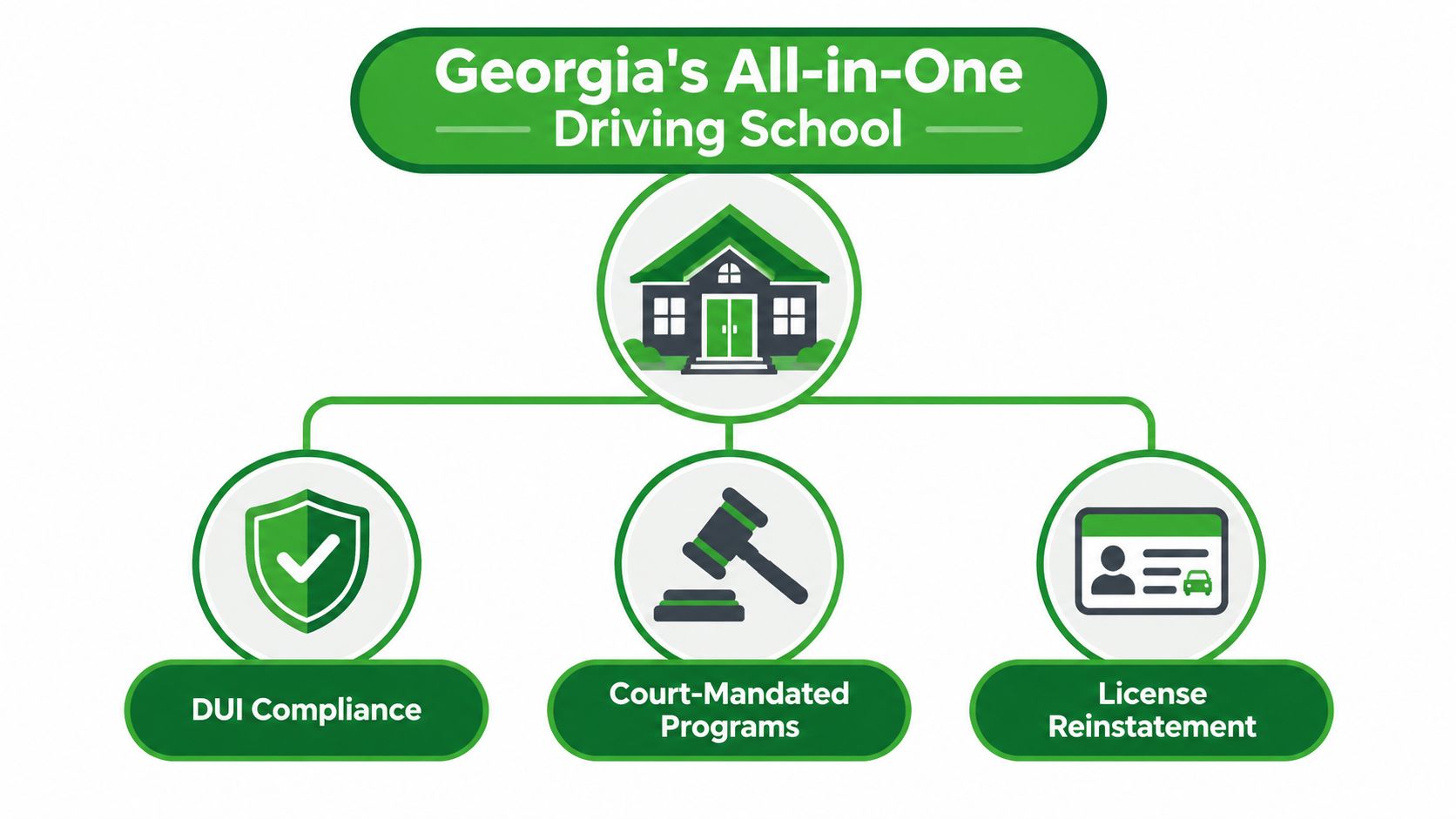
The three connected responsibilities
DUI compliance starts with identifying the program your case calls for. Georgia's DUI Risk Reduction process includes an assessment before the intervention class. A provider should explain how those pieces fit together and what completion documentation you'll receive.
Court-mandated programs may involve more than the class itself. Depending on the order, you may need clinical evaluation proof, treatment, or participation in a Victim Impact Panel. Those services aren't interchangeable, and completing one doesn't automatically satisfy another.
License reinstatement depends on the state's requirements and your individual record. A school can help you organize course completion and related documents, but you should still verify the final reinstatement requirements with DDS and, where appropriate, your attorney or probation officer.
A standalone defensive driving course has a narrower purpose. It may help with points or insurance, while a teen education course serves initial licensing. Those programs shouldn't be treated as substitutes for DUI Risk Reduction or clinical services. Georgia drivers looking for a broader overview can review Georgia driver's license classes before choosing a program.
The provider's approval status remains central. Ask whether the exact course is approved for the exact purpose you need, rather than assuming that approval for one class applies to every service.
Core Services You Should Expect Under One Roof
A genuine all-in-one option should make its services concrete. You should be able to identify the course, the assessment, the supporting services, and the paperwork process without guessing which items are available.
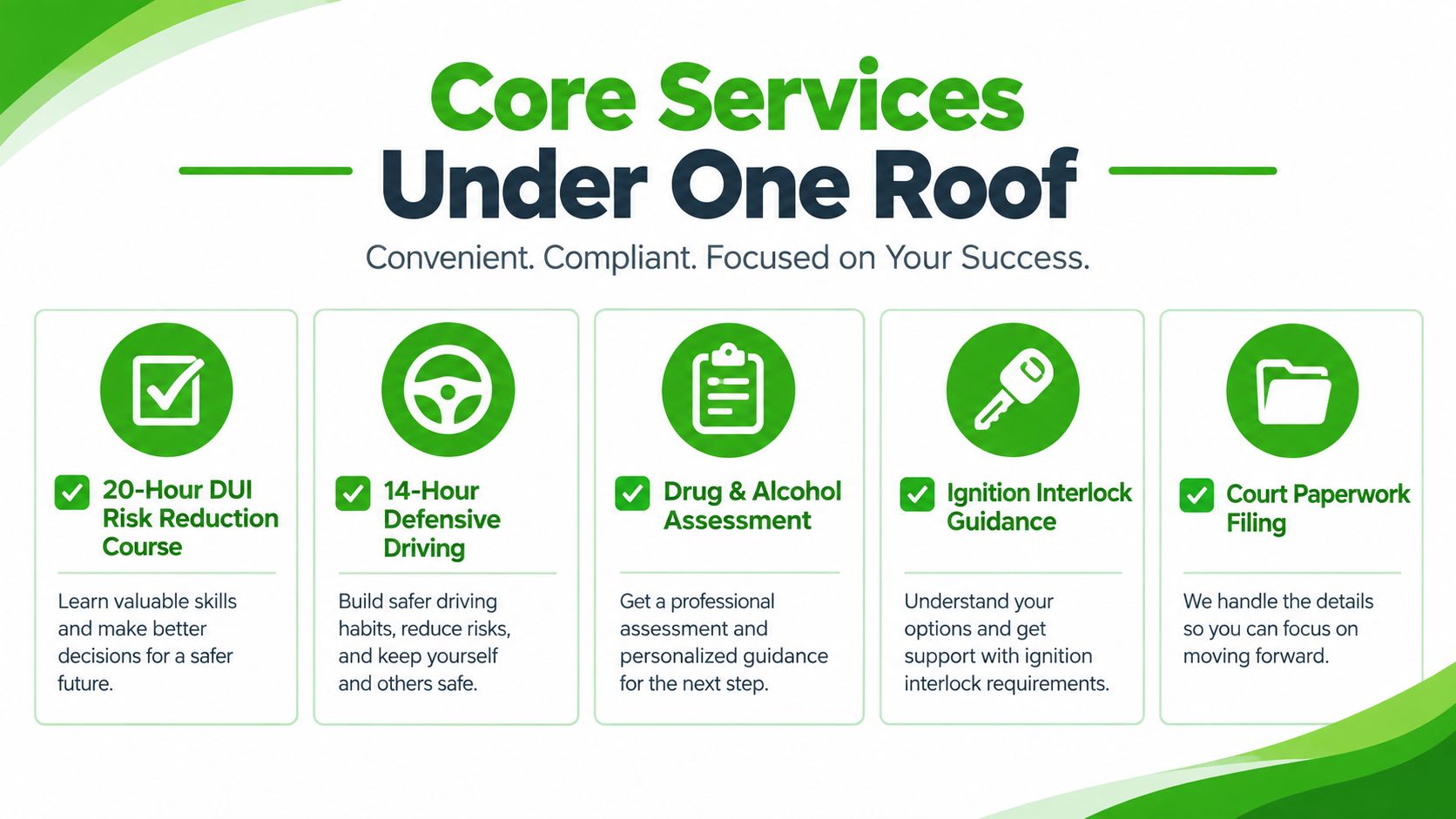
DUI Risk Reduction
Georgia's DUI Risk Reduction Program is a mandatory 20-hour course. Its state-set structure includes a $100 assessment, a $235 intervention class, and a $25 workbook, for a total cost of $360 (Georgia DUI Schools course information). The assessment comes before the intervention class, so enrolling in the class without confirming that first step can create an avoidable problem.
The assessment helps determine the appropriate intervention path. The class then provides structured education related to alcohol, drugs, impaired driving, decision-making, and risk. It's a compliance requirement, but it also gives the student a chance to examine the choices that led to the offense.
Defensive driving
Defensive driving is a different tool. A driver may seek it for point reduction, insurance purposes, or focused behavior correction after a citation. It can address hazard awareness, space management, distraction, speeding decisions, and defensive habits.
Don't assume defensive driving will satisfy a DUI Risk Reduction order. Ask the school to identify the exact certificate associated with your requirement before you register.
Clinical and court-related services
Some cases require more than education. An all-in-one provider may offer:
- Drug and alcohol assessment: A structured evaluation that can produce documentation for court or reinstatement purposes.
- Clinical evaluation: Additional proof that may be required in certain reinstatement cases, especially when the driver has broader compliance obligations.
- ASAM Level 1 treatment: A clinical service that may be ordered after assessment.
- Victim Impact Panel: A court-connected educational experience that focuses on the consequences of impaired driving.
- Ignition interlock guidance: Help understanding a device-related obligation when it applies to the driver's reinstatement path.
- Court paperwork support: Assistance organizing documents and identifying what must be submitted, while recognizing that the court or DDS makes the final decision.
The practical benefit is continuity. A provider can tell you whether a clinical evaluation should happen before treatment, whether your certificate is the correct type, and which documents need to go to your attorney, probation officer, court, or DDS. For organizations handling high volumes of student questions, a resource on AI call handling for tutors illustrates how structured call support can help route inquiries, although your own case still requires human confirmation.
Online Classroom and Live Virtual Options Compared
The format you choose matters, but convenience doesn't override compliance. Georgia providers describe DUI Risk Reduction programs in classroom and live virtual formats, including live Zoom instruction, while the required program remains 20 hours (Georgia DDS-certified live Zoom program details).
Georgia also rejects online DUI completion certificates for license purposes, which means a self-paced course that looks convenient may not solve a reinstatement requirement. Confirm the rule for your exact program before paying.
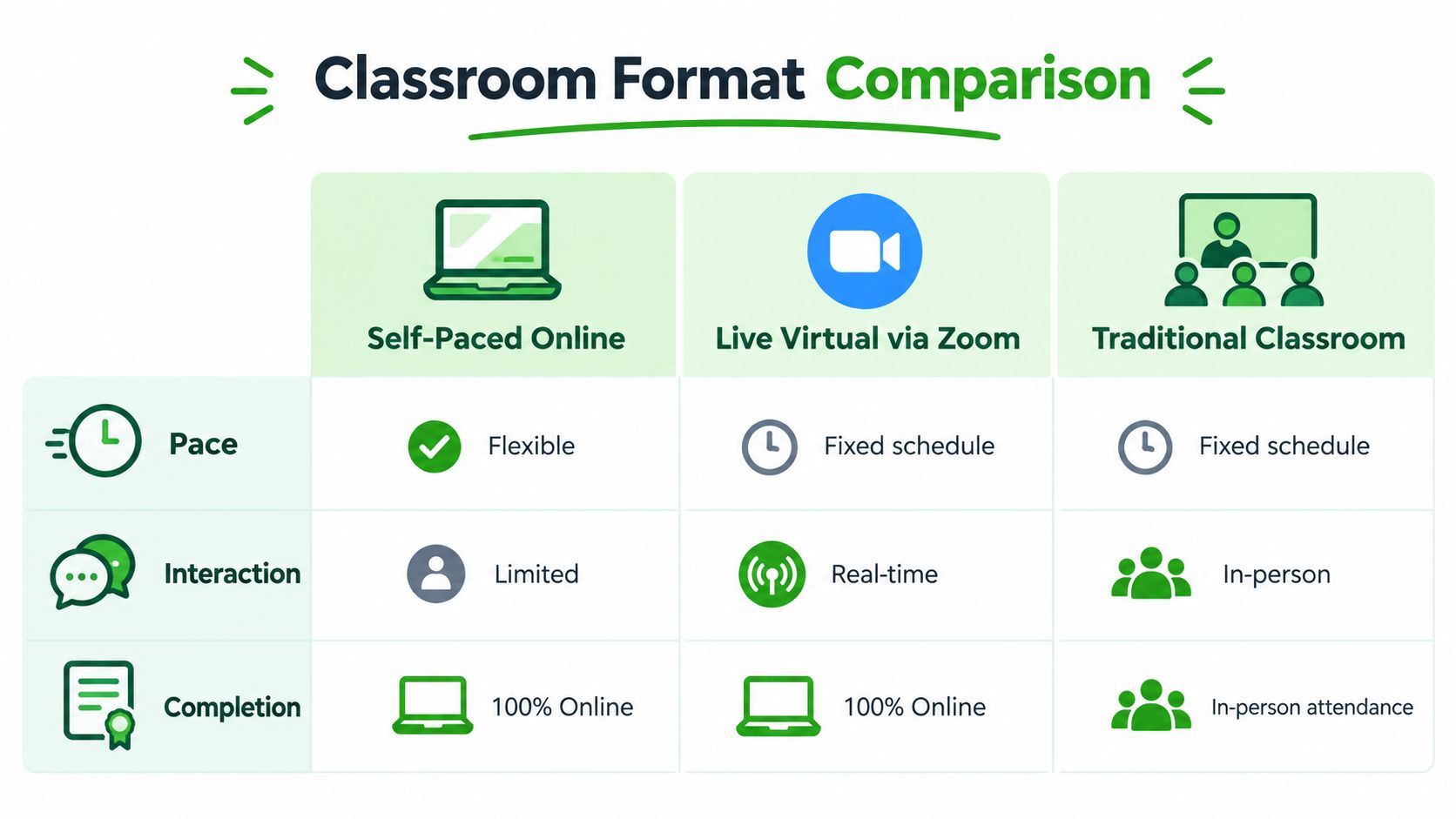
Self-paced online
Self-paced online learning can fit a driver who needs control over study time. You might complete a lesson after work, pause for family responsibilities, and return later. That flexibility can be useful for some defensive driving programs, but you shouldn't presume it works for DUI reinstatement.
Before enrollment, ask three direct questions:
- Is this course accepted for my specific DDS purpose?
- Does the certificate come from an approved provider?
- Will my court or probation officer accept this format?
You need written or clearly documented answers, not just a general statement that the school offers online classes. The broader market is moving toward digital delivery, but Georgia's reinstatement rule can still make a particular online certificate unusable (driver education market overview).
Live virtual via Zoom
Live Zoom instruction is different from self-paced study. You attend at scheduled times, interact with an instructor, and participate from home. This can be a practical choice for someone in a rural Georgia county, a professional working near Atlanta, or a student who can't reach a classroom easily.
The fixed schedule is the trade-off. You'll need reliable attendance and a device or connection that lets you participate. Ask how attendance is recorded and how the official certificate is issued.
Traditional classroom
In-person instruction provides direct contact and a structured room environment. It can suit students who learn better by asking questions as they arise or who want fewer home distractions. It also gives you a clear physical schedule, which some people find easier to follow.
For an overview of online defensive driving availability, review the Georgia online driving course and then confirm whether that offering matches your legal requirement. A course can be online, live, or in person, but the correct choice depends on the program type.
Why a Single Provider Approach Saves Time and Prevents Mistakes
The strongest argument for one provider is not that it eliminates every task. It's that it reduces the number of handoffs between tasks that must occur in the right order.
Georgia's DUI process requires an assessment and an intervention component. The assessment comes first, and some DDS-approved providers state that both the assessment and the class must be completed before reinstatement can proceed (provider explanation of the sequence). If you purchase the class from one organization, the assessment from another, and clinical services from a third, you become responsible for tracking every appointment, certificate, date, and submission.
One record trail
A coordinated provider can maintain a clearer record trail. You can ask one office:
- Whether the assessment has been completed.
- Which class remains.
- Whether clinical documentation is needed.
- When the certificate will be available.
- Which documents should go to your attorney or probation officer.
That doesn't guarantee approval, and it doesn't transfer responsibility away from you. It does make it easier to identify a missing step before a deadline passes.
Scheduling that matches real life
Drivers often work shifts, care for children, or travel across metro Atlanta. A provider with multiple locations and online options can help you compare a weekday classroom, a weekend schedule, or a live virtual class without restarting the search each time. Georgia DUI Schools reports 18 locations and courses available seven days a week, with weekday and weekend options, but you should confirm current availability for the location and program you need.
Realistic expectations about safety
Education has a measurable safety impact in some driver populations. A U.S. Traffic Safety Marketing fact sheet reports that teen drivers who haven't completed driver education are 75% more likely to receive a traffic ticket, 24% more likely to be involved in a fatal or injurious crash, and 16% more likely to have any crash (driver education safety fact sheet).
At the same time, systematic reviews indicate that post-license driver education rarely reduces crashes or injuries. The strongest supported effects are generally improved knowledge and self-rated driving skill, with some reviews finding only a small reduction in traffic offenses (systematic review of driver education). A responsible provider should present DUI and defensive driving as compliance, behavior-correction, and risk-management tools, not as guarantees that a crash will never occur.
How to Evaluate an All in One School for Court and DDS Requirements
Start with approval, then examine the sequence. A polished website can't tell you whether the particular program will satisfy your order.
Georgia's repeat-offense rules also deserve careful attention. State law defines a Habitual Violator as someone with a third conviction involving certain offenses within 5 years. The related felony punishment can include a fine of at least $1,000, imprisonment for 1 to 5 years, or both (Georgia DDS safety responsibility law). If your record may involve repeat offenses, ask an attorney or DDS about the consequences rather than treating the class as the entire solution.
A practical comparison
| Evaluation Criteria | What to Confirm | Why It Matters in Georgia |
|---|---|---|
| DDS approval | Approval for the exact course and purpose | A provider's approval for defensive driving may not cover DUI Risk Reduction |
| Sequence | Assessment before the intervention class | The order affects whether reinstatement paperwork can proceed |
| Clinical services | Clinical evaluation, ASAM Level 1 treatment, or other ordered services | Some cases require documentation beyond the course |
| Victim Impact Panel | Availability and acceptance for your order | A court requirement may be separate from class completion |
| Format | Self-paced, live virtual, or classroom rules | Online DUI certificates aren't accepted for license purposes |
| Documentation | Certificate timing and submission process | Missing paperwork can delay a completed requirement |
| Location and schedule | Atlanta, Athens, surrounding communities, or statewide online options | Travel and work constraints affect attendance |
| Language | Instruction language and accessibility | Some providers specify that online instruction is English only |
Review a provider's DDS-approved driver education course information and ask whether it relates to your requirement. Then call with your case documents nearby.
Ask before enrolling: “My order requires these specific items. Which one comes first, which format is accepted, and what certificate or clinical document will I receive?”
Don't rely on a promise that a school “handles everything.” Ask what the school does, what DDS does, what the court does, and what you must submit yourself. That division of responsibility protects you from assuming that enrollment equals reinstatement.
Taking Your Next Step Toward Reinstatement and Safer Driving
An all-in-one driving school is useful when it turns a confusing list into a correctly sequenced path. The sequence may begin with an assessment, continue through the Risk Reduction intervention class, and include clinical evaluation, treatment, a Victim Impact Panel, or other documentation when your order requires it.
Your next step should be specific. If your notice names DUI Risk Reduction, verify the assessment and intervention requirements first. If you're addressing points or insurance, ask about defensive driving instead. If the court mentions clinical services, confirm those services before assuming a class certificate is enough.
Driver education also has a long history in the United States. Formal instruction began in the mid-1930s, and by 1965, more than 13,000 schools provided instruction to over 1.7 million students, according to a historical review in ERIC's driver education record. The modern lesson is practical: education works best when it matches the driver's actual stage, risk, and legal obligation.
Georgia DUI Schools offers Georgia DDS-approved DUI/Risk Reduction and defensive driving programs, along with clinical evaluations, ASAM Level 1 treatment, and Victim Impact Panels. Review Georgia DUI Schools with your court or DDS paperwork in hand, then contact the provider to confirm the exact sequence and format your case requires.