
You've searched for a DDS approved driver education course because a letter, traffic case, insurance question, or license problem told you to complete one. Then you find several Georgia programs that appear similar, enroll in the first convenient option, and later learn that the certificate doesn't satisfy your specific requirement. The problem usually isn't that the course lacked any approval at all. It's that you completed the wrong DDS approval category.
Georgia separates teen driver education, adult driver improvement, and DUI Risk Reduction programs. Each serves a different purpose, follows different rules, and produces documentation for a different outcome. Understanding that distinction before you pay protects your time, money, driving privileges, and court compliance.
Why Finding the Right DDS Approved Course Matters
A driver in Atlanta might receive a notice saying a course is required for reinstatement and search for “DDS approved driver education course.” A parent in Athens might use the same phrase while looking for a Joshua's Law program for a 16-year-old. An adult with points on a license might search it while trying to complete defensive driving for court or insurance purposes. All three people may see similar advertising, but they don't need the same program.
Consider a common mistake. A licensed adult receives instructions connected to a DUI-related suspension, enrolls in a short defensive driving class, and finishes every assignment. The provider sends a completion certificate, so the driver assumes the requirement is over. At the reinstatement stage, DDS or the court explains that the driver needed a DUI Alcohol or Drug Use Risk Reduction Program, not adult driver improvement. The driver now has to locate the correct program and complete it while the original obligation remains unresolved.
Practical rule: Approval only helps when the provider and course type match the requirement written in your notice, court order, or DDS record.
Georgia DDS states that only DDS-certified driving schools may provide Driver Education, Defensive Driving, and DUI programs. DDS also warns that certificates from uncertified schools won't be accepted for licensing or reinstatement, as explained in its Defensive Driving Program FAQs. A website's use of phrases such as “state approved” or “Georgia compliant” isn't enough by itself.
The safety evidence also gives driver education a more realistic role. A U.S. Department of Transportation review identified a 6% crash reduction in a DeKalb County driver-education demonstration project, while broader reviews reported effects as high as 16% in some jurisdictions, with many results between 5% and 10%. The same federal review notes that other evaluations found little long-term crash reduction, so education works best alongside graduated licensing and supervised practice, not as a guarantee against crashes. Read the federal review of driver education evaluations.
That distinction matters for families, attorneys, probation officers, and employers referring drivers to a program. Before enrollment, identify the legal purpose first. Then verify the exact DDS category, delivery format, completion requirements, and certificate process.
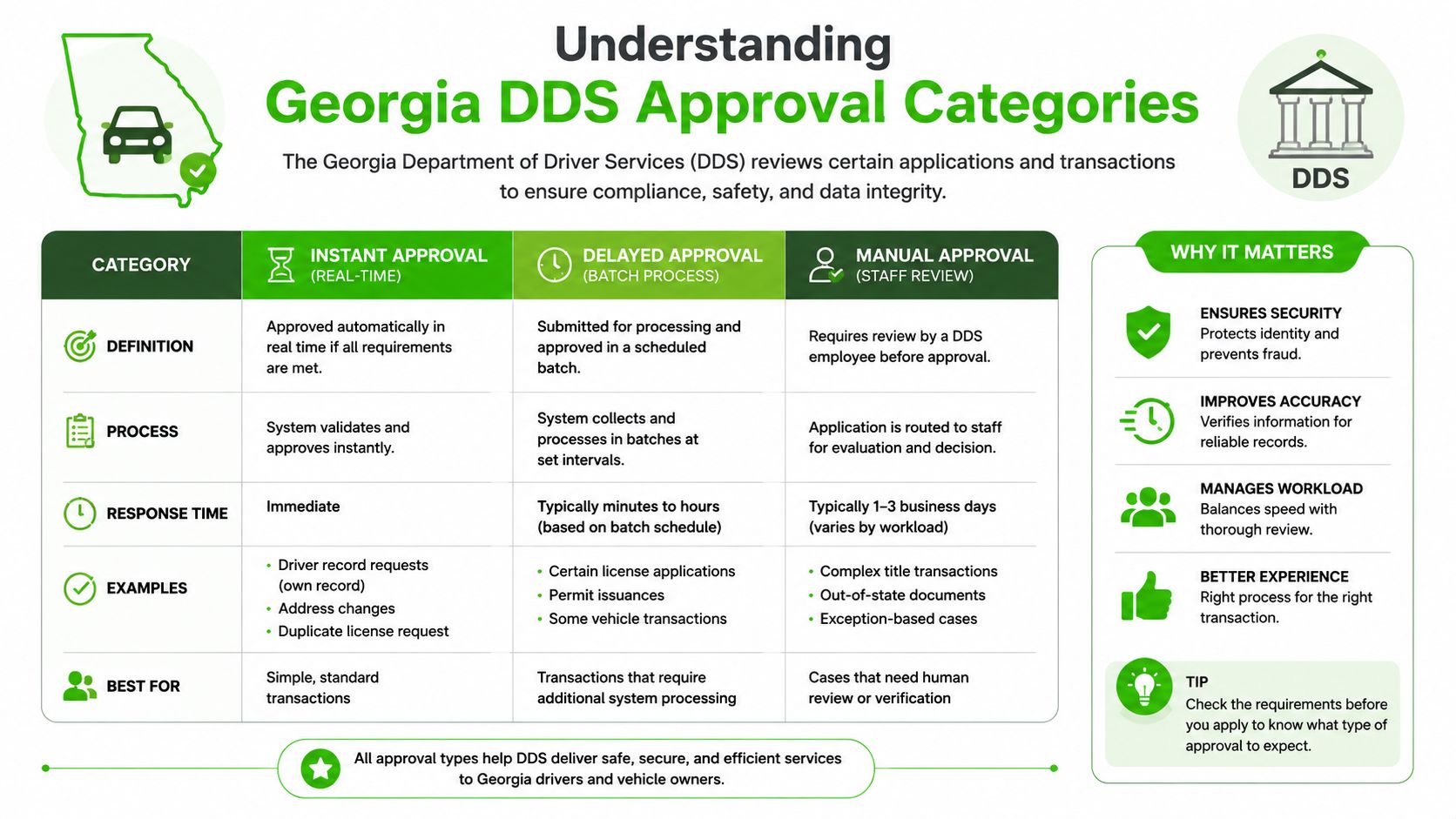
Understanding Georgia DDS Approval Categories
Start with the outcome you need. Georgia DDS approval isn't one universal label that makes every course interchangeable.
Teen driver education for a Class D license
Teen Driver Education, commonly associated with Joshua's Law, applies to 16-year-olds seeking a Class D license. Georgia's framework comes from the Graduated Driver Licensing system created by TADRA, enacted on July 1, 1997. Joshua's Law amended that framework in May 2005 and requires a 16-year-old seeking a Class D license to complete a DDS-approved driver education course.
The standard structure is 30 hours of classroom instruction and 6 hours of behind-the-wheel training, together with 40 hours of supervised driving, including 6 hours at night. DDS treats classroom education, instructor road training, and supervised practice as separate layers. An approved online course can satisfy the theory component, but it can't replace the practical training or supervised-driving evidence required for the Class D path. Review Georgia's Joshua's Law requirements through DDS.
Adult driver improvement and defensive driving
Driver Improvement, often called defensive driving, is for licensed adults and other drivers who need a remedial course. Typical reasons include point reduction, an insurance request, court use, or reinstatement instructions that specifically identify driver improvement. It isn't the same as teen licensing education and doesn't substitute for a DUI Risk Reduction program.
A driver cited in downtown Atlanta may need a defensive driving course for a traffic case. A driver in Gwinnett County may seek the course for an insurance-related benefit. The court, insurer, or DDS notice controls the required format and purpose.
DUI Risk Reduction
DUI Alcohol or Drug Use Risk Reduction, often called DUI Risk Reduction or RRP, addresses DUI and certain drug-related license consequences. DDS guidance identifies a mandatory 20-hour intervention component, and the program has two required components that must both be successfully completed before a completion certificate is issued. Partial attendance isn't enough. Review the DDS DUI Risk Reduction policies and procedures guide.
A driver dealing with a habitual-violator revocation needs to look beyond the class itself. Georgia's rule requires proof of an approved DUI or Drug Risk Reduction Program, a clinical evaluation, any treatment recommended by that evaluation, and documentation showing satisfaction of applicable ignition interlock requirements. The rule also states that five years must have elapsed before reinstatement eligibility is calculated for habitual-violator revocations. Read Georgia's habitual-violator reinstatement rule.
Course Requirements and Compliance Pathways
The course structure determines whether completion is useful for your specific legal purpose. Georgia DDS describes approved driver education as a package with separate theory, road-training, and supervised-practice requirements. For a teen following the traditional Joshua's Law path, that means 30 hours of theoretical instruction, 6 hours of behind-the-wheel instruction with a certified instructor or an approved parent-taught alternative, and 40 hours of supervised driving, including 6 hours at night. See the DDS regulated driver-training guidance.
The practical question is whether online coursework replaces everything. It doesn't. Online instruction can meet the theory requirement when the course is approved, but the teen still needs the required road-training and supervised-driving evidence for the applicable Class D path.
Adult defensive driving follows a different purpose. DDS describes driver improvement as a 6-hour defensive driving course that may be used for point reduction, insurance discounts, reinstatement, or court purposes. The issuing authority may impose additional instructions, so a driver shouldn't assume that any six-hour class satisfies every order.
DUI Risk Reduction is different again. Its curriculum includes a mandatory 20-hour intervention component, and both required components must be completed successfully. A defensive driving certificate cannot stand in for an RRP certificate because both programs discuss safer driving.
| Course Type | Required Hours | Key Components | Primary Compliance Outcome |
|---|---|---|---|
| Teen Driver Education | 30 hours of theory, plus 6 hours of instructor road training or an approved parent-taught alternative | Classroom or approved online education, practical training, and 40 hours of supervised driving including 6 hours at night | Supports the Class D licensing path under Joshua's Law |
| Adult Driver Improvement or Defensive Driving | 6 hours | Approved defensive-driving instruction for the specific court, DDS, point, or insurance purpose | Point reduction, insurance use, reinstatement, or court compliance |
| DUI Risk Reduction | 20-hour intervention component within the approved program | Required intervention and education components, completed successfully | DUI-related reinstatement and other approved compliance needs |
A course's marketing page may emphasize convenience, but the certificate must document the correct category and completion. Families comparing teen options can review a Georgia driver education course while confirming that the program meets their exact DDS pathway before registering.
Choosing Your Delivery Format
Format is a compliance decision, not merely a scheduling preference. Georgia DDS-approved programs may use traditional classroom instruction, live virtual learning, or approved self-paced online coursework, but the acceptable format depends on the program category and the authority requiring completion.
In-person classroom learning
Traditional classroom instruction gives students a fixed schedule, direct access to an instructor, and a structured setting. That can help a teen who needs accountability or an adult who prefers asking questions in real time. Georgia DUI Risk Reduction programs also involve required components that shouldn't be treated as interchangeable with a casual online defensive-driving class.
Live virtual instruction
Live virtual classes use video conferencing to preserve real-time instructor contact while reducing travel. This can suit a working professional in Marietta, a college student in Athens, or a parent managing school and employment schedules. Before enrolling, confirm that the live format is approved for your specific program and accepted by the court or agency involved.
Self-paced online learning
Self-paced online education offers the most schedule flexibility. It can work well for the theory portion of an approved teen driver education pathway or for an adult defensive-driving requirement that expressly permits online completion. It doesn't automatically satisfy behind-the-wheel training, supervised driving, or a court order requiring a particular live or in-person component.
| Format | Flexibility | Instructor Access | Court Acceptance | Best For |
|---|---|---|---|---|
| In-person classroom | Fixed schedule and location | Direct, on-site interaction | Depends on the course and order | Learners who benefit from structure |
| Live virtual | Scheduled attendance with remote access | Real-time instructor contact | Must be confirmed for the specific requirement | Busy adults and students needing interaction |
| Self-paced online | Highest scheduling flexibility | Usually limited or asynchronous | Must be expressly accepted for the requirement | Approved theory or defensive-driving pathways that permit online study |
A provider may advertise a “fully online” option, but that phrase doesn't answer whether your entire legal obligation can be completed online. Review the online Georgia driver education option alongside your DDS notice, court order, or licensing checklist.
Enrollment and Documentation Steps
A smooth enrollment begins before you enter payment information. First, identify the exact obligation in writing. Look for terms such as Driver Education, Driver Improvement, Defensive Driving, DUI Risk Reduction, reinstatement, point reduction, or court compliance. If the wording is unclear, contact DDS, the court, your attorney, or the referring agency before choosing a course.
Verify the provider
Check the provider's current certification through Georgia DDS or ask the school to identify the approval category that applies to your course. DDS says only certified schools may provide the regulated Driver Education, Defensive Driving, and DUI programs. Don't rely on a badge, search result, or phrase such as “state approved” without confirming what it means.
Match your records
Provide your name and identifying information exactly as they appear in DDS records. Keep your license, permit, court order, DDS correspondence, and any reinstatement instructions available during registration. Small differences in names or dates can create unnecessary questions when the certificate is reviewed.
Confirm completion and submission
Before starting, ask about attendance rules, course components, completion timing, reporting, and certificate delivery. After finishing, obtain the official certificate and check the course type, provider information, completion date, and authorized signature. Keep a digital copy and a paper copy, then submit it through the channel identified by DDS, the court, or your insurer.
Families and referral professionals can also use Formcarry application form samples as a practical reference when organizing intake questions and documentation fields. A clear application should capture the driver's identifying information, legal purpose, required course category, and relevant deadlines without leaving the provider to guess.
Before you enroll: Ask, “Will this exact certificate satisfy my DDS, court, licensing, or insurance requirement?” Get the answer in writing when the consequence of a mismatch is suspension or a missed court deadline.
Real Benefits After Course Completion
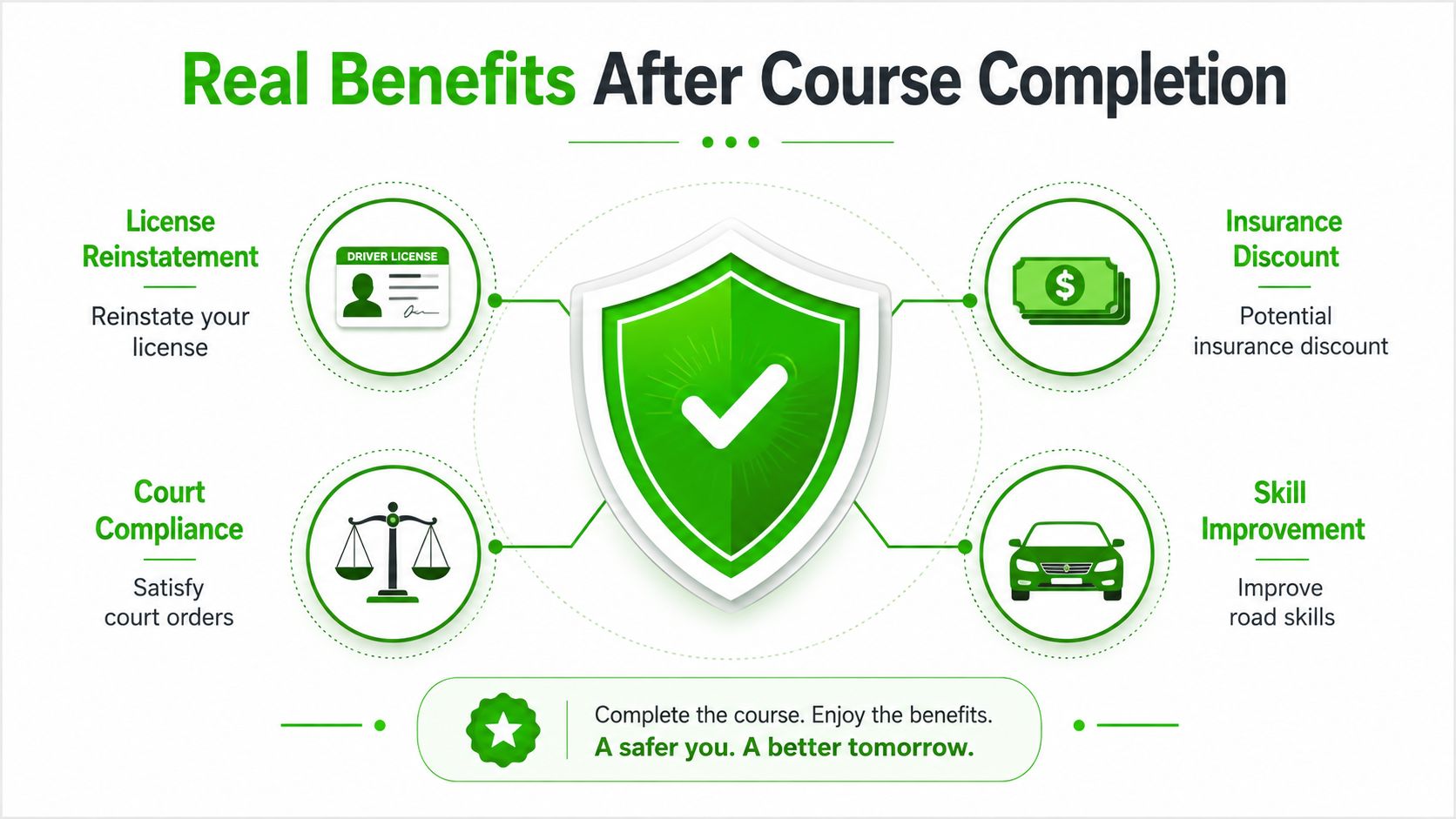
The value of a compliant course depends on the problem it solves. For a teenager, an approved education pathway supports the requirements for a Class D license. For an adult with a traffic matter, driver improvement may support point reduction, an insurance request, or court compliance. For a driver facing DUI-related reinstatement, Risk Reduction is one part of a larger documentation process.
Georgia DDS distinguishes driver education from driver improvement. Its FAQ identifies driver improvement as a 6-hour defensive driving course that may be used for point reduction, insurance discounts, reinstatement, or court use. That makes the certificate's category important. An adult who needs point-related relief shouldn't submit a teen licensing certificate, and a teen shouldn't assume an adult defensive-driving certificate meets Joshua's Law.
The safety benefit also needs honest framing. Research summarized in a systematic review found no reliable population-level reduction in crashes or injuries from pre-licence or post-licence driver education, and a Cochrane review reached a similar conclusion for post-licence education. For defensive-driving-style courses, stronger studies reported an approximately 10% decrease in traffic violations, but the review found no consistent crash reduction. Read the systematic review of driver education and defensive driving.
That doesn't make education pointless. Knowledge, compliance behavior, supervised practice, and better hazard awareness still matter to individual drivers. The responsible promise is narrower: complete the correct approved course, satisfy the stated requirement, and use the training as one part of safer driving rather than treating a certificate as a guarantee.
For drivers comparing program options, the benefits of driver education are easiest to understand when connected to the exact outcome the driver needs, not to a generic promise of savings or safety.
Common Mistakes and How to Avoid Them
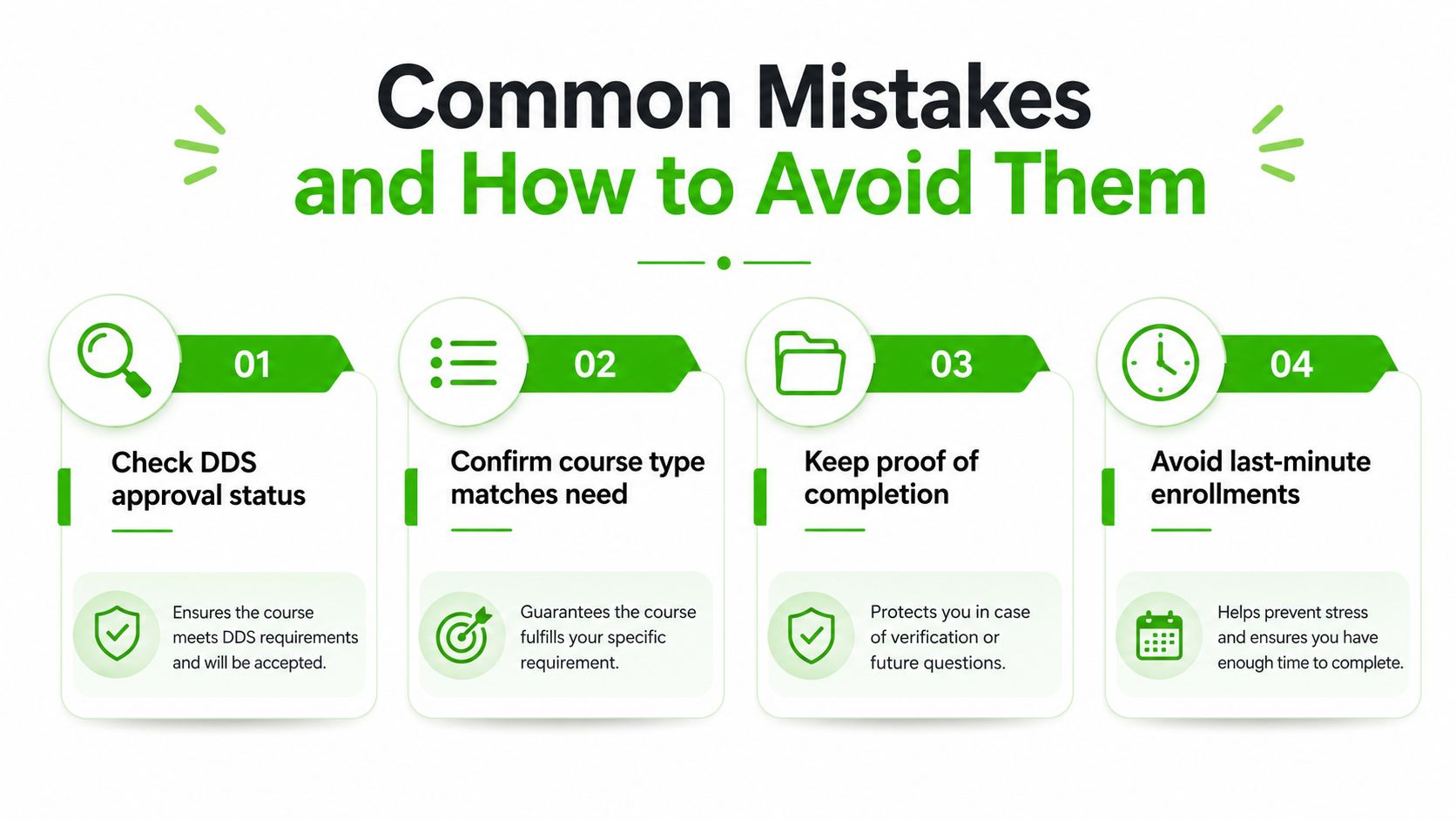
The most expensive assumption is that every course using “DDS approved” language serves the same purpose. It doesn't. A provider may be certified for one program category without being authorized for another, so verify the specific course rather than the brand name alone.
Watch for these errors:
- Choosing by price first: A low fee doesn't help if the certificate is rejected.
- Confusing categories: Defensive driving won't replace DUI Risk Reduction when RRP is required.
- Trusting out-of-state marketing: A course advertised to Georgia drivers may not satisfy Georgia DDS or a Georgia court.
- Skipping document checks: Keep the completion certificate and confirm its course type, date, and provider information.
- Waiting until the deadline: Enrollment, attendance, certificate delivery, and agency processing all take coordination.
Georgia's reinstatement rules can include consequences beyond class completion. For driving while suspended, disqualified, or revoked, the fee for a first conviction within five years is $210 online or $200 by mail, a second conviction is $310 online or $300 by mail, and a third or subsequent conviction is $410 online or $400 by mail. DDS says reinstatement occurs after the additional six-month suspension ends. Review the statutory reinstatement fees.
Georgia DUI Schools offers DDS-approved DUI Risk Reduction and defensive driving programs, along with clinical evaluations, ASAM Level 1 treatment, Victim Impact Panels, online options, and classroom scheduling for drivers across Georgia. If you're unsure whether you need teen education, driver improvement, or DUI Risk Reduction, visit Georgia DUI Schools to review the relevant program and take the next compliance step with the correct course category.