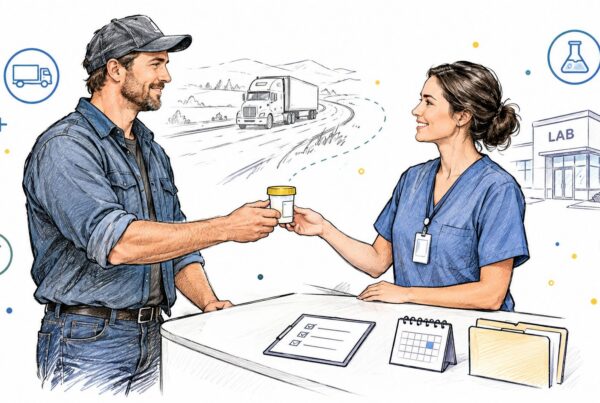
You're a commercial driver in Georgia, and an employer has just told you to report for a DOT drug test. At the same time, a court order may require a Georgia DUI Risk Reduction Program, a clinical evaluation, or other reinstatement steps. Those obligations can overlap, but they don't come from the same system. Confusing a federal workplace test with a state DUI requirement can create avoidable problems with your employer, license, or court case.
DOT drug test regulations create a national safety process for transportation workers in safety-sensitive positions. Georgia requirements add a separate state layer for drivers dealing with DUI or drug-related consequences. The safest approach is to identify which rule applies, follow the correct process, and avoid assuming that completing one requirement automatically satisfies the other.
Introduction to DOT Drug Testing and Why It Matters
A driver may think, “I'm in Georgia, so Georgia law controls my test.” That assumption can be wrong when the driver works in a transportation position regulated by the U.S. Department of Transportation. A motor carrier, airline, railroad, transit agency, or pipeline employer may have federal testing duties that continue regardless of whether the employee is also completing a state-required program.
The modern federal framework began with DOT's interim final workplace drug-testing rule issued on November 21, 1988, effective December 21, 1988. Congress expanded the system in 1991 through the Omnibus Transportation Employee Testing Act, adding alcohol testing and connecting procedures to federal laboratory standards. The process is now centered on 49 CFR Part 40, which establishes how regulated employers conduct drug and alcohol testing across transportation modes. This history is documented in the transportation industry drug-testing overview from the Office of Justice Programs.
That national structure matters because employers aren't left to create separate testing systems for every state. The same basic procedural model supports safety-sensitive work in aviation, rail, transit, motor carrier, and pipeline operations. One industry summary cited by the Office of Justice Programs says DOT regulations applied to nearly 7 million private-sector transportation workers in regulated industries.
Practical rule: A DOT test is a federal compliance event, not simply an employer preference.
Georgia drivers can face a second track at the same time. A DUI conviction may require a DDS-approved Risk Reduction Program, a screening assessment, a clinical evaluation, and treatment if indicated. Those requirements address driving privileges and rehabilitation. A DOT test addresses continued eligibility for safety-sensitive transportation work.
This distinction helps explain why a driver might complete a court-ordered program and still need to satisfy an employer's return-to-duty process. It also explains why an employer can't replace a DOT test with an informal test from a local clinic. The collection, laboratory, review, documentation, and follow-up steps must match the federal framework.
Who DOT Drug Test Regulations Cover and How the System Works
Think of 49 CFR Part 40 as the shared road map for federally regulated testing. Different transportation agencies oversee different industries, but Part 40 supplies the common directions for employers, collection sites, laboratories, Medical Review Officers, and employees.
DOT coverage generally reaches safety-sensitive positions in several transportation modes:
- Motor carriers: Commercial drivers and other covered employees working under FMCSA rules.
- Aviation: Employees performing safety-sensitive functions under FAA oversight.
- Rail: Covered railroad employees regulated by FRA.
- Transit: Safety-sensitive workers under FTA requirements.
- Pipeline operations: Covered employees regulated by PHMSA.
The employer's industry alone doesn't answer every question. The employee's duties matter too. A person working for a transportation company may not be subject to DOT testing if the person doesn't perform a covered safety-sensitive function, while a worker with a particular safety-sensitive role can fall under the rules even when job titles vary.
Why one national process exists
Without a shared system, a driver moving from Atlanta to another state could face a completely different collection process, paperwork standard, or laboratory rule. Part 40 gives the employer and employee a consistent procedure. It also establishes responsibilities for the people who handle the specimen and interpret the result.
The process is easier to understand if you treat it like a commercial vehicle inspection. The driver presents the vehicle, the inspector follows an approved checklist, records move with the inspection, and the final decision depends on documented findings. A DOT test uses the same basic idea. The specimen, custody records, laboratory work, and medical review must connect.
Georgia rules can sit beside this federal process without replacing it. For example, a Georgia driver dealing with a DUI suspension may need to complete state-approved education and clinical steps before reinstatement. An employer may still require federal testing before allowing the driver to perform a safety-sensitive job.
The key question isn't only “Where do I live?” It's “What job do I perform, and which authority regulates it?”
Employers should identify the applicable DOT operating agency, determine which positions are covered, and use qualified service providers. Employees should ask whether a test is DOT-regulated or non-DOT, especially when an employer conducts both types. The distinction affects the panel, paperwork, laboratory standards, and consequences.
Types of DOT Drug Tests You Will Encounter
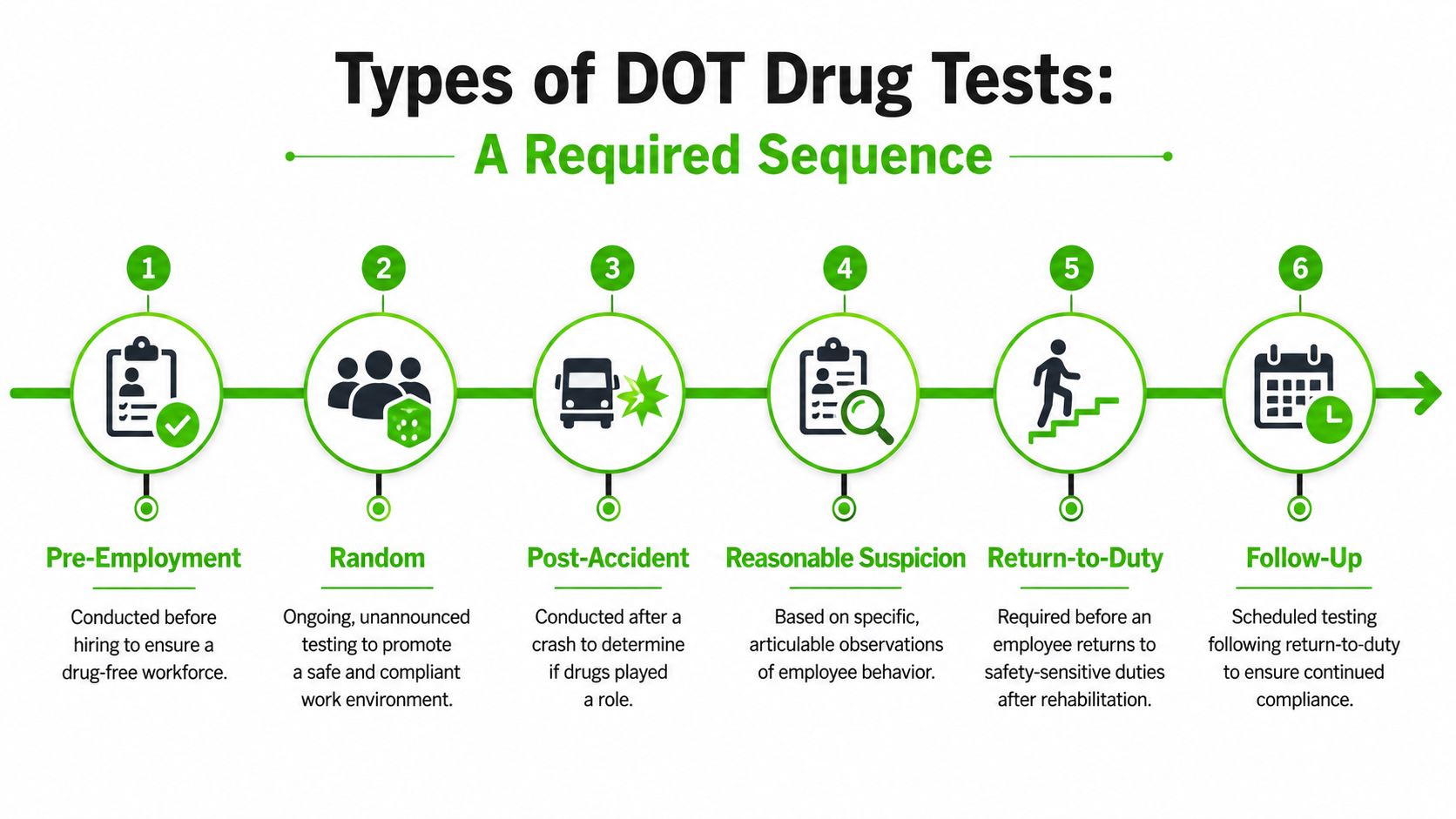
DOT testing follows the employee through several possible events. The exact requirement depends on the employee's role and the event that triggers the test.
Pre-employment testing happens before a covered employee begins regulated duties, subject to the applicable agency rules. A Georgia motor carrier may require a negative result before placing a new commercial driver into a safety-sensitive position.
Random testing occurs without advance notice to the employee. DOT sets rates by transportation mode and reviews industry performance. For calendar year 2026, FMCSA-regulated motor carriers must randomly test 50% of covered employees for drugs and 10% for alcohol. DOT says the FMCSA drug rate stayed at its 2025 level, with the last change occurring in 2020. The DOT random testing rate notice explains the agency-specific rates and annual basis for setting them.
Post-accident testing may follow a qualifying accident or incident. The employer must evaluate the event under the relevant agency rules and determine whether testing is required. A driver shouldn't assume that every collision automatically produces the same DOT testing response.
Reasonable-suspicion testing follows trained observations of signs that may indicate drug or alcohol use. The decision must be based on permitted observations, not rumor or personal disagreement.
Return-to-duty testing applies after a violation or other removal from safety-sensitive work. A qualified Substance Abuse Professional directs the evaluation and education or treatment process, while the employer follows the required federal steps before the employee returns.
Follow-up testing occurs after return to duty according to the prescribed plan. It isn't a substitute for random testing. It's an additional monitoring requirement connected to the prior violation.
Missing a required test, refusing to test, or failing to follow collection instructions can create serious employment consequences. A driver who receives a testing notice should report as directed, bring required identification, disclose relevant prescription information to the Medical Review Officer when appropriate, and keep copies of personal documentation.
State rules create a different timeline. A Georgia DUI case may involve a DDS-approved assessment and intervention course, while a DOT violation may require a separate federal return-to-duty process. Drivers comparing systems across states may also benefit from reviewing this explanation of California random drug test laws, but California procedures don't replace Georgia or DOT requirements.
Substances Tested and What Cutoffs and Validity Checks Mean
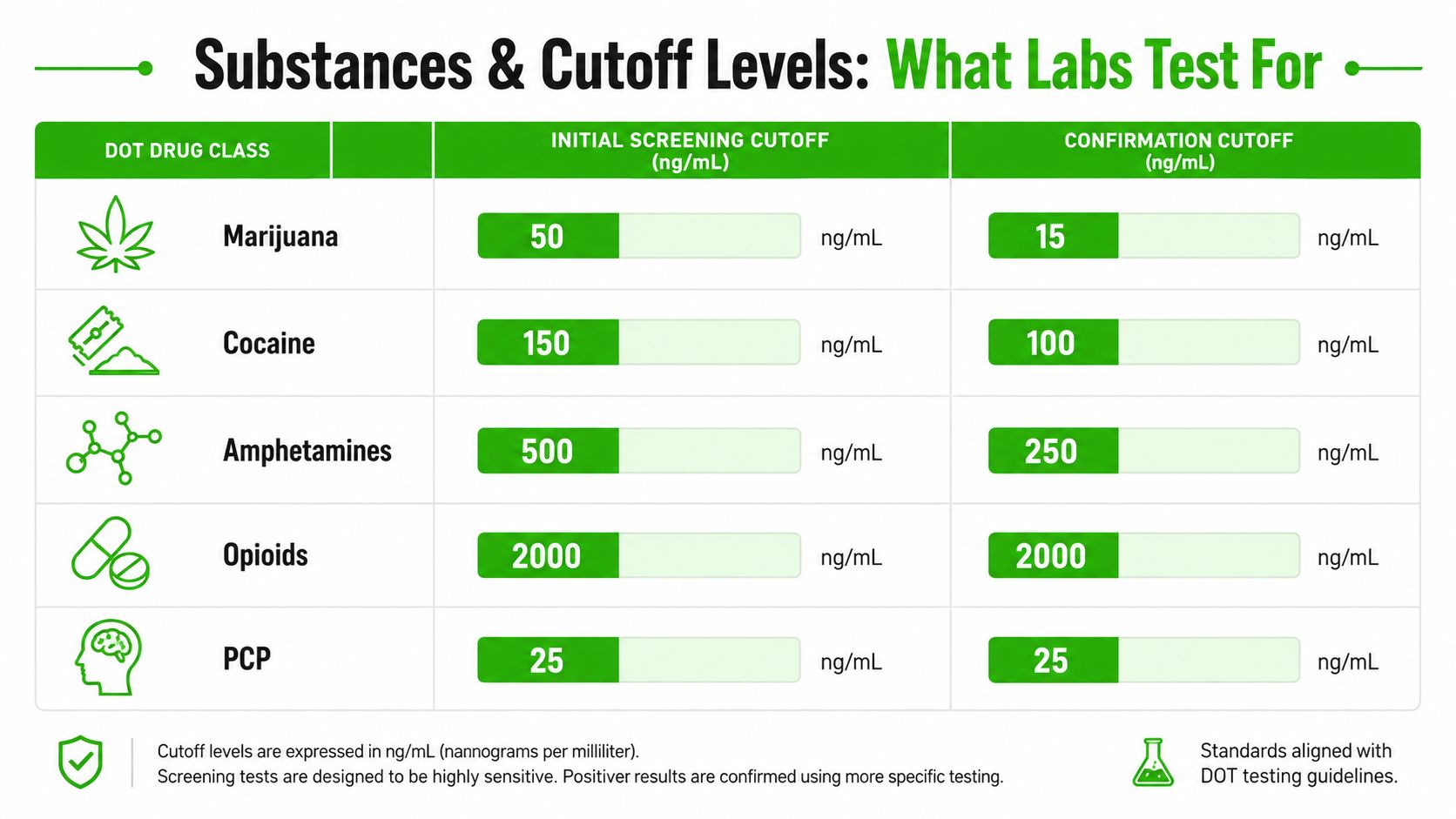
A DOT urine test doesn't treat every trace detected by an initial screen as a final positive. The laboratory uses federally defined cutoff concentrations for the initial immunoassay and the confirmatory analysis. The DOT Part 40 cutoff table lists the applicable thresholds.
Examples include:
| Drug class or metabolite | Initial screen | Confirmation |
|---|---|---|
| Marijuana metabolites | 50 ng/mL | 15 ng/mL |
| Cocaine metabolites | 150 ng/mL | 100 ng/mL |
| Amphetamines and methamphetamines | 500 ng/mL | 250 ng/mL |
| 6-acetylmorphine, a heroin metabolite | 10 ng/mL | 10 ng/mL |
The initial screen is a filter. If the screening result reaches the applicable cutoff, the laboratory performs confirmation using a more specific method. That second analysis is central because it helps distinguish a reportable result from a preliminary signal.
Cutoffs don't mean that a driver can calculate a safe amount to use. They define how the laboratory reports a specimen under the federal program. They also reduce the chance that incidental environmental exposure will be treated like confirmed drug use. The result still moves through chain-of-custody controls and Medical Review Officer review.
Validity is separate from drug detection
The laboratory also checks whether the urine specimen is consistent with normal human urine. Under DOT specimen validity requirements, if creatinine is below 20 mg/dL, the laboratory must also determine specific gravity.
That rule matters because a specimen can be negative for a drug and still raise a validity concern. Excessive fluid intake may dilute urine, and adulteration or substitution can create other findings. Depending on the laboratory result, the specimen may be reported as dilute or invalid, prompting additional steps.
A negative drug screen doesn't automatically answer whether the specimen itself was valid.
The safest response isn't to manipulate hydration before a test. Follow collection instructions normally, don't bring unapproved substances into the process, and tell the collector or MRO about legitimate concerns. A driver researching how THC evidence is handled in a criminal case should keep that separate from DOT employment rules. For a different legal context, THC DUI defenses in Florida offers background on why impairment evidence and workplace laboratory testing aren't interchangeable.
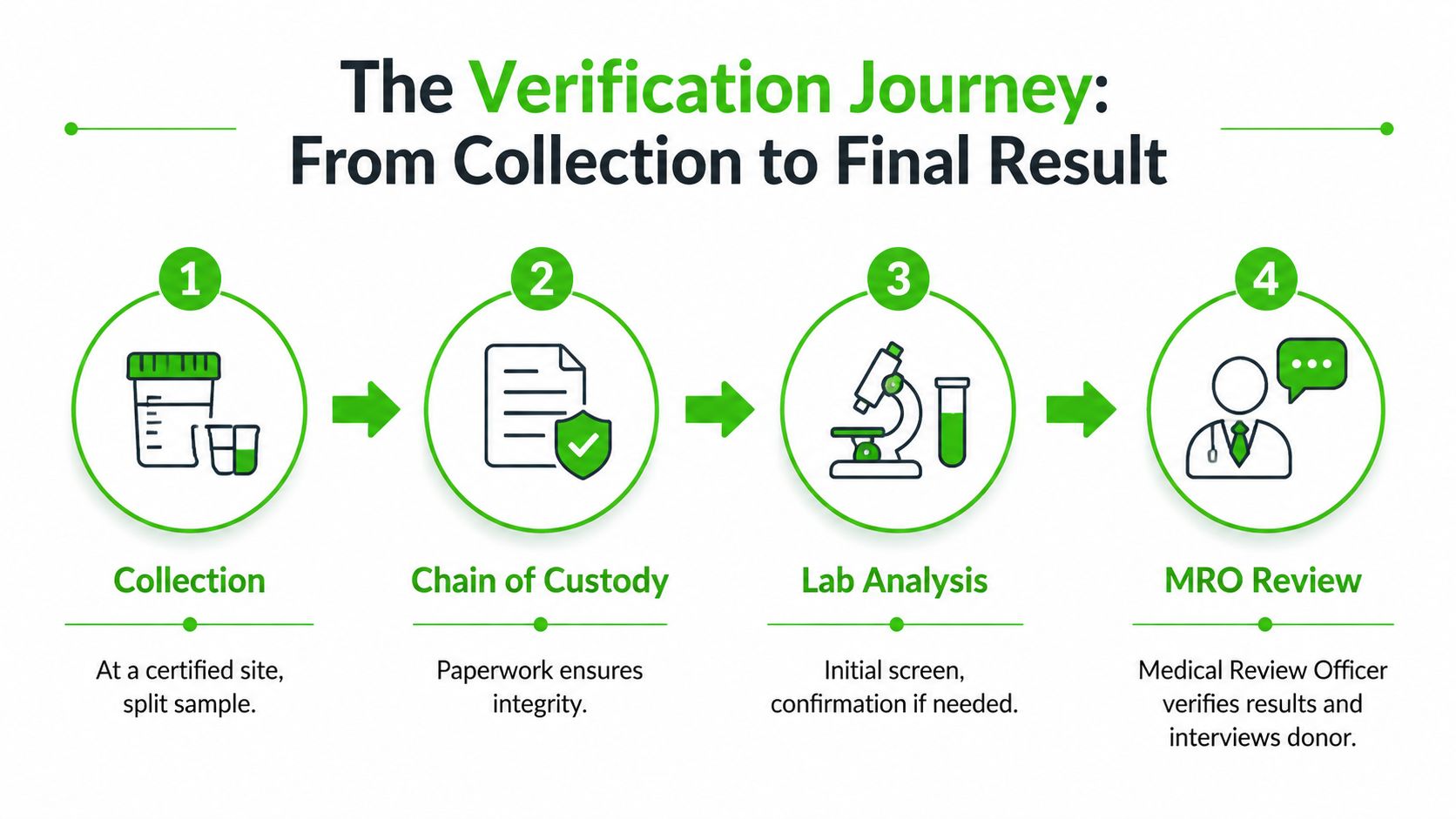
From Collection to MRO Review How Results Are Verified
A DOT result is the end of a chain, not the product of one quick cup at a clinic. The collection site identifies the donor, follows the required procedure, seals the specimen, and completes custody documentation. The specimen is divided into a primary sample and a split sample, creating an additional safeguard if the result is challenged.
The custody record connects each handoff
The chain-of-custody record documents movement from collection to laboratory. If people, containers, or paperwork don't line up, the integrity of the result can become an issue. That's why employees should review the collection paperwork before leaving and report an obvious error promptly.
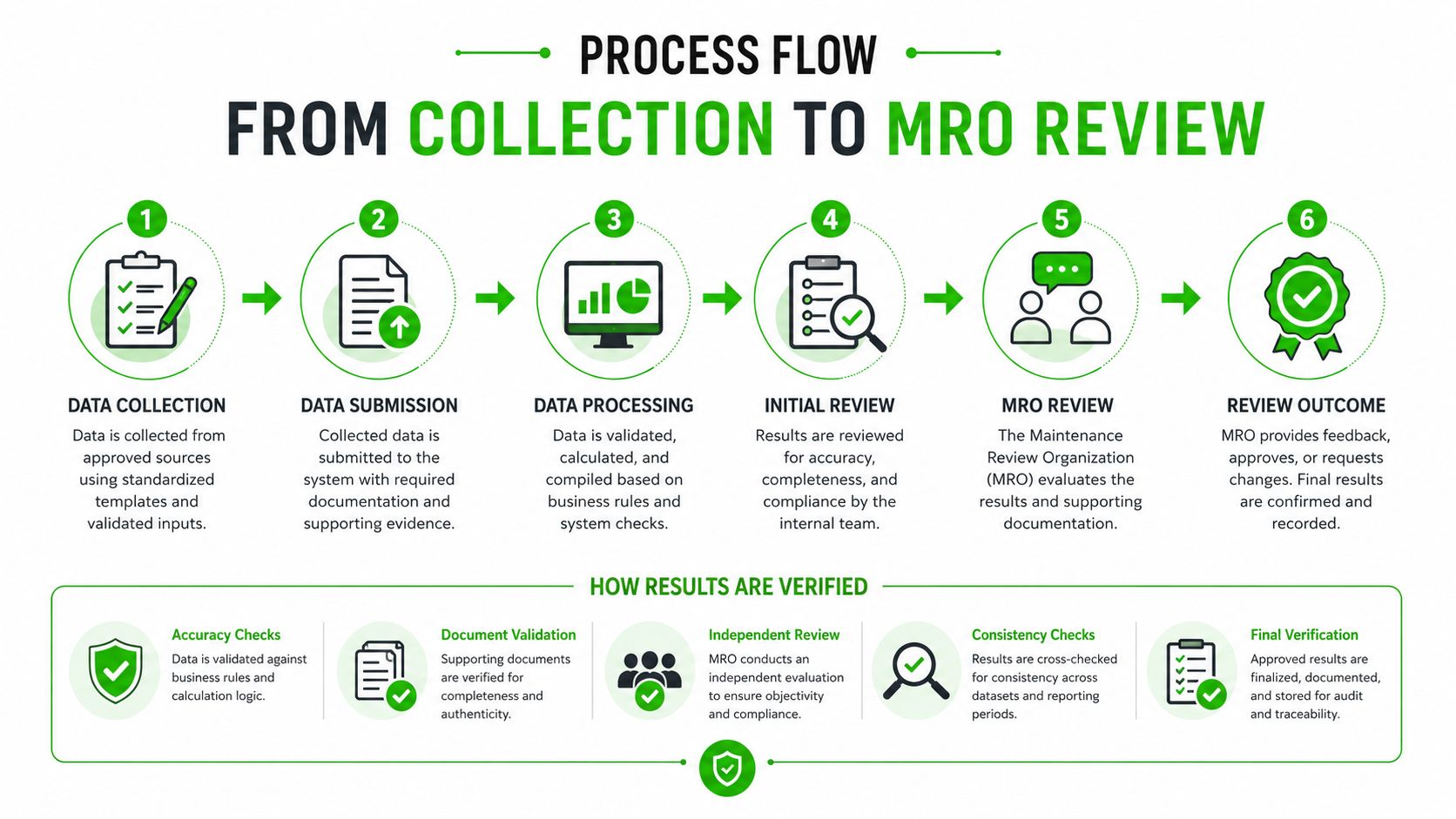
The laboratory performs the initial analysis and confirmation when required. The employer generally doesn't interpret raw laboratory data. Instead, the verified result goes to the Medical Review Officer, a licensed physician who evaluates the laboratory report and considers whether a legitimate medical explanation applies.
The MRO may contact the employee to discuss prescriptions or relevant medical information. A lawful prescription can matter when it explains a confirmed result under the federal rules, but a state authorization or personal explanation isn't automatically enough. Employees should respond to MRO communications and provide requested documentation within the stated timeframe.
Urine remains the practical focus
DOT's framework allows oral fluid as an approved specimen category, but operational availability remains limited because there aren't enough HHS-certified oral-fluid laboratories operating for broad practical use. Industry guidance continues to describe urine as the fully operational DOT specimen type in day-to-day programs. Authorization on paper doesn't mean an employer can immediately switch collection methods.
The same caution applies to proposed panel changes. DOT proposed adding fentanyl and norfentanyl on September 2, 2025, but ODAPC stated in 2026 that the DOT drug and alcohol testing process had not changed yet. The DOT ODAPC news page is the appropriate place to watch for final rules and implementation notices.
For Georgia court-ordered testing procedures, employees and drivers can review the court-ordered drug test procedure separately. Court testing and DOT testing may both involve a laboratory, but they aren't automatically the same event.
Employer Responsibilities Employee Rights and Georgia Rules
Employers carry the operational burden under DOT rules. They must use the correct testing process, maintain required records, manage random selections, make required Clearinghouse checks when applicable, and respond properly to verified violations. A company can't solve a compliance problem by keeping informal notes or sending a driver to any convenient testing location.
Employees have responsibilities too. They must arrive promptly, provide a specimen as instructed, protect the accuracy of their information, and cooperate with the MRO. They also have procedural protections, including the opportunity to discuss a result with the MRO and, when permitted, request testing of the split specimen.
Federal duties and state consequences are different
| Federal workplace issue | Georgia driving issue |
|---|---|
| DOT test selection and collection | DDS license reinstatement |
| Laboratory and MRO review | Risk Reduction Program |
| Return-to-duty process | Clinical evaluation and treatment if indicated |
| Employer safety-sensitive decision | Court or administrative requirements |
Georgia DDS describes the Risk Reduction Program as a standardized screening assessment and a DDS-approved therapeutic education course focused on alcohol, drug use, and driving. The state's program structure includes a 130-question assessment and a 20-hour intervention course, with the assessment completed before the intervention component. The Georgia DDS Risk Reduction Program requirements explain why certification matters. DDS says uncertified schools aren't accepted for licensing, reinstatement, or court requirements.
Georgia DUI guidance also pairs every DUI conviction with a Risk Reduction Program and clinical evaluation, with treatment if indicated, as described by the Governor's Office of Highway Safety. A driver in Atlanta, Athens, or another Georgia community should confirm that the provider is DDS-certified before paying for a course.
Habitual violator consequences can be more severe. Georgia's rule is triggered by three qualifying convictions within a five-year period, and DDS says a declared habitual violator has a license revoked for five years. Once eligible for reinstatement, the person becomes subject to a 12-month ignition interlock requirement, according to the Georgia habitual violator information.
A driver who needs a clinical evaluation can review online drug and alcohol evaluation options while confirming acceptance with the court, attorney, probation officer, or DDS.
Next Steps for Compliance Remediation and Getting Back on the Road
The most reliable approach in 2026 is to separate current obligations from proposed changes. DOT's existing Part 40 procedures remain the operating framework while proposed additions, such as fentanyl and norfentanyl, move through the rulemaking process. Employers shouldn't rewrite testing policies based only on headlines, and drivers shouldn't assume a proposed panel is already in use.
A practical Georgia compliance sequence
Identify the authority. Ask whether the event is DOT-regulated, court-ordered, DDS-related, or a non-DOT employer test. Get the answer in writing when the consequences are significant.
Confirm the current rule. Employers should check DOT and the applicable operating agency for a final effective rule or implementation notice. The 2026 employer guide to DOT drug-testing requirements discusses the gap between formal authorization and practical implementation, including urine and oral-fluid testing.
Document every step. Fleets should maintain clear testing records, notices, custody documentation, MRO communications, and return-to-duty materials. Employers building flawless compliance documentation for fleets can use a structured recordkeeping process to reduce confusion during audits or employee disputes.
Complete Georgia requirements separately. If a DUI conviction requires Risk Reduction, complete the assessment before the intervention course. Schedule a clinical evaluation and follow treatment recommendations when indicated. A Victim Impact Panel may also apply to a particular court or case, so confirm that requirement with the court or supervising professional.
Use the federal return-to-duty path when necessary. A DOT violation generally requires SAP-directed evaluation and completion of assigned education or treatment before the employer can consider a return. The DOT return-to-duty process should be coordinated with the employer and the qualified professionals handling the case.
Georgia drivers often need flexibility because court dates, work schedules, and reinstatement deadlines collide. Approved programs may be available through metro locations or online statewide options, but acceptance depends on the specific requirement. Verify the provider, keep completion certificates, and send documents to the person who requested them.
The goal isn't to guess which rule applies. It's to build a documented path that satisfies the federal workplace requirement and the Georgia driving requirement independently.
Georgia DUI Schools offers DDS-approved Risk Reduction education, clinical evaluations, treatment services, and Victim Impact Panel support for drivers navigating DUI and drug-related requirements. Visit Georgia DUI Schools to find an in-person or online option and take the next documented step toward compliance.