
You've got the paperwork in front of you, the court deadline is closing in, and one word keeps showing up without much explanation, ASAM. If you're in Georgia, that can feel like another test you didn't ask for, especially when the same packet also mentions Risk Reduction, a clinical evaluation, and maybe a class schedule that doesn't seem to match your work week. The good news is that ASAM treatment levels are not a mystery code, they're a way for a clinician to match care to what you need, so you're not pushed into too little support or more treatment than makes sense.
What ASAM Levels Mean After a DUI in Georgia
A lot of people in Atlanta, Athens, Macon, and smaller Georgia towns see ASAM for the first time on a referral sheet and assume it's the name of a program. It isn't. ASAM treatment levels are a placement framework, which means they help a clinician decide how much structure, monitoring, and support fits the situation.
That matters after a DUI because the paperwork can blur together fast. A court form might mention treatment, the DDS process might mention Risk Reduction, and a counselor might mention Level 1 or Level 2.1. Those are not interchangeable labels. One is the clinical intensity level, another is the state-required education path, and another may be the court's compliance step.
For a first-time DUI client, the best way to think about ASAM is this, it's the route map, not the destination. The route can start with a clinical evaluation, then move to a level of care, then connect to the Georgia steps you need to finish. That's why an ASAM level should feel like guidance, not a sentence.
Practical rule: if a document says you need an ASAM level, it's asking where you fit on the treatment continuum, not telling you that you've already failed.
If you're trying to translate the language on your own, a plain overview of what substance abuse treatment means in Georgia can help you separate the clinical pieces from the administrative ones. The rest of this guide keeps that same plain-language approach so the labels stop feeling like a trap.
How the ASAM Continuum and Six Assessment Dimensions Work
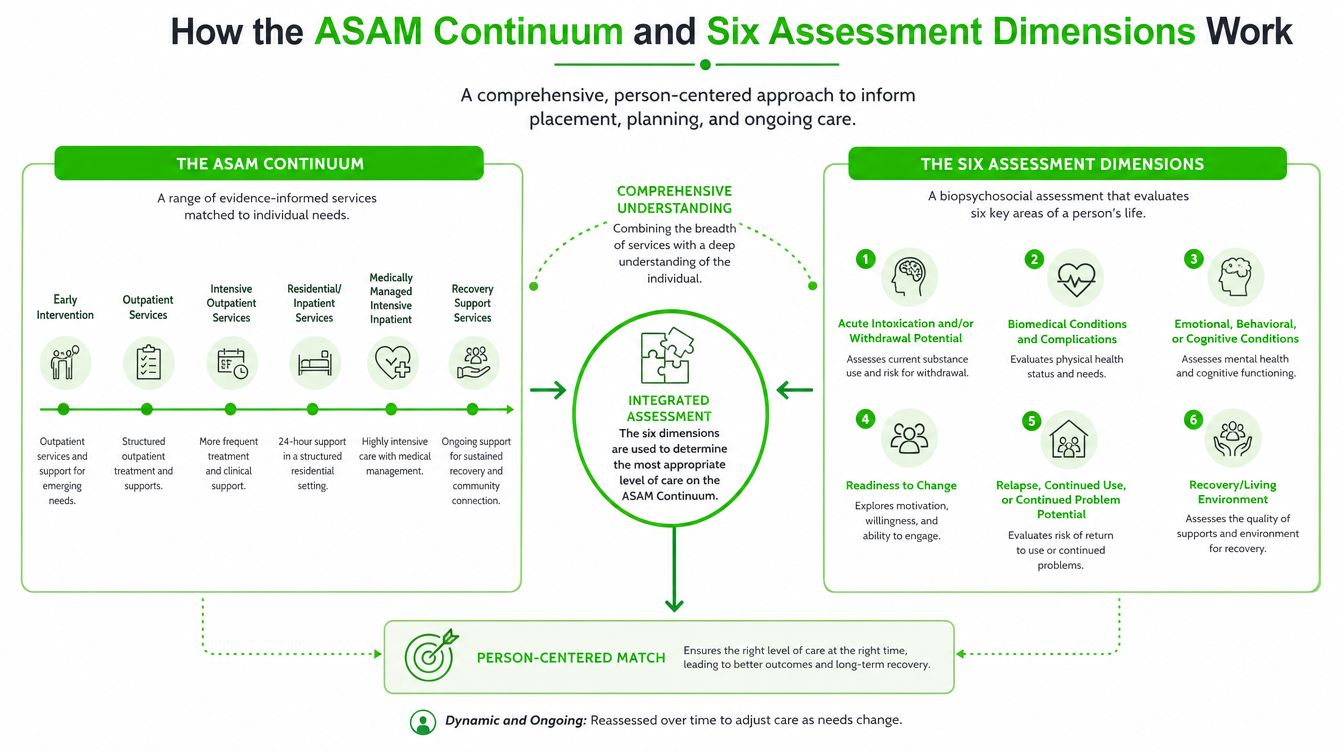
ASAM works like a graded ladder, not a yes-or-no switch. The framework uses a 0.5 to 4.0 continuum of addiction-treatment intensity, with levels moving upward as service needs increase, and published guidance shows how that intensity translates into weekly hours, from Level 1 outpatient care under 9 hours, to Level 2.1 at 9 to 19 hours, and Level 2.5 at 20 or more hours per week (Medicaid ASAM resource guide). That helps explain why two people with the same charge can end up with different recommendations.
The six questions underneath the level
A clinician doesn't pick a level from one detail. The ASAM framework uses six assessment domains, including intoxication or withdrawal, biomedical status, psychiatric and cognitive status, relapse risk, recovery environment, and person-centered factors (ASAM overview). It functions like a six-question checklist. If one area is unstable, it can raise the level of support, even if the rest look manageable.
That's also where confusion often starts. A person may feel fine medically but have a chaotic home situation, or may have strong family support but a withdrawal concern that needs monitoring. ASAM is built to weigh all of that together.
If you want a deeper look at how a clinician converts those dimensions into a recommendation, the ASAM level 1 treatment page for Georgia is useful because it connects the clinical label to the kind of weekly services people attend.
Why this framework feels different from a simple referral
The point is matching. A person doesn't get placed into treatment because the label sounds serious, they get placed where the risk level and the support need line up. That's why ASAM is often described as a placement system. It helps clinicians avoid a common mistake, under-treating someone who needs more structure or over-placing someone who could do well with less.
A good ASAM placement should answer one question clearly, what is the minimum safe level of care right now?
find dual diagnosis support in Dallas-Fort Worth can be useful if the DUI situation overlaps with depression, anxiety, or another mental health concern, because those issues can affect placement just as much as the alcohol or drug charge itself.
Each ASAM Level From 0.5 to 4 Explained
ASAM treatment levels make more sense when you read them like service intensity, not like a score. The higher the number, the more structure, supervision, and time you're getting from the program. In Georgia DUI cases, the level you're assigned depends on the clinical evaluation, not on what friends say happened in their case.
The basic ladder
Level 0.5 is early intervention. It's for someone who may not need full treatment but does need education, screening, or a brief intervention. In older materials, this sometimes appears as part of the continuum, but it's better to think of it as the lightest touch on the ladder.
Level 1 is standard outpatient care. A published guide says it is generally under 9 hours of skilled treatment per week (Medicaid ASAM resource guide). For many first-time DUI clients, this is the level they hear about most often.
Level 2.1 is intensive outpatient care, with service time generally above Level 1, and provider summaries often place it at about 9 to 19 hours per week (Aetna ASAM criteria summary). Level 2.5 is partial hospitalization, and one provider manual says it requires at least 20 hours per week with a minimum daily limit of 4 hours (Alaska provider training manual).
Level 3 is residential care. That means the person lives in a structured setting and gets round-the-clock support. Level 4 is medically managed inpatient care, which is the most intensive setting in the continuum and includes 24-hour nursing care and daily physician visits (ASAM criteria overview).
What that can look like in real life
A driver with a first DUI, stable housing, and no withdrawal risk often fits outpatient care. A person with repeated use, mental health instability, or a shaky recovery environment may need a higher level. The point isn't punishment, it's safety and fit.
| ASAM Levels 0.5 to 4 at a Glance | |||
|---|---|---|---|
| Level | Setting | Typical Weekly Hours | Typical DUI Relevance |
| 0.5 | Early intervention | Brief education or screening, not a full treatment load | Sometimes used for prevention-focused referrals |
| 1 | Outpatient | Under 9 hours (Medicaid ASAM resource guide) | Common for first-time DUI cases |
| 2.1 | Intensive outpatient | About 9 to 19 hours (Aetna ASAM criteria summary) | Used when more structure is needed |
| 2.5 | Partial hospitalization | 20 or more hours, with a 4-hour daily minimum (Alaska provider training manual) | Less common, but possible with higher clinical need |
| 3 | Residential | Overnight stay and structured living | Usually for more significant risk or instability |
| 4 | Medically managed inpatient | 24-hour nursing care and physician oversight (ASAM criteria overview) | Reserved for severe medical or psychiatric risk |
Some Georgia providers, including Georgia DUI Schools' ASAM Level 1 treatment page, are set up to serve clients whose evaluation lands in that outpatient range.
Withdrawal Management Levels When Detox Is Needed
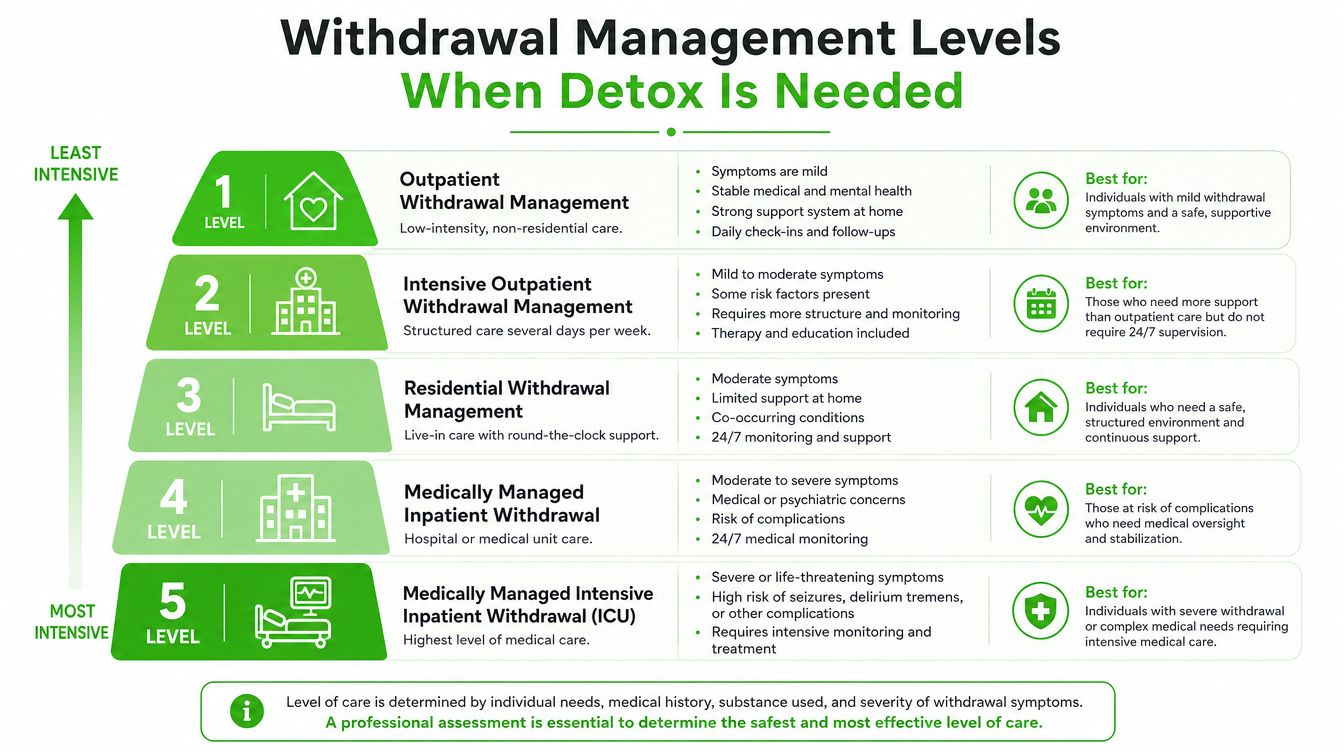
Not every DUI client needs detox, but when withdrawal is part of the picture, ASAM uses a separate set of levels with a -WM suffix. That's important, because withdrawal management is not the same thing as long-term treatment. It's the short, medicalized phase that helps a person get stable enough to step into the right treatment level afterward.
The withdrawal ladder in plain language
Level 1-WM is ambulatory withdrawal management without extended on-site monitoring. That means the person can be seen and monitored without staying in a facility around the clock. Level 2-WM adds extended on-site monitoring, so the person gets a closer watch while still not needing the highest medical setting (Arizona AHCCCS ASAM brochure).
Then the setting gets more structured. Level 3.2-WM is clinically managed residential withdrawal management. Level 3.7-WM is medically monitored inpatient withdrawal management. Level 4-WM is medically managed intensive inpatient withdrawal management, reserved for the most severe withdrawal situations, where 24-hour nursing care and physician oversight are necessary (Arizona AHCCCS ASAM brochure).
Why this matters for DUI clients
A lot of people hear “detox” and think it means the whole treatment plan. It doesn't. Detox is usually the first step when there's a withdrawal concern, then the person moves into the longer treatment level that fits the ongoing clinical need.
That distinction prevents two common mistakes. One is assuming every alcohol-related case needs inpatient detox. The other is assuming detox alone is enough to satisfy the treatment recommendation. In reality, a clinician is looking at symptoms, supervision needs, and safety risk, then matching the person to the least intensive level that still protects them.
If withdrawal is active, the question isn't how much inconvenience the person can tolerate. It's what level keeps them medically safe.
For Georgia drivers comparing treatment paperwork with a diversion or court packet, a plain overview like DUI diversion program explained can help separate legal diversion from medical withdrawal care, which are often discussed together but are not the same thing.
How Georgia DUI Cases Get Matched to an ASAM Level
In Georgia, the ASAM recommendation usually starts with a state-approved clinical evaluation. That's where the evaluator reviews the person's substance use history, current functioning, and the six ASAM domains, then assigns a level of care that fits the risk picture. The recommendation can go to the court, the DDS process, or both, depending on what the case requires.
A lot of first-time DUI clients end up in Level 1 outpatient treatment because their evaluation shows they can stay safe and engaged with a lighter weekly schedule. That lines up well with the state's broader Risk Reduction path, which is why clinical treatment and the education requirement often appear in the same compliance conversation. If you need the evaluation side explained in plain terms, this Georgia DUI Schools page on alcohol evaluations is a useful starting point.
Who can send you for the evaluation
Referrals don't always come from the court. Attorneys, probation officers, employers, and even self-referral can put the process in motion. The important part is that the evaluation itself has to be done by a qualified provider who understands how to translate what they learn into an ASAM placement.
That placement can change if the facts are different. A prior offense, a refusal, a positive drug screen, or stronger signs of impairment can move someone higher on the continuum. The evaluator isn't guessing, they're matching the service level to the clinical pattern they see.
Why the recommendation matters for compliance
Georgia DUI compliance usually gets messy when people try to do things in the wrong order. Someone may finish a class before getting the evaluation, or sign up for the wrong level because a friend said it worked for them. That wastes time and can create paperwork problems.
A better path is simple. Get evaluated first, follow the level assigned, and then complete the required education and panel work in the sequence your court or DDS paperwork expects. For many drivers, that means outpatient treatment first, then the state education steps, then final submission of documents.
find a certified addiction specialist can be a helpful option if the evaluation reveals broader substance-use or medical concerns that need a clinician with addiction experience.
The 2025 to 2026 ASAM Update and Common Misconceptions
The biggest terminology change many Georgia drivers miss is the move toward ASAM Fourth Edition language. State guidance says Level 0.5 was removed and renamed Early Intervention and Secondary Prevention, and that early intervention may still be authorized under a Level 1 license depending on the jurisdiction (ASAM Fourth Edition overview). That means older handouts and newer documents can sound like they're talking about different systems, even when they're really referring to the same clinical idea.
Common myths that cause confusion
Myth 1, a higher ASAM level is a punishment.
Not true. It's a support match. Higher levels usually mean more structure because the clinical risks are higher.
Myth 2, Level 1 means no real treatment.
Also false. Level 1 outpatient is still treatment, just at a lower weekly intensity than higher levels. For many DUI clients, that's exactly the right fit.
Myth 3, the Risk Reduction course alone satisfies the clinical requirement.
It usually doesn't. The education course and the clinical treatment recommendation are separate pieces of the Georgia process.
Myth 4, insurance will automatically cover every ASAM level.
That assumption can backfire. Coverage depends on the plan, the setting, and the documentation, so it's smart to verify before you commit.
The new terminology causes trouble because people compare old and new documents side by side and think something is missing. In many cases, the core idea hasn't disappeared. The label has changed, and the state licensing context matters more than ever. That's why readers should be careful about advice pulled from old forum posts or outdated PDFs.
Your Practical Path Through Assessment and Treatment in Georgia
A clean Georgia DUI plan usually starts with three decisions, get the clinical evaluation, follow the ASAM level the evaluator recommends, and complete the Risk Reduction course plus the Victim Impact Panel through a DDS-approved provider. If your case also involves license limits or ignition interlock rules, those need to be handled in the same paperwork flow so nothing gets held up later.
For the treatment side, many people can expect a Level 1 outpatient schedule that fits around work and family life, rather than a residential stay. That's where simple planning matters. Missed appointments, late forms, and signing up for the wrong class format cause more delays than the treatment itself.
A practical week-by-week approach
- Gather every document. Court papers, DDS notices, and any referral sheet should all be in one place.
- Schedule the evaluation first. That keeps you from guessing at the wrong level.
- Choose the class format that fits your calendar. Some people need online flexibility, others do better in person.
- Finish the required education and panel. The order should match your paperwork, not a friend's story.
A lot of drivers also want a realistic sense of timing. For Level 1, the schedule is often manageable enough to fit around work, but the exact completion window depends on the provider and the court process. Costs and insurance treatment can vary too, so it's worth checking the provider's intake desk before you start.
Georgia DUI Schools offers clinical evaluations, ASAM Level 1 treatment, the Risk Reduction course, and the Victim Impact Panel in one system, which can simplify the handoff from assessment to completion. If you're still sorting out what your paperwork means, that kind of structure can keep you from bouncing between separate offices.
Next Steps to Start the Right ASAM Level in Georgia
Your three priorities are straightforward, get a state-approved evaluation, follow the level the evaluator assigns, and complete the Georgia DDS requirements in the right order. If you're unsure whether your paperwork calls for education, treatment, or both, use this week to gather the documents, schedule the evaluation, and compare the court instructions with the DDS requirements before you sign up for a class.
For a second opinion on the clinical side, it can also help to speak with a certified addiction specialist who understands how placement works. Then choose the course format that fits your schedule, online or in person, and keep every completion certificate together for submission.
If you need a clear next step, Georgia DUI Schools offers the state-required Risk Reduction course, clinical evaluations, ASAM Level 1 treatment, and Victim Impact Panels for Georgia drivers moving through DUI compliance. Visit Georgia DUI Schools to find the course and support that match your paperwork, your schedule, and your next deadline.