
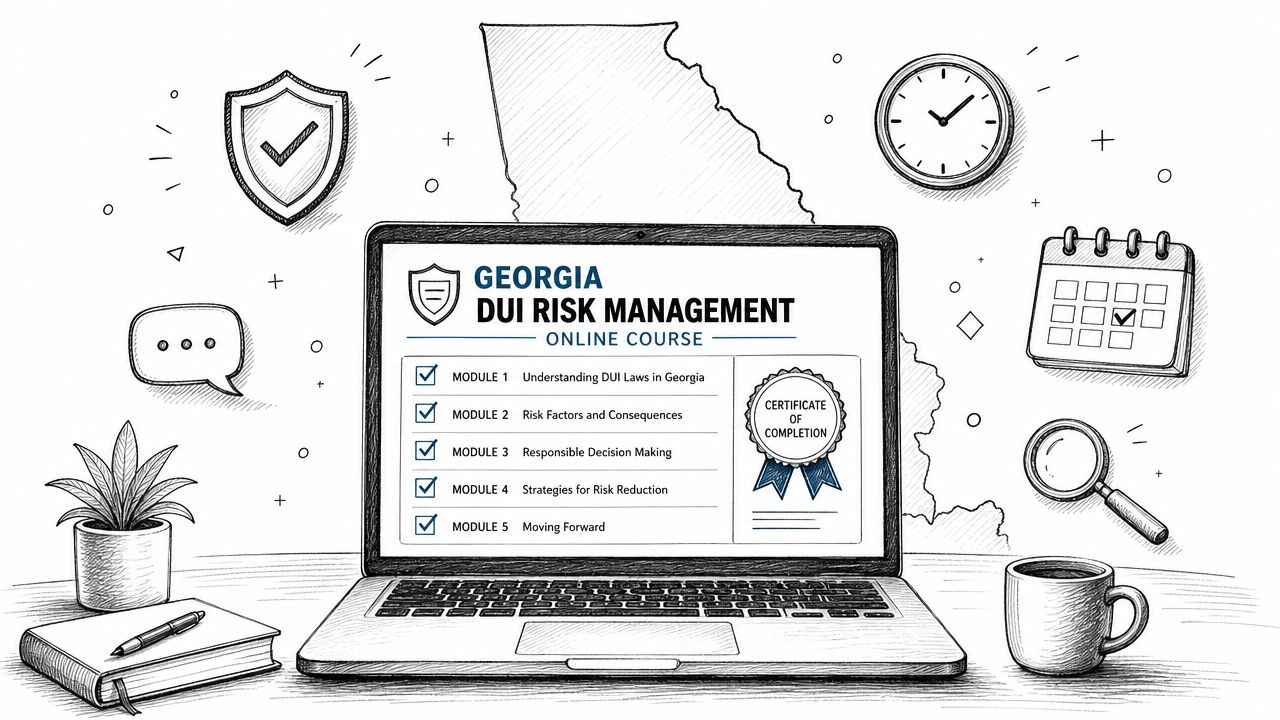
You searched for a risk management course online because someone told you to complete one, and now the internet is giving you everything except the course that counts. You're seeing corporate compliance programs, cybersecurity training, insurance certifications, and broad university coursework. None of that helps if a Georgia court, probation officer, or the Department of Driver Services has ordered you to complete the state DUI program.
That confusion is common. Georgia Department of Driver Services data cited in this context shows that over 45,000 drivers were required to complete Risk Reduction education in 2025, while many national online course providers still focus on corporate or financial risk instead of legally binding driver requirements. That mismatch is exactly where people lose time.
The practical issue isn't finding any course with “risk management” in the title. The issue is finding the one Georgia-approved course that satisfies your legal requirement and won't be rejected later.
Navigating Your Course Requirement in Georgia
If your paperwork says you need a risk management course, read it as Georgia Risk Reduction Program unless your attorney or court order says something else. In Georgia DUI and drug-related driving cases, the state isn't asking for general education about managing risk. It's requiring a specific, regulated intervention program.
A generic certificate from a national training platform won't fix a Georgia license problem. It won't satisfy a DUI sentence. It won't help with a DDS reinstatement hold. The words may sound similar, but the legal meaning is completely different.
Why search results mislead people
Most search results for “risk management course online” are built for business users. They cover topics like:
- Corporate compliance: workplace safety, HR, internal controls
- Financial risk: insurance, auditing, enterprise risk
- Cybersecurity risk: NIST, privacy, supply chain controls
Those can be legitimate courses in their own field. They just aren't the Georgia DUI course.
For example, NIST's RMF Introductory Course is a real online risk management course built around SP 800-37 Rev. 2, and NIST describes it as free, on-demand, and foundational for cybersecurity and privacy risk management. That has value in federal and enterprise settings. It has nothing to do with a Georgia DUI reinstatement requirement.
Practical rule: If the provider talks about cybersecurity, finance, OSHA, ISO, or enterprise governance, you're almost certainly looking at the wrong kind of course for a Georgia DUI or drug offense.
What actually works
The course that works in this situation is the Georgia DUI Alcohol or Drug Use Risk Reduction Program. That's the state-approved program used for court compliance and DDS-related requirements tied to DUI and certain drug or alcohol offenses involving vehicle operation.
Use this filter before you register:
- Check the course type: It must be the Georgia Risk Reduction Program.
- Check the approval status: The provider must be DDS-approved.
- Check the delivery format: If it's self-paced and on-demand, it won't satisfy the Georgia requirement.
- Check the certificate purpose: It must be issued for Georgia court or DDS compliance, not general education.
People get into trouble when they shop by keyword instead of legal requirement. In this area, a cheap or fast wrong course is worse than no course at all, because it can push your case back and create more paperwork.
What Is the Georgia Risk Reduction Program
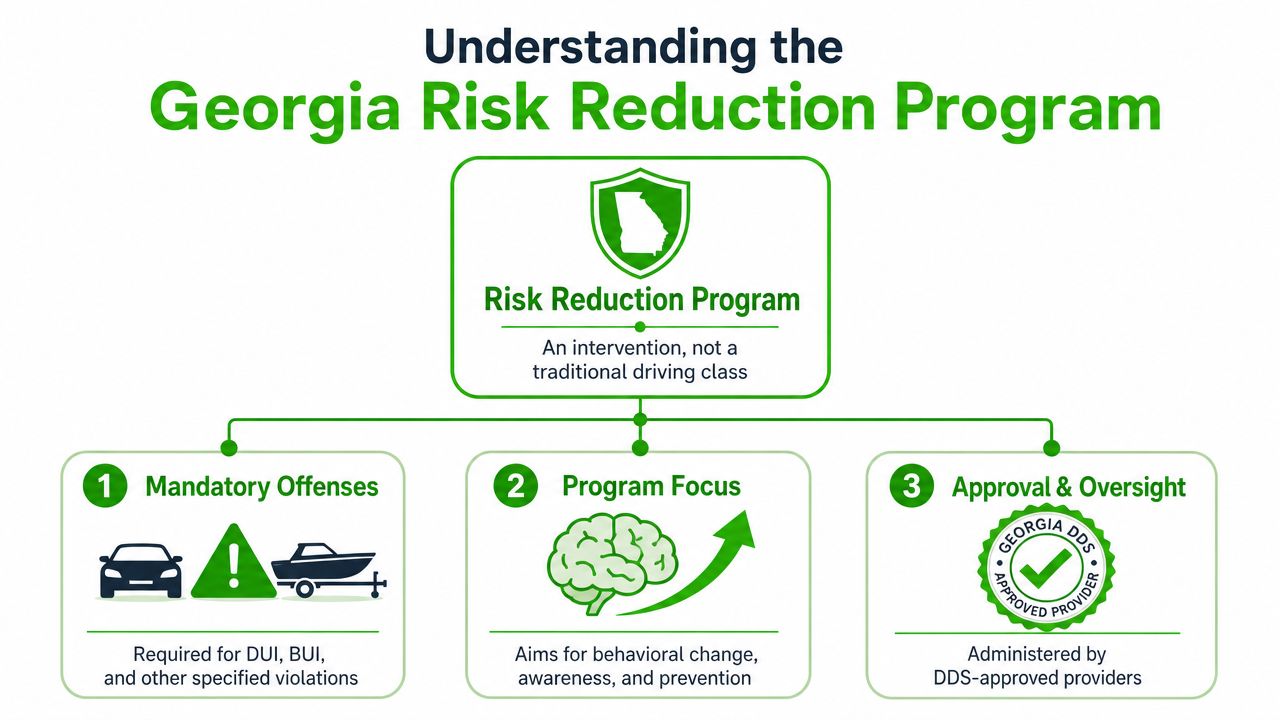
The Georgia Risk Reduction Program isn't a standard driving class. It's an intervention program for people whose case involves alcohol, drugs, and vehicle operation. The state treats it differently because the purpose isn't simple rule review. The purpose is to address behavior, judgment, and substance-use risk in a structured setting.
Who has to take it
Under Georgia administrative rules for Risk Reduction Programs, the program is required for individuals convicted of DUI, BUI (Boating Under the Influence), possession of illegal drugs, or underage possession of alcohol or drugs while operating a vehicle. The same rules state that instructors must complete a minimum of 32 hours of continuing education annually in alcohol/drug training or group facilitation.
That annual training requirement matters. It tells you the state expects trained instructors delivering a controlled curriculum, not a passive video library.
If you want a plain-language overview of the program itself, this explanation of what risk reduction means in Georgia gives the local context people usually need first.
The two parts you must complete
Georgia structures the program in two mandatory components. You don't finish by doing only one.
The NEEDS Assessment
This is the screening component completed before class. It's designed to identify patterns and risk factors related to alcohol or drug use.The Intervention Component
This is the live instructional portion of the program. It's the class most people think of when they hear “Risk Reduction course.”
This program is an intervention, not a shortcut. If you treat it like a checkbox and enroll in the wrong format, the state won't treat that as compliance.
What the program is trying to do
The state-approved curriculum is built to push self-assessment and better decisions, not just memorization. That's why students are expected to engage, attend, and complete the process in order.
That also explains why broad “risk management” education from national providers misses the mark. A business risk course teaches frameworks. A Georgia Risk Reduction course addresses legal compliance tied to impaired or substance-related operation of a vehicle.
How State Approval and Court Acceptance Works
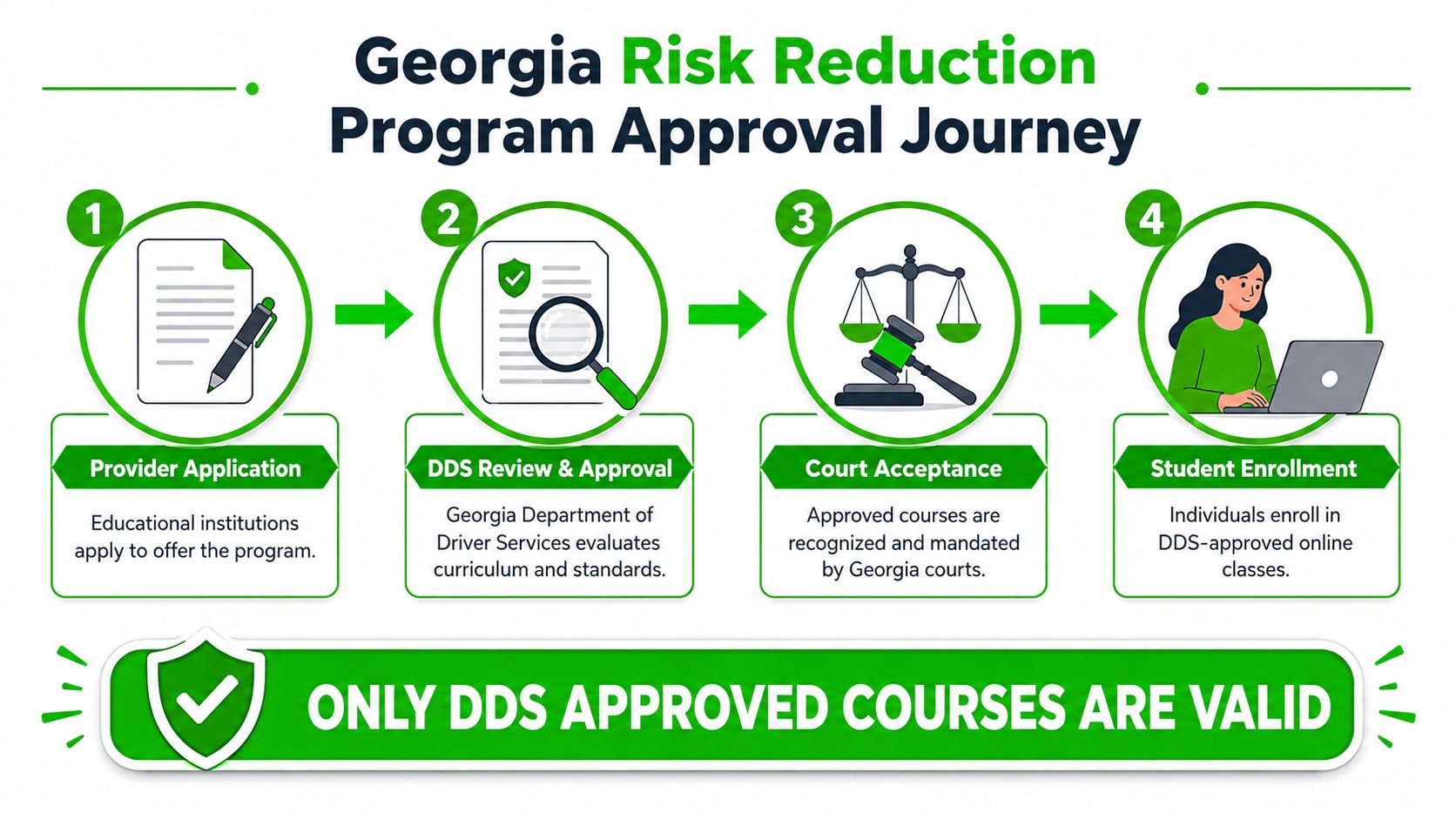
The approval chain is simple once you strip away the marketing language. Georgia DDS decides which providers can offer the program. Courts rely on that approval. Students have to choose from those approved providers.
If a provider isn't approved by DDS for the Georgia Risk Reduction Program, the course isn't valid for this purpose. It doesn't matter how polished the website looks. It doesn't matter if the company operates nationally. It doesn't matter if the certificate says “completed.”
What courts actually recognize
When a judge orders a course in a Georgia DUI or related case, the expectation is a DDS-approved Risk Reduction Program. Court acceptance doesn't exist separately from state approval. The court doesn't create its own private category of substitute online classes.
That's why self-paced providers create so many problems. They market convenience first, but convenience doesn't equal acceptance.
The easiest way to avoid a rejected certificate
Use a decision test before you enroll:
| Question | If the answer is no |
|---|---|
| Is the provider DDS-approved for Georgia Risk Reduction? | Don't register |
| Is the course the Georgia DUI Alcohol or Drug Use Risk Reduction Program? | Don't register |
| Is the online option live and instructor-led rather than self-paced? | Don't register |
| Will the completion be accepted for court or DDS purposes in Georgia? | Get confirmation before paying |
What usually goes wrong
People often make one of these mistakes:
- They assume “online” means any online format: In Georgia, that assumption causes the most avoidable enrollment errors.
- They choose by price or speed: If a course promises instant completion, that's usually a warning sign in this context.
- They trust broad language: “Risk education,” “substance awareness,” and “online certificate” are not the same as the Georgia-approved program.
Compliance check: Before you pay, verify the provider is offering the Georgia DDS-approved Risk Reduction Program, not a general risk management course online with similar wording.
Completing Your Approved Online Course Step by Step
For Georgia DUI purposes, “online” doesn't mean watch videos whenever you want. It means a live, instructor-led virtual class, usually through Zoom, offered by an approved provider.
That distinction is where many students either stay on track or lose weeks.

If you want to preview what students are expected to cover, this page on Risk Reduction course content is useful before enrollment.
The actual process
Most students complete the course in a straightforward sequence:
Register with an approved school
Use the provider's official registration process. Double-check that you're enrolling in the Georgia Risk Reduction Program, not defensive driving and not a general online education course.Complete the assessment before class
The assessment comes first. If you skip that step or do it too late, you can create a same-day problem for your seat in class.Attend the full live class schedule
These sessions are instructor-led. You must be present for the required class time and follow attendance rules.Participate appropriately
This isn't a self-study module running in the background while you do something else. Instructors monitor participation and completion.Receive your completion paperwork when all requirements are satisfied
You only finish once every required component is complete.
What students often misunderstand
The biggest misunderstanding is format. A lot of people type “risk management course online” into a search bar and assume they need flexibility above all else. In Georgia DUI cases, legal validity comes first.
A second misunderstanding is thinking partial completion counts. It doesn't. If you complete only part of the process, you haven't completed the program.
What helps the process go smoothly
- Use a stable device and internet connection: Live virtual attendance matters.
- Read the class instructions closely: Login timing, identification, and class conduct all matter.
- Handle the assessment early: Last-minute scrambling is one of the most common avoidable problems.
- Keep your records: Save confirmation emails and your certificate copy for court, probation, or your attorney.
A compliant online course in Georgia is live, scheduled, and supervised. If it feels like a streaming subscription, it's the wrong product.
State Mandated Timelines and Costs
You register for what looks like a cheap online "risk management" class, then learn the court will not accept it because it is not Georgia DDS-approved. That mistake costs more than money. It can delay reinstatement, create problems with probation, and force you to pay again for the correct program.
Georgia removes the guesswork on price for the actual Risk Reduction Program. The fee is set by the state, and approved schools must follow it. If a provider advertises a different price for the same Georgia DUI or drug offense course, treat that as a warning sign.
If you want the local breakdown in one place, this page on Georgia Risk Reduction course fees shows what you should expect to pay.
Georgia Risk Reduction Program Mandated Costs 2026
| Component | Mandated Fee |
|---|---|
| Assessment Component | $100.00 |
| Intervention Course | $235.00 |
| Official Workbook | $25.00 |
Timing rules that matter
Cost is fixed. Timing is where people get into trouble.
The Georgia DDS Risk Reduction Program includes two parts: the NEEDS Assessment and the 20-hour intervention course. According to the Georgia Department of Driver Services Risk Reduction Program rules, students must complete the assessment before class, and the intervention course must be completed within one year of the assessment date.
That one-year period sounds generous. In practice, waiting creates avoidable problems. Class dates fill, work conflicts come up, and court or probation deadlines do not move just because you put the course off.
A second point matters here. The state-required course is a specific Georgia program with attendance, scheduling, and completion rules. A generic "risk management course online" from Coursera, a corporate trainer, or a self-paced platform does not satisfy this requirement for a DUI or drug-related case in Georgia.
Scheduling in real life
Approved schools usually offer several live schedule options so students can fit the course around work and family obligations. Common formats include:
- Weekend classes
- Weekday class blocks
- Live virtual or in-person attendance, when offered by an approved provider
Choose a date you can finish without interruption. In a regulated course, missed time can stop completion and force you to reschedule. The practical rule is simple. Pick the approved Georgia program, pay the state-set fee, and book a class date that fits your life the first time.
After the Course What Comes Next
Finishing class is a major step. It might not be the last one in your case.

Where your certificate goes
Once you complete the required program, keep your certificate and provide it to whoever ordered the course. That may be:
- The court clerk
- Your probation officer
- Your attorney
- Another authority named in your case paperwork
Don't assume everyone automatically sees completion at the same time. Keep your own copy and follow instructions from the court side of your case.
Other requirements you may still have
A Risk Reduction certificate doesn't automatically satisfy every alcohol- or drug-related requirement. Depending on your facts, you may also be told to complete:
- A clinical evaluation
- ASAM Level 1 treatment
- A Victim Impact Panel
- Other court-specific conditions
Students often get tripped up by incomplete planning. They finish the course, then learn there's still another document or service required before the court closes the issue or before reinstatement can move forward.
Finish the course, then immediately confirm whether your case also requires a clinical evaluation, treatment, or a panel. Don't wait for a deadline letter to tell you what's missing.
What to do after completion
Use a short post-course checklist:
- Save the certificate.
- Send it where your case requires.
- Confirm DDS reporting has been handled by the provider if applicable.
- Ask whether any additional DUI-related conditions remain open.
That last step matters more than many realize.
Frequently Asked Questions About Georgia DUI Courses
Can I take a self-paced risk management course online for a Georgia DUI requirement
A student gets a court order, searches "risk management course online," buys a cheap certificate, and then learns the court will not accept it. That mistake costs time, money, and sometimes a missed deadline.
Georgia DUI and drug-related cases require the DDS-approved Georgia Risk Reduction Program in an approved format. A generic self-paced course from Coursera, a corporate training company, or another online platform does not meet that requirement.
Is the Georgia Risk Reduction Program the same as defensive driving
They are different programs with different legal uses. Defensive driving is commonly used for ticket issues, point reduction, or insurance-related purposes in some situations. The Georgia Risk Reduction Program is the course used for DUI and certain alcohol- or drug-related vehicle offenses.
If the court ordered Risk Reduction, a defensive driving certificate does not satisfy the order.
How long is the Georgia Risk Reduction Program
Georgia requires two parts: the NEEDS Assessment and the intervention class. The program is not a casual on-demand course you complete whenever you have free time.
The Georgia Department of Driver Services describes the Risk Reduction Program as a 20-hour course that includes an assessment component before class participation begins. See the DDS program overview here: Georgia DDS Risk Reduction Program information.
Do I have to complete both parts
Yes. Completing only the assessment or only the class does not count as completion.
That is a common point of confusion, especially for students who register quickly and assume the online class by itself is enough.
What if I already found a general online course with “risk management” in the title
Course titles mislead people all the time. "Risk management" is a broad term used in business, workplace safety, insurance, compliance, and cybersecurity training.
For a Georgia DUI, BUI, or certain drug-related vehicle case, the only course that matters is the DDS-approved Georgia Risk Reduction Program. If the provider cannot clearly confirm that point, do not enroll.
Is this only for DUI cases
No. Georgia can require this program in other alcohol- and drug-related driving cases as well.
The exact reason depends on the charge and the order in your case. Read your paperwork closely and match it to the program name, not to a vague course description online.
Can I start with the assessment and wait to do the class later
You can, but waiting creates avoidable problems. Students under court, probation, or reinstatement deadlines usually do better when they complete the process promptly and in the correct sequence.
I tell students to treat the assessment and class as one requirement, not two separate errands.
Will the court automatically know I finished
Do not assume that. Keep your certificate and submit it wherever your case requires.
Some courts want it filed with the clerk. Some probation officers want it sent directly to them. Some attorneys collect it for the file. If you guess wrong, the course may be done and your case can still show incomplete compliance.
What's the biggest mistake people make
They sign up for the wrong course because the search term sounded close enough.
The phrase risk management course online brings up many legitimate courses that have nothing to do with Georgia DUI compliance. The safe question is simple: is this the DDS-approved Georgia Risk Reduction Program, and is it being offered in a compliant format?
What should I verify before I enroll
Use this checklist:
- Program name: It should be the Georgia Risk Reduction Program.
- Provider status: Confirm DDS approval.
- Format: Confirm the class format is accepted for your requirement.
- Legal purpose: Verify it is accepted for your Georgia court or DDS obligation.
- Case details: Check whether your case also requires a clinical evaluation, treatment, or a Victim Impact Panel.
Getting that answer upfront prevents rejected certificates, extra fees, and deadline trouble.
If you need a compliant Georgia DUI course, start with a DDS-approved provider that offers the actual program required for court and license reinstatement. Review class options, schedules, and next steps through Georgia DUI Schools Risk Reduction courses.