Your Study Guide for Georgia's Risk Reduction Course
Facing a mandatory Risk Reduction program in Georgia can feel overwhelming, but preparing for the course exam doesn't have to be. The core of your curriculum is risk management, a systematic way to think about and reduce dangers on the road. While many online resources are generic, this guide filters through them to highlight Quizlet sets that are most useful for Georgia students who need to study smart, finish requirements, and move forward.
That matters because Georgia's official Risk Reduction Program is a state-mandated 20-hour course for first-time DUI offenders, divided into 12 hours of individual clinical assessment and 8 hours of group education, and participants must complete the full 20 hours within 120 days of conviction or adjudication to satisfy the Georgia Department of Driver Services reinstatement requirement. You can treat the exam prep the same way you should treat the course itself. Stay organized, use the right material, and focus on the concepts that show up again and again in safer driving decisions.
Many people reading this are juggling court dates, work, family, and the stress of getting a license back. If that's you, start with short Quizlet drills, then connect each term to a Georgia driving situation like alcohol use, fatigue after a late shift in Atlanta, or phone distraction on GA-316. If points are also part of your situation, it also helps to understand how to protect demerit points with defensive driving while you handle your DUI-related requirements.
1. RISK MANAGEMENT BASIC COURSE (2021) Quizlet
If you need a fast reset before class or before a knowledge check, RISK MANAGEMENT BASIC COURSE (2021) on Quizlet is one of the easiest places to start. It stays tight on the basics instead of flooding you with side topics.
That small scope is useful when your brain is already full of court paperwork, class dates, and reinstatement steps. For a Georgia student, the value isn't that it teaches every DUI law. The value is that it helps you lock in the basic language of risk, hazard, controls, and process order.
Why it works for quick review
- Short set: You can run through it in a brief study session.
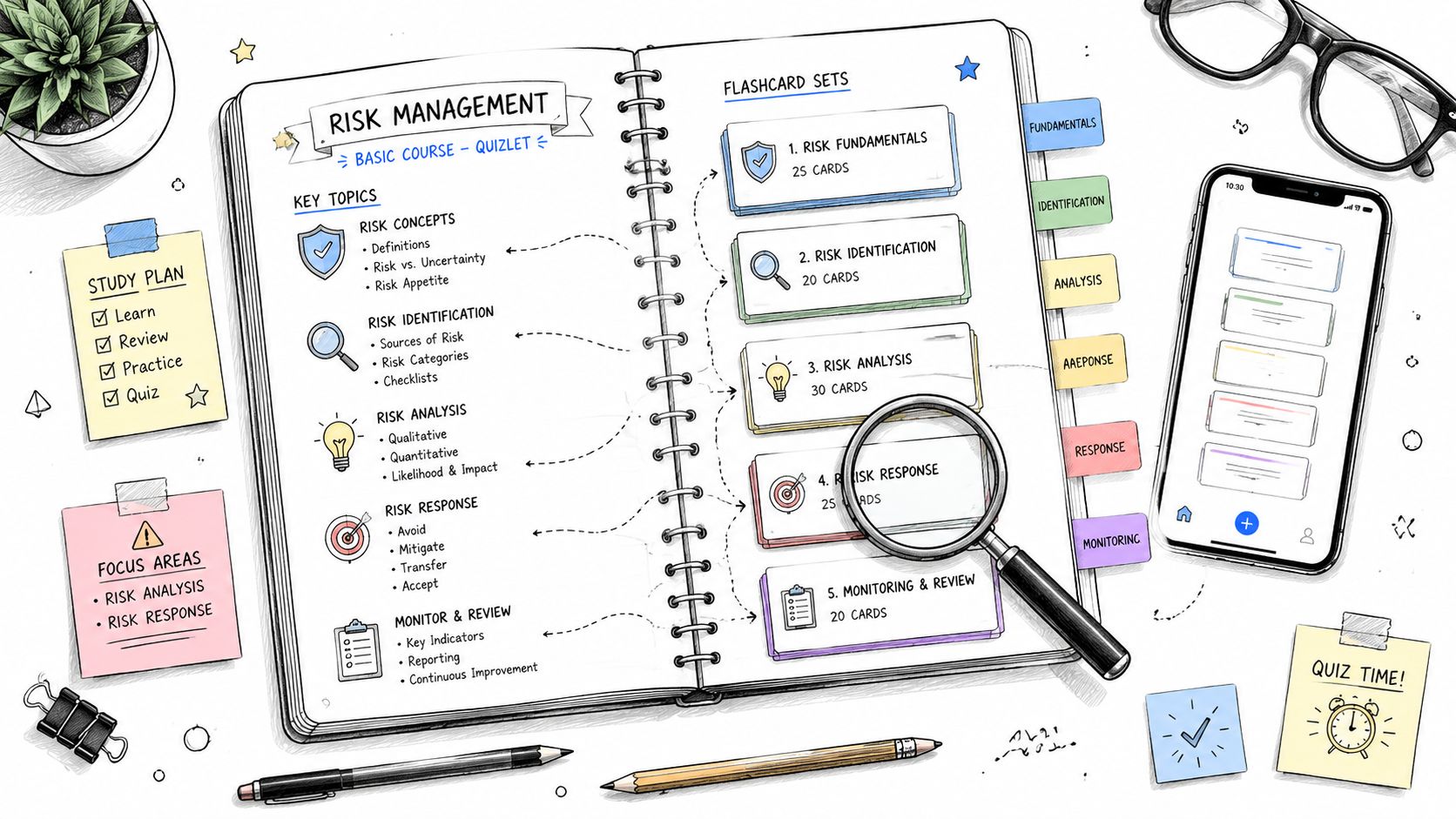
- Basic process focus: It reinforces the five-step risk management sequence many entry-level quizzes rely on.
- Simple wording: It fits well with last-minute review on your phone before class.
The downside is obvious. Because it's user-generated, you shouldn't assume every card matches your course wording exactly. Pair it with your official class material and the Georgia-focused overview of Risk Reduction course content so you're memorizing ideas that connect to your required program.
Practical rule: If a flashcard gives you a definition, say out loud how that term would apply to a real driving choice, such as deciding not to drive home after drinking in Athens or after taking medication that affects alertness.
This set is best for students who want speed, not depth. Use it early in your prep if you're rusty, or late in your prep if you need a quick confidence boost.
2. Risk Management Basic Course (2025) Quizlet
A newer-looking option, Risk management Basic Course (2025) on Quizlet, is helpful if you like studying from material that feels current in wording and presentation. Some students focus better when the deck looks recent and clean.
Its strength is pace. You won't get buried in dozens of side concepts. You can move through it during a lunch break, on MARTA, or while waiting outside court.
Best use case
This is the set I'd hand to a student who says, "I don't have much time. I just need to get the main ideas into my head tonight." It emphasizes the five-step process and core principles without stretching into broader workplace or insurance language.
A short deck can also be a weakness. It may not give you enough scenario practice to connect the concept to Georgia DUI decision-making. That matters because long-term driver behavior improves when instruction goes beyond memorization and connects content to real-life decisions, which is why quiz-only studying should be paired with reflection and scenario practice.
Try a simple method with this set:
- First pass: Memorize terms as written.
- Second pass: Turn each card into a road example.
- Third pass: Ask yourself what choice would reduce risk in that situation.
For example, if a card mentions identifying hazards, think of hazards that are common in DUI or Risk Reduction discussions: alcohol, drugs, fatigue, peer pressure, and smartphone distraction. That extra step is what turns a generic risk management basic course Quizlet search into real Georgia program prep.
3. Risk Management Basics Quizlet
Some students don't need a flashy study tool. They need a clean vocabulary set. Risk Management Basics on Quizlet fits that job well.
This one leans on foundational words like risk, hazard, controls, and evaluation. That's useful because a lot of confusion in Risk Reduction classes starts with vocabulary, not law. If you mix up "hazard" with "risk," or "control" with "response," later material gets harder than it needs to be.
Where it fits in your Georgia prep
Use this deck when you want to build the base layer before tackling Georgia-specific topics such as clinical evaluations, victim impact panels, or repeat-offender requirements. A good first step is to read a plain-language explanation of what risk reduction means in Georgia and then drill the terms here until they feel natural.
This set is especially good for beginners because it doesn't assume much prior knowledge. It also works well if you're returning to school-style study after years away from a classroom.
Some of the best prep happens when you stop trying to memorize every sentence and start asking, "What would this look like behind the wheel tonight?"
Its limits are similar to other user-made Quizlet sets. It won't walk you through a full Georgia DUI compliance path. It won't explain how a court might layer in a clinical evaluation or a Victim Impact Panel. But for vocabulary, it's solid, simple, and easy to revisit.
4. Chapter 33 The Basics of Risk Management Quizlet
A student in Georgia finishes the DUI arrest process, starts looking at license reinstatement costs, and suddenly sees unfamiliar terms everywhere. Hazard. Peril. Premium. Exposure. That is the kind of moment when Chapter 33: The Basics of Risk Management on Quizlet can help, because it reads more like a chapter review than a fast memorization deck.
This set stands out for its insurance and financial vocabulary. That may sound less relevant than driving behavior at first, but Georgia Risk Reduction students often need both ideas in view at the same time. One poor driving decision can lead to court requirements, higher insurance costs, and a longer trail of consequences than many students expect.
Why this chapter-style deck helps
Risk management works like a chain of cause and effect. A hazard creates the possibility of harm. A risky choice increases the chance of loss. The loss then shows up in real life through money, injuries, legal trouble, or all three.
That framework matters in a Georgia DUI/Risk Reduction context. Your course is not training you to become an insurance professional. It is training you to recognize how choices behind the wheel create predictable consequences, including costs that follow you after the class ends.
A widely cited summary from the Insurance Institute for Highway Safety on the costs of alcohol-related crashes supports the broader point that impaired driving creates large social and financial losses. That is the bigger picture this deck helps you see.
Use this set if textbook wording helps you learn. It is a good fit for students who want to slow down, define terms carefully, and connect those terms to what happens after a DUI in Georgia.
Here is the best way to study it. Do not try to memorize every insurance term in one sitting. Instead, sort cards into three groups: terms about causes of harm, terms about consequences, and terms about prevention. That simple sorting method helps you connect abstract vocabulary to real course themes such as safer decisions, reduced exposure to harm, and the long-term cost of risky behavior.
If you only need a quick review of the five-step process, this deck may feel too detailed. If you want to understand why risk reduction classes talk about behavior, consequences, and responsibility in the same conversation, this one gives useful context.
5. Risk Management (92 terms) Quizlet
A larger Quizlet deck can feel like walking into class with a thick binder instead of a one-page cheat sheet. For some students, that is too much. For a Georgia DUI/Risk Reduction student who keeps asking, “How do all these ideas fit together?” it can be the set that finally makes the course click.
Risk Management (92 terms) on Quizlet covers far more than a quick definition review. It pulls in language tied to safety programs, compliance, continuity planning, and organizational decision-making. That wider view helps if you want to understand risk as a pattern of choices and consequences, not just a list of terms to memorize for one class session.
This deck fits best for three kinds of learners:
- Students who want context: You learn better when a term connects to a real process.
- Adult learners with work experience: You can relate driving decisions to safety rules, reporting systems, or prevention steps on the job.
- Students reviewing after the basics: You already know the main course ideas and want more fluency with the vocabulary around them.
That broader vocabulary matters in Georgia's Risk Reduction setting. The course is state-mandated, but the goal is not only to finish hours in a classroom. The goal is to see how risk builds. One unsafe choice can lead to legal penalties, financial strain, loss of driving privileges, and harm to other people. The Centers for Disease Control and Prevention reported in 2020 that alcohol-impaired driving deaths made up a large share of traffic fatalities in the United States. That is the public safety context behind the course material.
The challenge with a 92-term set is focus. If you study every card in order, you can spend too much time on business or organizational terms that are useful background but not the heart of what you need for class.
Use a filter. On your first pass, mark cards that answer one of these questions: What creates risk? What increases the consequences? What reduces harm? That method keeps the deck tied to Georgia course themes such as decision-making, personal responsibility, and prevention. On a second pass, review only the cards you marked. That saves time and keeps a big deck from turning into busywork.
6. Risk Management Set (52 terms) Quizlet
Some Quizlet decks help you memorize. Risk Management Set (52 terms) on Quizlet does something more useful for many adult learners. It helps you catch common mistakes.
That's valuable in DUI and Risk Reduction education because people often know the rule in theory, then fail to apply it under pressure. They recognize the hazard after the fact. They don't slow down early enough, change plans early enough, or remove themselves from a risky situation early enough.
A stronger choice for scenario thinking
This set pays more attention to sequence, control hierarchy, and assessment errors. That's closer to the kind of thinking students need in real life. Not "What is the definition?" but "What did I miss, and what should I have done earlier?"
Research on driver education shows that scenario-based practice and behavioral feedback support longer-term safer driving better than rote memorization alone. That's why this deck can be more useful than a smaller, purely definitional set if you're trying to turn course terms into actual judgment.
Try these habits while using it:
- Pause at each control-related card: Ask which control is strongest in a driving example.
- Look for failure points: Identify where a bad decision starts, not just where it ends.
- Connect to Georgia reality: Think about late-night rides home, game-day drinking, medication use, and phone distraction in metro Atlanta traffic.
This isn't tied to one accredited course, so you'll still need to validate wording against your program. But for moderate study time and better application, it's a smart middle-ground option.
7. Risk Management and Risk Assessment Quizlet
Risk management and risk assessment on Quizlet stands out because it leans toward practical cues rather than just abstract definitions. If you've been searching for a risk management basic course Quizlet option that feels a little more real-world, this one earns attention.
It stays manageable, but the examples and hazard-identification angle make it easier to picture actual choices. That's important because many publicly available Quizlet resources don't do enough to connect foundational terms to actual pressure points that matter in DUI prevention.
Better for students who need examples
For a Georgia learner, in this context, generic study starts becoming useful study. Pair the deck with the broader idea that classroom concepts need to connect to behavior behind the wheel, not just memorization. Even if you've looked at general driver education classes in Georgia, your real focus here should stay on DUI, Risk Reduction, and safer decision-making.
You can even use outside critical-thinking prompts from unrelated online literacy discussions, such as debunking YouTube trust score, as a reminder that not every polished study aid is accurate. Quizlet decks are helpful, but they still need to be checked against official course expectations.
Study habit: When a card names a hazard, add one local example. In Georgia, that might mean driving home from Buckhead after drinks, accepting a ride from an impaired friend in Athens, or glancing at your phone on I-285.
This set won't replace your course packet or instructor. It does a good job of helping you move from term recognition to practical judgment.
8. 101 Safety Fundamentals Operational Risk Management Quizlet
101 – Safety Fundamentals – Operational Risk Management on Quizlet is the best pick on this list for students who learn by asking, "What control would I use?"
It pays attention to engineering controls, administrative controls, personal protective equipment, supervision, and safety instruction. That sounds workplace-heavy, and it is, but the framework transfers well to driving behavior.
Why operational thinking helps drivers
An operational approach pushes you to intervene early. For driving, that might mean not bringing alcohol into the plan at all, choosing a sober ride before the evening starts, or removing phone access before you pull onto the road. Those are stronger controls than hoping you'll make a good decision in the moment.
That matters because distracted driving and smartphone use remain major safety concerns, and modern driver education needs to address technology-related risk along with alcohol, drugs, and speed. Many basic flashcard sets don't cover that gap very well. This one at least gives you a control mindset that translates to those newer hazards.
Students in safety-sensitive jobs often like this deck because it mirrors how their employers talk about risk. If you're balancing a DUI-related requirement with work expectations, that overlap can make the concepts easier to remember.
The tradeoff is focus. If you only want Georgia court and reinstatement prep, some of the organizational wording may feel too broad. But if you want a practical "what control comes first?" lens, this is one of the stronger choices.
9. ORM Operational Risk Management Basic Level Quizlet
ORM (Operational Risk Management) – Basic Level on Quizlet is useful when you run into a six-step variation and want to sort out the structure without getting lost.
That sounds minor, but it matters. Many students get tripped up not because they don't understand risk management, but because different study sources use slightly different frameworks. If your class emphasizes five steps and your flashcards use six, confusion creeps in fast.
Use it carefully
This deck is best treated as a comparison tool, not your only study source. Read the cards, note the wording, then check that structure against what your Georgia program expects.
That caution is especially important if you're dealing with repeat-offense rules. In Georgia, individuals charged with second or subsequent DUI offenses face added requirements, and the core Risk Reduction requirement remains a 20-hour course plus a court-ordered 30-hour education/intervention component instead of the standard 20-hour program for first-time offenders. When the legal stakes are that high, your study material should support clarity, not mix up your terminology.
The True/False style helps some learners retain concepts faster than plain definition cards. If that's your style, this deck can be helpful. Just don't let alternate models replace the exact framework your instructor uses.
A good method is to write your course's official sequence on paper, then compare each card back to it. That way you're learning to translate, not memorize the wrong version.
10. Risk Management 5 Step Process Quizlet
Sometimes you don't need a full deck. You need one thing nailed down cold. Risk Management 5 Step Process on Quizlet is built for that moment.
This micro-set is as stripped-down as it sounds. One card per step. Fast repetition. Easy mobile review.
Best final-night refresher
If you've already studied broader material, this set works well right before class or before a quiz. It helps you hold the exact order in short-term memory without distraction.
That kind of focused repetition fits well with what broader learning research shows about frequent low-stakes quizzes. Learners who use retrieval-practice tools retain more factual content over time than learners who only review passively. For process-order material, that's exactly what you want.
Use this one in a short cycle:
- Run all five cards once
- Say the steps without looking
- Attach one driving example to each step
- Repeat until the order feels automatic
Keep this deck open on your phone, but don't stop at reciting the steps. Tie each step to a real decision, such as calling for a ride instead of driving after drinking, or pulling over to deal with navigation instead of handling the app while moving.
On its own, this set is too shallow. As a final lock-in tool, it's excellent.
Top 10 Quizlet Risk Management Sets Comparison
| Item | Scope & Core Content | Best For | Depth & Coverage | Value / Unique Selling Point | Cautions / Price |
|---|---|---|---|---|---|
| RISK MANAGEMENT BASIC COURSE (2021), Quizlet | RM definition, principles, five-step process; ~20 terms | Last-minute refreshers for basic RM exams | Compact, intro-level | Quick drills aligned to basic coursework; free core access | Limited depth; user-created; some Quizlet Plus features paid |
| Risk management Basic Course (2025), Quizlet | Five-step RM process & principles; short term list | Learners needing current phrasing in practice quizzes | Brief, targeted | Mobile-friendly, labeled as up-to-date; free core modes | Omits scenarios; quality varies; Plus for advanced tools |
| Risk Management Basics, Quizlet | Core vocabulary: risk, hazard, controls, evaluation | Beginners needing foundational definitions | Basic vocabulary flash-drills | Straightforward terms that complement classroom instruction | Limited context; user-generated; Plus features paid |
| Chapter 33: The Basics of Risk Management, Quizlet | Insurance-focused RM terms (hazard, peril, premium); 20+ terms | Learners needing insurance/defensive-driving crossover | Textbook-style, basic coverage | Clear textbook definitions; useful for insurance topics | Less focus on five-step process; may be too basic; Plus |
| Risk Management (92 terms), Quizlet | Broad RM topics: BCP, DRP, continuity, process | Comprehensive review for workplace, compliance, study depth | Deep, wide-ranging (~90+ terms) | Builds broad RM literacy beyond basic course needs | Time-intensive; may exceed basic test needs; user-generated |
| Risk Management Set (52 terms), Quizlet | Control hierarchy, assessment pitfalls, feedback | Preparing for scenario-style and sequence questions | Mid-sized, balanced coverage | Good mix of process items and common mistakes | Not tied to accredited course; validate content; Plus |
| Risk management and risk assessment (26 terms), Quizlet | Five-step process with applied examples and mnemonics | Learners who want practical application and quick mastery | Concise, application-oriented | Bridges memorization to real-world use; quick to learn | Narrow scope; user-created; some features paid |
| 101 – Safety Fundamentals – Operational Risk Management (46 terms), Quizlet | Operational RM: five steps, controls (engineering/admin/PPE) | Safety and operations personnel | Practical operational emphasis | Maps definitions to on-the-job application | Less relevant for insurance-only learners; verify accuracy |
| ORM (Operational Risk Management) – Basic Level (45 terms), Quizlet | Six-step ORM variant, memorization cues, T/F items | Entry-level safety training using six-step models | Basic-level operational | Targets basic learners with retention aids (T/F, cues) | Six-step may conflict with five-step courses; user-created |
| Risk Management 5 Step Process (5 terms), Quizlet | Ultra-focused micro-set: one card per RM step | Final-minute drilling of step order | Ultra-shallow, microlearning | Fastest way to memorize exact step order; mobile-optimized | Too shallow as standalone prep; limited context; Plus |
Ready to Complete Your Course with Confidence?
You finish a late shift, get in the car, and start driving home on autopilot. Your phone lights up. A friend texts. You tell yourself you are fine to answer at the next light. That small moment is what risk management class is trying to change. The goal is to train your judgment before a routine choice turns into a serious problem.
That is why a risk management basic course Quizlet set can help, but only if you use it the right way. Flashcards teach the vocabulary. Your Georgia DUI or Risk Reduction course asks you to apply that vocabulary to real decisions, real consequences, and real state requirements. Study the terms like tools in a toolbox. Then practice choosing the right tool for the situation.
For Georgia students, context matters. A generic Quizlet set may define hazard, consequence, control, and assessment clearly, but your course is tied to a state-regulated process. The Georgia Department of Driver Services explains the Risk Reduction Program and its role in meeting certain reinstatement and court-related requirements on its official page at dds.georgia.gov/risk-reduction-programdui-alcohol-or-drug-use-risk-reduction-program. If your case also involves license points, Georgia DDS outlines the state point system and related rules at dds.georgia.gov/points-and-points-reduction. Those official pages are the best place to confirm what applies to your situation.
Here is the practical takeaway. Use Quizlet to memorize the language, then connect each term to a Georgia driving scenario. A hazard could be fatigue after work. A risk factor could be alcohol, speed, distraction, or pressure from passengers. A control could be handing your keys to someone else, calling a rideshare, silencing your phone, or leaving earlier so you are not rushing through Atlanta, Athens, Marietta, or Gwinnett traffic.
That is how the class starts to stick.
Georgia DUI Schools gives students a clear path for handling the course requirements, with online options statewide and 18 locations across Georgia. If you want more structure than flashcards alone can provide, it can also help to see how other education providers organize student prep, including tools used in software for standardized test tutoring.
Choose a DDS-approved provider that can help with the services your case calls for. That may include Risk Reduction, defensive driving, clinical evaluations, ASAM Level 1 treatment, and Victim Impact Panels. The point of studying is not just finishing a class. It is getting back into compliance, working toward reinstatement, and building safer habits that last.
If you're ready to complete your Georgia requirement with a DDS-approved provider, enroll in the Georgia DUI Schools Risk Reduction course and take the next step toward reinstatement, compliance, and safer driving.