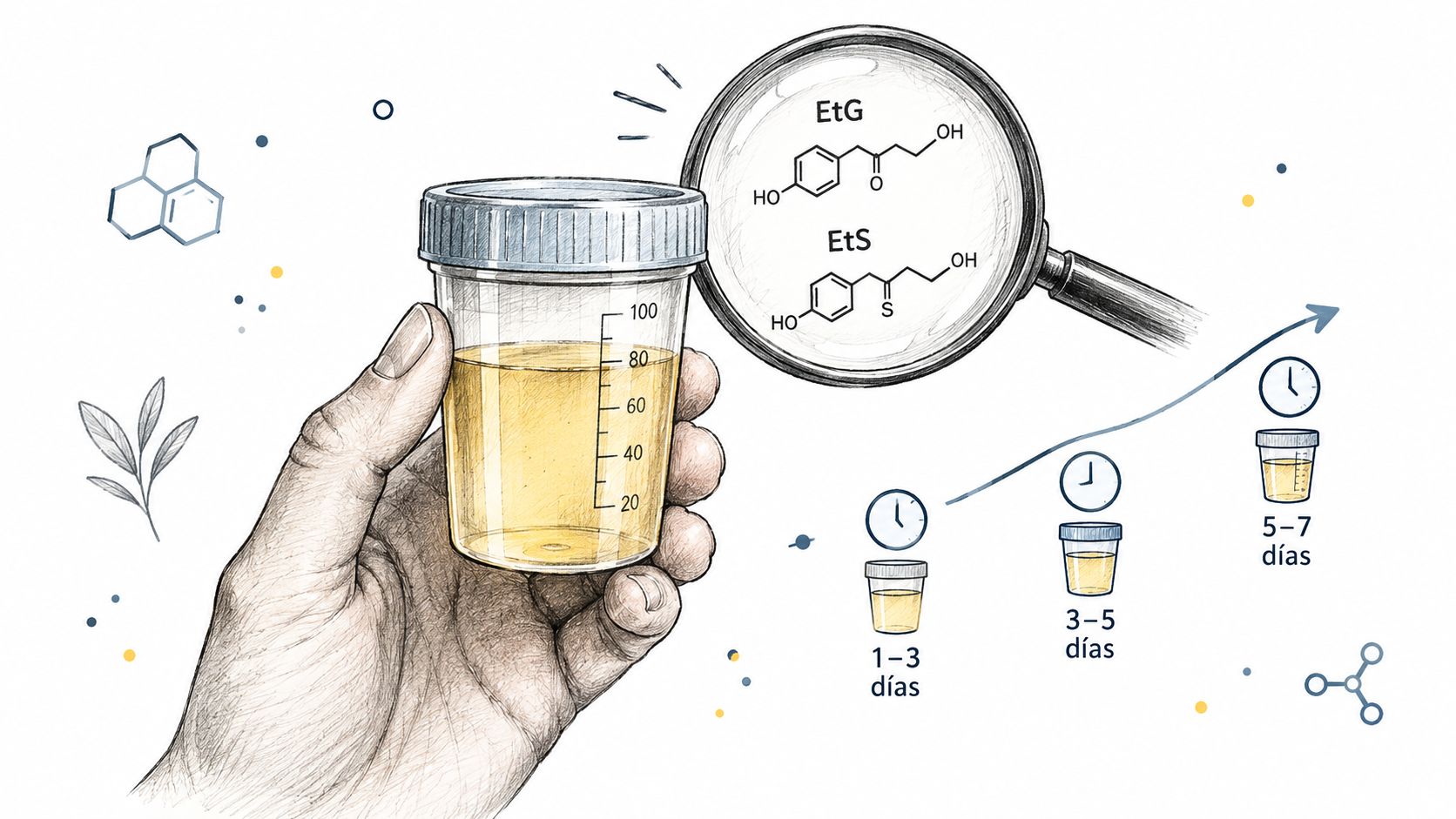
There is no reliable shortcut to pass a urine alcohol test. EtG may appear in urine in less than 60 minutes and remain detectable for about 24 hours after small amounts, up to 130 hours after excessive consumption, even after you no longer feel intoxicated.
The popular advice usually focuses on flushing, sweating, sleeping, or finding the right number of hours to wait. Those suggestions miss the central issue. A urine alcohol test may look for ethanol metabolites, not the alcohol currently making you feel impaired. Your result depends on the test method, the cutoff, the amount and timing of alcohol exposure, urine concentration, and individual biology.
If a test is court-ordered, probation-related, or part of treatment, treat it as a compliance question rather than a contest. You can't guarantee a negative result with a home remedy. You can, however, understand what the laboratory is measuring, document legitimate exposures, follow the collection rules, and complete the Georgia requirements attached to your case.
Why Passing a Urine Alcohol Test Is Not a Shortcut Problem
“Passing” is the wrong starting point if it means defeating the test. The more useful question is: What does this test measure, and what evidence can the result support? That change in perspective matters because ethanol and its metabolites behave differently in urine.
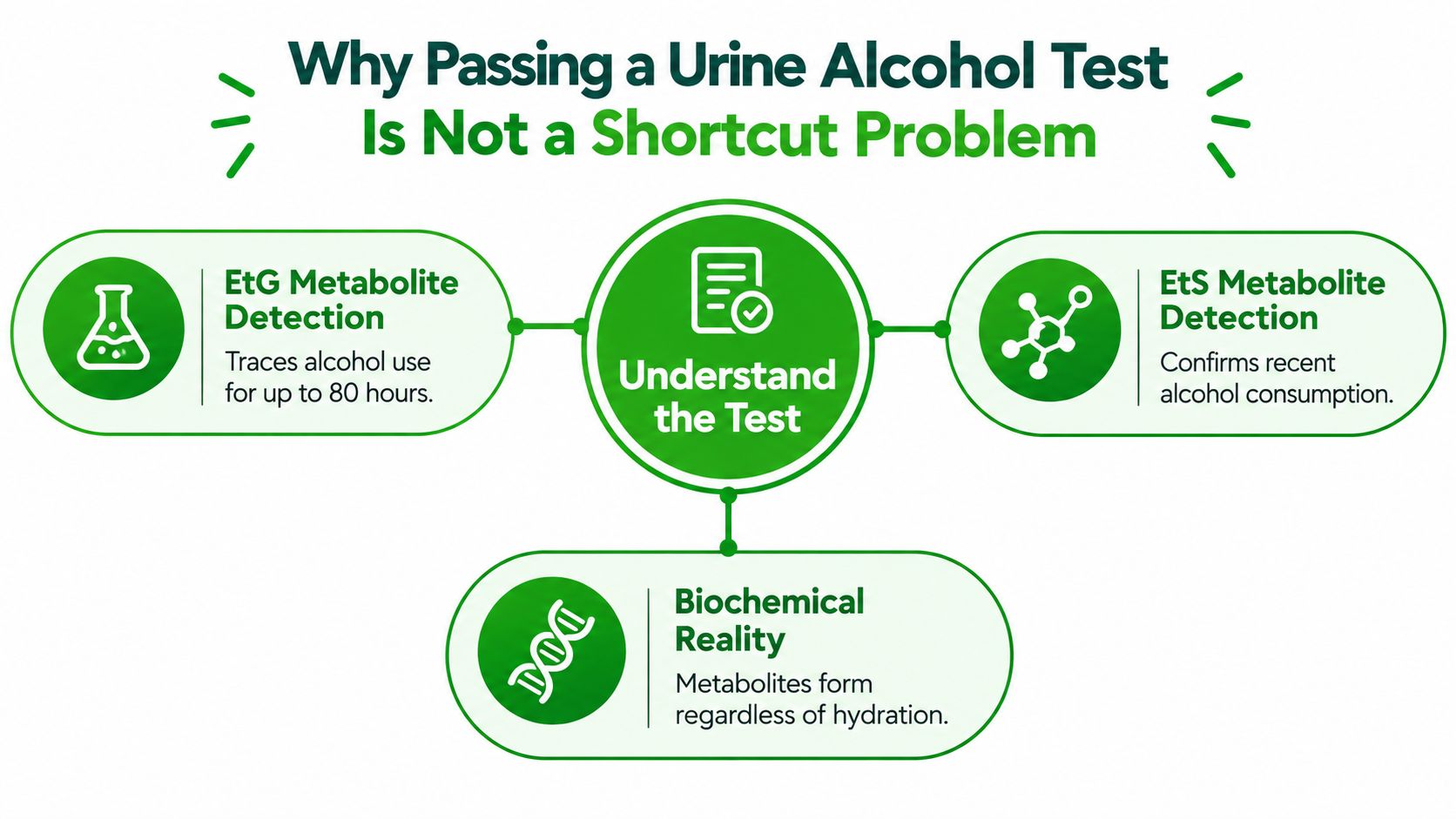
A standard urine ethanol test looks for alcohol itself and has a relatively short useful window. EtG, or ethyl glucuronide, and EtS, or ethyl sulfate, are minor metabolites created after the body processes ethanol. EtG can appear in urine in less than 60 minutes and may remain detectable for about 24 hours after small amounts, up to 130 hours after excessive consumption. Other clinical reviews describe a more typical 48 to 72 hour window after heavy drinking. The clinical review of EtG and EtS testing explains why metabolite testing lasts longer than testing for urine ethanol itself.
That doesn't mean a positive result tells the whole drinking story. EtG and EtS can confirm recent ethanol exposure, but they can't reliably distinguish a small drink a few hours earlier from heavier drinking several days earlier without context. Cutoffs also change the meaning of a result. A lower cutoff can identify lighter or older exposure while increasing the importance of incidental exposure, whereas a higher cutoff reduces some incidental positives but can miss lighter drinking.
Practical rule: Don't promise yourself a result based on a single detection-window number. Ask which analytes are being tested, which cutoff applies, and whether the laboratory confirms unexpected findings.
No tea, vitamin, shower, exercise routine, or “detox” product can reliably rewrite the biology of metabolite formation. Excessive water can create a diluted or otherwise questionable specimen, not a clean explanation. The sections below separate ethanol from EtG and EtS, show why dose changes the window, explain cutoff tradeoffs, address mouthwash and sanitizer concerns, and connect the science to Georgia DUI compliance.
How Urine Alcohol Testing Actually Works
Think of direct ethanol testing as checking whether water is still flowing from a recently used faucet. EtG and EtS testing checks the residue left after the water has run. Both approaches concern alcohol exposure, but they answer different questions and operate over different periods.
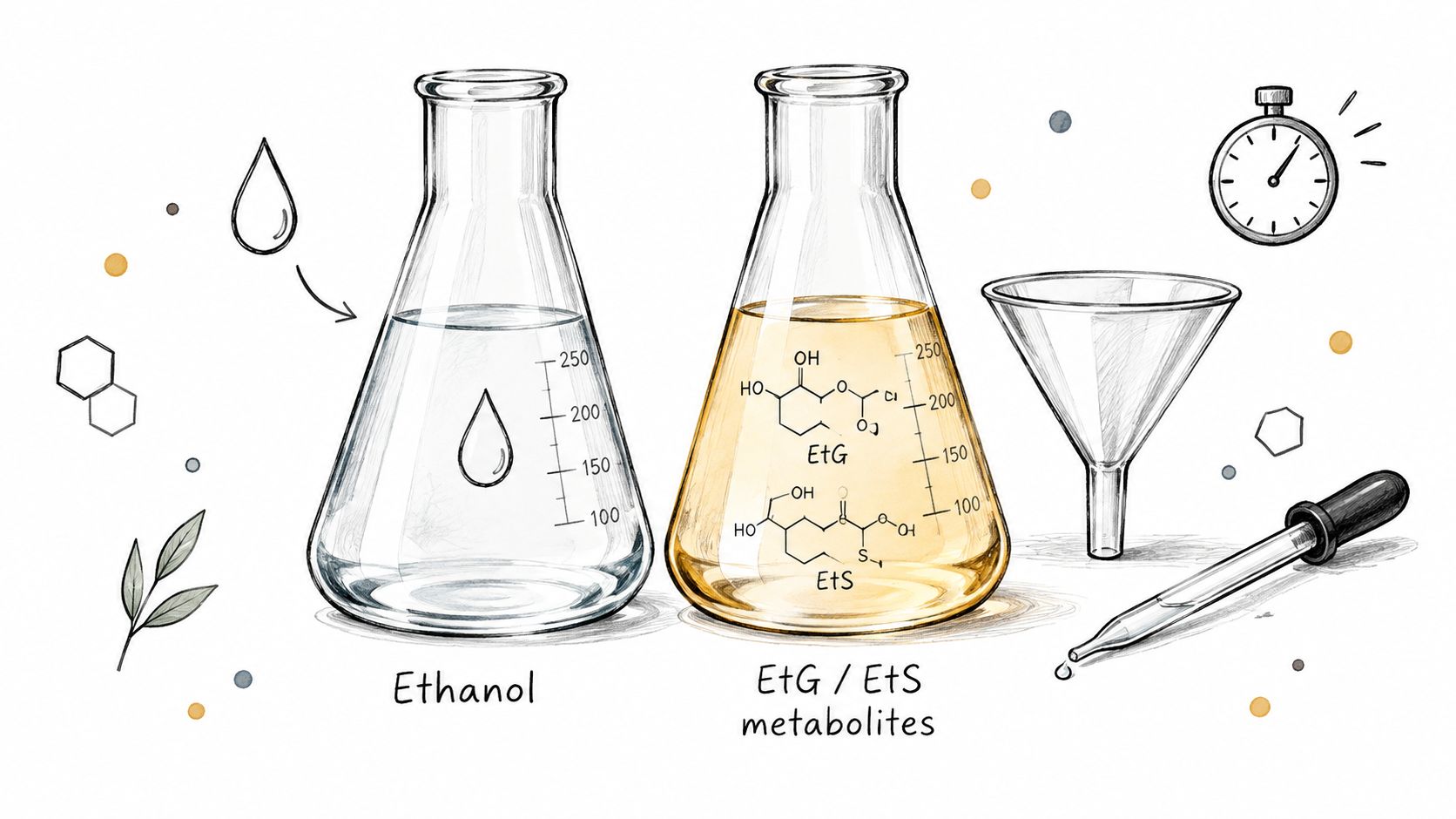
Ethanol is the alcohol in a drink. The body processes most of it relatively quickly, so urine ethanol is useful mainly when collection occurs close to consumption. EtG and EtS are formed in smaller amounts when the body processes ethanol. Because these metabolites remain after ethanol has cleared, a person may feel sober, have no measurable alcohol on a breath test, and still have a positive EtG or EtS urine result. Georgia DUI Schools' explanation of alcohol in urine testing provides a plain-language comparison of urine ethanol and metabolite panels.
What the laboratory is looking for
After drinking, the body absorbs ethanol and processes it through several metabolic pathways. A small portion is converted into EtG and EtS, which are then filtered into urine. The laboratory isn't measuring intoxication directly. It's looking for biochemical evidence that ethanol was recently processed.
That distinction is important in court and treatment settings. A metabolite result can support a finding of recent alcohol exposure, but it doesn't establish a precise amount consumed or prove current impairment. The result must be interpreted with the collection time, cutoff, specimen validity information, reported products, and any confirmatory testing.
EtG also creates an interpretation problem because it is sensitive to low-level exposure under some testing conditions. EtS can provide useful additional context, and guidance from Quest Diagnostics says accuracy improves when both markers are included. The same guidance notes that EtG may be detectable for about 80 hours after ingestion and EtS may persist for 24 hours or more, depending on cutoff and metabolism. Quest's clinical FAQ on EtG and EtS interpretation explains why the panel and cutoff matter.
Why a negative ethanol result can mislead
A negative urine ethanol result doesn't necessarily mean no recent alcohol use. It may mean that ethanol itself is no longer measurable, while EtG or EtS remains. Mayo Clinic Laboratories states that EtG and EtS may be detected for up to 5 days in urine at a 500 ng/mL cutoff, while screening guidance commonly describes EtG as detectable for 1 to 3 days at that threshold. Mayo Clinic Laboratories' EtG confirmation guidance sets out this difference between direct ethanol and metabolite testing.
A collection form or probation order may identify the panel, but don't assume the word “alcohol” tells you whether the lab is measuring ethanol, EtG, EtS, or more than one marker. If the paperwork is unclear, ask the testing provider before collection. That question won't change the result, but it can prevent you from misunderstanding what a result can and can't establish.
Detection Windows by Amount Consumed
A single answer such as “alcohol leaves urine in three days” sounds useful, but it isn't clinically dependable. Dose, timing, cutoff, hydration, urine dilution, and individual metabolism all affect whether the metabolite concentration remains above the laboratory's reporting threshold.
Available clinical data describe a wide range. EtG and EtS can appear within the first hour after drinking and peak around 5.5 hours on average. After typical intake, metabolites may remain traceable for roughly 22.5 to 31.5 hours. After heavier consumption, the window can expand to 48 to 72 hours, and some studies report more than 90 hours, with extreme reports reaching about 130 hours. Mayo Clinic Laboratories' EtG screening guidance describes the dose relationship and cautions that cutoffs and urine conditions affect interpretation.
| Consumption Pattern | Typical Dose (standard drinks) | Approximate Detection Window | Confidence Notes |
|---|---|---|---|
| Small amount | Not reliably convertible into one universal drink count | About 24 hours in some cases | A small exposure may fall below a reporting threshold sooner, but no individual result is guaranteed. |
| Typical intake | Not reliably convertible into one universal drink count | Roughly 22.5 to 31.5 hours after typical intake | The cited clinical range describes traceability, not a pass-or-fail promise. |
| Heavy drinking | Not reliably convertible into one universal drink count | Commonly 48 to 72 hours | Hydration, dilution, cutoff, and collection timing can change the reported result. |
| Excessive consumption | Not reliably convertible into one universal drink count | In some reports, more than 90 hours and up to about 130 hours | These are extended observations, not a timetable that applies to every person. |
The table is a clinical reference, not a pass-or-fail calculator. The verified literature does not support assigning one fixed number of standard drinks to every detection window, and a person's body composition, age, liver function, hydration, and metabolic activity can influence the concentration measured in a specimen. The amount consumed generally affects metabolite production, but the relationship isn't perfectly linear.
A person can have no measurable urinary ethanol and still have detectable EtG or EtS. That isn't a contradiction. It reflects two different targets.
The practical lesson is straightforward. If you drank recently and a court-ordered test is pending, don't assume that feeling normal means the metabolite window has closed. If you haven't been drinking, preserve information about products or medical circumstances that may help explain an unexpected low result, and report that information through the proper provider rather than trying to manipulate the sample.
Cutoffs, False Positives, and Real Sensitivity
The cutoff is the concentration at which a laboratory classifies an analyte as positive or negative. It isn't a universal measure of intoxication, and it doesn't translate neatly into a precise number of drinks.
The United States commonly uses a 500 ng/mL EtG cutoff advised by SAMHSA to reduce positives from incidental exposure such as mouthwash or sanitizer. At that threshold, a positive is generally interpreted as heavy drinking within the previous 1 to 3 days or light drinking within the previous 12 to 36 hours. Low results between 100 and 500 ng/mL can reflect recent drinking or non-beverage alcohol exposure. The SAMHSA advisory on alcohol biomarkers explains this sensitivity and specificity tradeoff.
How the threshold changes the question
| Cutoff (ng/mL) | Typical Use | Result for Light Exposure | Result for Heavy Exposure |
|---|---|---|---|
| 100 | More sensitive interpretation of low-level EtG | More likely to detect recent light drinking or incidental exposure | More likely to detect an older or lighter residual result |
| 200 | A cutoff discussed in validation work as a balance for detecting use over 24 to 120 hours | May detect exposure that a higher cutoff misses | Can retain useful sensitivity while still requiring context |
| 500 | SAMHSA-advised threshold used to reduce incidental-exposure positives | A light or older episode may fall below the threshold | A positive is more consistent with recent heavy drinking or recent light drinking, but it isn't proof of a precise amount |
The same urine specimen can be reported differently under different cutoffs. A concentration below 100 ng/mL is negative under a 100 ng/mL rule, while a concentration above 100 ng/mL and below 500 ng/mL may be reported positive at the lower threshold but not at the SAMHSA-advised threshold. The laboratory's actual reporting policy controls the outcome.
A clinical review found that 300 to 500 ng/mL showed high specificity, about 0.86 to 0.97, but lower sensitivity across a 24 to 120 hour window. That is the central tradeoff: higher thresholds reduce some false positives but can miss lighter or older drinking. The clinical chemistry review of EtG and EtS limitations also describes false-positive, false-negative, and indeterminate results, including poorer sensitivity than PEth in a predominantly transplant population.
What confirmation can and can't solve
An initial screen isn't the same as a final interpretation. If a result is unexpected, ask whether the program uses confirmatory laboratory testing and whether EtG and EtS were both measured. Confirmation can improve analytical confidence, but it still can't reconstruct the exact amount or time of drinking from one urine result.
Some apparent discrepancies can involve contamination, specimen handling, or biological circumstances. That is why you should give the provider a factual account of prescribed products, over-the-counter products, medical conditions, and timing. Don't dismiss a result, and don't accept an unexplained result without asking how the lab interpreted it.
Why Mouthwash, Sanitizer, and Water Hacks Do Not Work
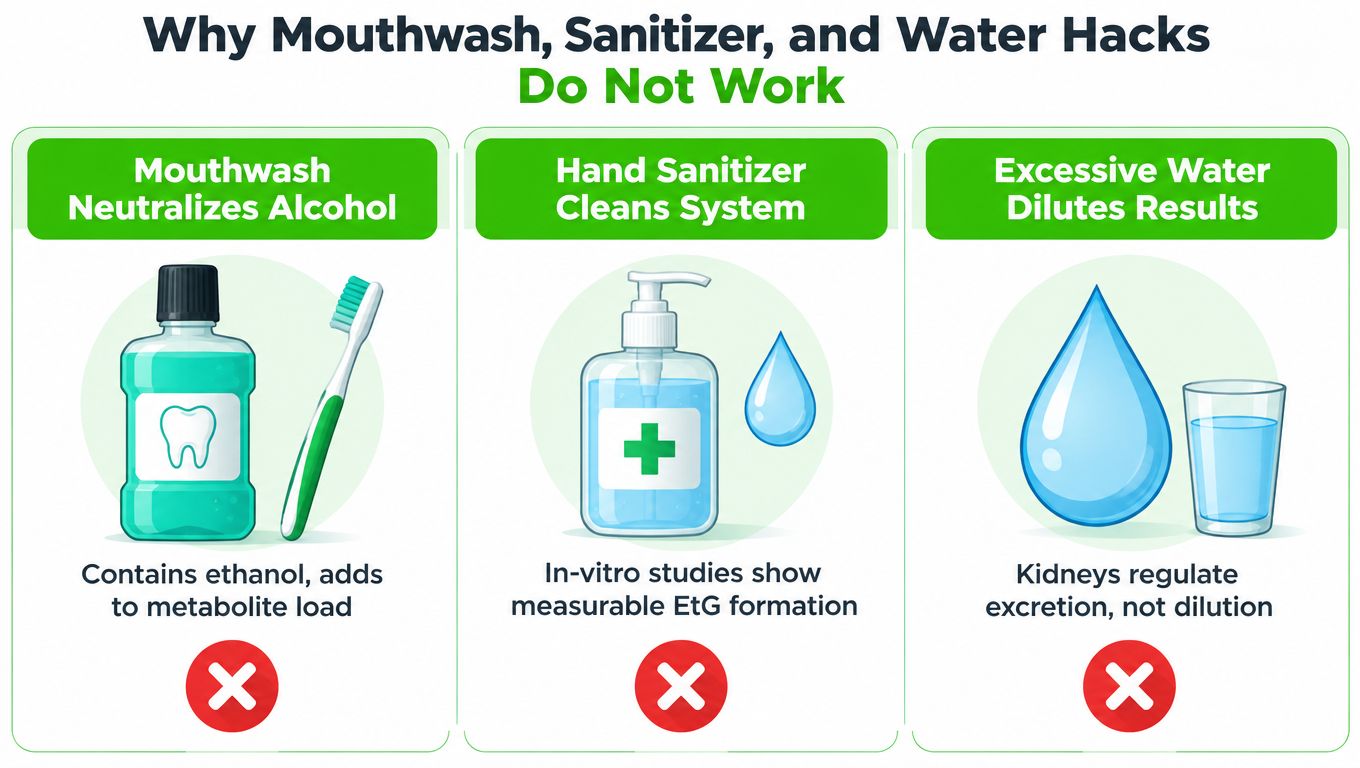
Mouthwash, hand sanitizer, and excessive water do not provide a dependable way to pass an alcohol urine test. Some products contain ethanol, which can create incidental exposure relevant to an EtG or EtS result, depending on the product, amount, timing, laboratory cutoff, and reporting policy. A single use does not automatically mean a positive court result, but ignoring product exposure can make an unexpected result harder to interpret.
EtG can also form in a specimen after collection when ethanol-producing bacteria are present. Bacterial contamination or a urinary tract infection may complicate interpretation, and clinical testing can produce false-positive, false-negative, or indeterminate findings. The appropriate response is to document the circumstances and request professional review, not to test a home theory with sanitizer or mouthwash.
Three common myths
Mouthwash neutralizes alcohol: Mouthwash cannot neutralize an alcohol metabolite that has already formed in the body. If it contains ethanol, repeated or substantial exposure may become relevant, especially under a sensitive cutoff. Keep the product name, ingredients if available, and use details in case the collection site or clinician asks about incidental exposure.
Hand sanitizer cleans the system: Sanitizer does not remove EtG or EtS from urine. It may introduce another exposure detail for the laboratory or clinician to assess. The test panel, cutoff, specimen context, and timing still determine how the result is interpreted.
Excessive water dilutes everything: Water can change urine concentration, but it cannot direct the body to form or eliminate metabolites. Overhydration may create an unusually dilute specimen, which can lead to added scrutiny or a collection problem.
Do not create a second compliance problem while trying to avoid the first one. Manipulating hydration or using an adulterant can make the specimen questionable while leaving the alcohol result unresolved.
“Flushing” confuses urine concentration with metabolism. Hydration may affect what the laboratory measures, yet it cannot guarantee that EtG or EtS will fall below the applicable cutoff. A negative result after heavy water intake may also be difficult to interpret when specimen validity is reviewed.
If you are unsure about a product, ask the collection site or treatment provider before using it. For practical context on what you can drink to pass a drug test, timelines, and test types, this educational guide to passing a urine test explains why home methods cannot guarantee an outcome. Use that information as background, not as a substitute for instructions from your court, probation officer, laboratory, or clinician.
What Georgia Drivers Face After a DUI Charge
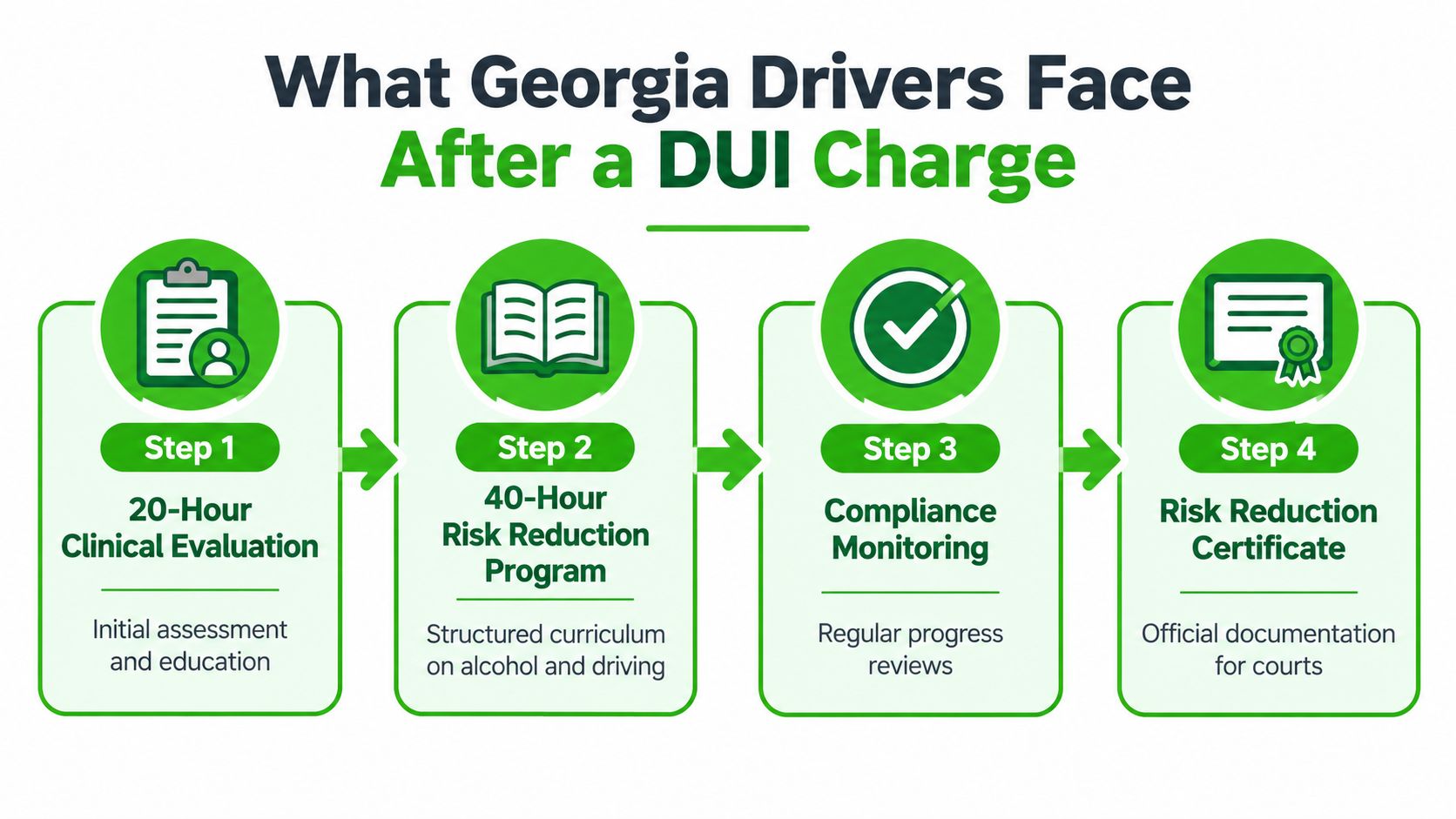
A urine result is only one piece of Georgia DUI compliance. The Georgia Department of Driver Services identifies two required parts of the DUI Risk Reduction Program: an Assessment Component, known as the NEEDS Assessment, and an Intervention Component. A driver must complete both to receive a Certificate of Completion. DDS also requires documented proof of a state-approved clinical evaluation for reinstatement after two or more DUI convictions within the past 10 years. The Georgia DDS DUI FAQs contains the controlling state-level information.
These requirements work like separate checkpoints. A clinical evaluation considers assessment and treatment needs. The Risk Reduction course fulfills the intervention requirement. A court or probation order may also require a Victim Impact Panel, with completion documents submitted to the court clerk or probation officer by the sentencing deadline. The accepted provider, format, and deadline can vary by court, so confirm those details in writing. This Georgia Victim Impact Panel guidance explains that court-specific compliance issue.
Testing is only one part of supervision
A urine EtG or EtS screen and an ignition interlock device answer different questions. The interlock checks breath alcohol before or during vehicle use under the program's conditions. Urine monitoring looks for metabolites left after ethanol exposure, potentially after impairment has ended. The two tests are more like a snapshot and a trace than duplicate measurements.
The court, probation officer, treatment provider, or monitoring program determines whether EtG or EtS testing applies. Georgia DUI cases do not all use the same panel or schedule. Review the written conditions and the applicable court-ordered drug test procedure to identify who controls collection, reporting, missed appointments, and confirmatory review.
A missed appointment can create a compliance concern even when the urine contains no detectable alcohol marker. A positive result can prompt questions about probation or treatment compliance, with consequences governed by the order and supervising authority. The practical goal is understanding the test and meeting the order, not trying to defeat the process. Complete each required component, follow the monitoring rules, keep records, and address a disputed result through the designated review process.
Smart Steps That Actually Help Your Situation
You can't control the cutoff, your metabolic rate, or how long EtG and EtS remain above a reporting threshold. You can control how accurately you communicate, whether you follow the collection instructions, and whether you create a clear record before an unexpected result becomes a larger problem.
Start with the testing paperwork. Confirm whether the panel measures ethanol, EtG, EtS, or multiple markers, and ask which cutoff the program applies. If the order or provider doesn't explain the method, request clarification in writing. Keep copies of collection instructions, appointment confirmations, receipts, and completion certificates.
Build a clean account of possible exposures
Before collection, tell the laboratory or treatment provider about relevant prescriptions, supplements, medical products, and alcohol-containing products you used. Don't stop a prescribed medication without medical advice. Disclosure gives the provider a chance to decide whether a result needs confirmation or clinical review, rather than leaving you to explain an unexpected finding after the report reaches court.
A documented medical or product explanation doesn't guarantee that a positive result will be reversed. It does create context. The same principle applies to possible infection, specimen contamination, or a collection concern. Report facts promptly and use the provider's dispute or review process.
Choose time, treatment, and compliance over hacks
If you have been drinking, allowing time for the body to process alcohol is the only biologically meaningful option. Water, coffee, sleep, exercise, and detox products don't provide a guaranteed way to make EtG or EtS disappear. If you drink heavily or regularly, stopping abruptly can carry medical risks, so speak with a clinician about safe support rather than focusing only on the test.
Complete the Georgia Assessment and Intervention components through an accepted provider, arrange any required clinical evaluation, and confirm Victim Impact Panel expectations with the court or probation officer. Georgia DUI Schools offers DUI and Risk Reduction education, clinical services, and Victim Impact Panels, with online and in-person options for Georgia participants. Use the provider named in your court or DDS instructions, and retain the completion documents.
The most useful checklist is short:
- Read the order: Identify the supervising authority, test type, cutoff information, and reporting process.
- Disclose relevant facts: Report medications, supplements, products, health conditions, and possible incidental exposure.
- Avoid alcohol and risky “detox” tactics: Neither can guarantee a result, and sample manipulation can create additional concerns.
- Keep documentation: Save certificates, appointment records, provider messages, and any confirmation or review paperwork.
- Ask for help early: Contact your clinician, attorney, probation officer, or treatment provider before a missed test or disputed result becomes a deadline crisis.
A urine alcohol test is evidence about recent exposure, not a complete history of your behavior and not a direct measure of current impairment. Treat the result seriously, but insist on an accurate explanation of the analyte, cutoff, collection conditions, and confirmation process.
Georgia DUI Schools can help you address the education, clinical evaluation, and Victim Impact Panel components that may accompany a Georgia DUI case, while keeping your testing questions focused on compliance rather than shortcuts. Review the available options and contact Georgia DUI Schools to choose an accepted course or service that fits your court and DDS requirements.