
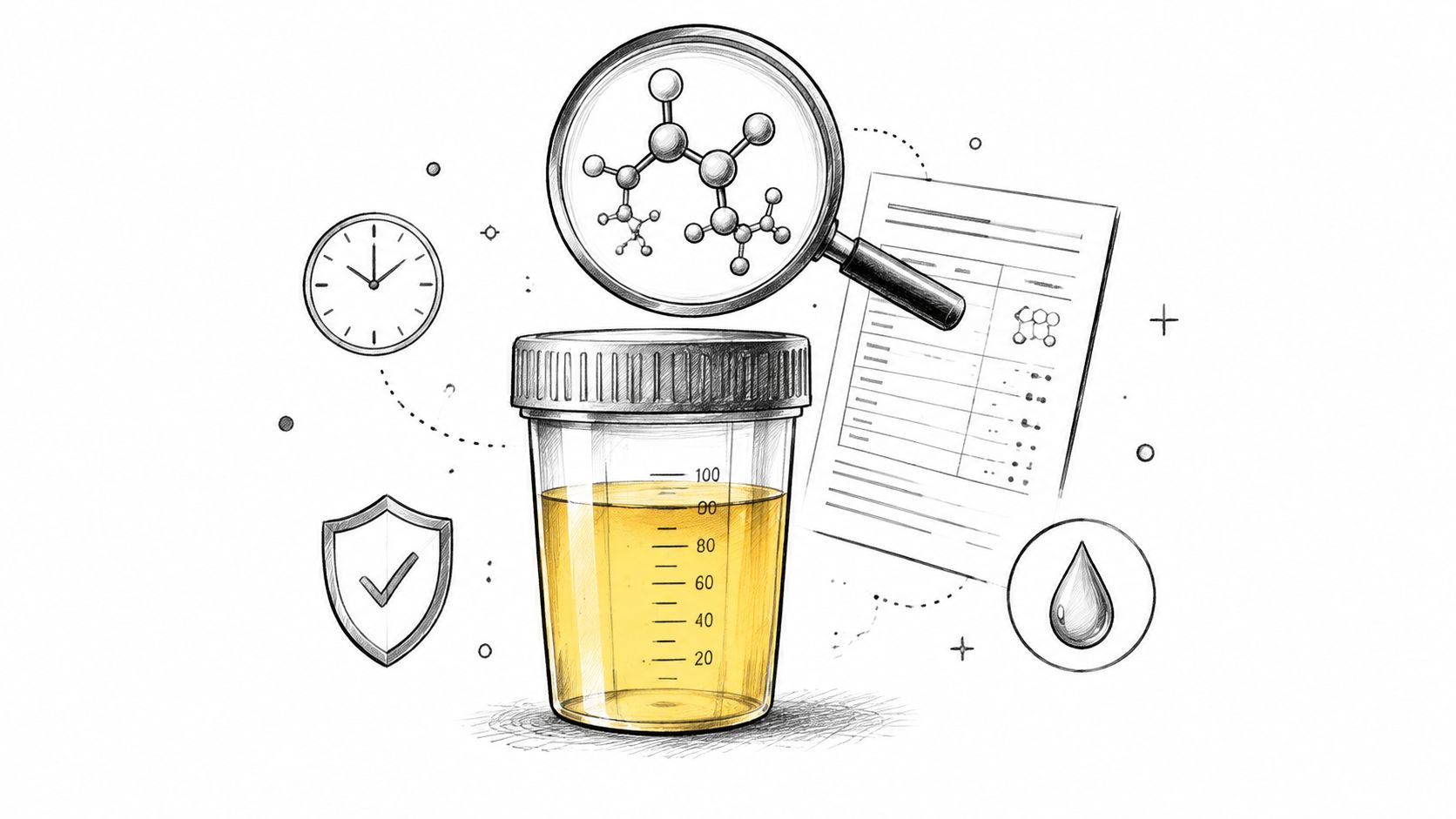
A driver in Atlanta leaves a DUI stop believing the hardest part is over. Then, three days later, a report arrives showing “ethyl glucuronide detected.” The breath test had been inconclusive, but now a urine result seems ready to affect a job, custody arrangement, professional license, probation status, or driver's license.
That reaction is understandable, but a urine alcohol result needs context before it can be understood. The phrase alcohol in urine drug screen can describe several different testing approaches, and a routine drug panel isn't the same as an EtG or EtS alcohol biomarker test.
Why a Urine Result Can Feel Like a Life Sentence
The driver reads the report again, searching for a number that might explain what happened. Instead, the page may list only a result such as “positive,” “detected,” or “above cutoff.” Without knowing which substance the laboratory measured, the cutoff it used, and why the test was ordered, the result can feel more conclusive than it really is.
Urine screens appear in many settings. Probation departments may use them to monitor compliance. Treatment programs may use them to evaluate abstinence. Employers may order drug testing under workplace policies, while family courts and professional-monitoring programs may request alcohol-specific testing. A DUI arrest is only one possible setting.
The central distinction is simple:
A standard drug screen and an alcohol biomarker panel answer different questions.
A routine urine drug screen generally looks for drug classes such as cannabinoids, cocaine metabolites, amphetamines, opioids, or benzodiazepines. Alcohol usually requires a separate test. A dedicated EtG or EtS panel looks for metabolites created after the body processes ethanol, rather than asking whether the person is impaired at the moment the specimen is collected.
That difference matters in Georgia DUI cases. A positive biomarker result may become part of a clinical evaluation, probation report, treatment record, or court submission, but the result still has to be interpreted according to its testing method and purpose. It isn't automatically proof that someone was intoxicated during a traffic stop.
The pages ahead separate the two types of testing, explain why 100 ng/mL and 500 ng/mL cutoffs can produce different conclusions, and show what a Georgia reader should ask before responding to a result.
How the Body Processes Alcohol After Your Last Drink
Think of alcohol metabolism like cleaning a kitchen after a drink spills. Ethanol is the liquid on the counter, and the body removes it relatively quickly through metabolism and elimination. Other compounds are more like residue in the grout. They can remain measurable after the visible spill is gone.
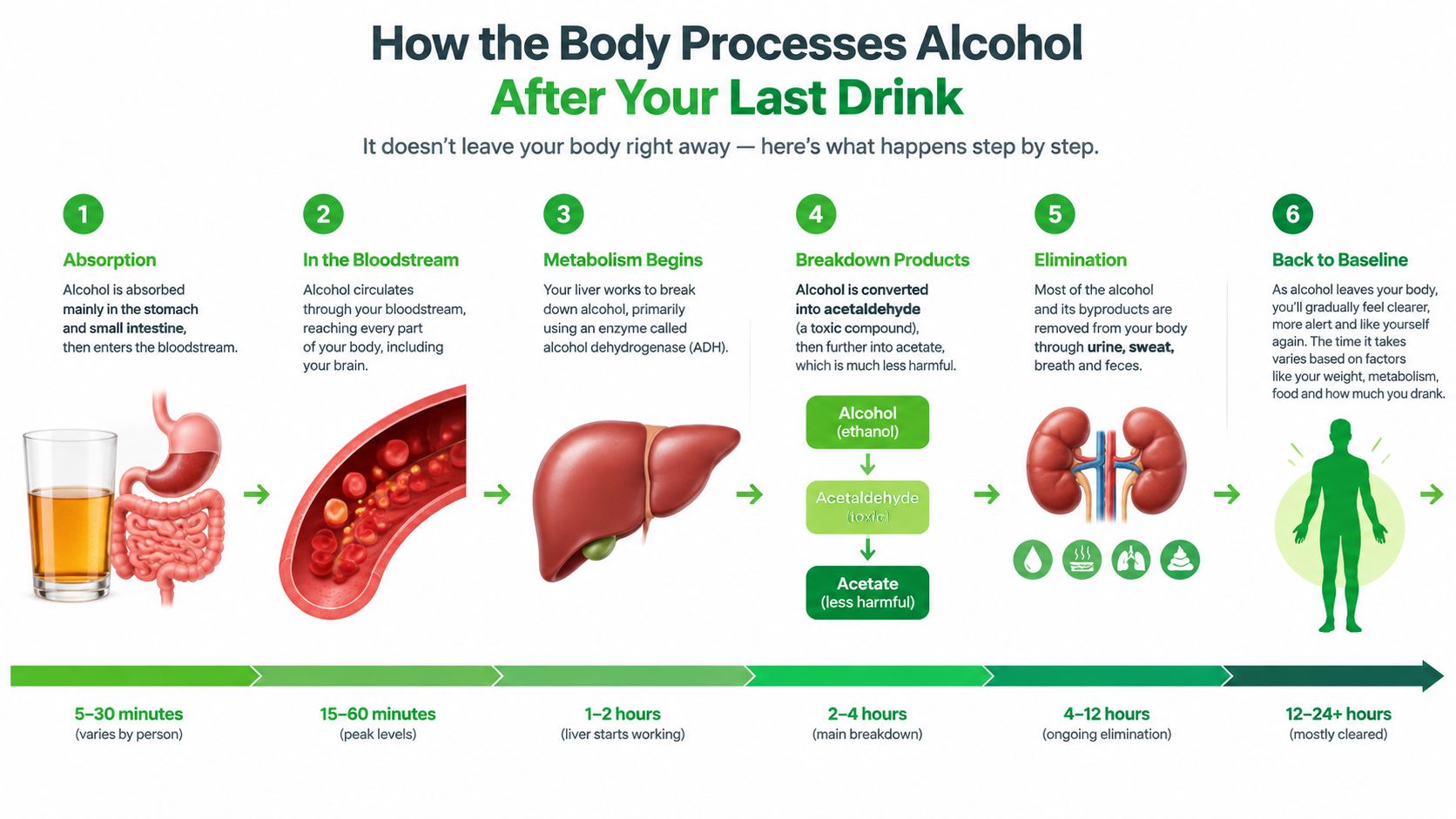
Alcohol enters the bloodstream mainly through the stomach and small intestine. The liver then processes most of it through enzymes including alcohol dehydrogenase, producing intermediate compounds such as acetaldehyde and acetate. A small fraction is transformed through conjugation into ethyl glucuronide, or EtG, and ethyl sulfate, or EtS. The verified clinical literature describes this fraction as under 0.1 percent of consumed alcohol, but its small size doesn't make it clinically unimportant. The clinical review of EtG testing and alcohol metabolism explains why these metabolites can remain useful after ethanol itself has disappeared.
Two measurements, two different questions
A urine ethanol test attempts to measure alcohol itself. Because ethanol leaves the urine relatively quickly, it generally provides a short lookback period. By contrast, EtG and EtS are direct metabolites of ethanol, which makes them longer-window markers of recent exposure. Mayo Clinic Laboratories explains the difference between ethanol and EtG testing.
The practical analogy is the difference between checking whether a counter is still wet and checking whether a chemical trace remains in the grout. The first may speak to what is happening now. The second may indicate that alcohol was present earlier, but it doesn't establish current impairment, the exact amount consumed, or the precise time of drinking.
EtG and EtS travel into urine as the body clears them. Their presence can therefore outlast breath or blood alcohol measurements. That longer window is useful for abstinence monitoring, but it also creates the interpretation problem that follows: the laboratory must decide how much metabolite is enough to call a result positive.
Standard Drug Screens Versus EtG and EtS Panels
A routine five-panel or ten-panel urine drug screen and an alcohol biomarker panel should be treated as separate services, even when a collection site obtains one urine specimen. A standard panel typically targets drug classes. It rarely includes ethanol, and an EtG-only positive result on a routine drug-screen report would be unusual unless the ordering party requested an alcohol add-on.
EtG and EtS tests target recent alcohol exposure, not current intoxication. The federal workplace panel described by SAMHSA doesn't include EtG or EtS, so an employer's standard drug screen shouldn't be assumed to include alcohol biomarkers. Testing.com's explanation of ten-panel testing also distinguishes ordinary drug panels from separate EtG or breath testing.
| Test Type | Target Analytes | Who Typically Orders | Typical Purpose |
|---|---|---|---|
| Standard urine drug screen | Drug classes and their metabolites | Employers, probation programs, medical providers | Drug-use screening or medication monitoring |
| EtG/EtS alcohol panel | Ethyl glucuronide and ethyl sulfate | Treatment programs, DUI evaluators, family courts, professional-monitoring programs | Recent alcohol-exposure or abstinence monitoring |
| Urine ethanol test | Ethanol itself | Clinical or forensic settings when short-window alcohol measurement is needed | Recent alcohol presence |
The ordering party's purpose often determines the panel. A probation office may use a routine panel for one requirement and request EtG separately for an abstinence condition. A DUI clinical evaluation may include alcohol screening as part of a broader assessment. Someone seeking confidential alcohol care at Empire Medical Wellness may encounter a clinical process that considers testing alongside history and treatment needs.
Georgia readers should also ask whether the request involves a DOT drug test and its separate regulations. A DOT-related drug panel isn't automatically an alcohol biomarker test. Breath alcohol testing, saliva screening, urine ethanol, and EtG or EtS each serve different purposes.
The report should identify the analyte, specimen type, laboratory method, and cutoff. If it doesn't, contact the ordering organization before drawing conclusions.
The Cutoff Number That Changes Everything
The cutoff is the laboratory's decision point. It separates a detected concentration that will be reported as positive from one that will be reported as negative. That mechanical rule can change the meaning of the same urine sample.
Consider a report showing 250 ng/mL of EtG. At a 100 ng/mL cutoff, that result is above the reporting threshold. At a 500 ng/mL cutoff, the same measured concentration is below the threshold. The urine didn't change. The laboratory's decision rule did.
| Feature | 100 ng/mL Cutoff | 500 ng/mL Cutoff |
|---|---|---|
| Sensitivity | Higher sensitivity for lighter or earlier exposure | Lower sensitivity |
| Incidental exposure | More likely to raise interpretation questions | Less likely to flag incidental exposure |
| Monitoring use | Often useful when programs prioritize detecting any recent exposure | Often preferred when avoiding low-level incidental positives matters |
| Detection window | Can capture drinking farther back in time | Shortens the effective window |
| Interpretation | Requires careful exposure and timing history | Still requires context, but generally emphasizes more recent or heavier exposure |
A review of EtG testing found that a 100 ng/mL cutoff is most likely to detect heavy drinking for up to five days and any drinking during the previous two days. A 500 ng/mL cutoff is widely used in legal or workplace contexts because it reduces the chance that incidental exposure will produce a positive, although the effective detection window becomes substantially shorter. The review of EtG cutoffs and detection windows describes this sensitivity tradeoff.
That doesn't make one cutoff universally correct. A treatment program may prioritize sensitivity because it wants to identify possible alcohol exposure early. A forensic program may prioritize a threshold that is less vulnerable to incidental exposure. The key questions are who ordered the test, what question they wanted answered, and what consequence follows from the result.
Ask for the cutoff before interpreting the word “positive.”
The number also matters because low-level results aren't self-explanatory. Timing, dose, product exposure, specimen handling, and the use of EtS for comparison can all affect how a clinician or reviewing authority understands the finding.
Realistic Detection Windows by Drinking Pattern
Detection windows aren't a countdown clock. They depend on the amount consumed, the time between drinks, metabolism, urine concentration, and the laboratory cutoff. Even so, the research provides useful ranges for thinking about why one person's result may differ from another's.
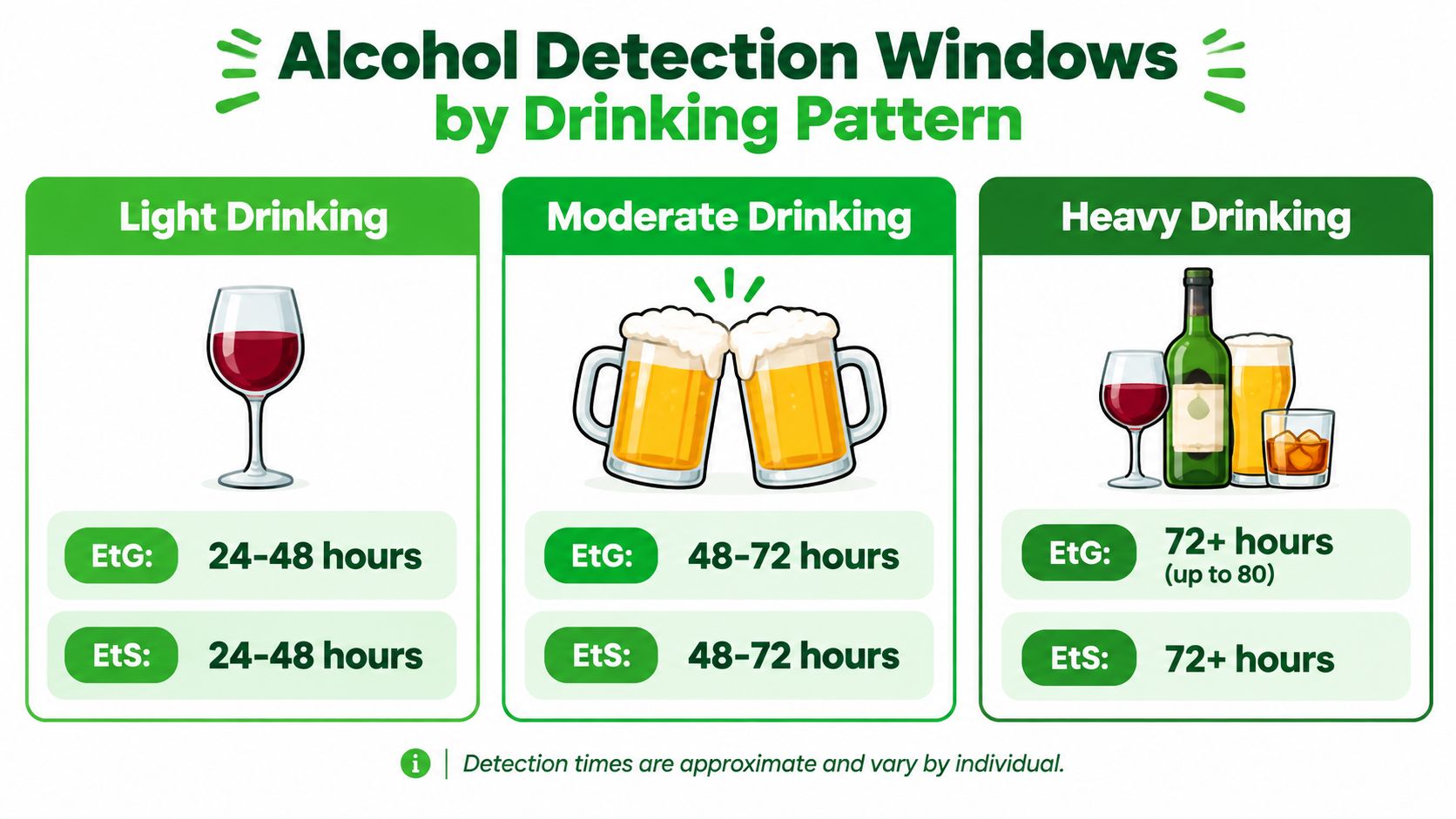
For lighter drinking, EtG may remain detectable in urine for 24 to 48 hours. Controlled human studies describe EtG detection in that range after drinking, while the relationship between dose and timing becomes less predictable as consumption increases. The clinical and forensic review of urinary EtG detection documents these detection patterns.
Moderate drinking may produce a result within a typical 24 to 72 hour window, depending on the cutoff and collection time. Heavy drinking can extend detection to about 80 hours or more, and controlled or intoxicated-subject studies have reported wider ranges, including 40 to 130 hours. A clinical overview of alcohol urine testing summarizes how dose and metabolism influence the window.
A practical mental model
- Light drinking: A result may be detectable around 24 to 48 hours, especially when the laboratory uses a lower cutoff.
- Moderate drinking: Detection may extend through roughly 48 to 72 hours, though the result can fall below a higher cutoff sooner.
- Heavy drinking: Detection may continue beyond 72 hours, with some sources describing approximately 80 hours or longer and controlled studies reporting broader ranges.
The body doesn't produce the same amount of EtG for every drinking episode. More alcohol generally creates more metabolite, and repeated drinking can extend the time required for urinary levels to fall. Hydration and body composition can influence concentration, but they can't provide a reliable way to predict or manipulate a laboratory result.
A reader trying to estimate a testing risk should start with the last drink, total amount, pattern of drinking, and collection time. The discussion of drinking the night before a pre-employment drug test can provide general context, but it can't replace the cutoff and specimen details on an actual report.
Why a Positive Result Does Not Always Mean Drinking
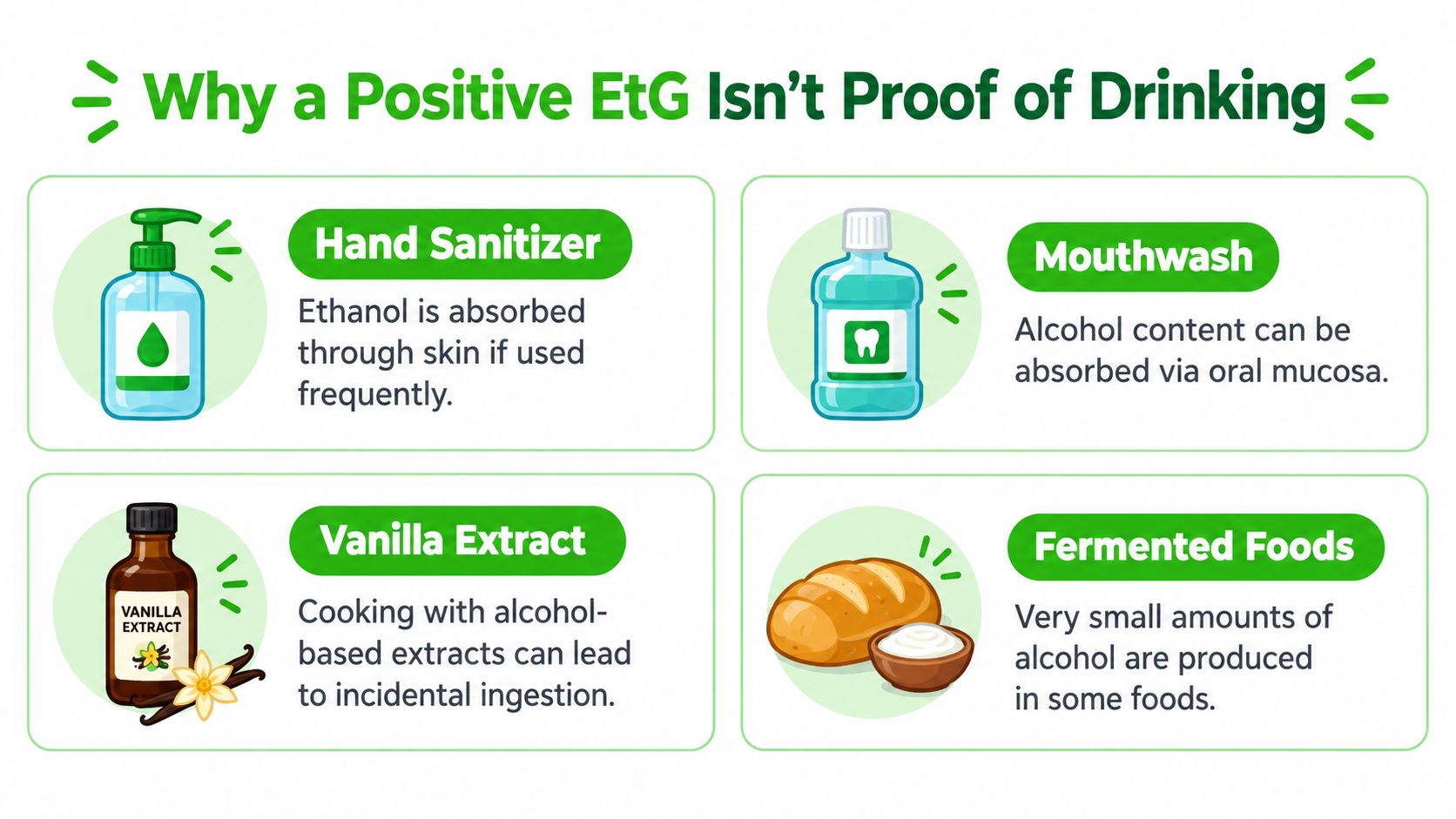
A positive EtG result doesn't prove that someone is currently drunk. It also doesn't always prove that beverage alcohol caused the finding. EtG is sensitive to ethanol exposure from products such as hand sanitizer and mouthwash, particularly when exposure is frequent or intense.
The body can absorb ethanol through skin or mucous membranes. That exposure may create measurable EtG even when the person hasn't consumed an alcoholic beverage. A clinical review notes that incidental exposure can complicate interpretation and that EtG and EtS results need to be considered alongside the person's exposure history. The review of alcohol biomarkers and incidental exposure describes this context problem.
Common exposure questions
- Hand sanitizer: Frequent use can expose the skin to ethanol, especially in healthcare, childcare, or public-facing work.
- Mouthwash: An ethanol-containing product can expose the oral mucosa and create a relevant history for a low-level result.
- Cold preparations: Some over-the-counter medicines may contain alcohol and should be recorded before testing.
- Food and religious products: Fermented foods, alcohol-based flavor extracts, and communion wine may matter when the laboratory reports a low concentration.
SAMHSA guidance describes 100 to 500 ng/mL as a very low positive range that may be consistent with heavy drinking one to three days earlier, light drinking 12 to 36 hours earlier, or recent extraneous exposure. It describes 500 to 1,000 ng/mL as a low-positive range that may reflect drinking within the previous 24 hours or recent intense exposure, while a result above 1,000 ng/mL generally indicates same-day or prior-day drinking. The SAMHSA biomarker advisory emphasizes why timing and exposure history matter.
A positive number is a clue that demands context, not an automatic verdict.
What a Positive Result Means in Georgia DUI Cases
Georgia readers may encounter an EtG or EtS result at different points in the DUI process. A court may order an evaluation or monitoring condition. A probation officer may request testing. A treatment provider may include alcohol biomarkers in a clinical program. The Department of Driver Services may be involved in a license hearing or reinstatement process.
These paths aren't interchangeable. A DUI conviction can lead to Risk Reduction course enrollment, while a probation or family-court order may impose a separate testing requirement. A clinical evaluation may assess alcohol and drug use, treatment needs, and compliance history. The result's meaning depends on the order, the evaluator's role, and the rules governing the proceeding.
Georgia statutes such as O.C.G.A. § 40-5-67.1 and O.C.G.A. § 42-8-60 may arise in DUI, license, probation, or court-ordered evaluation matters, but a laboratory result alone doesn't explain how those provisions apply to a particular case. The DDS hearing process, court conditions, and clinical evaluator's discretion can each affect what happens next. This is procedural information, not legal advice.
How professionals may read the result
A Georgia evaluator may compare EtG or EtS with:
- Self-report: The person's account of drinking, abstinence, and product exposure.
- Clinical history: Prior treatment, symptoms, screening results, and functional concerns.
- Other biomarkers: A provider may consider phosphatidylethanol, or PEth, when clinically appropriate.
- Testing purpose: A treatment program may favor sensitivity, while a court-related setting may focus more heavily on incidental exposure and confirmation.
A single result at a 500 ng/mL cutoff may prompt review rather than automatic punishment. A result at a 100 ng/mL cutoff may raise more questions about low-level exposure because the threshold is more sensitive. Neither outcome should be separated from the report's collection date, laboratory method, chain of custody, and governing order.
If the result could affect a license, employment, custody matter, or criminal case, a Georgia attorney or qualified clinical professional should review the actual paperwork.
Practical Next Steps if a Urine Screen Is on Your Horizon
Panic can make a confusing report harder to resolve. A written record and a few precise questions are more useful.
Before collection
Write down potential ethanol exposures during the prior 80 hours, including hand sanitizer, mouthwash, cold medicine, kombucha, alcohol-based flavor extracts, fermented foods, and products used repeatedly at work or home. Record approximate timing and bring prescription information to the collection site. Don't stop prescribed medication without speaking with the prescriber.
Ask the ordering party:
- What test was ordered? Confirm whether the panel measures ethanol, EtG, EtS, or more than one marker.
- What cutoff applies? Request the actual threshold, not just the word positive.
- What confirmation method is used? Ask whether a presumptive result will be confirmed with LC-MS/MS.
- How is the specimen documented? Request information about chain of custody, specimen validity, and any split-sample or retest procedure.
- Who receives the report? Clarify whether the result goes to probation, a court, an employer, DDS, a treatment provider, or another reviewing authority.
For a recent result, request the complete laboratory report rather than relying on a verbal summary. The Georgia court-ordered drug test procedure can help explain the procedural side of collection and documentation, but the ordering agency controls the requirements in an individual case.
Choose the right professional response
A clinical evaluator can help interpret alcohol screening in relation to treatment needs. A Georgia-licensed addiction counselor can help assess exposure history and support a compliant plan. An attorney may be appropriate when the result could affect a criminal case, license hearing, employment action, custody order, or professional credential.
Georgia DUI Schools offers DDS-approved Risk Reduction education, clinical evaluations, ASAM Level 1 treatment, and Victim Impact Panel services, with online and in-person options for Georgia participants. If a urine alcohol result is connected to a DUI requirement, Georgia DUI Schools can help you identify the appropriate next compliant step and understand which service belongs in your situation.