
You're standing in an Atlanta courthouse hallway with a court order in your hand. It says you must complete anger management, but it doesn't explain whether you need an assessment, a short class, a longer program, or a particular type of certificate. The deadline is approaching, and choosing the wrong course could leave you paying twice or returning to court without acceptable documentation.
That confusion is common. Atlanta anger management classes are often a compliance decision before they're a personal-development decision. You need to understand what the referring court, probation officer, attorney, employer, or family-court professional requires, then choose a program that teaches useful skills and produces the right proof of completion.
What Atlanta Anger Management Classes Actually Are
Anger management classes are structured, time-limited educational programs. They aren't the same as open-ended individual therapy, and they aren't just a room where participants confess their worst arguments. A well-designed class teaches you how anger develops, how your body signals escalation, and how to interrupt the pattern before it turns into a threat, fight, damaged relationship, or violation of a court condition.
Atlanta providers commonly organize these programs around cognitive behavioral therapy, or CBT. The practical focus includes recognizing triggers, slowing impulsive reactions, using de-escalation techniques, communicating assertively, resolving conflict, and planning for future high-risk situations. A court-facing program may also include an assessment before enrollment, particularly when the referring authority wants a professional opinion about the appropriate level of intervention. One Atlanta provider lists anger assessments for court-ordered clients, attorney referrals, HR referrals, and self-evaluation clients, with a listed assessment cost of $200. You can review that provider's Atlanta anger-management assessment information before assuming a class alone is what you need.
What happens during the learning process
A typical class asks you to do more than listen. You may examine a recent incident, identify the first warning sign you missed, practice a calmer response, and write down what you'll do differently next time. Depending on the program, you may complete trigger logs, reflection exercises, workbook activities, or role-play conversations.
The point isn't to eliminate anger. Anger can signal that something feels unsafe, unfair, or important. The point is to make sure anger doesn't choose your words or actions for you.
Practical rule: Don't enroll based only on the words “anger management.” Confirm whether the program provides the exact hours, format, assessment, and certificate your referring authority expects.
Atlanta's market uses fixed-duration options rather than vague promises to attend “a few sessions.” One local provider advertises 4, 8, 12, 16, 26, and 52-hour options, with prices ranging from $100 for 4 hours to $1,050 for 52 hours. Those formats reflect the documentation needs of courts and probation systems, not just informal counseling preferences. The provider also offers live online attendance for Atlanta and Fulton County residents, which can remove the need to travel across the metro area. See the published Atlanta anger-management program options and pricing before comparing programs.
Who Gets Sent to Anger Management in Atlanta and Why
People arrive at Atlanta anger management classes through several routes. Some receive a court order after a criminal matter. Others receive a probation referral, a diversion condition, a family-court instruction, or a recommendation from an attorney. Some enroll voluntarily after a workplace conflict, relationship breakdown, or repeated argument at home.
Georgia sources describe anger-management classes as conditions that may appear in a sentence, plea agreement, probation requirement, or diversion program. They may also arise in family-court or child-protective-services matters. That means the same phrase, “complete anger management,” can carry different practical requirements depending on who issued it and why. A judge may want documented education, while another authority may first require a clinical evaluation or a written recommendation.
The referral source changes the paperwork
A criminal-justice referral may focus on attendance, completion hours, and a certificate sent to probation. A family-court matter may involve custody, visitation, parenting concerns, or a broader behavioral assessment. An employer referral may care more about participation and workplace conduct than a court-specific certificate. A self-referred client may have no external documentation requirement at all.
That's why you should keep the original order or referral letter in front of you when you call a provider. Ask the provider to explain whether the document requests a class, an evaluation, counseling, or a combination. If the wording is unclear, your attorney or supervising officer should make the final determination.
A clinical assessment and a class aren't interchangeable. An assessment examines your history, behavior patterns, and triggers, then recommends an appropriate next step. A class teaches skills and records your participation. If the order asks for both, completing only the class won't necessarily satisfy the entire condition. You can start by reviewing the anger management assessment service and then confirming the requirement with the person supervising your case.
Don't confuse anger requirements with DUI requirements
A DUI case may involve separate obligations. Georgia's DDS states that the DUI, Alcohol or Drug Use Risk Reduction program is required for people convicted of DUI, possession of illegal drugs, underage possession of alcohol while operating a motor vehicle, or Boating Under the Influence. The program has an Assessment Component and an Intervention Component, and both must be completed to receive a certificate of completion. Review the Georgia DDS DUI FAQs if your case involves a driving-related conviction.
An anger-management class may address behavior and conflict, but it doesn't automatically replace a DUI Risk Reduction requirement, clinical evaluation, substance-abuse treatment, or another court condition. Treat each requirement as a separate item until the issuing authority confirms otherwise.
Comparing In-Person, Virtual, and Online Class Formats
The format matters because convenience doesn't equal acceptance. An Atlanta resident may find an in-person class in Buckhead, Decatur, Marietta, or Lawrenceville, a live virtual class attended through Zoom, or a self-paced online course completed independently. Your order determines which option is safe to use.
In-person classes usually make attendance easy to verify. You sign in at the location, participate in real-time exercises, and receive documentation from an instructor who observed your attendance. This format may also help if your order uses language requiring physical presence or a specific facility.
Live virtual classes are different from self-paced courses. You attend at a scheduled time, interact with an instructor, and may need to keep your camera available throughout the class. A provider should explain how it records attendance, handles interruptions, and produces dated documentation. For a plain-language explanation of how live online learning works, MEDIAL's guide to virtual classrooms can help you understand the difference between a live classroom and an asynchronous course.
Self-paced online programs offer flexibility, but acceptance can be harder to predict. They may be appropriate only when the order explicitly permits asynchronous completion and the provider's curriculum meets the required standard.
| Format | Court Acceptance | Documentation | Typical Use Case |
|---|---|---|---|
| In-person | Often the easiest format to verify, but confirm the order | Sign-in records, dated completion certificate, and instructor verification | Orders that emphasize physical attendance or direct supervision |
| Live virtual | May be accepted when the authority permits live online attendance | Attendance logs, session dates, participation records, and completion certificate | Atlanta residents who need scheduled learning without metro-area travel |
| Self-paced online | Appropriate only when asynchronous completion is expressly allowed | Digital progress records and a certificate, subject to authority approval | Voluntary education or orders that clearly approve self-paced work |
For a court-ordered program, ask for written confirmation before paying. If you need a longer program, selecting the cheapest format can create a larger problem if the court later rejects the certificate. Review the court-approved online anger management options and compare their documentation with your order, not just their schedule.
Matching Class Hours to Atlanta Court and Probation Orders
Atlanta anger management requirements are commonly expressed as fixed hour blocks. A local Fulton County court resource lists programs built around 4, 8, 12, 16, 26, and 52 hours, which shows why “I completed an anger class” may be too vague for a probation check-in. The required dosage is the number written into the order, not the number that feels reasonable to the participant.
Before enrolling, underline four details: the required hours, the completion deadline, the permitted format, and the certificate language. If any one of those is missing, ask the attorney or probation officer for clarification.
| Hour Block | Typical Order Source | Common Scenarios | Format Options |
|---|---|---|---|
| 4 hours | Short educational referral or assessment-directed requirement | Introductory education or a narrowly defined condition | In-person or live online when approved |
| 8 hours | Probation, diversion, or a short court condition | Basic skills education after a lower-level behavioral incident | In-person, live virtual, or another approved format |
| 12 hours | A more developed educational requirement | Additional practice with triggers, communication, and de-escalation | Scheduled classroom or approved virtual delivery |
| 16 hours | A condition requiring deeper skills practice | Extended behavioral education with more exercises and review | Provider and authority must confirm the format |
| 26 hours | A substantial court or probation requirement | Longer compliance programs where documentation and practice matter | In-person or live online only if the order allows it |
| 52 hours | A highly structured long-form requirement | Intensive or extended intervention ordered by the referring authority | Confirm provider credentials, schedule, and acceptance first |
These descriptions are decision aids, not substitutes for an order. Don't assume that a longer class can replace a shorter requirement, or that a shorter class can satisfy a longer one. If your paperwork specifies an 8-hour program, compare the provider's 8-hour anger management classes with the exact language in your order before registering.
What Happens Inside a Typical CBT-Based Class
A CBT-based class usually follows the anger response cycle. You look at the trigger, the thoughts and body sensations that signal escalation, the point at which control narrows, and the recovery period after the event. This structure helps you replace “I just snapped” with a more useful account of what happened and where you could have intervened.
The instructor may begin with a check-in or review of an assignment. You might describe a recent disagreement, record the physical signs that appeared first, or identify the thought that intensified the situation. The class then turns that observation into a skill you can practice.
Skills you'll practice
- Early-warning recognition: Notice clenched muscles, rapid speech, racing thoughts, or the urge to prove a point before the conflict peaks.
- Cognitive restructuring: Test automatic conclusions such as “They're disrespecting me, so I have to respond now.”
- Timeouts and de-escalation: Leave a conflict safely, communicate that you need a pause, and return when you can speak without threatening or attacking.
- Assertive communication: State a concern directly without insults, intimidation, or passive-aggressive silence.
- Relapse prevention: Plan for the situations, people, environments, and emotional states that make an old reaction more likely.
Group classes may use role-play and peer feedback. Individual or hybrid programs may rely more heavily on workbook exercises and one-to-one coaching. The method should be active rather than purely conversational. A meta-analysis summarized by the U.S. Department of Justice found that anger-focused CBT approaches emphasizing skill development outperform affective education, and that modeling, feedback, and homework are associated with stronger outcomes. The CBT evidence summary on anger interventions explains why practice belongs in a serious program.
At completion, ask what documentation you'll receive. A useful certificate should identify the participant, dates, hours, curriculum, instructor, and completion status. Keep it with your personal relapse plan and any written verification provided to the referring authority.
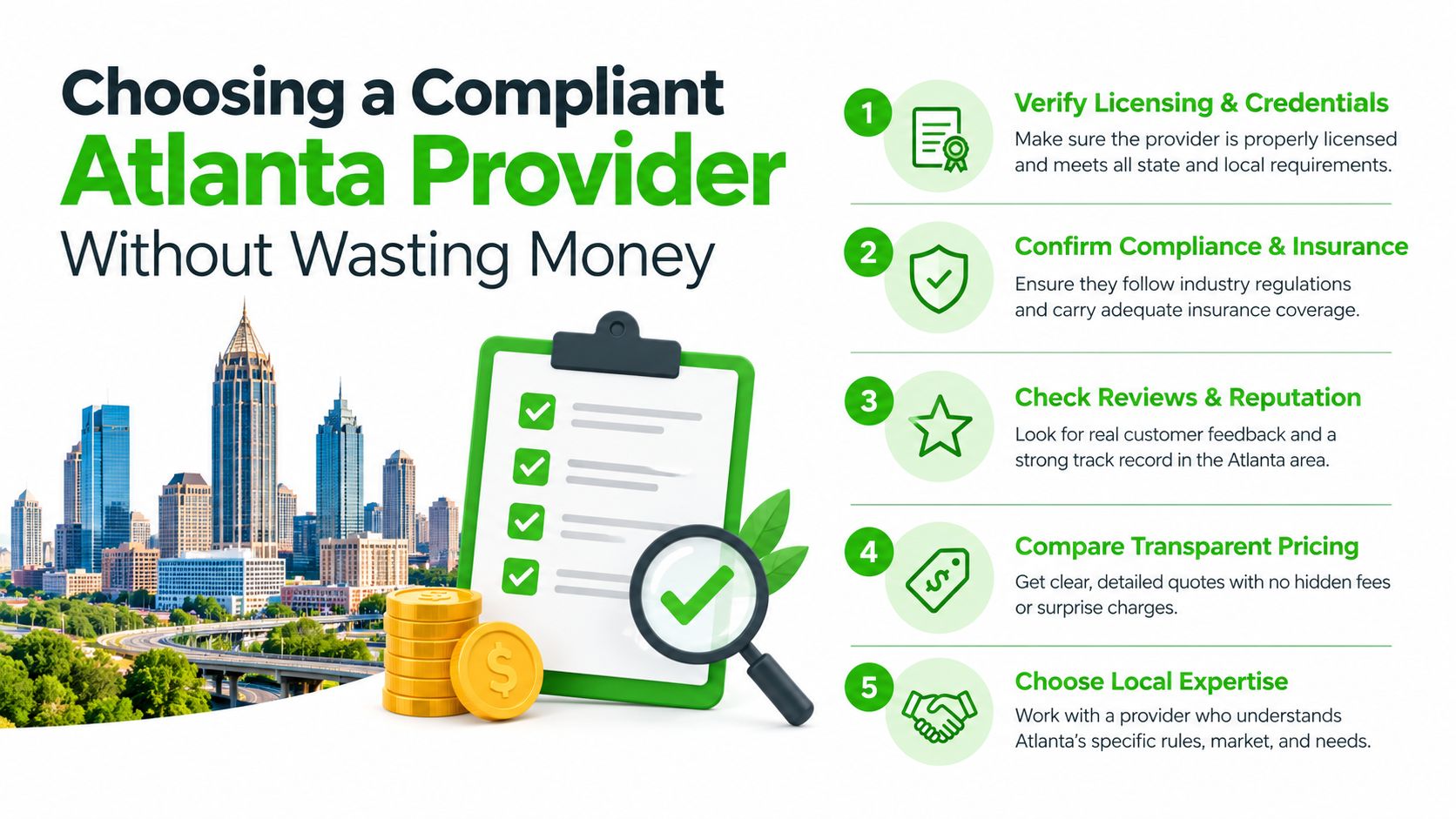
Choosing a Compliant Atlanta Provider Without Wasting Money
Start with the paperwork, not the provider's advertising. Write down the required hours, deadline, location or virtual requirement, whether an assessment comes first, and whether the certificate must come from a licensed clinician or another specified provider.
Use this provider checklist
- Confirm acceptance first. Ask the attorney, probation officer, court clerk, or family-court contact whether the provider and format will be accepted. Get the answer in writing when possible.
- Match the hours exactly. A certificate showing fewer hours than the order may not satisfy the condition. A longer program may also require prior approval.
- Inspect the certificate details. Confirm that it will include the hour count, dates, topics, instructor credentials, signature, and a way to verify completion.
- Ask about attendance rules. Find out whether late arrival, missed sessions, camera problems, or make-up work affects completion.
- Request the total cost. Published Atlanta options range from $100 for 4 hours to $1,050 for 52 hours, so compare the full program price and any assessment, materials, rescheduling, or documentation fees using the provider's Atlanta pricing information. Don't convert that published range into an assumed hourly rate, because program structure and services can differ.
- Protect your records. Save the order, receipt, attendance record, certificate, progress letter, and every email in one folder.
Privacy matters when you're sending an assessment, court order, or behavioral history through a digital system. Ask who can access your records, how the provider handles electronic communications, and whether a business associate agreement is relevant to the service arrangement. PatientNotes offers a practical HIPAA BAA requirements guide that can help you form better questions about protected health information.
Don't let a low advertised price make the decision for you. The true cost includes the risk of an unacceptable certificate, a missed deadline, or having to repeat a course that didn't match the order.
Your First Week After You Sign Up
The first week should turn uncertainty into a written plan. Start by calling the provider and asking four direct questions: Is there a seat available, is the class in-person or live virtual, what must you bring, and does the certificate match the wording of your order?
A workable first-week schedule
Day one: Gather your photo ID, court order or referral letter, payment information, and contact details for your attorney or probation officer. Send the provider the relevant paperwork and ask for confirmation of the required hours and completion format.
Day two: Schedule the intake or first class. Put every class date on your calendar, including the deadline for submitting the certificate. If you're attending virtually, test your webcam, microphone, internet connection, and quiet workspace before the first meeting.
Day three: Confirm the missed-session policy. Ask whether a missed day requires a make-up class, whether partial attendance counts, and how an emergency should be reported. Don't wait until the deadline to discover that the provider won't let you replace a missed session with a self-paced module.
Before the first class: Arrive early for an in-person appointment, or log in early for a virtual session. Bring a notebook, keep your phone silent, and have your order available so you can recognize any mismatch in hours or documentation.
Verify completion while the details are fresh
At the end of each session, keep your attendance confirmation. When the program ends, ask the instructor or office to confirm in writing the total hours completed, the dates attended, and the date the certificate was issued. Store that confirmation with the original order.
Atlanta's traffic and distance can make a physical schedule difficult, especially when you're traveling from outside the city. A live virtual option may solve the travel problem, but only after the issuing authority confirms that format is acceptable. Convenience should support compliance, not replace it.
Putting It Together and Getting Started
The decision becomes simpler when you separate the legal requirement from the personal goal. If you're completing a Fulton County condition, satisfying probation, responding to a family-court order, or trying to stop destructive arguments at home, you still need a program you can attend fully and document clearly.
Three actions prevent most avoidable mistakes:
- Confirm the exact requirement. Identify whether you need an assessment, class, treatment, or more than one service.
- Verify acceptance before payment. Ask the attorney, probation officer, court contact, or other referring authority whether the provider, hour block, delivery format, and certificate will count.
- Choose a realistic schedule. Select in-person attendance when physical presence is required, or use live virtual learning only when the order allows it and you can participate consistently.
The educational work can be practical. You learn to identify the moment when irritation becomes escalation, take a safe pause, challenge the thought that fuels the conflict, and return to the conversation with a different response. The compliance work is practical too. You attend the required hours, keep your records, and submit the certificate by the deadline.
A class won't erase the event that brought you to this point. It can give you a documented path forward and a set of skills you can use in the next argument, family conversation, workplace disagreement, or stressful encounter. Start with the order in your hand, not a generic search result.
Georgia DUI Schools offers anger management assessments and online anger management classes when a court-ordered virtual format is allowed. Visit Georgia DUI Schools with your order or referral details to discuss the appropriate next step and documentation.