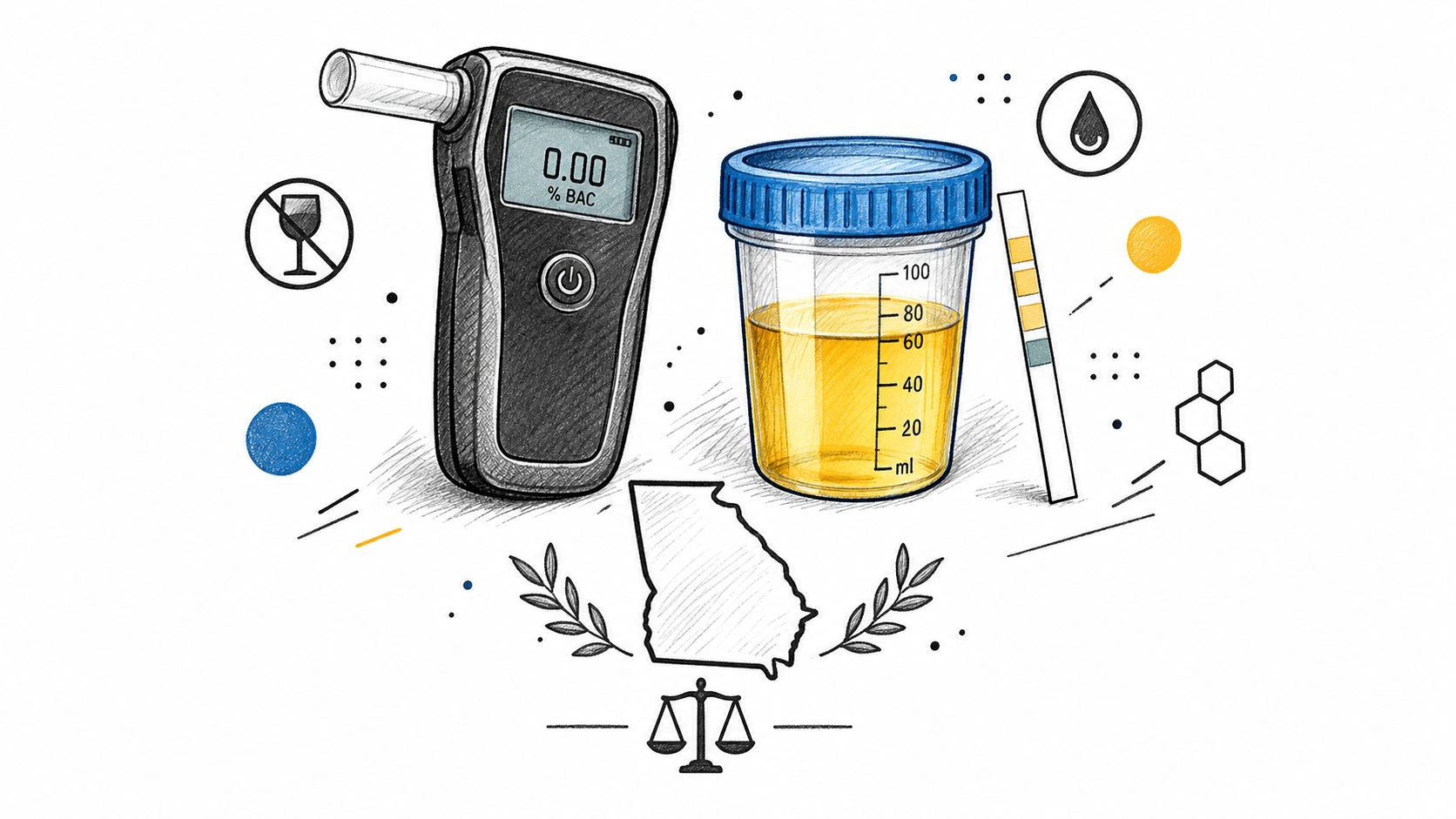
Standard workplace drug panels typically don't include alcohol, and a urine EtG test may detect alcohol exposure for about 24 to 72 hours, sometimes up to 80 hours or about five days after heavier use. In a Georgia DUI case, however, alcohol may be checked separately through specialized tests such as breath, blood, and urine EtG or EtS testing.
Could a negative drug screen give you false confidence because nobody tested for alcohol? That misunderstanding matters in Georgia, where a routine workplace panel and a DUI-related alcohol test serve different purposes. A standard screen may look for controlled substances while leaving alcohol unexamined, yet a judge, probation officer, treatment provider, or other authorized program can require a dedicated alcohol test.
A person can also have no detectable ethanol in their breath or blood and still produce a positive alcohol-metabolite result later. The result doesn't necessarily establish intoxication at the time of collection. It may establish prior alcohol exposure, which can still matter under a court or probation condition requiring abstinence.
Does a Standard Drug Test Include Alcohol?
Usually, no. Common workplace drug tests are often 5-panel or 10-panel screens, and those panels generally don't include alcohol unless an alcohol-specific test is ordered separately. The panel may evaluate substances such as marijuana, cocaine, and opioids, but a negative result only answers questions about the substances included in that order.
Laboratories treat alcohol differently because alcohol requires a different testing target and, often, a different collection method. Direct testing can involve breath, blood, saliva, hair, or urine testing for alcohol metabolites. The exact answer depends on the order, the specimen, and the laboratory method, not merely on the phrase “drug test.” Laboratories.org's guide to drug testing explains this distinction between routine panels and separate alcohol testing.
Read the order, not the label
A form may use broad language such as “drug and alcohol screening,” but a standard drug panel alone doesn't prove that alcohol was tested. Ask which analytes were ordered and whether the laboratory used ethanol, EtG, EtS, or another alcohol-specific method. A collector or medical review process can often clarify the test category, although a legal case may require advice from your attorney before you interpret or challenge a result.
For someone facing a Georgia DUI, the practical sequence is straightforward:
- Identify the panel. Find out whether the order was a routine 5-panel or 10-panel screen or a combined order with a separate alcohol assay.
- Identify the specimen. Breath, blood, saliva, urine, and hair answer different timing questions.
- Identify the marker. Ethanol and EtG or EtS don't remain detectable for the same length of time.
- Check the governing condition. A probation order or treatment agreement may impose abstinence requirements beyond ordinary workplace testing.
A negative routine screen therefore shouldn't be described as a clean alcohol result unless the paperwork confirms that alcohol was tested. For related practical guidance about testing and probation consequences, see Ticket Shield, PLLC on probation violations.
How Alcohol Is Actually Detected in Georgia
Georgia DUI testing uses different tools for different questions. A breath test is suited to current alcohol presence, a blood draw can preserve a laboratory sample for evidentiary analysis, and urine metabolite testing can identify earlier exposure after ethanol itself has cleared. Saliva and hair can also be used in appropriate laboratory or monitoring settings, though their role depends on the program and the order.
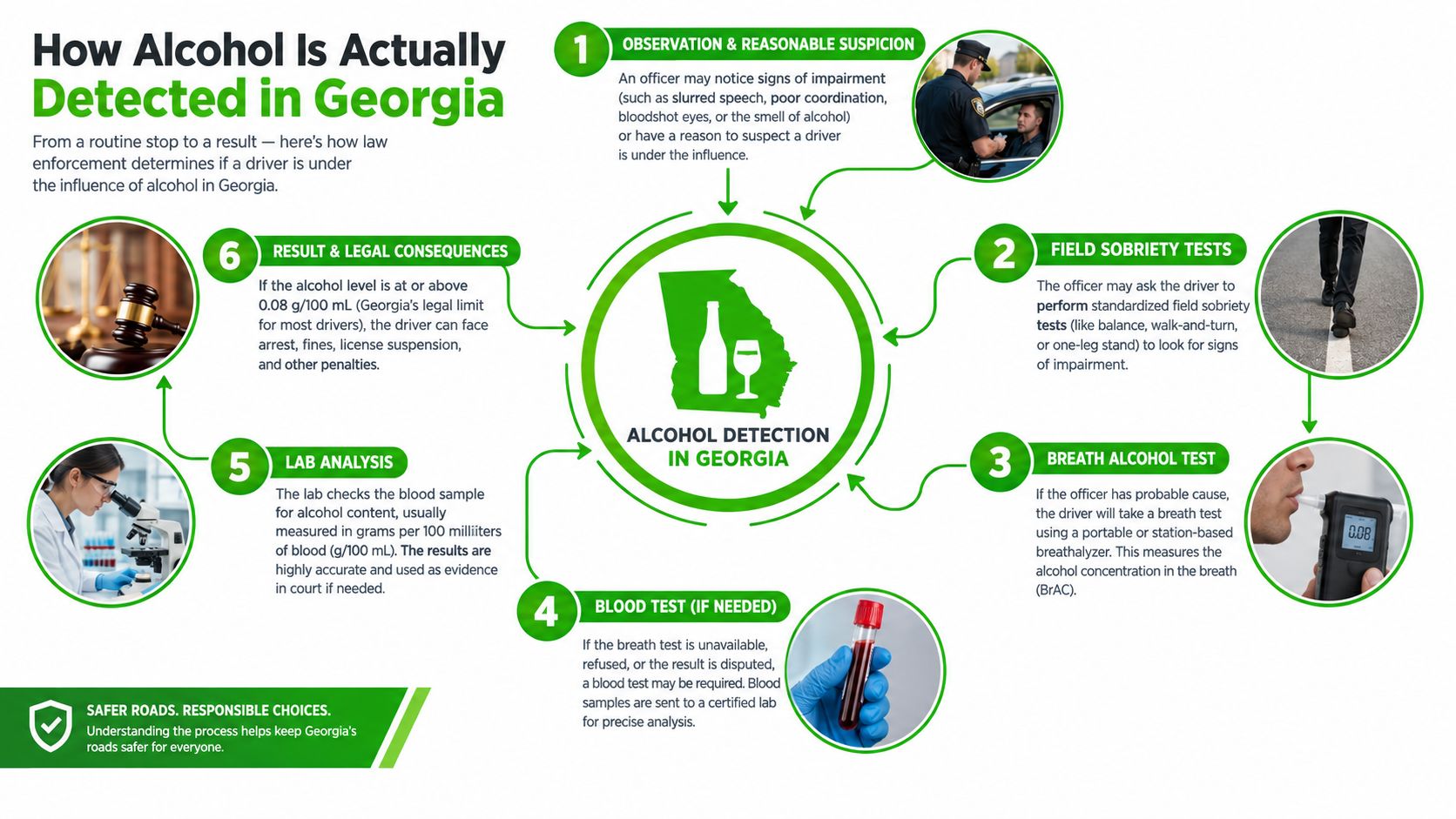
Five testing routes, five different questions
- Breath testing: Measures alcohol in exhaled breath and is used when the question concerns alcohol present around the time of driving or testing. Georgia drivers can review the practical distinctions in this breathalyzer test information.
- Blood testing: Measures alcohol in a blood specimen and may provide laboratory evidence connected to a particular collection event.
- Saliva testing: Uses oral fluid and can be selected for recent exposure monitoring, depending on the testing program.
- Urine ethanol testing: Looks for ethanol itself. Ethanol generally remains detectable in urine for only a few hours.
- Urine EtG and EtS testing: Looks for metabolites produced after the body processes alcohol. These markers can remain detectable substantially longer than ethanol.
The major development in alcohol testing was the shift from measuring ethanol itself to measuring ethyl glucuronide, or EtG, and ethyl sulfate, or EtS. Clinical literature describes EtG detection for roughly 24 hours after one or two drinks and up to two to four days after heavier consumption. One review also reported possible urine EtG detection up to 130 hours after excessive drinking, which demonstrates why the absence of alcohol odor doesn't answer the testing question. The clinical review on EtG and EtS testing provides the medical context for that shift.
Practical rule: A test that measures current ethanol and a test that measures alcohol metabolites aren't interchangeable.
This distinction also helps explain why alcohol can have consequences beyond a single traffic stop. People who want broader health context can read this holistic overview of alcohol on brain health from Be Your Best Self & Thrive Counseling, PLLC. It addresses a different question, but understanding the substance and understanding the test are connected parts of responsible decision-making.
Understanding EtG and EtS Metabolite Testing
EtG and EtS are direct alcohol metabolites. They aren't the same as ethanol, and they don't show whether a person is impaired during urine collection. Their value is that they can reveal prior alcohol exposure after the parent alcohol has disappeared from blood, breath, or untreated urine.
That timing makes EtG and EtS particularly relevant to abstinence monitoring. A court or probation program may not be asking whether someone is intoxicated at the appointment. It may be asking whether alcohol was consumed during a period when the person agreed not to drink. The laboratory result must then be interpreted under the applicable cutoff and monitoring rule.
Cutoffs change the meaning of a result
Laboratory guidance discusses urine EtG and EtS cutoffs around 100 to 500 ng/mL. Higher cutoffs generally improve specificity but can reduce sensitivity for light or older drinking. A 500 ng/mL cutoff may miss remote, low-level exposure, while lower cutoffs can increase the possibility of incidental positives associated with products such as mouthwash or hand sanitizer. Mayo Clinic Laboratories' EtG and EtS guidance explains why cutoff selection matters.
That doesn't mean every positive result is meaningless. It means the result should be read with the specimen type, collection date, cutoff, chain of custody, and monitoring terms in view. EtG and EtS can be highly sensitive and specific for recent exposure, but they don't calculate the number of drinks consumed and don't establish impairment at collection.
What the test can and cannot prove
An EtG or EtS result can support a conclusion that alcohol exposure occurred within a relevant detection period. It generally can't tell you the exact time of drinking, the exact amount consumed, or whether you were legally impaired when the sample was taken. Incidental exposure may also become important when a low cutoff is used, which is why complete disclosure of products and circumstances matters.
For a practical explanation of urine testing in this context, review alcohol in urine drug screening. If you receive a disputed or unexpected result, don't assume that arguing “I wasn't drunk” resolves it. Impairment and prior exposure are separate questions, and the governing program may focus on the latter.
Detection Windows for Different Alcohol Tests
A Georgia DUI timeline can involve several testing points. A breath or blood test may address alcohol near the traffic stop or collection event. A later urine test may address exposure during a longer monitoring period. The same person can therefore receive different results from different specimens without the laboratory contradicting itself.
The main error is treating the word “alcohol” as though every test detects it for the same amount of time. It doesn't.
| Test target | General detection picture |
|---|---|
| Urine ethanol | About 12 hours in some guidance |
| Urine EtG or EtS | Can extend to about 80 hours |
| EtG or EtS after heavier drinking | Some sources report up to 130 hours |
These windows are method-dependent, and every quantitative statement in the table comes from this review of alcohol urine testing. Collection timing, specimen type, laboratory cutoff, and the amount and pattern of drinking can all affect interpretation.
A typical legal sequence
A driver is stopped, investigated, and tested close to the driving event. That immediate testing may focus on breath or blood. Later, if a court, probation condition, treatment program, or license-related process requires monitoring, the person may be directed to provide urine for EtG or EtS analysis.
By the time the later sample is collected, the person may not smell of alcohol and may feel entirely sober. That doesn't prevent a metabolite test from detecting earlier exposure. Conversely, a negative ethanol result from an untreated urine sample doesn't automatically rule out recent drinking because ethanol clears sooner than EtG or EtS.
The safest response is to follow the actual monitoring terms rather than estimate a personal “safe” window. Trying to time drinking around a test can create a compliance problem even when the person believes the alcohol should have cleared.
When Alcohol Testing Is Required in Georgia
The answer changes with the setting. Employment testing, probation monitoring, and court-related testing aren't identical programs, and the test ordered in one setting doesn't establish what happened in another.
A workplace may use a routine drug panel that excludes alcohol unless the employer orders a separate alcohol test. A probation officer or treatment provider may use EtG or EtS because the purpose is abstinence monitoring over a broader period. A judge may impose conditions that require compliance with testing, treatment, or other obligations. A negative workplace drug screen doesn't cancel those separate requirements.

Employment testing
Employers typically define their own testing policy unless a specific regulatory framework applies. A safety-sensitive employer may request alcohol testing in addition to a drug panel, while another employer may test only for listed controlled substances. The policy and authorization paperwork should identify what is included.
Don't infer the testing scope from the collection site or the cup alone. Ask for the test category and read any consent or authorization documents carefully.
Probation and court monitoring
Probation conditions can be more specific than ordinary employment testing. If the order requires abstinence, the relevant question may be whether an alcohol-specific test detects prior exposure, not whether a standard drug panel is negative. Missing a test, refusing a test, or violating a testing condition can create a separate compliance concern.
Georgia driver's license consequences can also involve implied-consent procedures and choices after a traffic stop. The Georgia implied consent information provides background on that separate issue. It shouldn't be confused with later EtG or EtS monitoring, which addresses a different testing purpose.
A negative standard drug screen proves only what that particular order was designed to detect.
For official interpretation of a court order, speak with your defense lawyer, probation officer, or testing provider. General online explanations can't replace the exact language of your case documents.
Preparing for Your Georgia DUI Monitoring
Preparation starts with the written condition, not with an internet estimate of how quickly alcohol leaves the body. Confirm whether the program requires breath, blood, urine ethanol, EtG, EtS, or another method. Ask about reporting times, random notifications, collection locations, cutoff interpretation, and what happens if you miss an appointment.
Keep a record of instructions and testing dates. Follow notification directions promptly, and don't delay because you feel sober or believe alcohol is no longer detectable.
Reduce avoidable confusion
- Read product labels: Mouthwash, hand sanitizer, and other alcohol-containing products may matter when low EtG or EtS cutoffs are used. Ask your monitoring provider what to avoid.
- Disclose relevant exposure: Tell the collector or supervising professional about products or circumstances that may affect interpretation before testing, not after a disputed result.
- Don't substitute a routine panel: A negative 5-panel or 10-panel result doesn't answer whether a separate alcohol test was performed.
- Keep documents together: Save the order, testing instructions, receipts, results, and communications in one place.
- Get legal advice promptly: If a result is unexpected, ask your attorney about confirmation procedures, laboratory records, and the consequences under your specific order.
A positive EtG result may affect probation, treatment participation, or the conditions attached to license reinstatement. It doesn't automatically prove impairment, but that distinction may not prevent a violation finding if the rule prohibits alcohol exposure. Treat the result as a legal and clinical issue, not just a laboratory vocabulary problem.
Complete Your Georgia Risk Reduction Course
Alcohol testing answers one question, while a Georgia Risk Reduction course addresses education and compliance requirements connected to a DUI case or license reinstatement. Completing the required course doesn't erase a test result, but it can be an important part of satisfying the obligations assigned by DDS or the court.
The practical takeaway is simple. Confirm what test was ordered, understand whether it measures ethanol or metabolites, respect the stated monitoring conditions, and keep proof of every completed requirement. If your case also involves a clinical evaluation, ASAM Level 1 treatment, or a Victim Impact Panel, coordinate those steps rather than assuming one completion substitutes for another.

Georgia DUI Schools provides Georgia DDS-approved DUI and Risk Reduction education through online, live virtual, and classroom formats, along with related clinical services and Victim Impact Panels. Visit Georgia DUI Schools to review the Risk Reduction options, confirm the format that fits your requirements, and take the next documented step toward compliance.