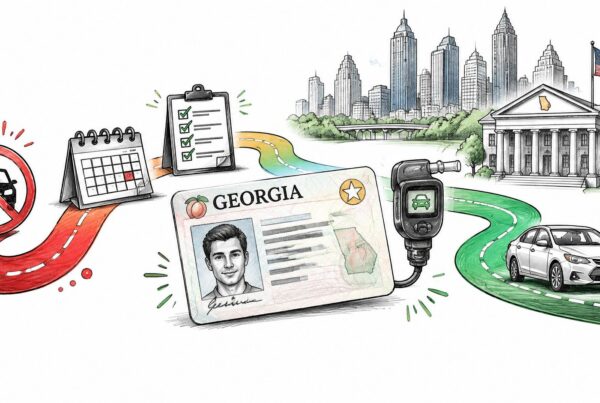
What good is the cheapest insurance quote if it doesn't satisfy the requirements to get your Georgia license back? After a DUI, the premium is only part of the problem. You also need to coordinate your suspension timeline, required education, insurer filing, liability limits, and reinstatement paperwork.
High risk auto insurance isn't a single policy you buy off the shelf. It's coverage offered to a driver an insurer considers more likely to generate costly claims. For Georgia drivers, understanding that distinction helps you avoid paying for a policy that doesn't solve your actual reinstatement problem.
Who Counts as High Risk and Why Insurers Care
A driver becomes high risk when convictions, suspensions, accidents, or repeated violations tell an insurer that a costly claim is more likely. The insurer may charge more, restrict eligibility, or decline the application. Another company may accept the same driver under different underwriting rules.
Insurers examine conviction history, claims history, and gaps in coverage. A DUI tells them something different from an isolated parking ticket. An at-fault collision raises questions about claim costs, while interrupted insurance can complicate eligibility even when the driver hasn't had another accident.
Events that trigger high-risk status in Georgia
The distinction between an insurer's response and a state's requirement matters. A company sets its underwriting rules, but Georgia DDS determines what you must satisfy to restore driving privileges.
| Trigger | Typical insurer response | Georgia requirement |
|---|---|---|
| First DUI conviction | Surcharge; SR-22 usually required | SR-22 kept for three years from the conviction date |
| Second DUI within five years | Surcharge or nonstandard policy | Minimum 18-month suspension; first 120 days with no driving, then possible interlock-restricted driving with interlock maintained for 12 months |
| Third qualifying serious offense within five years | Often nonstandard coverage or declined application | Habitual violator revocation; possible probationary license only after serving two years |
| Multiple convictions for driving without insurance | Possible SR-22A filing | SR-22A may be required by Georgia DDS |
| At-fault accident or several moving violations | Surcharge; may move to the nonstandard market | Follow the DDS requirements attached to the resulting conviction or suspension; the insurance label alone doesn't establish a filing requirement |
For a second DUI within five years, the Georgia DDS driver's manual specifies a minimum 18-month suspension, an initial 120-day hard suspension, and possible subsequent driving eligibility with a certified ignition interlock installed and maintained in each vehicle the person intends to drive for 12 months.
A third qualifying serious-offense conviction within five years can trigger habitual-violator status, and the Georgia DDS habitual-violator guidance says possible probationary-license eligibility begins only after two years of revocation. The qualifying offenses include DUI and other listed serious offenses, not any collection of traffic tickets.
Read your record before describing your situation
Nonstandard insurance means coverage offered through a market serving drivers who don't fit preferred underwriting criteria. It doesn't automatically mean the policy is inadequate, but you still need to examine its limits, exclusions, fees, and filing capability.
Say an Athens driver has a DUI conviction and an older at-fault collision. Describing the situation as only needing an SR-22 leaves out information the insurer will use to price the policy.
Pull your driving record and make a working list of every conviction, suspension, accident, and coverage interruption from the last five years. That review window is a preparation tool, not a promise that every insurer uses the same lookback period. Match your list against court orders and DDS notices before requesting quotes.
What an SR-22 Is and How Long It Lasts
An SR-22 is like a receipt for your coverage, not the coverage itself. More precisely, it's a certificate an insurer files with the state to verify that you maintain the required liability insurance. You buy the insurance policy, and the insurer handles the certificate.
That distinction explains why getting an insurance card isn't always enough. You can have an active policy while still needing confirmation that the required filing has reached DDS.

Confirm the obligation attached to your case
Under Georgia's DUI reinstatement rule, a DUI-related SR-22 generally must be maintained for three years from the conviction date as a condition of reinstatement. The rule also addresses SR-22A requirements after multiple no-proof-of-insurance convictions and acceptance of an SR-22 marked paid in full in specified circumstances.
Don't treat SR-22 and SR-22A as interchangeable names. Give the insurer the actual DDS requirement so it can identify the correct filing and payment conditions.
Other states also use financial-responsibility filings after serious violations. For example, the Texas Department of Public Safety lists DWI, certain drug offenses, driving with an invalid license, and repeated uninsured-driving convictions among its triggers. Those examples aren't a substitute for checking your Georgia notice.
Ask about dates before paying
Use these questions when speaking with the agent or insurer:
- Filing start: What date will the policy and certificate become effective?
- Required end date: What date does DDS recognize as the end of my obligation?
- Reporting: What cancellation, nonpayment, or coverage change triggers notice to the state?
- Carrier changes: Can the replacement insurer submit the filing before the existing coverage ends?
- Confirmation: What written evidence will I receive that the filing was submitted?
A cancellation or lapse can trigger insurer reporting and jeopardize reinstatement status. Depending on the enforcement action, you may also face additional costs before you can resolve the problem.
Practical rule: Don't cancel the old policy based on a new quote. Confirm replacement coverage and the required filing first.
The Georgia SR-22 insurance guide can help you prepare for that conversation. Never plan a temporary break during the filing period, even if you won't be driving.
Why a DUI Raises Your Premium So Much
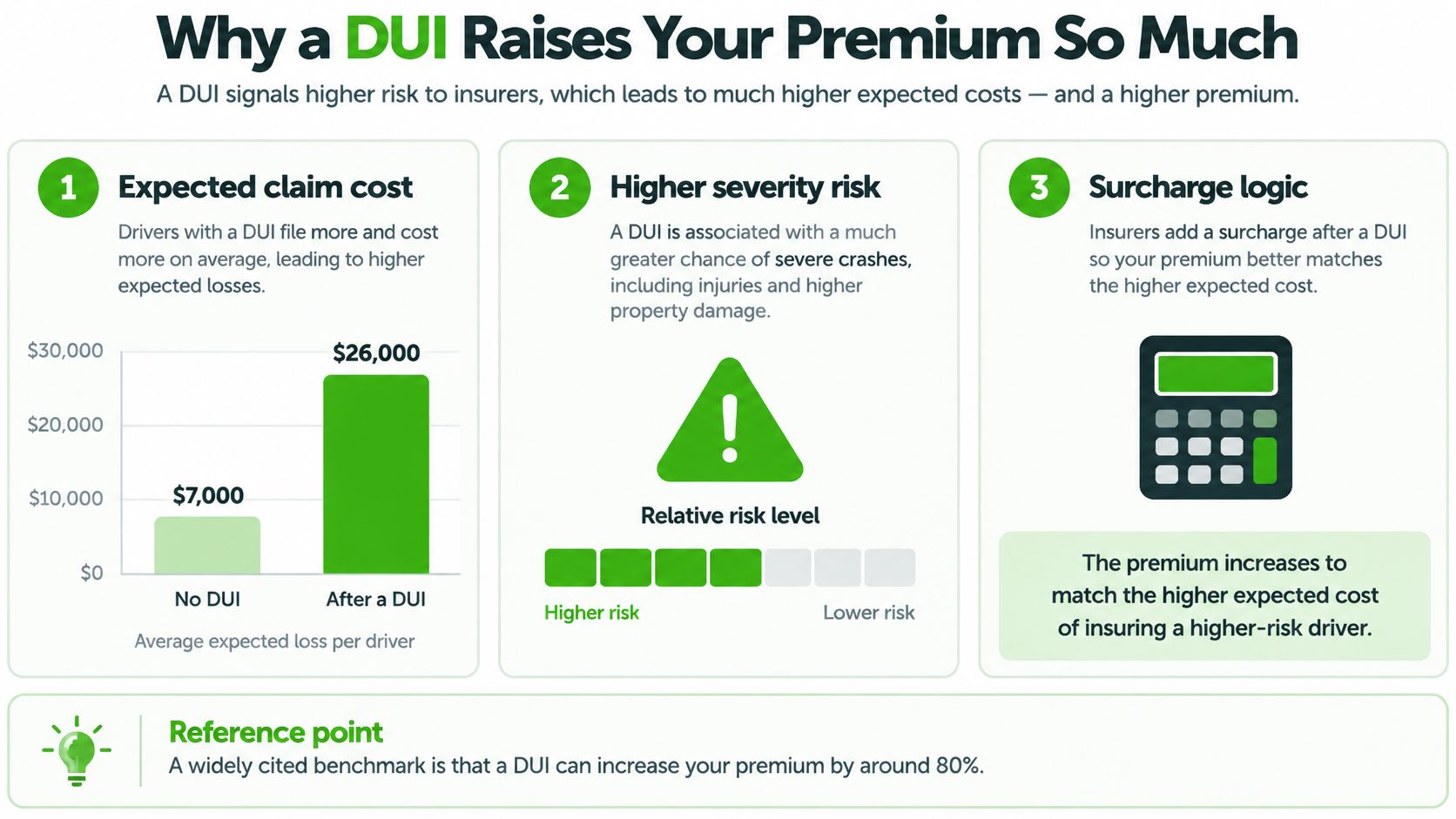
Insurers price the claims they expect to pay. A DUI signals a greater chance of a serious loss, so the resulting premium reflects more than the administrative work of filing a certificate.
A consumer-insurance estimate cited by GoAuto's high-risk insurance guide puts the average full-coverage increase after a DUI at approximately 90%, with an estimated annual cost of about $4,469 for the affected driver profile. That's an illustrative market estimate, not a Georgia quote.
Why the surcharge isn't the same for everyone
The relationship between impaired-driving history and future risk isn't just an insurance label. NHTSA's impaired-driving overview reports that, in 2021, 7% of drivers in fatal crashes with blood alcohol concentrations of at least 0.08 g/dL had a DWI conviction within the preceding five years, compared with 2% of sober drivers.
That finding doesn't predict what any individual driver will do. It helps explain why insurers take a prior conviction seriously when assessing potential losses.
Your actual price reflects several factors:
- State rules: Insurance regulation and financial-responsibility requirements affect available coverage.
- Carrier eligibility: Some insurers accept recent DUI convictions; others won't offer coverage.
- Coverage selection: Liability limits, collision coverage, and deductibles change the quote.
- Driving history: Previous claims and additional violations can worsen the insurer's assessment.
- Offense age: A recent conviction may receive different treatment from an older one.
- Policy continuity: A coverage gap can create another underwriting concern.
A carrier's willingness to insure you may matter more than a small advertised discount. If your current insurer won't renew, you're comparing different underwriting markets, not merely negotiating a surcharge.
Separate filing costs from insurance costs
The SR-22 filing fee is generally small compared with the premium increase associated with the underlying violation. Don't assume that removing a filing charge would remove the DUI-related increase.
Ask the agent to identify the DUI surcharge on the quote, rating breakdown, or declarations documents where available. Ask whether any separate filing charge applies, whether it recurs, and whether the insurer is charging for the conviction, the filing, or both.
Then request matching coverage from at least three carriers. That's a shopping method, not a guarantee of savings. A lower quote with weaker limits or an unconfirmed filing isn't an equivalent offer.
A Worked Example of a First DUI Year
Say an Atlanta driver with a previously clean record receives a first DUI conviction. The immediate temptation is to compare the old monthly payment with the new one, but an annual budget makes the consequences easier to understand.
For a national reference point, Insurify's 2024 comparison reported average annual full-coverage premiums of $2,532 for clean-record drivers and $4,176 for drivers with a DUI, a difference of $1,644. Holding that difference constant across a hypothetical three-year budget produces $4,932 in additional premiums, calculated from those averages, before filing charges, reinstatement costs, and required programs.
Build a budget, not a prediction
That calculation isn't a forecast for an Atlanta address. It assumes the annual difference stays unchanged, although insurers can change prices at renewal and your eligibility can improve or worsen.
Use your actual quotes to replace the national averages. Keep the vehicle, drivers, liability limits, deductibles, and optional coverages consistent so that you aren't comparing different policies.
Georgia minimum liability limits after a DUI conviction
| Conviction | Bodily injury per person | Bodily injury per accident | Property damage |
|---|---|---|---|
| First DUI conviction | $50,000 | $100,000 | Confirm the applicable requirement with DDS and the insurer |
| Second or later DUI conviction | $100,000 | $300,000 | $100,000 |
These are the DUI reinstatement limits specified in Georgia's reinstatement requirements, not a definition of full coverage. The first-conviction property-damage cell deliberately doesn't borrow a figure from another state or assume that the bodily-injury requirement answers that separate question.
Adapt the calculation to your circumstances
Write down the proposed annual premium, subtract your comparable pre-conviction premium, and use the difference to estimate your added insurance expense. Keep the reinstatement fee and program charges separate so you can see which costs recur.
- Insurance budget: Include the premium, filing charges, and installment fees.
- Reinstatement budget: Include the applicable DDS fee and required documentation costs.
- Program budget: Include the assessment and intervention course, plus any separately ordered services.
- Contingency: Allow room for renewal changes rather than assuming your first quote will last indefinitely.
A first-year budget should answer both questions: what must you pay to become eligible, and what must you keep paying to stay compliant?
A later conviction can change both the coverage requirement and the suspension process. Don't reuse a first-offense worksheet without checking your new DDS requirements. The course charge also belongs in your reinstatement budget, not hidden inside an estimated insurance total.
Whether Premiums Fall and What Actually Lowers Them
Headline premiums can fall while drivers with a DUI pay more. A national average describes a broad population, not the offer an insurer will make to someone with a recent conviction.
A KXAN report on auto-insurance pricing described average full-coverage premiums falling 6% nationally in 2025 to $2,144, while separate profile-based findings showed DUI-driver premiums rising 35% between the first and second halves of 2025 to $4,461. The report also described 14% growth in minimum-coverage premiums and, from January 2023 to January 2026, national insurance-cost growth of 32.3%, compared with 13% growth in per-capita personal income, with a $1,183 increase for DUI drivers over that period.
Don't confuse a cheaper payment with a cheaper policy
Those figures come from different measures and periods. They shouldn't be combined into a personal forecast or treated as proof that your next renewal will rise by a particular amount.
They do expose a practical problem: cutting coverage doesn't automatically solve affordability. You still need to satisfy DDS requirements, and a smaller monthly payment may reflect a larger initial payment or a different payment schedule.
Compare the written annual total, not just the amount highlighted on the quote screen. Ask what happens if an automatic payment fails and how much notice you'll receive before cancellation.
Improve the factors you can control
There isn't a reliable shortcut that erases a DUI from underwriting. A workable strategy combines compliance with careful shopping:
- Keep coverage continuous: Set payment reminders and monitor the account used for automatic withdrawals.
- Meet the required limits: Don't accept an underinsured quote just because it fits this month's budget.
- Shop with the filing requirement disclosed: Let each carrier price the policy it can issue.
- Request a fresh review: Ask when the conviction's age may change your eligibility under that insurer's rules.
- Document completed requirements: Retain education, treatment, and other required completion records without assuming they guarantee a discount.
- Compare annual totals: Include filing and payment-plan charges, not only the base premium.
The guide to lowering insurance premiums offers additional preparation for those discussions. Ask your insurer whether a defensive-driving discount is available before purchasing an optional class.
If you're also replacing your car, evaluate the combined vehicle and insurance budget. Fintrack's guide to affordable car buying provides a useful framework for considering affordability alongside the loan payment.
Judge each quote by total annual cost and lapse risk, not the lowest first price. A payment arrangement you can maintain is more useful than a bargain you can't keep active.
Georgia Reinstatement Sequence and Course Booking
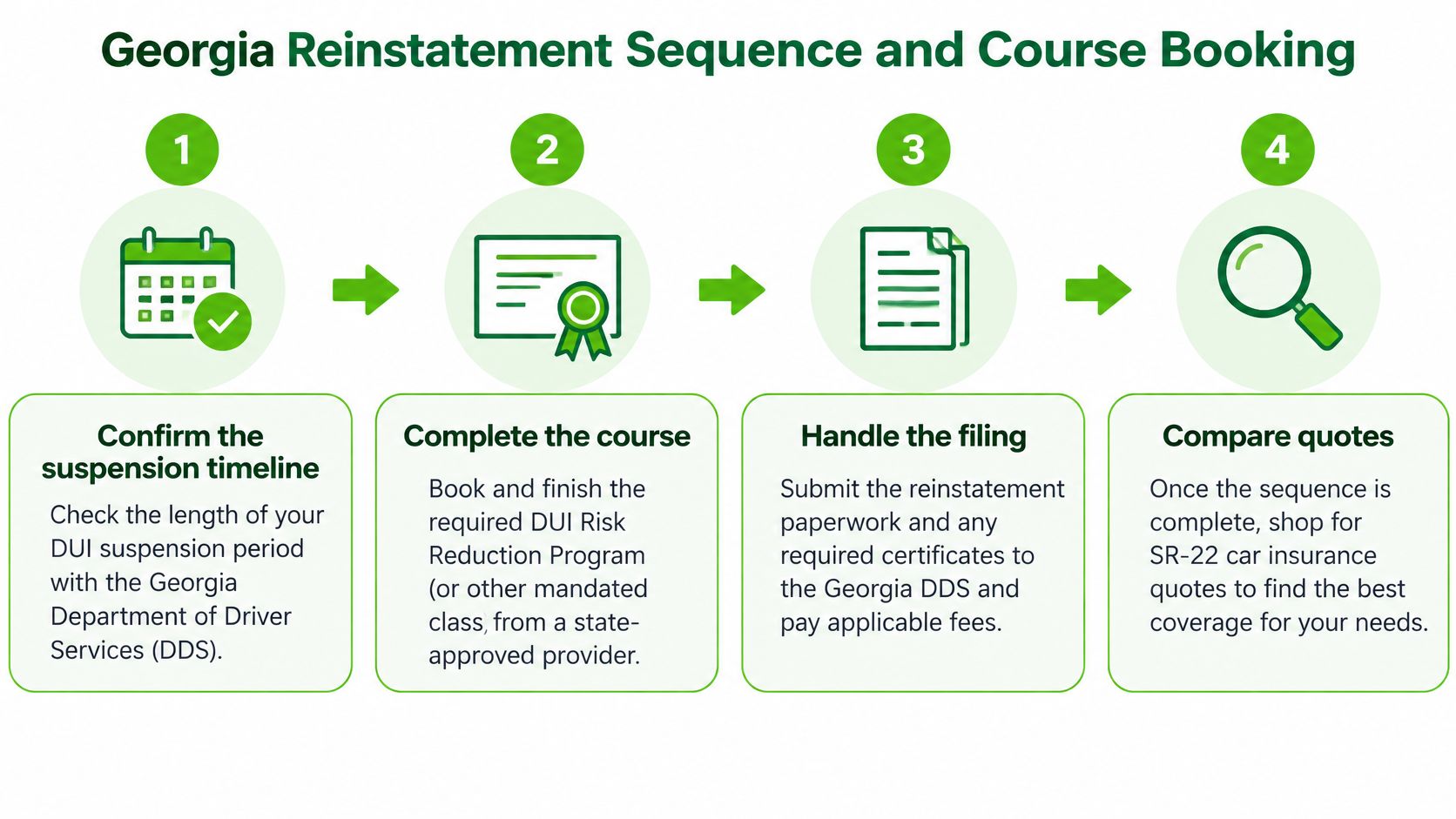
Georgia reinstatement requires coordinated steps. Confirm your course, filing, coverage, and payment requirements before treating an insurance quote as the solution. You can gather preliminary prices early, but don't confuse a quote, an active policy, and restored driving privileges.
The Georgia DDS first-DUI reinstatement guidance says eligible drivers may seek reinstatement after 120 days when the required conditions are met, and lists a first-offense reinstatement fee of $200 by mail or $210 in person. Confirm your case-specific eligibility date and current payment instructions directly with DDS.
Complete the requirements in a workable order
Confirm the suspension timeline. Obtain your DDS requirements and compare them with your court paperwork. Don't shop as though your license is already valid, and don't assume finishing a course ends a suspension.
Complete the assessment before the intervention course. The Georgia DDS DUI program FAQs describe a 130-question NEEDS Assessment and a 20-hour intervention course, both required before a completion certificate is issued. Our assessment takes 25 to 45 minutes and must be completed before class. The common mistake is booking instruction first and overlooking the assessment appointment.
Arrange the insurer filing. Give the insurer your exact DDS requirement and conviction information, then obtain written submission confirmation. Verify the required start and end dates rather than assuming the policy's renewal date determines the filing period. Buying coverage without arranging the certificate can leave the administrative requirement unresolved.
Confirm the liability limits in writing. Have the agent match the policy to your conviction-specific requirements and check property-damage coverage separately. A quote described as state minimum coverage doesn't, by itself, establish that it meets your DUI reinstatement obligation.
Pay the required reinstatement fee and verify status. Keep the receipt and follow DDS submission instructions. Don't drive merely because the payment cleared or the insurer issued a card. Confirm that DDS shows your driving privilege as reinstated or that you hold the appropriate valid permit.
Complete your carrier comparison without creating a gap. Once the requirements are settled, compare matching offers from at least three carriers. If you already activated compliant coverage to satisfy the filing requirement, coordinate any replacement before canceling it.
Choose an accepted course format and keep a complete file
Georgia DDS doesn't accept self-paced online DUI/Risk Reduction certificates for license reinstatement or court purposes. Don't confuse a self-paced course with instructor-led virtual instruction. Select an accepted format for your specific requirement.
We help drivers in Atlanta and Athens complete the required Risk Reduction process. Our DUI/Risk Reduction Program costs $360, which belongs in your budget alongside insurance and reinstatement expenses; separately required clinical services should be budgeted separately.
Use the Georgia license-reinstatement checklist to organize your paperwork. Keep the completion certificate, insurer filing confirmation, coverage records, and fee receipt throughout the required compliance period.
Before you drive: Verify your license status with DDS. A course certificate and insurance card aren't permission to ignore a suspension.
Georgia DUI Schools offers DUI/Risk Reduction education to help you complete the course requirement while coordinating your insurance and reinstatement paperwork. Visit Georgia DUI Schools for program information, then book your DUI/Risk Reduction course and arrange your assessment before class.