A suspension end date has passed, your commute still depends on a car, and you think you're cleared to drive. Then a traffic stop reveals that DDS hasn't restored your driving privileges. In Georgia, the date on the notice and the date you can legally drive again may not be the same.
Driving on a suspended license can turn an unresolved administrative issue into a new charge. The safest next step isn't to guess based on a calendar or a payment receipt. Check what DDS says about your individual record, then confirm that reinstatement has been processed.
Why Waiting Out a Suspension Is Not Enough
Say your suspension notice lists an end date, and that date has passed. You drive to work, get stopped, and learn that your license still isn't active. The confusion is understandable, but a suspension doesn't necessarily lift itself when the calendar runs out.
Georgia DDS defines a suspension as a temporary withdrawal of all driving privileges for a specified period or until required conditions are completed. Waiting out the suspension doesn't automatically restore your license. You must apply for reinstatement and meet the requirements attached to your specific record, which can depend on the suspension type, conviction, and prior history. The Georgia DDS reinstatement guidance directs drivers to check their individual status and requirements through DDS online services.
Three dates that are easy to confuse
The first date is the end of the withdrawal period. It tells you that the time portion of the suspension may be over, not that you can drive.
The second is the date you become eligible to apply for reinstatement. You might reach this point only after completing required conditions, such as resolving a fee or satisfying a course requirement.
The third is the date DDS processes reinstatement and returns your driving privileges. That's the date that matters before you get behind the wheel.
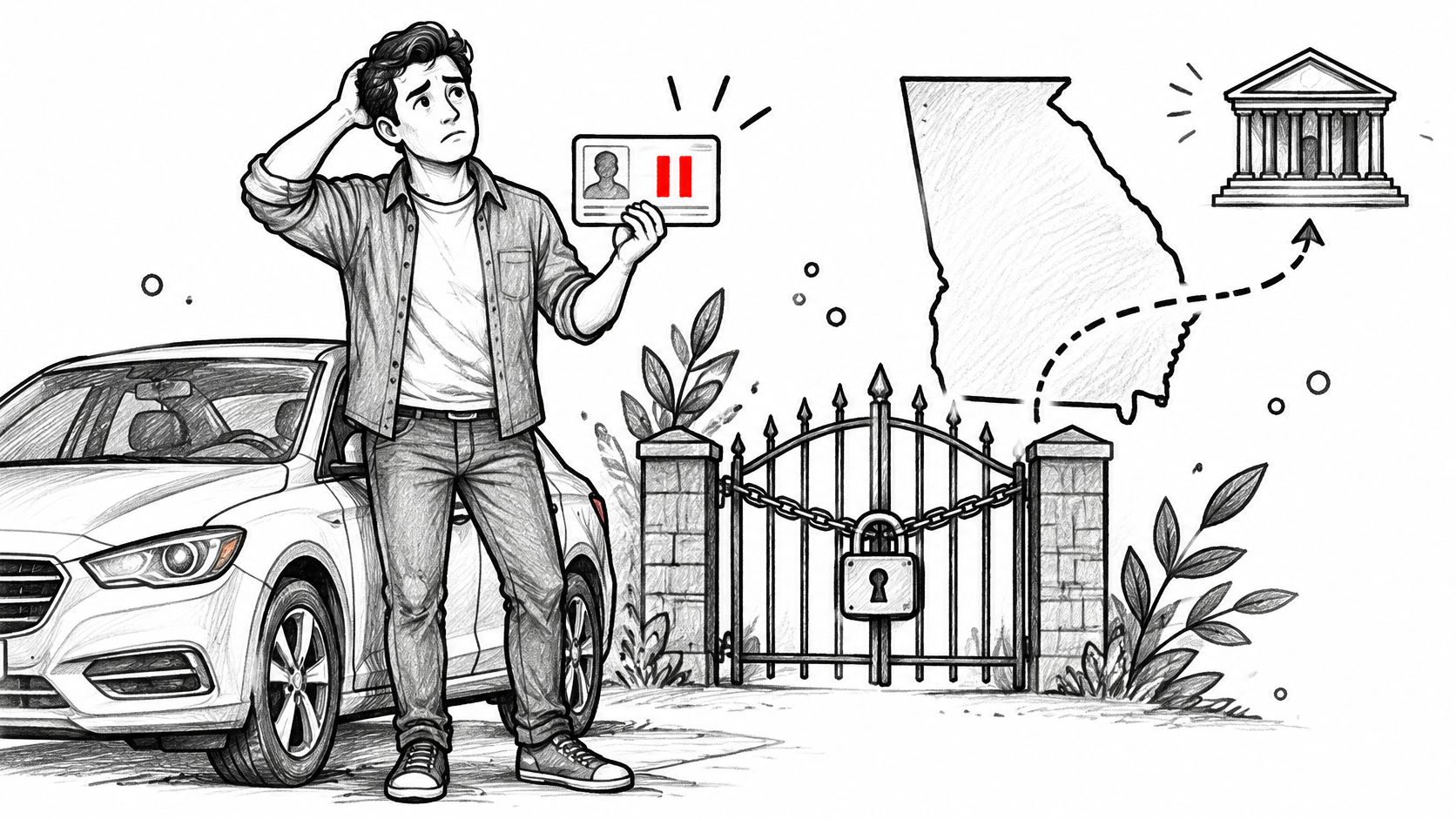
Think of a suspension as a locked gate with a timer on the lock. The timer may stop, but the gate won't open until you complete the required steps and DDS processes them.
Check the record, not just the calendar
Use DDS Online Services or the DDS 2 GO app to find your status and individualized checklist. Don't assume a generic list, a course certificate, or proof of payment answers every question on your record.
Before driving, confirm three things: your status shows active, every listed condition is closed, and reinstatement is shown as processed. If any of those checks is unclear, contact DDS before operating a vehicle.
Penalties for Driving While Suspended in Georgia
A driver whose license was suspended after a DUI takes a five-minute trip to a job interview. If an officer stops that driver, the interview stops mattering. Georgia charges driving while suspended as its own offense, with its own court date, its own fine, and its own addition to the suspension the driver was already serving. The trip does not pause the clock. It adds to it.
A suspension works like a parking meter that only stops running when you feed it lawfully. Driving during the suspension keeps the meter running and, on a conviction, adds a fresh interval you still have to serve. That is why the date you become eligible for reinstatement and the date DDS shows reinstatement as processed can drift further apart after one unauthorized trip.
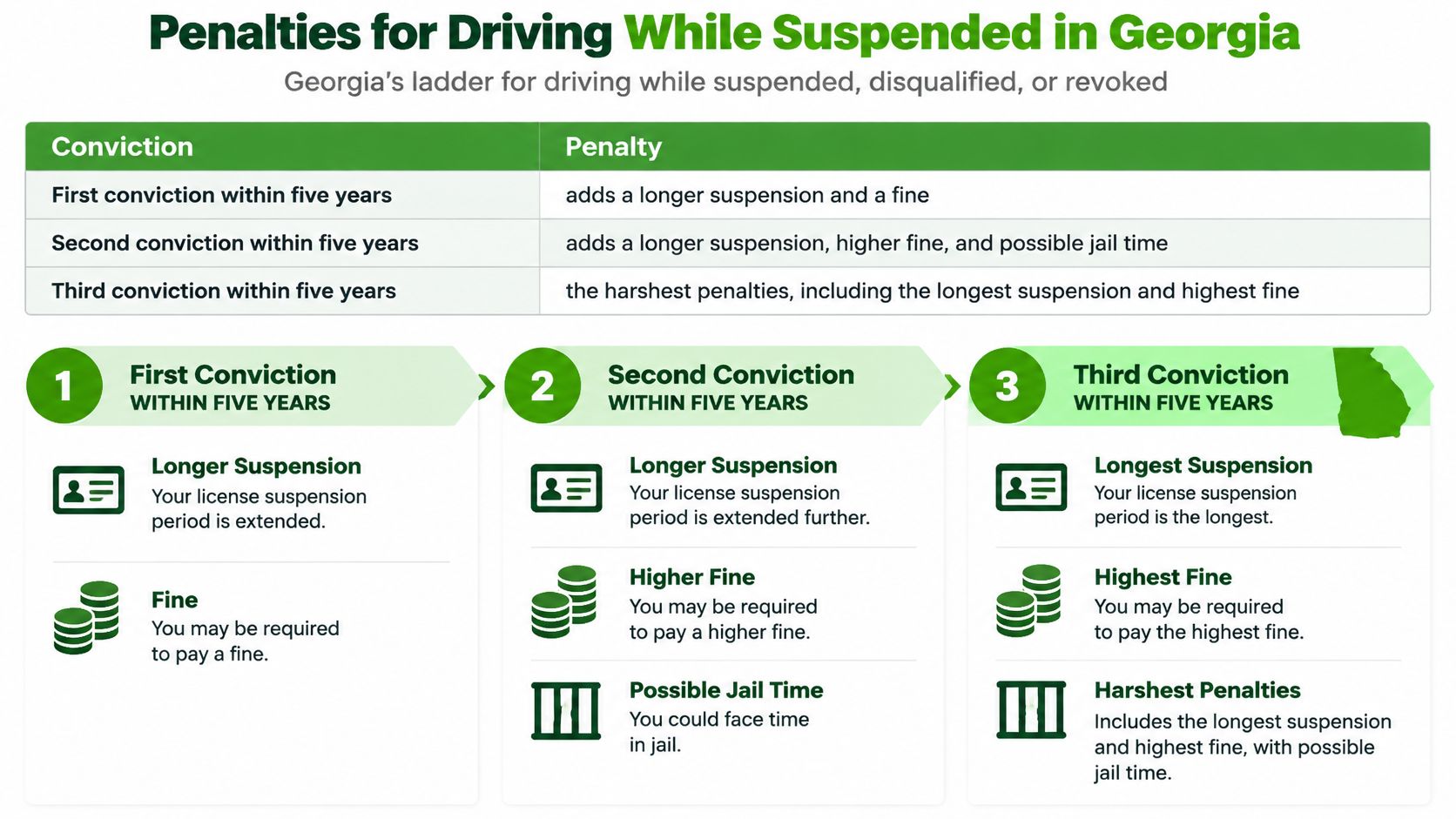
Georgia escalates the consequences by counting convictions within a five-year window.
| Conviction within five years | Classification | Added licensing consequence |
|---|---|---|
| First | Administrative consequence | Six-month suspension or disqualification, plus a reinstatement fee |
| Second or third | High and aggravated misdemeanor | Six-month suspension or disqualification |
| Fourth or later | Felony | Six-month suspension or disqualification |
How the penalty ladder works
Read the table from the top down and the pattern is plain: the licensing consequence stays fixed while the criminal exposure grows. The added suspension is separate from the suspension you were already serving, so the two run in sequence rather than overlapping. A conviction that lands near the end of an original suspension can put you back at the start of a new one, with another reinstatement fee due on the back end.
A second or third conviction within five years is charged as a high and aggravated misdemeanor. The court can impose jail time and a fine, and the range it works from is higher than the one available on a first offense. A fourth or later conviction is a felony, meaning prison exposure measured in years and a fine set at a corresponding level.
The judge decides where inside that range a particular case falls. What the court weighs includes the reason for the original suspension, how the driver came to be stopped, and the record in front of the judge that day.
The gap most drivers misread is the one between the criminal case and the licensing case. Paying a fine closes the court file, not the DDS record. Until DDS processes reinstatement, the suspension is still live, and the next stop produces the next charge.
Limited Driving Permits and Everyday Trips
A full suspension means you can't drive. A limited driving permit is a narrow exception only when DDS makes one available for your particular situation. It can restrict both the purpose of a trip and its destination, so needing to get somewhere doesn't by itself make the drive lawful.
| Trip | What to verify under a permit |
|---|---|
| Commute to work | Permit availability, listed purpose, route, and hours |
| School or training | Whether the permit names the school and route |
| Medical appointment | Whether the permit covers medical travel |
| Child care drop-off | Whether the permit lists the purpose and destinations |
| Court or probation visit | Whether the court order and permit both allow the trip |
| Treatment program attendance | Whether the program location is on the permit |
The DDS guidance on violations and suspensions emphasizes that permit eligibility and conditions vary. That means “I'm only driving to work” isn't enough. You need a permit that authorizes that purpose and the relevant destination, route, and hours.
Consider a home health aide whose permit allows travel for work to listed locations. If a road closure sends the driver on a detour outside the permitted route, the original work purpose may not resolve the problem. The permit's specific wording matters.
Before starting the car: Confirm that a permit is available for your suspension, get its permitted purposes and destinations in writing, and carry it while driving. Follow any listed hours or route limits, and remember that a permit isn't the same as full reinstatement.
If you're checking whether a restricted license or ignition interlock conditions apply, review the details of a restricted license and ignition interlock. Don't treat a permit as general permission to drive. That assumption can lead to a new charge.
What Causes Suspensions and What Clears Them
| Cause | Typical trigger | What clears it | Trap to avoid |
|---|---|---|---|
| DUI conviction | Impairment by alcohol, drugs, or both | DDS-approved DUI Risk Reduction certificate and reinstatement fee | A generic defensive-driving class doesn't count |
| Points accumulation | Repeated moving violations | Reinstatement fee set by DDS | Fees rise for repeated points-related suspensions |
| Super Speeder assessment | Unpaid $200 assessment | Payment within 120 days | Nonpayment adds a $50 reinstatement fee |
| No proof of insurance | Missing or lapsed coverage | Reinstatement fee and insurance-related requirements | The fee is separate from other suspensions |
| Non-driving conduct | Unpaid fines, missed child support, or a drug offense | Resolve the underlying obligation with the court or agency | Driving while still suspended is a new offense |
The DDS reinstatement-fee information explains that Georgia has separate reinstatement fees for DUI, insurance, and points-related suspensions. It also describes fee stacking: more than one suspension or conviction can create more than one outstanding condition, and partial payments aren't accepted.
One notice can become a licensing problem
A Super Speeder assessment is a useful example of how a suspension can begin without a new traffic stop. DDS gives the driver 120 days to pay the $200 assessment. If it isn't paid, the license can be suspended and a separate $50 reinstatement fee added.
Say a driver pays an old court fine but misses a mailed Super Speeder notice. The driver may believe the original matter is resolved, yet the unpaid assessment can still create a new barrier to reinstatement. Insurance-related requirements and points suspensions can add further conditions to the same record.
Courts report convictions to DDS, and reporting delays can also leave a suspension active after a driver believes a case is finished. For a closer look at how points can affect driving privileges, review the Georgia driver's license points system.
Don't assume that one payment, court appearance, or course clears everything. Check the DDS record for each open item and confirm that the court or other agency has reported the required resolution.
How to Reinstate a Suspended License in Georgia
A suspension end date can pass while conditions remain open, which is why DDS processing, not the calendar, marks the finish line. Your DDS record works like an itemized repair estimate: it names each condition that must be cleared before the state will restore your driving privilege. Start there instead of with a general checklist.
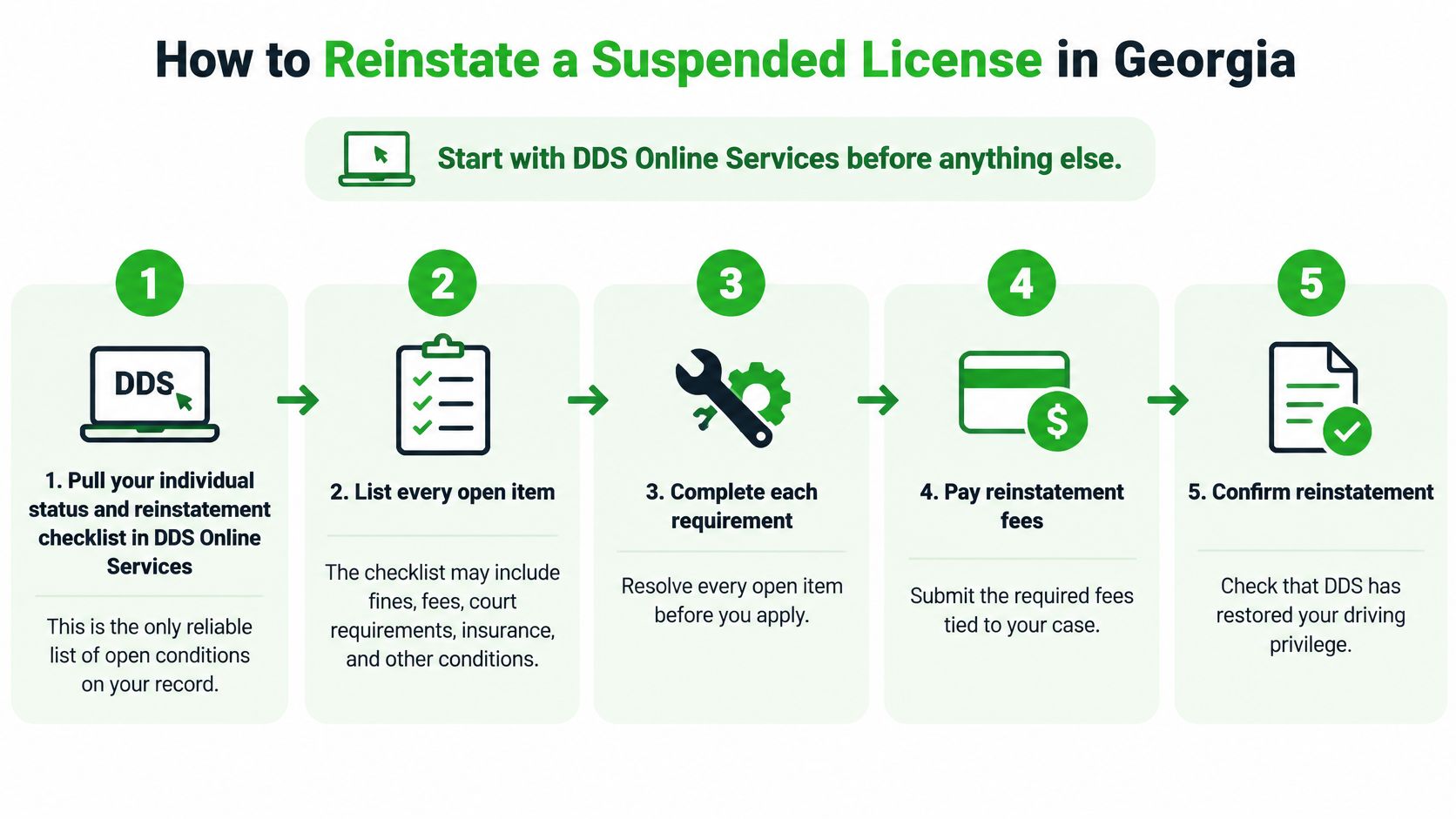
Pull your status and requirements. Sign in to DDS Online Services and review the reinstatement conditions attached to your record. The personal record matters because two drivers with the same conviction can have different open items.
Write down every open item. List fees, Super Speeder assessments, insurance requirements, court reporting, education, and treatment. If a court ordered a clinical evaluation or Victim Impact Panel, confirm that the completion has been reported.
Complete each requirement on the list. For a DUI matter, confirm that the program is the one DDS accepts. Keep copies of certificates, evaluation paperwork, and court receipts.
Pay each fee in full. DDS does not accept partial payments, and more than one suspension can create more than one amount due. Check the itemized total on your record before you pay.
Apply, then verify. For a first DUI suspension involving a driver age 21 or older, the DDS first-DUI guidance describes a 12-month suspension. It allows an application for reinstatement after 120 days if all conditions are met, including completion of a DDS-approved DUI Alcohol or Drug Use Risk Reduction Program and payment of the applicable reinstatement fee.
The length of a DUI suspension depends on your history and the offense, so the dates on your DDS record control the timeline. A generic defensive-driving class does not replace the required DUI program. Completing a course alone does not restore driving authority. DDS must process the documentation, payment, and any other open requirement before the privilege is restored.
If a DUI suspension requires the Risk Reduction program, review the steps for suspended-license reinstatement and compare the course requirement with your DDS checklist. Georgia DUI Schools issues an official Certificate of Completion only after both DUI components are finished. Georgia DDS does not accept certificates from self-paced online DUI/Risk Reduction programs for reinstatement or court purposes.
Do not drive until DDS shows reinstatement as processed and your license as active. A certificate or receipt proves you finished a step. It does not prove the state has restored your driving privilege.
Court Options After a Driving on Suspended Charge
Start with the citation and the court date printed on it. A driving-while-suspended charge is handled by the court identified in your paperwork, and missing the date can create another problem. Compare the charge with your DDS record so you and your attorney can identify any mismatch in the status or dates.
Before deciding how to respond, speak with a Georgia attorney about the charge and your options. Depending on the case, you may need to appear and enter a plea, discuss a resolution with the prosecutor, or ask the court what conditions it can impose. Whether an alternative program is available depends on the circumstances and the judge.
If you're trying to understand how a hearing is organized, this overview of case management hearing procedures can help you prepare questions about scheduling and case steps. It isn't a substitute for advice about your particular charge.
Keep records of every court-ordered item, including payment receipts, clinical evaluation results, Victim Impact Panel certificates, and fee receipts. Ask whether the court has reported the disposition to DDS, and confirm the status with DDS as well. A court resolution and a restored driving privilege are separate things to verify. Court procedures vary by county, so check the process with the clerk handling your case.
Habitual Violator Status and Repeat Offenses
Repeated convictions can trigger a separate licensing track. Georgia DDS materials say a driver may be declared a Habitual Violator after a third conviction within five years for any combination of listed offenses, including DUI. Once the driver receives notice that the license has been revoked as a habitual violator, driving is unlawful unless the driver has obtained a valid license or qualifies for a specific exception, as described in the DDS habitual-violator materials.
Consider a driver with two prior DUI-related convictions who receives a third conviction for an offense that seems minor by comparison. The history can still matter to habitual-violator review. The risk comes from the combined record, not only from how serious the latest incident feels.
Treat the notice as a stop sign
If a habitual-violator notice arrives, don't drive while you try to sort it out. Gather the notice and conviction records, check your status through DDS Online Services, and speak with a Georgia attorney before applying for anything. That gives you a clearer picture of what the notice says and which legal steps may apply.
Repeat DUI cases can also involve additional requirements, such as counseling, rehabilitation measures, a clinical evaluation, or a Victim Impact Panel. Check the court's orders and the DDS record rather than assuming that completing one requirement resolves the whole matter.
After a new conviction, confirm which status DDS has recorded. If you receive a revocation notice, don't treat an application, appointment, or partial completion as permission to drive. Wait until you have confirmed that your license is valid or that a specific legal exception applies.
Start Your DUI Risk Reduction Course
Choose a course only after you know what your record requires. First, check DDS Online Services to see whether your license shows as suspended, eligible for reinstatement, or reinstated. Then gather the court order and confirm whether you also need a clinical evaluation or another court-ordered service.
Select a DDS-approved DUI Alcohol or Drug Use Risk Reduction program that matches your suspension. Georgia DUI Schools' 20-hour intervention course can't be completed in one day; it's commonly scheduled across a weekend or several evenings. The course certificate is issued after both DUI components are successfully completed, and self-paced online DUI/Risk Reduction certificates aren't accepted by DDS for reinstatement or court purposes.
If you're comparing formats and scheduling, this guide to DUI courses for busy learners can help you consider what to ask before enrolling. Georgia DUI Schools' Defensive Driving courses are separate from the DUI Risk Reduction program and are available in self-paced online, live virtual Zoom, and instructor-led classroom formats. Confirm which requirement applies to your case before choosing.
Once you've checked your status and identified the right program, enroll in the Georgia DUI course.
Georgia DUI Schools offers Georgia DDS-approved DUI/Risk Reduction education, along with clinical services and Victim Impact Panels for drivers working through court or reinstatement requirements. Check your DDS record first, then visit Georgia DUI Schools to choose the service that matches your next required step.