
A lot of people looking for DUI school in Pooler, GA are in the same place emotionally. You got charged in Chatham County or nearby, your license situation is suddenly unclear, and every website seems to say something slightly different. One page says “online.” Another says “virtual.” A court clerk mentions one requirement, while DDS seems to want something else.
That confusion is normal. Georgia's process is strict, but it isn't random. If you understand the order of the steps and choose a valid program, you can avoid delays, wasted money, and the bigger mistake of taking a course DDS won't accept.
The key is knowing that “DUI school” in Georgia usually means the DUI Alcohol or Drug Use Risk Reduction Program, often called the Risk Reduction Program or RRP. If your goal is license reinstatement, court compliance, or both, that's the program you need to focus on.
Your First Step After a DUI in Pooler GA
The first hard moment usually isn't court. It's the day after, when you start trying to figure out what has to be done.
A Pooler driver might leave court with paperwork in hand, search “dui school pooler ga,” and get hit with a mix of local offices, Zoom classes, self-paced offers, and legal terms that all sound similar. Then the questions start. Do you need a class first? An assessment first? Does a weekend course count? Does the certificate go to the court or DDS?
The first answer is simple. In Georgia, the required program for many DUI and drug-related cases is the state-certified Risk Reduction Program. It's the formal path tied to reinstatement and court compliance, not just a general education class. If you're sorting out your next move, this guide to Georgia license reinstatement after a DUI helps connect the course requirement to the bigger DDS process.
What usually throws people off
The stress comes from mixing up separate requirements. A person may hear about a clinical evaluation, a victim impact panel, probation terms, or defensive driving and assume they're all the same thing. They aren't.
For many Pooler-area drivers, the urgent issue is making sure they complete the correct DDS-recognized DUI course path first, in the right order, through the right provider.
Practical rule: Don't enroll based on the word “online” alone. Start by asking whether the program is accepted by Georgia DDS for license reinstatement.
What you need to remember right now
- The process is manageable: It feels bureaucratic at first, but it becomes much clearer once you separate court terms from DDS terms.
- The program is specific: Georgia doesn't let you substitute a random alcohol class for the Risk Reduction Program.
- Provider choice matters: A valid provider and a valid format can save you from having to do the course again.
If you're in Pooler, Savannah, Garden City, Port Wentworth, or the surrounding area, the smartest first move is to slow down and confirm exactly what Georgia law requires before paying for anything.
What Georgia Law Requires for DUI Education
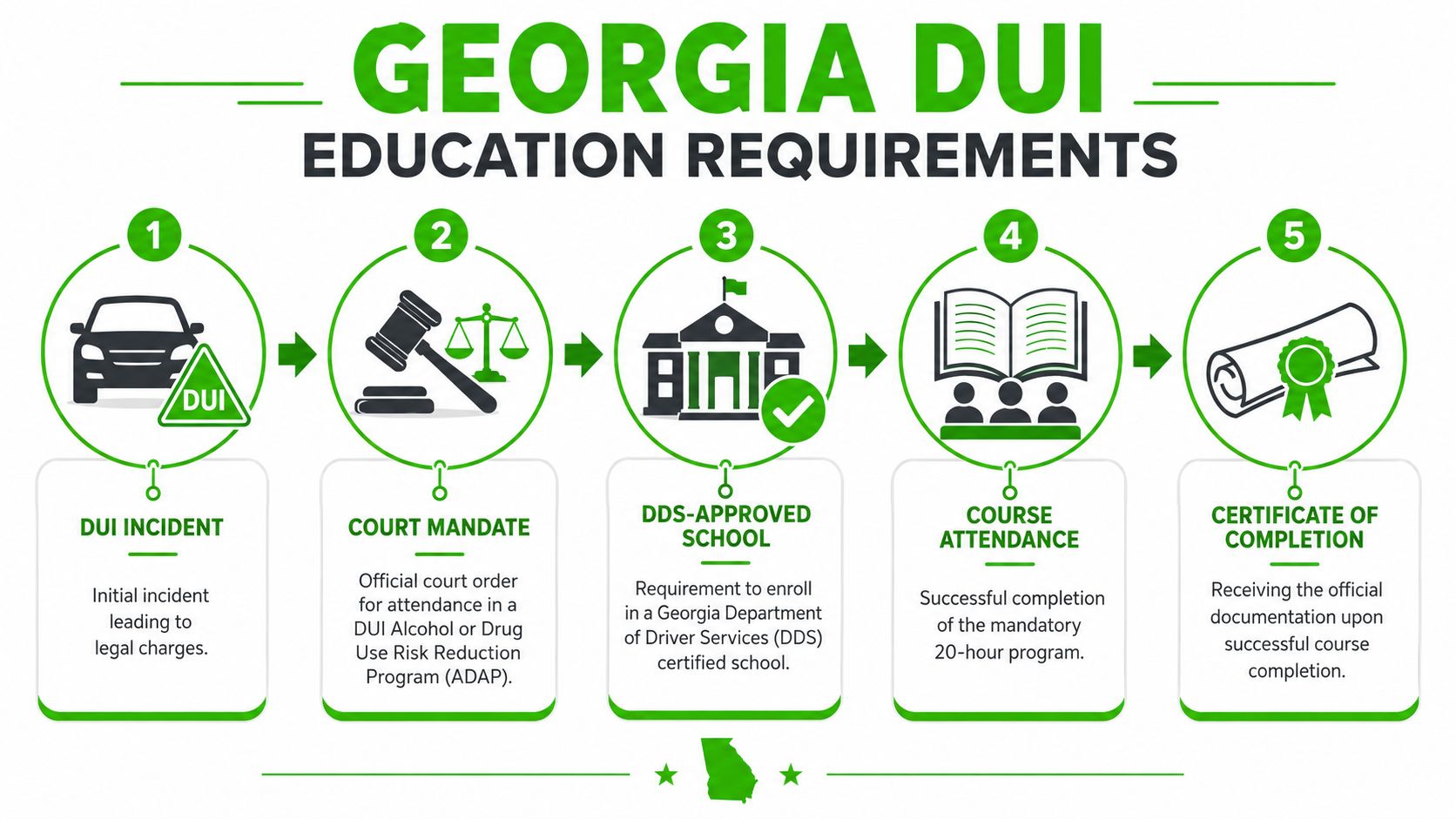
Georgia uses a specific two-part structure for DUI education. It isn't optional, and it isn't flexible in the way many people expect.
The formal requirement is the Georgia DUI Alcohol or Drug Use Risk Reduction Program. According to the Georgia DDS regulated Risk Reduction Program rules, participants must first complete a 130-question clinical screening assessment called the NEEDS or GAPS assessment, and only after that can they take the 20-hour intervention course. The same DDS source states that the total program cost is fixed by law at $360.00, made up of a $100.00 assessment fee, a $235.00 intervention fee, and a $25.00 workbook fee.
The two parts people often confuse
The assessment comes first. It isn't a pass-or-fail exam. It's a screening tool used before the class.
Then comes the intervention course. That's the classroom portion many people mean when they say “DUI school.”
If you want a plain-language breakdown of how that program works, this overview of what the Georgia Risk Reduction course is can help make the terminology less intimidating.
What the fixed fee covers
Here's the cost structure Georgia sets statewide, using the DDS figures above:
| Program piece | State-set cost |
|---|---|
| Assessment | $100.00 |
| Intervention course | $235.00 |
| Workbook | $25.00 |
| Total | $360.00 |
That matters because it helps you spot a problem early. If a school is advertising a much cheaper “DUI class” for reinstatement, that should make you pause and verify whether it's the actual DDS-approved program.
Why DDS certification matters so much
A school must be DDS-certified for the course to count. That's the compliance line that many stressed drivers miss when they're trying to sign up quickly.
A course can sound right, look professional, and still be the wrong program for Georgia reinstatement if the provider or format isn't approved.
Some people also discover that their DUI case is pointing to a deeper alcohol issue than they first realized. If that's part of your situation, a practical resource on managing alcohol withdrawal symptoms can help you understand what requires medical attention while you work through the legal side.
The plain-English version
- You need the assessment before the class
- You need the official state program, not a substitute
- You pay the state-set total of $360.00
- You need a DDS-certified provider
Once you know those four points, the process gets a lot easier to manage.
Finding a Certified DUI School Near Pooler
Once you know what program you need, the next question is where to take it without making a costly mistake.
For someone in Pooler, that usually means choosing between a local classroom option and a live virtual class offered by a provider serving the Savannah metro area. What matters most is not the marketing language. It's whether the school is operating under Georgia DDS certification.

Local Pooler example
A local reference point helps. According to this listing of Pooler DUI school options, 1 Stop Driving and DUI is identified as a certified provider at 111 US Hwy 80 SE, Pooler, GA 31322. The same source notes that Pooler residents may also access DDS-certified live virtual Zoom classes from providers in nearby Savannah.
That gives local drivers two realistic paths. You can attend in person in the Pooler area, or you can look at live virtual classes from a compliant provider serving the region.
How to verify before enrolling
Use a simple checklist before you register:
- Check DDS approval: Confirm the school appears on the Georgia DDS list or is clearly operating as a DDS-certified provider.
- Ask about format: “Live virtual” and “self-paced online” are not the same thing.
- Confirm the program name: You want the Georgia DUI Alcohol or Drug Use Risk Reduction Program, not a generic alcohol awareness course.
- Keep your court and DDS needs separate: A program that helps one part of your case may not satisfy the reinstatement side unless it's the correct certified course.
People dealing with both legal compliance and treatment questions sometimes need to think beyond the class itself. If you're sorting through that side too, this guide to understanding rehab program selection gives a useful framework for evaluating support options.
A practical Pooler-area mindset
If you live in Pooler, Bloomingdale, Rincon, or Savannah, convenience matters. But convenience should come after compliance.
A nearby option can be easier for attendance. A live virtual option can fit work or family demands better. Either can be valid. The safer move is to start with certified local and regional options, such as those listed through this page on Savannah-area driving schools and DUI classes, and verify details before paying.
The Enrollment and Course Completion Checklist
By the time you're ready to enroll, the biggest risk usually isn't unwillingness. It's missing a technical requirement.
A lot of delays happen because someone signs up for the class and assumes the assessment can wait until later. In Georgia, the order matters. The Barber's Driving School explanation of the Georgia RRP process states that the Assessment Component must be completed first and submitted at least 60 minutes before the 20-hour Intervention Component begins. That same source says missing that 60-minute deadline means you're excluded from the course.
What to have ready before enrollment
Keep your paperwork together before you start. That usually means your photo ID, any court paperwork you were given, and your schedule.
You also want a quiet window to complete the assessment carefully. Since it comes before the intervention class, treating it like an afterthought is one of the easiest ways to create a delay.
The simplest working checklist
- Register with a certified provider: Don't wait until the last minute if you need a specific weekend or evening session.
- Complete the assessment first: This is part of the required sequence, not a separate extra.
- Submit it on time: The deadline matters. Missing it can block you from entering class that day.
- Bring what the school asks for: That often includes identification and case-related paperwork.
- Show up ready for the full course commitment: Don't plan errands, work calls, or interruptions around class time.
If your class starts soon, treat the assessment deadline like a hard cutoff, not a suggestion.
What the class experience is usually like
The course is structured and instructor-led. You're not just clicking through screens. The point is education, reflection, and group-based learning around impaired driving and substance use.
Many students are worried the class will feel like public shaming. In practice, DDS-certified settings are usually much more straightforward than that. The environment is typically focused on completion, participation, and meeting state requirements.
Where people lose time
The common issues are practical:
| Problem | Result |
|---|---|
| Assessment not finished first | Enrollment gets delayed |
| Assessment submitted too late | You can be excluded from the class |
| Wrong program selected | Certificate may not help with reinstatement |
| Missing required documents | Check-in problems and avoidable stress |
If you want to get through DUI school in Pooler, GA with the fewest surprises, focus less on “finding any class fast” and more on getting the order right.
In-Person vs Live Virtual DUI Classes
A common mistake happens here. Someone in Pooler finds an "online DUI class," pays for it, finishes it on their own time, and later learns Georgia will not accept it for reinstatement. That mistake costs money, time, and often another delay in getting back on the road.
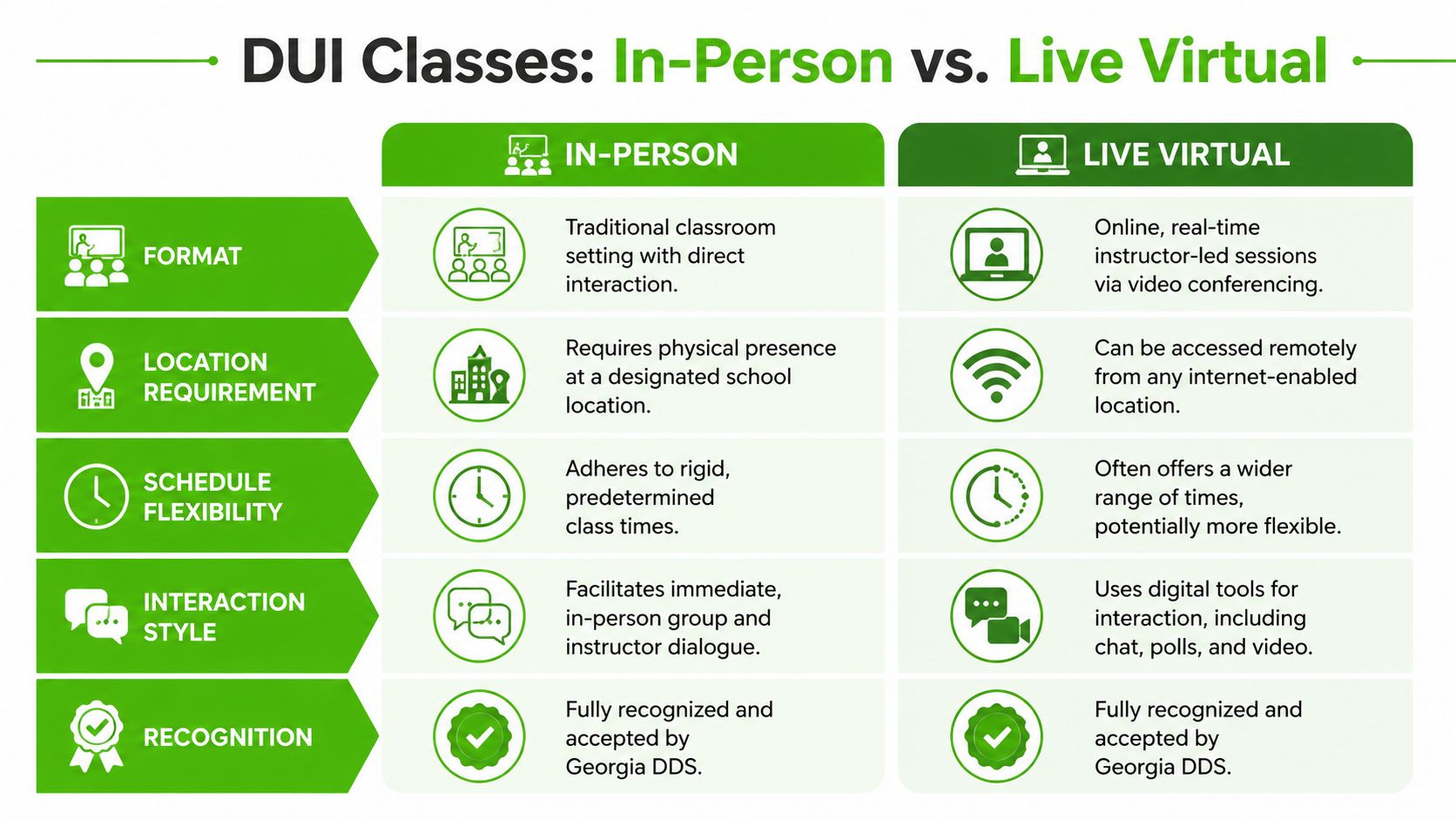
For Georgia purposes, the choice typically narrows to two valid formats: in-person and live virtual. Both can satisfy DDS rules if the school is approved and the class is run the way Georgia requires. The problem is that self-paced online courses are often advertised in a way that makes them sound interchangeable with live virtual classes. They are not the same thing.
What both valid formats have in common
Georgia requires a state-certified 20-hour DUI Alcohol or Drug Use Risk Reduction Program. DDS explains in its certified DUI school guidance that the course length is fixed, and it gives an example schedule spread across a weekend and an evening session.
That schedule tells you something important. This is a real-time class with required hours, not a course you finish whenever you have spare time. Whether you sit in a classroom or join from home, the school still has to deliver the same program under the same state rules.
A simple way to sort the options is this: live virtual means you attend class live, with an instructor, during set hours. Self-paced online means you log in whenever you want and work alone. For Georgia DUI school, those are very different products.
Comparing the two valid choices
| Format | Best fit for | Watch for |
|---|---|---|
| In-person | People who focus better in a classroom and want face-to-face instruction | Travel time, traffic, and getting to the school on time |
| Live virtual | People who need to avoid commuting or work around childcare and transportation issues | You must attend live, stay engaged, and meet the school's technology and attendance rules |
The option that causes the most confusion
Self-paced online courses create the most problems for Georgia drivers. They often sound easier because you can start and stop on your own schedule. But ease does not make them valid.
A live virtual DUI class works like a Zoom meeting with rules, attendance, and scheduled instruction. A self-paced course works more like an on-demand training module. That difference is exactly what trips people up.
If a website says you can log in anytime, finish at your own pace, or complete the program in pieces whenever convenient, pause before paying. Ask one direct question: "Is this a Georgia DDS-approved live instructor-led Risk Reduction Program, or is it a self-paced online course?" If the answer is vague, keep looking.
This same kind of licensing confusion shows up in other states too. For a separate example, see Reinstating a suspended license in Texas.
How Pooler residents usually choose
The best format depends on what helps you complete the class without attendance problems.
If driving to Savannah or another nearby location would create work or childcare issues, live virtual may be the better fit. If being at home makes it harder to stay focused, in-person may be the safer choice. The right answer is the format that matches your life while still meeting Georgia's rules.
Keep the goal simple. Choose a DDS-approved school, confirm the class is either in-person or live virtual, and avoid any course sold as self-paced online if you need it for Georgia compliance.
After Your Course Common Questions Answered
You finish the class, you get home, and then the stress changes shape. The question is no longer "How do I complete DUI school?" It becomes "What do I do now, and how do I avoid a mistake that slows down my license or court case?"
Start with the document that proves you completed the Georgia Risk Reduction Program. Once you finish the required parts, the school issues a Certificate of Completion. That certificate is the record you will use for the next step in your case.
What do you do with the certificate
Keep the certificate in a safe place and follow the instructions tied to your specific situation. You may need it for DDS reinstatement, for court, or as proof for your attorney or probation officer.
Do not assume every office already received what it needs. A good rule is to treat the certificate like a receipt after an important payment. Until the right person has it, your task may not be finished.
Can you replace the assessment with some other class
No.
This confuses many drivers because the names sound similar. In Georgia, the assessment and the class are separate parts of one state-required process. You cannot swap in a different course, a defensive driving class, or another program and expect DDS or the court to accept it. If your paperwork calls for Georgia DUI school, follow that wording closely and confirm the provider is giving the exact state-approved program.
What if you miss part of the class
Call the school right away.
Georgia Risk Reduction classes have attendance rules, so missed time can affect whether you are marked complete. The school can tell you what has to happen next. Waiting usually makes the problem harder to fix.
Is defensive driving the same as DUI school
No. They serve different legal purposes.
A defensive driving course may help with points or insurance issues in some cases. DUI school in Pooler, GA means the Georgia Risk Reduction Program for DUI, drug-related, or certain license reinstatement requirements. Some drivers also have separate items to finish, such as a victim impact panel or clinical evaluation. Read your court papers line by line and treat each requirement as its own task until your attorney or a qualified provider tells you otherwise.
One more warning matters here. If you completed a self-paced online course that was marketed as "Georgia DUI school," do not assume it will count. Georgia generally requires an approved in-person or live virtual instructor-led program for valid compliance. That is the mistake that causes many avoidable delays for Pooler residents. If anything about your completion paperwork seems unclear, ask the school to confirm that your course met Georgia DDS standards before you rely on it.
Drivers who have dealt with another state's system are often surprised by how different the rules can be. For comparison only, this article on Reinstating a suspended license in Texas shows how another state handles the process. Georgia cases still have to be handled under Georgia's own requirements.