
You open the glove box, pull out the citation, and the first question hits fast. Can I fix this before it turns into points, higher insurance, and a bigger mess with the court?
If you got a speeding ticket in Georgia, a defensive driving course may help. The key word is may. Sometimes it helps with the court. Sometimes it helps with DDS points. Sometimes it helps with insurance. Those are three different outcomes, and drivers get into trouble when they treat them like the same thing.
I've seen the confusion over and over. A driver in Fulton County assumes taking a class will automatically erase the ticket. Someone in Gwinnett pays the fine first and only later asks about point reduction. A Cobb County driver signs up for a course before checking whether the court will even allow it. The class can be useful, but only when you use it the right way.
Got a Speeding Ticket? Here Is Why Defensive Driving Can Help
A speeding stop in Georgia usually feels routine until you read the citation closely. Court date. Fine. Possible points. Then the internet gives you mixed answers about whether a class can “dismiss” the ticket.
That's where drivers need a clear answer. A defensive driving course for a speeding ticket isn't some new trick people discovered online. It's a long-standing part of traffic safety and driver remediation. The National Safety Council says it pioneered the first Defensive Driving Course in 1964, and over 80 million drivers have been trained since then. That matters because courts, DMVs, and insurers have had decades to build these courses into real enforcement systems.

What the course actually does
In practical terms, a defensive driving class gives you a documented way to show corrective action. Courts may look at that favorably. DDS may allow point relief in the right situation. Your insurer may also treat completion as a basis for a discount if you qualify.
If you want a fuller overview of the practical upside, this guide on the benefits of defensive driving is a useful starting point.
Practical rule: Treat the course as a tool, not an automatic reset button.
Why Georgia drivers use it
Most drivers who call after a ticket want one of these results:
- Keep points off the license
- Reduce the financial hit from the court
- Avoid a longer-term insurance problem
The course can help with one, two, or sometimes all three. But it won't do that by itself. The rest comes down to eligibility, timing, and whether the court or DDS will recognize your completion for the purpose you want.
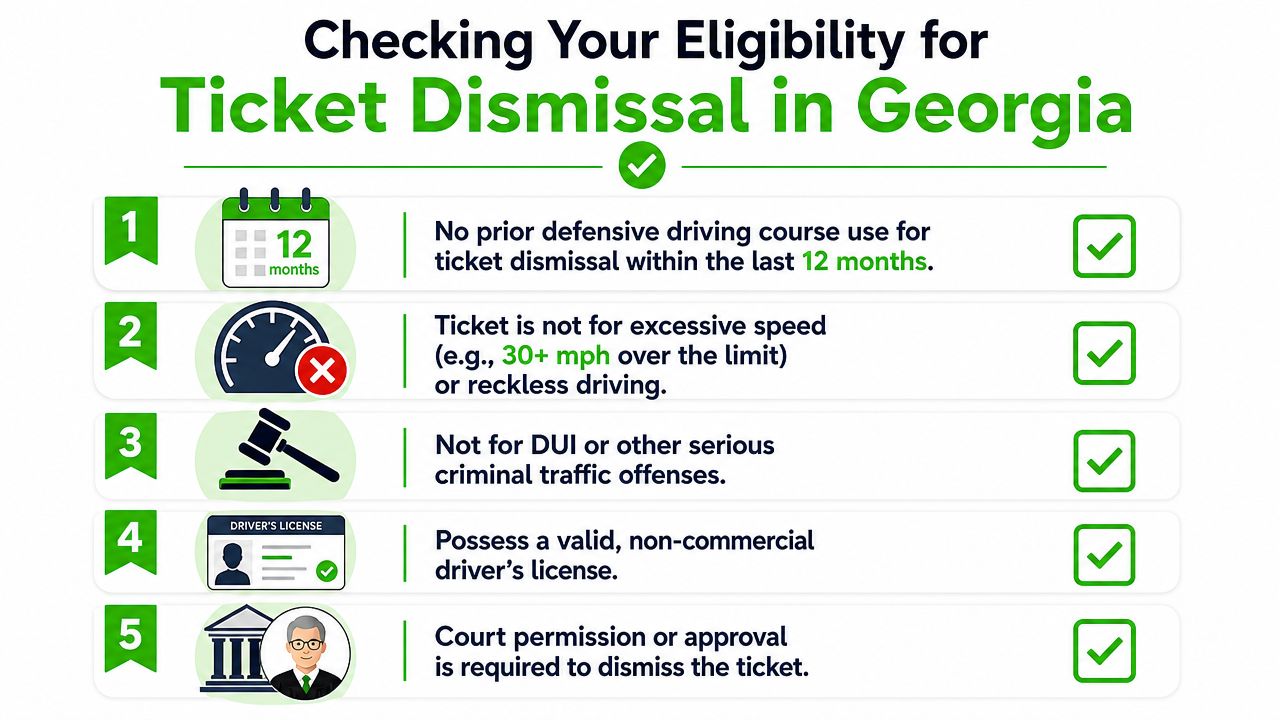
Checking Your Eligibility for Ticket Dismissal in Georgia
Before you spend time or money, check whether your ticket is even the kind of case where a course can help. Many drivers make a mistake here. They read advice from another state and assume Georgia works the same way.
Why state-specific rules matter
Eligibility rules differ sharply from state to state. For example, Arizona allows defensive driving for one eligible violation every 12 months and requires the ticket to be handled through that program, while New York allows point reduction but the violation remains on the record. That's exactly why Georgia drivers should stop looking for a generic national answer and start with the court listed on the citation.
Green lights and red flags in Georgia
Here's the practical screen I'd use if you were standing at the counter asking whether a defensive driving course for a speeding ticket is worth pursuing.
- Green light, minor speeding case: If the citation is a standard moving violation and the court gives discretion on resolution, you may have room to request a course.
- Red flag, serious traffic charge: If the case involves DUI or another serious criminal traffic offense, defensive driving usually isn't the right lane.
- Red flag, commercial driver status: If you hold a CDL, don't assume the same options apply. Commercial consequences can be stricter, even when the stop happened in your personal vehicle.
- Green light, clean recent course history: If you haven't recently used a defensive driving option for point relief or court mitigation, your chances are usually better.
- Red flag, excessive speed facts: The faster the alleged speed, the less likely a court is to treat the class as a simple cleanup step.
Court approval matters more than your opinion that the ticket was “not that bad.”
What to check before you enroll
Pull together these items first:
Your citation details
Look at the exact charge, the court name, and any appearance deadline.Your driving history
If you've already used a point-reduction option recently, that can affect what DDS or the court will allow.Your license type
A regular Georgia license and a commercial license are not treated the same way.The county or municipal court rules
Fulton, Gwinnett, Cobb, and smaller municipal courts may handle requests differently in practice.Whether you want dismissal, point help, or both
If you don't know your target outcome, you can't ask the court the right question.
A lot of Georgia confusion comes from one assumption: “If I take the class, the ticket disappears.” Sometimes the answer is no. Sometimes the better result is a reduced fine or a way to keep points from being added. That can still be worth doing, but only if you know what you're asking for.
Navigating the Georgia Court and DDS Process
Once you know the course might help, the next part is procedural. At this stage, drivers lose good options by acting out of order.
The sequence that usually works
Start with the court, not the classroom. Contact the clerk for the court listed on your speeding ticket and ask what options are available for a defensive driving course. You may be asking for permission to complete a course for mitigation, for point-related relief, or as part of a plea arrangement.
Then get the answer in a way you can rely on. If the court allows the class, confirm the deadline, what kind of course they accept, and exactly how they want proof submitted.
Take the course only after you know who needs the certificate and when they need it.
Why timing matters
The process is strict. Washington, D.C. gives examples where a driver may have only 15 calendar days to pay the ticket and 30 calendar days to finish traffic school after a hearing decision, and the certificate must be filed correctly. Georgia courts may set their own windows, but the larger lesson is the same. A class completed without approval or submitted after the deadline may do nothing for your case.
If your case specifically involves a court requirement, this page on a court-ordered defensive driving course shows the type of program drivers often need to satisfy that order.
Court outcome and DDS outcome are not the same
This distinction matters more than most drivers realize.
| Process | What you are trying to fix | Where you send proof |
|---|---|---|
| Court process | The ticket itself, the fine, or the judge's disposition | The court |
| DDS process | License points or administrative driving record relief | DDS, when applicable |
A lot of people complete the class, hand the certificate to one place, and assume everything else updates automatically. It often doesn't.
Common mistakes that cost drivers the benefit
- Paying the ticket first: That can operate like a guilty resolution and shrink your options.
- Taking the wrong course format: Some courts care that the provider and course type meet the requirement.
- Missing submission instructions: A certificate in your inbox isn't the same as a certificate filed with the right office.
- Assuming one filing covers all outcomes: Court relief and DDS relief can involve separate steps.
If you're trying to use a defensive driving course for a speeding ticket in Georgia, the safest mindset is simple. Approval first, course second, certificate filing third.
Choosing Your Georgia-Approved Defensive Driving Course
Once the court says yes, the decision becomes practical. You need a course that fits your schedule and satisfies the requirement.
The main format options
Georgia drivers usually look at three formats for a 6-hour defensive driving course.
| Format | Best for | Trade-off |
|---|---|---|
| Self-paced online | Busy drivers who want flexibility | Requires self-discipline |
| Live virtual class | Drivers who want structure without commuting | You have to attend at scheduled times |
| In-person classroom | Drivers who learn better face-to-face | Travel and scheduling are less flexible |
How to pick the right one
If your deadline is tight, focus first on completion logistics. Ask how quickly the certificate is issued, what format the court accepts, and whether you'll receive proof in time to file it correctly.
If you prefer one provider example, Georgia DUI Schools offers a state-approved defensive driving course in self-paced online, live virtual, and classroom formats. That matters because some drivers need flexibility, while others do better when an instructor keeps them on pace.
The best course format is the one you can complete correctly and submit on time.
What you should confirm before paying
- Court acceptance: Make sure the court will accept that provider and format.
- Completion certificate process: Ask how you receive proof after finishing.
- Schedule fit: Don't choose a format that creates avoidable deadline risk.
- Your own learning style: Fast doesn't help if you won't finish.
A lot of bad outcomes come from simple mismatches. The driver wanted online, but the court expected a specific approved course. Or the class was fine, but the certificate didn't get filed where it needed to go. Choosing well means looking past convenience and checking the administrative side first.
Understanding the Real Benefits for Your Ticket and Record
Expectations need to be clean. A defensive driving course can help, but the benefit depends on which system is giving the benefit.
The three outcomes drivers mix together
In Georgia, a 6-hour defensive driving program may lead to a 20% fine reduction from the court, may prevent points from being added to your license, can be used once every five years to remove up to 7 existing points, and insurance discounts commonly fall in the 10% to 15% range for eligible drivers. Those are separate outcomes, not one combined package.
| Outcome | How It Works | Who Grants It | Key Georgia Rule |
|---|---|---|---|
| Ticket dismissal or fine reduction | The judge or court accepts course completion as part of case resolution or mitigation | Court | Court approval and court rules control |
| Point reduction | Course completion is used for license-point relief when allowed | DDS | May be used once every five years to remove up to 7 points |
| Insurance savings | You provide proof of completion to your insurer for any available safe-driver discount | Insurance company | Discounts commonly fall in the 10% to 15% range for eligible drivers |
What works and what doesn't
What works is asking one direct question at a time. Will the court reduce the fine? Will DDS give point relief? Will the insurer apply a discount? Drivers who separate those questions usually get clearer answers and better results.
What doesn't work is asking whether the course will “make the ticket go away.” That phrase hides the actual issue.
If your main concern is the license record side, this guide on how to reduce points on your license is the more relevant path than a generic ticket article.
If insurance is the bigger worry, it also helps to understand the broader ways people get lower car insurance rates beyond course completion alone.
A court can help with the citation. DDS can help with points. Your insurer decides premium treatment. Keep those lanes separate.
Defensive Driving FAQs and Your Next Step
Can a defensive driving course automatically dismiss my Georgia speeding ticket
No. The class by itself doesn't automatically dismiss anything. The court has to allow that use, and you have to follow its instructions for completion and filing.
If I already paid the ticket, can I still use the course
Sometimes drivers find out too late that paying the ticket closed off a better option. Once you've paid, your choices may be narrower. Ask the court immediately if anything is still available, but don't assume the course can reverse a completed resolution.
Can I use the course for point reduction and insurance savings at the same time
Possibly, but they are separate requests. DDS relief doesn't automatically notify your insurance company, and insurance acceptance doesn't automatically change your court or license record.
Does a higher-speed ticket change things
Yes, it can. The more serious the speed allegation, the less likely it is that a court will treat the matter like an ordinary cleanup issue. If your citation alleges especially high speed, ask the court first before enrolling anywhere.
What if I have a CDL
Proceed carefully. Commercial drivers often face stricter consequences and shouldn't assume a standard defensive driving approach will solve the problem.
How do I prove completion to the court or my insurer
Use the official certificate of completion from the provider. Then submit it exactly the way the court or insurer requires. Keep a copy for yourself.
What should I do first today
Do these three things in order:
- Read the citation
- Call the court
- Ask whether a defensive driving course is approved for your case
That order prevents most avoidable mistakes.
If you're ready to handle the ticket the right way, review the Georgia DUI Schools Defensive Driving Course and choose the format that fits your deadline and court requirements.