

Georgia drivers usually pay $40 for a points-related reinstatement, while DUI- or drug-related reinstatement can start at $340 once the $85 fee and $255 administrative fee are both added. That number still doesn't include court costs, insurance filings, or required courses, so the total is often higher than the first notice makes it look.
A suspended license notice can feel simple at first, then the pages keep adding up. One line mentions payment, another lists a certificate, and a third says you still can't drive until the state has everything on file. That's why the license reinstatement fee matters, but only as one piece of the larger compliance picture.
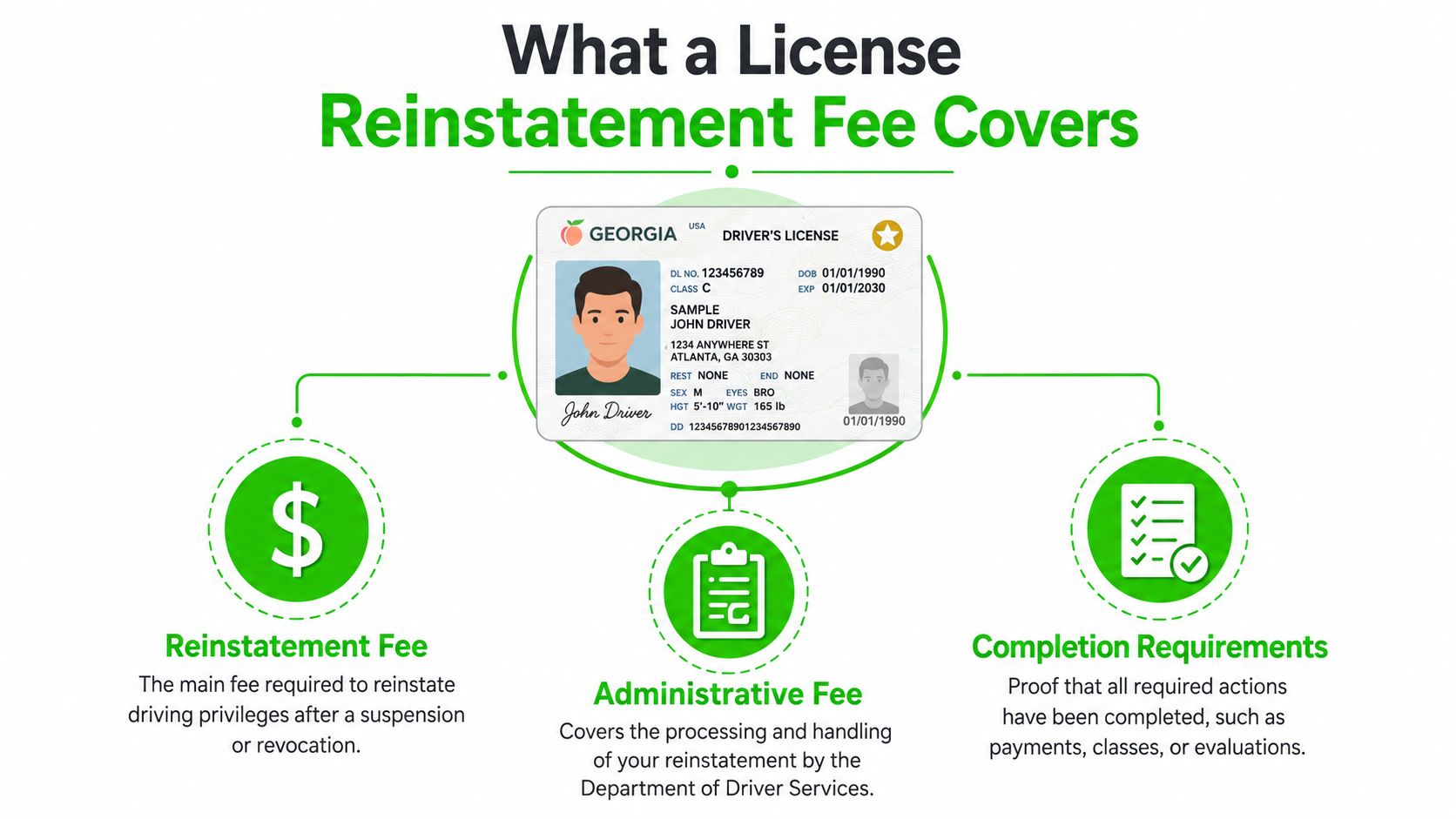
What a License Reinstatement Fee Really Covers in Georgia
A Georgia driver can open a DDS notice expecting a single bill and instead find a list of conditions. The license reinstatement fee is the state's administrative charge to clear the suspension from the driving record, but it does not stand alone. Court obligations, proof of insurance, and required course completion can all sit beside it, and paying the fee does not erase the reason the license was suspended.
The fee is only one part of reinstatement
Georgia treats reinstatement as a clearance process, not a one-step payment. A driver may still need to satisfy court fines, submit an insurance filing, or provide a completion certificate before DDS will finish the file. The fee opens the door, but the rest of the paperwork has to be in place before the record can move.
That is why some drivers mail payment and still see a hold on their account. DDS can receive the money and still wait for the other documents that prove the underlying issue has been handled. The fee starts the administrative part of reinstatement, but it does not replace the other steps.
A driver comparing state processes can see the same split between the fee and the rest of the compliance stack in the 2026 guide to Illinois license reinstatement. Georgia works in the same basic way, the charge clears the record only after the required conditions are satisfied.
Why Georgia uses this structure
The structure is administrative. The state needs a paper trail showing that the suspension reason has been resolved before driving privilege returns. In practice, the fee functions more like a processing charge than a reset button.
Practical rule: if the notice lists courses, insurance, or court steps, treat the fee as one item on the checklist, not the whole checklist.
The most important part is timing. If DDS has not recorded the required completion items, paying the fee early will not reinstate the license. It only begins the administrative review that follows.
Georgia Reinstatement Fees by Suspension Type
Georgia does not use one universal reinstatement number for every driver. The fee depends on the cause of the suspension, and that's where people get tripped up. A points suspension, a DUI-related case, and a child support-related hold don't land in the same bucket.
Matching the fee to the cause
For a points-based suspension, Utah's published schedule shows a $40 reinstatement fee, while alcohol- or drug-related cases add an $85 fee plus a $255 administrative fee, which brings the DUI-related reinstatement starting point to $340 before any other obligations are added. Georgia's framework works the same way in structure, different violations trigger different fee treatment rather than one flat statewide number. California's DMV shows the same pattern with a $55 reissue fee and a separate $125 Admin Per Se reissue fee, which reinforces the idea that the underlying violation drives the cost structure. Georgia's reinstatement fee schedule also makes clear that the amount varies by suspension type.
| Suspension Cause | Reinstatement Fee | Additional Administrative Fee |
|---|---|---|
| Points accumulation | Varies by violation class | May not apply |
| DUI or alcohol-related case | Higher than standard administrative suspensions | Separate fee may apply |
| Child support non-compliance | Varies by cause | Depends on the notice |
| Out-of-state conviction transfer | Depends on the underlying hold | Depends on the notice |
The bigger point is that a fee notice can't be read in isolation. Georgia drivers often ask “How much is the fee?” when the better question is “Which suspension type controls the fee?” If the old notice is stale, confirm the amount with DDS before you mail anything. A fee that matched one case file may be wrong for another.
Good habit: read the suspension reason first, then match the fee second, then gather the documents third.
Related Costs That Stack on Top of the Reinstatement Fee
The license reinstatement fee is usually the smallest visible part of the bill. Most Georgia drivers also deal with insurance filings, education requirements, and sometimes court-ordered treatment before the state will reopen the license record. Those items are separate obligations, not optional extras.
Insurance and education come first for many drivers
An SR-22 is a certificate your insurer files to show financial responsibility. It often comes with a premium increase because the policy is now written around a higher-risk driver profile, and the filing itself is separate from the reinstatement fee. That filing doesn't replace the DDS payment, it sits beside it.
For DUI-related cases, the Risk Reduction Program is a core part of the compliance stack. Georgia DUI Schools offers the course in classroom, live virtual Zoom, and self-paced online formats, which matters for drivers who need flexibility around work or court scheduling. Drivers facing point-related issues may instead need a Defensive Driving option, which serves a different purpose from the DUI course.
Court-ordered items can add more layers
Some drivers also get routed through a clinical evaluation, possible ASAM Level 1 treatment, and a Victim Impact Panel. Those items can appear in a court order, a probation instruction, or a DDS-related sequence, and each one has to be satisfied on its own terms.
- SR-22 filing: typically filed by the insurer, not the driver.
- Risk Reduction tuition: required for many DUI cases.
- Clinical evaluation: ordered when the court or provider needs a formal assessment.
- Victim Impact Panel: a separate educational requirement in some cases.
A state guide on reinstatement fees notes that these charges commonly sit inside a much larger compliance stack, and that the fee by itself doesn't restore driving privileges. Texas law is a good comparison point because it makes the $100 fee expressly conditional on meeting the chapter's other requirements. Georgia drivers should think the same way, pay the fee last, after the support items are ready.
How and Where to Pay the Georgia Reinstatement Fee
Georgia DDS gives drivers three ways to pay, and the right choice depends on how complete the rest of the file is. If the supporting documents are already posted, online payment is usually the fastest path. If a driver still needs to bring in paperwork, in-person payment can reduce back-and-forth.
The three payment channels
The first option is the online reinstatement portal. It's the cleanest route when the DDS record already reflects the needed completion items, and it allows credit or debit card payment. The second is payment by mail, which uses DDS forms and usually works best when the packet is fully assembled and double-checked. The third is paying in person at a DDS Customer Service Center, where cash or card may be accepted at the counter.

Keep the confirmation number or receipt. If DDS later says the fee wasn't matched to the right case, that proof saves time.
What to have ready
Bring a state-issued ID, the suspension or revocation notice, proof that any education requirement is complete, and SR-22 proof if your case requires it. Online payments usually post faster than mailed payments, while paper submissions can take longer because they depend on mail delivery and manual processing. If a payment is rejected, the usual fix is not sending the money again blindly, it's checking whether a required document is still missing from the file.
Mail and in-person options are useful when the notice is old or the situation is messy. Online is faster, but only if the DDS record is already aligned with the rest of the compliance stack. In every case, the fee is only one part of the release process.
Required Documents, Timelines, and Eligibility Windows
A lot of reinstatement delays come from timing, not money. A driver pays too early, or submits payment before the completion certificate has posted, and the file just sits there. Georgia drivers need to line up the dates, documents, and waiting period before they send anything.
Eligibility depends on the order of events
For DUI-related suspensions, the state uses a completion-based timeline, so the certificate often controls when reinstatement can begin. The driver must also account for the 120-day rule for limited permits after a DUI, which means the window for a restricted option is not the same as the window for full reinstatement. That's where people get confused, because a permit and a full restoration are not the same thing.
A limited permit lets you drive under narrow conditions. It does not mean the suspension is fully cleared.
The supporting documents usually include the DS-0001 Risk Reduction certificate, any clinical evaluation report if ordered, and the SR-22 if the case requires it. If one of those items is still pending with the provider, DDS can reject the reinstatement submission even if the fee itself has already been paid. That creates a delay that feels random but is just a sequencing problem.
Drivers should put every deadline on a calendar before they pay. If a course transcript is still being processed or an insurer hasn't filed the SR-22 yet, it's smarter to wait than to force a premature filing. For Georgia drivers who need a formal course path, the SAP-related page at this Georgia DUI Schools resource can help clarify how program steps fit into the compliance timeline.
How Risk Reduction and Clinical Services Feed Into Reinstatement
Georgia reinstatement often depends on proof that the driver completed the right education or clinical step, not just proof that a fee was paid. That is why the course certificate and any ordered evaluation matter as much as the DDS payment. The state wants the file to show completion, not intent.
Why the certificate matters
The 20-hour DUI Risk Reduction Program is the core educational requirement for most DUI-related reinstatements. Georgia DUI Schools is a DDS-approved provider, so its completion certificate is accepted by the state when the driver finishes the required course. The same program is available in classroom, live virtual Zoom, and self-paced online formats, which helps drivers in Atlanta, Athens, and other parts of Georgia choose a format that fits work or court schedules.
Clinical items can sit beside the course
A court or DDS file may also call for a clinical evaluation, ASAM Level 1 treatment, or a Victim Impact Panel. Those items are not interchangeable with the education course, and a driver who skips one can still get stuck even after paying the reinstatement fee. The safest approach is to treat each item as a separate deliverable with its own completion proof.
For drivers comparing program costs and scheduling options, Georgia DUI Schools' risk management course fees page is a practical place to check how the education piece fits into the larger budget. That matters because the reinstatement file is only complete when every required piece is documented.
If the DDS wants a certificate number, a receipt alone won't do the job.
Common Pitfalls and Mistakes That Delay Reinstatement
The most common reinstatement mistake is paying before the file is ready. Drivers assume the fee will trigger the rest of the process, then learn that DDS still needs a course certificate, an SR-22, or a court clearance before the license can move forward. The payment posts, but the privilege doesn't return.
Where people usually get stuck
One problem is mailing a check without the correct DDS forms. Another is thinking SR-22 insurance by itself is enough. It isn't, because the insurance filing is only one part of the compliance stack and does nothing by itself for a court-ordered course or an outstanding administrative hold.
A separate mistake is overlooking the additional administrative charge that comes with DUI-related cases. Georgia drivers sometimes budget for the base fee and forget the layer that sits on top of it. That leads to bounced payments, incomplete submissions, or a second trip to resolve the same file.
Repeat suspensions cause a different kind of delay. Fees can stack, and a permit won't erase the need for full reinstatement. If a payment posts but the license stays inactive, the driver should check whether DDS still shows an unresolved hold, an unposted certificate, or a missing form.
Watch for this sign: the money clears, but the status still shows suspended. That usually means the file is incomplete, not lost.
Your Reinstatement Action Plan and Next Steps
The cleanest reinstatement path starts with the suspension reason, not the payment. First, confirm the exact cause with DDS. Then request the reinstatement amount and check whether the case also needs SR-22 filing, a course certificate, or court paperwork.
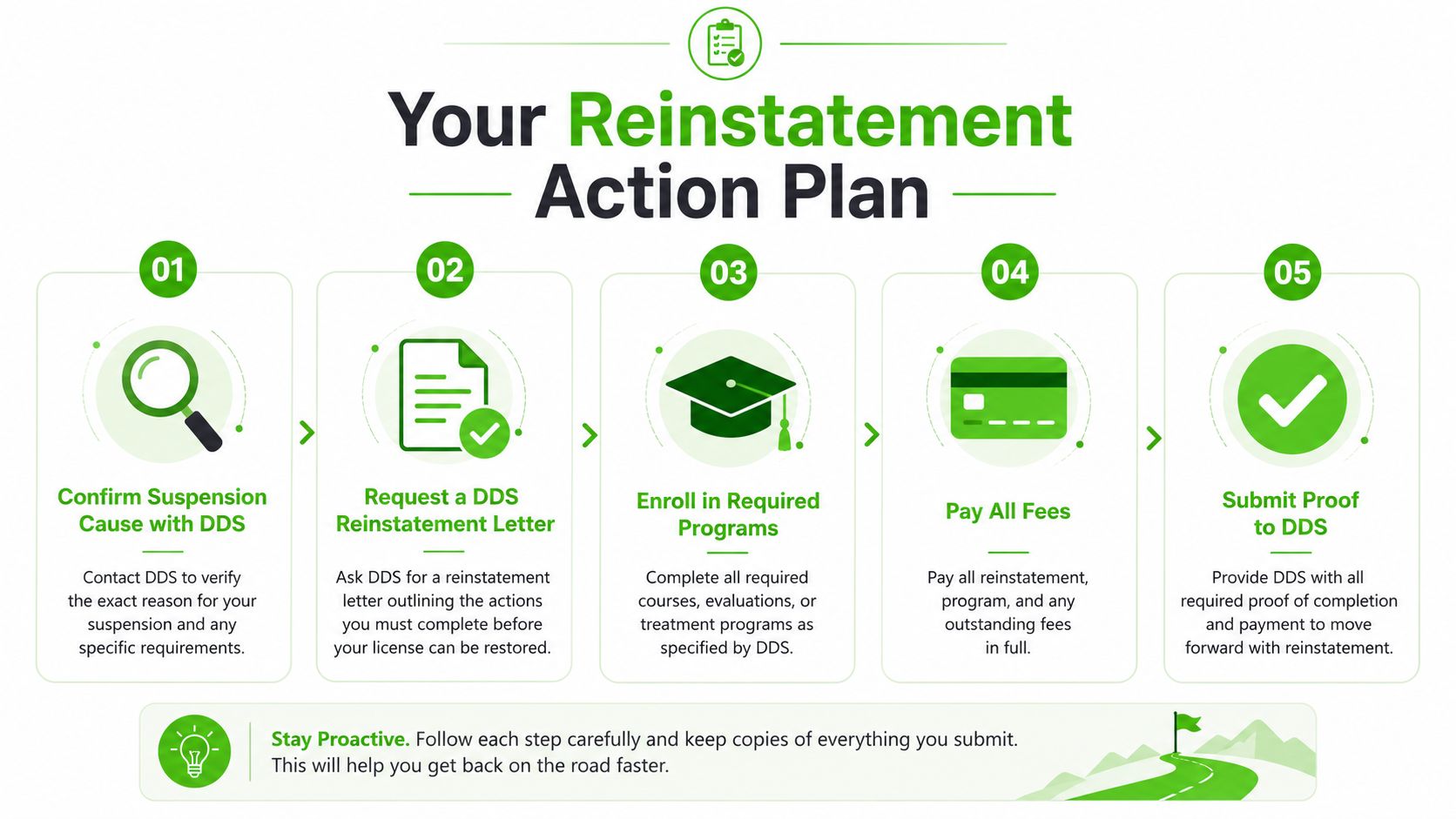
A practical sequence to follow
- Confirm the suspension cause with DDS. The violation class tells you which fee and documents matter.
- Request the reinstatement letter or notice. That keeps you from relying on memory or an old balance.
- Enroll in the required program. For many DUI cases, that means the Risk Reduction course and possibly a clinical step.
- Pay every required fee. Include the reinstatement fee, and don't forget related obligations.
- Submit proof to DDS. Make sure the file shows completion, not just payment.
If your situation involves DUI education, the Georgia DUI Schools reinstatement page is the most direct place to start. It keeps the focus on reinstatement steps, not on unrelated driving-school content.
The fastest path is usually the least complicated one, complete the program requirements first, then pay the fee with every supporting document already in place. If you're staring at a suspension notice today, pull it out, check the cause, and make the first call to DDS or the course provider before you send any money.
A CTA for Georgia DUI Schools.