Rush hour on I-285 can turn a normal commute into a test of nerve. One driver squeezes into the gap, another rides the bumper in front, and a third tries to “win” by getting one car ahead before the next exit. In Georgia, that split-second choice between forcing traffic and reading traffic can affect more than safety, it can shape a ticket, a court date, and what your insurer does next.
| Attribute | Defensive Driving | Offensive Driving |
|---|---|---|
| Main goal | Prevent conflict and preserve space | Gain position or force movement |
| Mindset | Anticipate mistakes by others | Act first, react later |
| Typical behavior | Scanning, signaling, yielding, spacing | Speeding up, crowding, cutting off |
| Risk profile | Lowers exposure to sudden hazards | Raises interaction intensity |
| Best outcome | More control, fewer surprises | Short-term advantage, higher crash risk |
The Daily Choice on Georgia Roads
A driver headed south toward Atlanta sees brake lights stack up near the connector, a tractor-trailer edging over, and a fast mover looking for any open lane. That's where the difference between offensive vs defensive driving stops being abstract. In real Georgia traffic, the question is simple, do you create space, or do you try to take it?
That choice matters because the road environment feels more hostile to many drivers now than it did a few years ago. Public perception lines up with the safety problem, 49% of Americans said people in their area were driving more dangerously than before the pandemic, while only 9% said drivers were safer, and distraction was a factor in 11.0% of all traffic crashes in 2022. Those facts don't mean every commute is chaotic, but they do explain why patience and anticipation beat impulse.
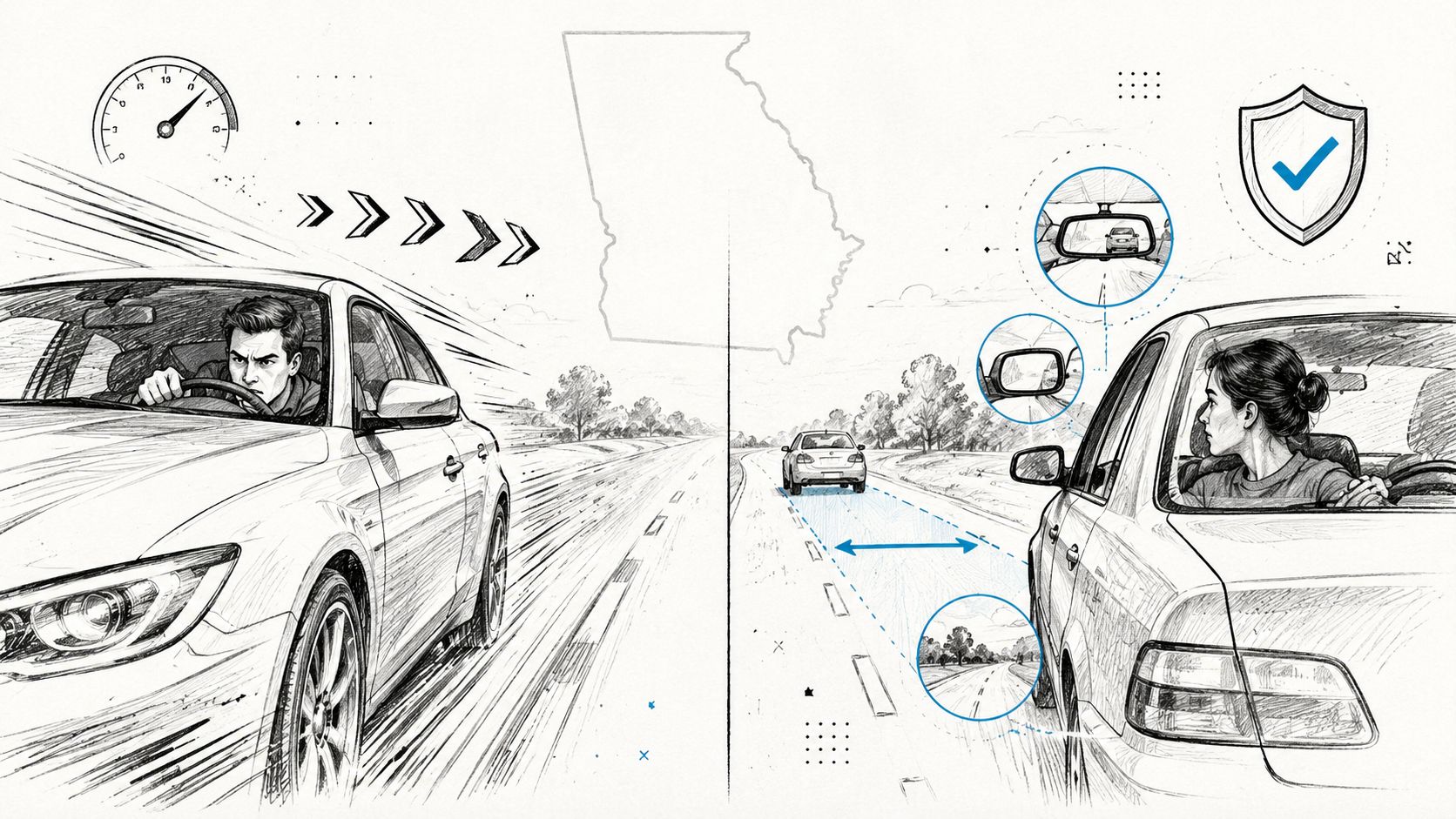
A defensive driver doesn't trust the traffic around them to behave well. They leave room, watch mirrors, and keep their speed steady enough to react. An offensive driver, by contrast, tries to push the pace, and that usually creates more tension than progress.
If you've ever driven with a phone app running, a court deadline looming, and a nervous eye on the rearview mirror, a tool like CARLOCK GPS systems can help you stay aware of what's happening around your vehicle, especially when you're also trying to keep your own habits in check.
Practical rule: If you can't describe the car two vehicles ahead, you're probably driving too close to the situation and not far enough ahead of it.
Defining the Two Driving Philosophies
Defensive driving is a system, not a mood
Defensive driving is built on anticipation, spacing, and scanning. The Federal Motor Carrier Safety Administration describes it as anticipating dangerous situations and making reasoned decisions to avoid crashes, and common training guidance teaches a 3 to 4 second following distance, roughly one car length per 10 mph, to preserve reaction time. The point is not to crawl. The point is to keep enough margin that another driver's mistake doesn't become your emergency.
The New York DMV puts that same idea into a practical rule, the two-second following-distance rule, with at least three or four seconds in bad weather or behind large trucks to protect stopping distance and reaction time. That's the core of defensive driving, space management. You're buying time with distance.
Offensive driving lives in the gray area
The term offensive driving is slippery because some people use it to mean assertive, proactive maneuvering, while others use it as a synonym for aggressive behavior. That distinction matters. A driver who changes lanes early to avoid a hazard is being deliberate. A driver who speeds up to block a merge or squeezes into a closing gap is creating conflict.
Safety-oriented guidance generally treats offensive-style moves as action taken to gain position, while defensive driving focuses on maintaining lane position, yielding, and reducing conflict exposure. That's why the more useful comparison isn't “who is faster,” it's who is lowering risk. In practice, offensive choices may win a few feet of roadway, but they usually increase interaction intensity and leave less room for error.
| Offensive vs. Defensive Driving at a Glance | Defensive Driving | Offensive Driving |
|---|---|---|
| Primary mindset | Prevent the crash before it starts | Influence traffic to gain position |
| Space use | Leaves room to react | Consumes space quickly |
| Lane changes | Signal early, check blind spots, wait for a real opening | Force gaps, cut off, merge late |
| Response to conflict | De-escalate and disengage | Press harder, match energy |
| Road result | Lower tension and better control | More friction and higher crash exposure |
A good Georgia driver needs to recognize the boundary. Assertive isn't automatically illegal. But when assertive turns into tailgating, unsafe passing, or weaving, it has crossed into danger.
For readers comparing course options and safety habits, this Georgia DUI Schools defensive driving resource is a useful place to see how spacing, scanning, and hazard awareness are taught in a structured format.
Keep your mirror checks active and your ego out of the car. That combination solves more roadway problems than speed ever will.
Applying Driving Styles in Common Scenarios
Merging onto a packed connector
On a packed I-75/I-85 Connector ramp, a defensive driver checks the lane early, matches speed gradually, and waits for the safest opening. If the gap isn't there, they keep rolling, signal clearly, and merge only when they can do it without forcing anyone to brake hard. The result is usually smooth, even if it takes an extra few seconds.
An offensive driver tries to take the smallest possible opening and expects everyone else to compensate. That's where merge panic starts, sharp braking, sudden lane changes, and near misses. A small delay turns into a bigger problem because the driver treated space like a prize instead of a buffer.
Handling a tailgater on GA-400
A defensive response to a persistent tailgater is to stay calm, keep a steady pace, and create room ahead if possible so the driver can pass. The goal isn't to teach a lesson, and it definitely isn't to brake-check. It's to reduce the pressure behind you and remove the trigger for escalation.
If you want a better visual of where your vehicle sits in traffic, DIY tips to avoid blind spots can help you set mirrors and reduce the hidden zones that make lane changes riskier. That kind of awareness matters most when someone behind you is impatient and your own view is already crowded.
Downtown Athens with pedestrians and cyclists
A defensive driver in a busy Athens intersection slows before the crosswalk, scans for pedestrians stepping off the curb, and expects a cyclist to move differently than a car. Offensive behavior in that setting often looks like impatience, rolling through the light, or trying to squeeze past before the lane clears. Those habits don't save meaningful time, they increase the chance of contact with people who have far less protection than a vehicle.
Practical rule: If the move only works because others had to yield to you suddenly, it was probably the wrong move.
Legal and Insurance Implications in Georgia
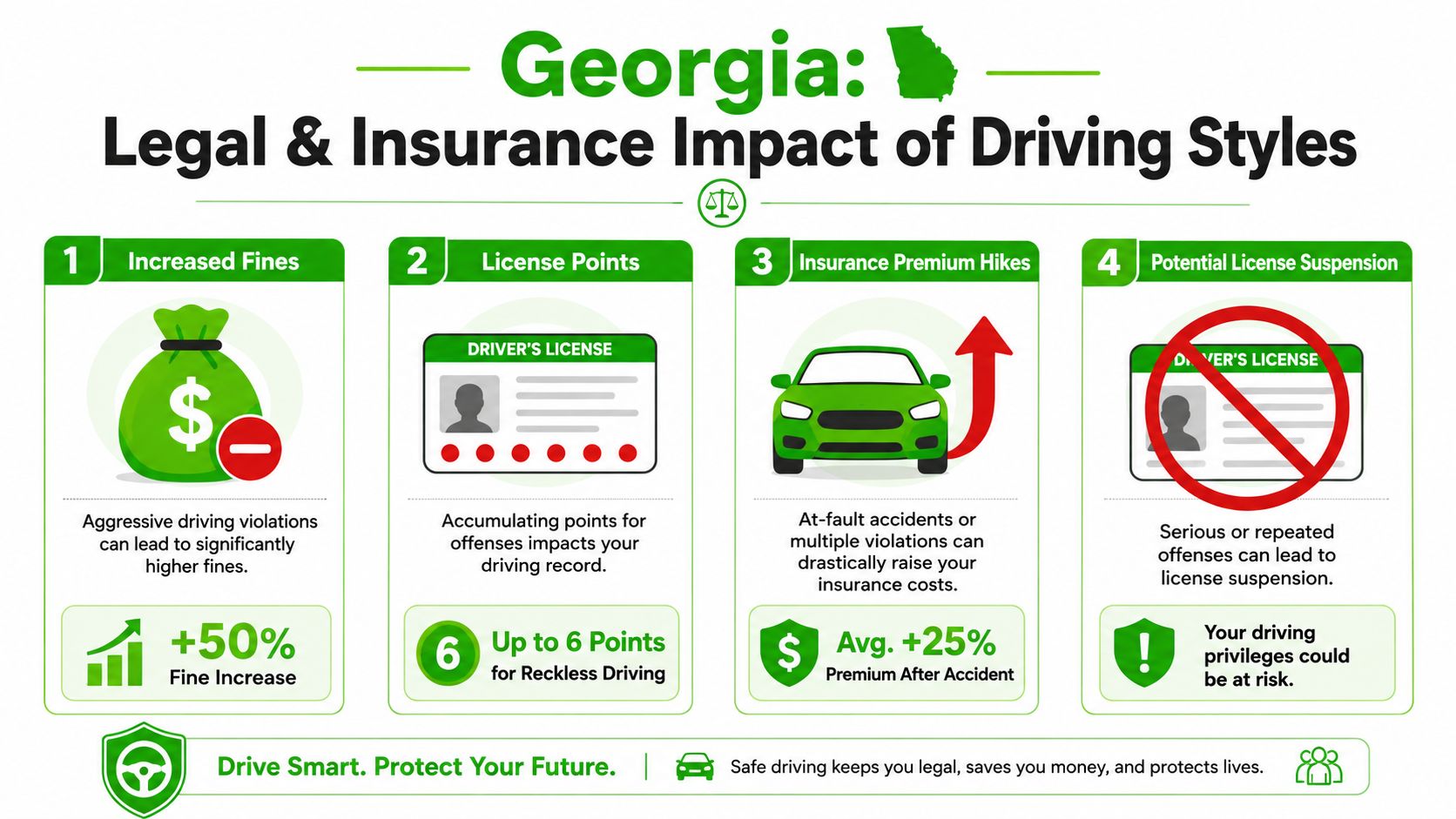
Georgia doesn't treat reckless roadway behavior as a personality trait. It treats it as a legal risk. When offensive habits turn into speeding, tailgating, unsafe passing, or aggressive lane changes, the result can move from bad judgment to a citation that affects your record, your license status, and your insurance.
Why Georgia insurers and courts care
NHTSA notes that speeding makes it easier for drivers to lose control and links it directly with aggressive behaviors like tailgating and unsafe passing. Those are the exact patterns that create crash liability and make insurers nervous. Once a crash or citation lands on your record, the financial effect can follow you long after the traffic stop ends.
A defensive record looks different to an insurer because it suggests lower conflict exposure. A driver who signals, yields, and keeps space is less likely to create the kind of claim file that drives premiums upward or triggers policy review. That's why safety habits and insurance consequences are tied together more tightly than many drivers realize.
Georgia-specific consequences get expensive fast
Georgia law allows aggressive or reckless behavior to be treated seriously when it endangers others. A conviction can mean fines, points, possible suspension concerns, and a lot of paperwork you didn't want. If the incident involved a crash, the insurer may also look at fault, claims history, and whether the conduct looked avoidable.
For drivers trying to understand how their record affects what they pay, this Georgia DUI Schools guide on lowering insurance premiums connects driving behavior with the insurance side of the equation in practical terms. If you're already worried about costs, that's the right mindset to take seriously now, not after the next ticket.
A traffic citation is never just a piece of paper. It can become a record of avoidable risk, and Georgia insurers know how to price that risk.
If you're also comparing carrier options, Tailored Car Insurance Policies from Duncan & Associates Insurance Brokers may help you understand how different records and coverage choices can affect what you pay after a violation or crash.
Choosing the Right Georgia Driving Course for Your Needs

A driver who gets a ticket for following too closely may need a very different course than a driver dealing with a DUI arrest or a court-ordered reinstatement step. That distinction matters in Georgia, because the wrong class does not satisfy the requirement, and the clock does not stop while you sort it out.
If your goal is safer habits, point reduction, or an insurance-related course, a 6-hour defensive driving course is the better fit. If the paperwork from court, probation, or the Department of Driver Services calls for a state-compliant alcohol and drug risk reduction program, you need the course that matches that order.
Georgia DUI Schools offers both formats, online and classroom, which helps when you have to balance court deadlines with work, family, and transportation. The practical rule is simple. Match the course to the legal requirement first, then choose the format that fits your schedule. A defensive driving class focuses on spacing, scanning, and judgment behind the wheel. A DUI/Risk Reduction course addresses the state-mandated topics tied to alcohol and drug-related offenses, along with the compliance steps that often follow them.
If you need a quick way to sort it out, start here:
- Choose defensive driving if your main need is safer habits, point reduction, or an insurance-related course.
- Choose DUI/Risk Reduction if your court paperwork, probation terms, or reinstatement process specifically requires it.
- Choose clinical services or related support if your situation includes evaluation, treatment, or victim impact requirements tied to a DUI case.
The right course should solve the exact problem in front of you. In Georgia, that can mean the difference between meeting a court requirement on time and paying more later because the wrong class did not count.
Frequently Asked Questions About Driving Styles
Is offensive driving the same as aggressive driving in Georgia law
Not always in everyday language, but in practice the line gets narrow fast. Mainstream safety guidance separates defensive anticipation from aggressive acts like speeding and tailgating, and that's the gray area drivers need to understand before they make a move they think is merely assertive. In Georgia, if the behavior endangers people, it can be treated like a serious traffic problem, not a harmless style choice.
Can a Georgia defensive driving course get a ticket dismissed
Sometimes drivers hope it will, but that depends on the charge, the court, and the judge's instructions. A defensive driving course is often useful for education, points-related goals, or showing a good-faith effort to improve, but it doesn't automatically erase every citation. The safest move is to check the paperwork on your actual case before you assume the course will solve it.
How do DUI/Risk Reduction skills connect to defensive driving
Both rely on the same road habits, staying alert, scanning ahead, managing space, and making decisions before pressure builds. The DUI/Risk Reduction setting goes further because it addresses the behavior behind the wheel that led to the legal problem in the first place. If you're trying to rebuild trust with the court, your insurer, or yourself, those habits matter just as much as the class certificate.
If you need a Georgia course that matches your situation, start with the requirement on your paperwork, then enroll in the right program without guessing. Visit Georgia DUI Schools to choose the defensive driving or DUI/Risk Reduction option that fits your case and get it done on time.