Most advice about defensive driving course answers is wrong from the start. People look for a shortcut, a quiz key, or a list of memorized responses. That approach usually fails because Georgia defensive driving courses reward judgment, not guessing. If you're taking a class for point reduction, insurance purposes, a court matter, or as part of a broader path that may also involve Risk Reduction requirements, clinical evaluations, or other compliance steps, the safest move is to understand why an answer is right.
A good student doesn't chase trick answers. A good student learns how the course frames risk, responsibility, and legal compliance on Georgia roads. That's what helps you pass legitimately, and it's what keeps you from making the same mistake twice.
Why Searching for Answers Misses the Point

The biggest mistake I see is treating defensive driving course answers like they belong on a flash card. They usually don't. A driver who wants a fixed script often misses the underlying pattern behind the question.
That matters because defensive driving is built around changing conditions. According to the material cited with Northern Arizona University's quiz example, 68% of collision prevention relies on adaptive decision-making under variable conditions, even though many quizzes still present answers as fixed True/False rules in a static format (NAU defensive driving quiz material). That's why a simple cheat sheet doesn't prepare you very well for the course or for the road.
What students usually get wrong
Students often assume the course is testing memory alone. In practice, many questions are really asking whether you can identify the safest legal choice when facts change slightly.
A question about following distance, for example, isn't only about space between vehicles. It may also involve speed, rain, congestion on I-285, distracted drivers in Midtown Atlanta, or a driver darting across lanes on GA-316. The rule stays grounded in safety, but the right response depends on context.
Practical rule: If two answer choices seem possible, pick the one that gives you more time, more space, and more control while staying within the law.
That's also why generic answer dumps online are a bad fit for Georgia drivers. They rarely explain the local reason behind the answer. If you're trying to understand the practical benefits of taking the class in the first place, a quick review of Georgia defensive driving benefits helps frame what the course is trying to teach.
The better way to prepare
Use the word "answers" differently. Don't ask, "What letter do I click?" Ask, "What decision would a safe, compliant Georgia driver make here?"
That shift does two things:
- It improves retention because you're connecting rules to real traffic situations.
- It lowers anxiety because you stop trying to memorize dozens of isolated facts.
- It helps with court-related pressure because you're less likely to confuse general driving advice with legal obligations.
If you're taking a course because of a ticket, a judge, or a license issue, understanding the logic behind the material is the legitimate shortcut.
Decoding Your Georgia Defensive Driving Course
Georgia students get into trouble when they lump every required class into one bucket. A defensive driving course is not the same thing as a Risk Reduction course. If you're dealing with a DUI, drug offense, habitual violator issue, or reinstatement problem, you may need more than one step, and each one has its own rules.
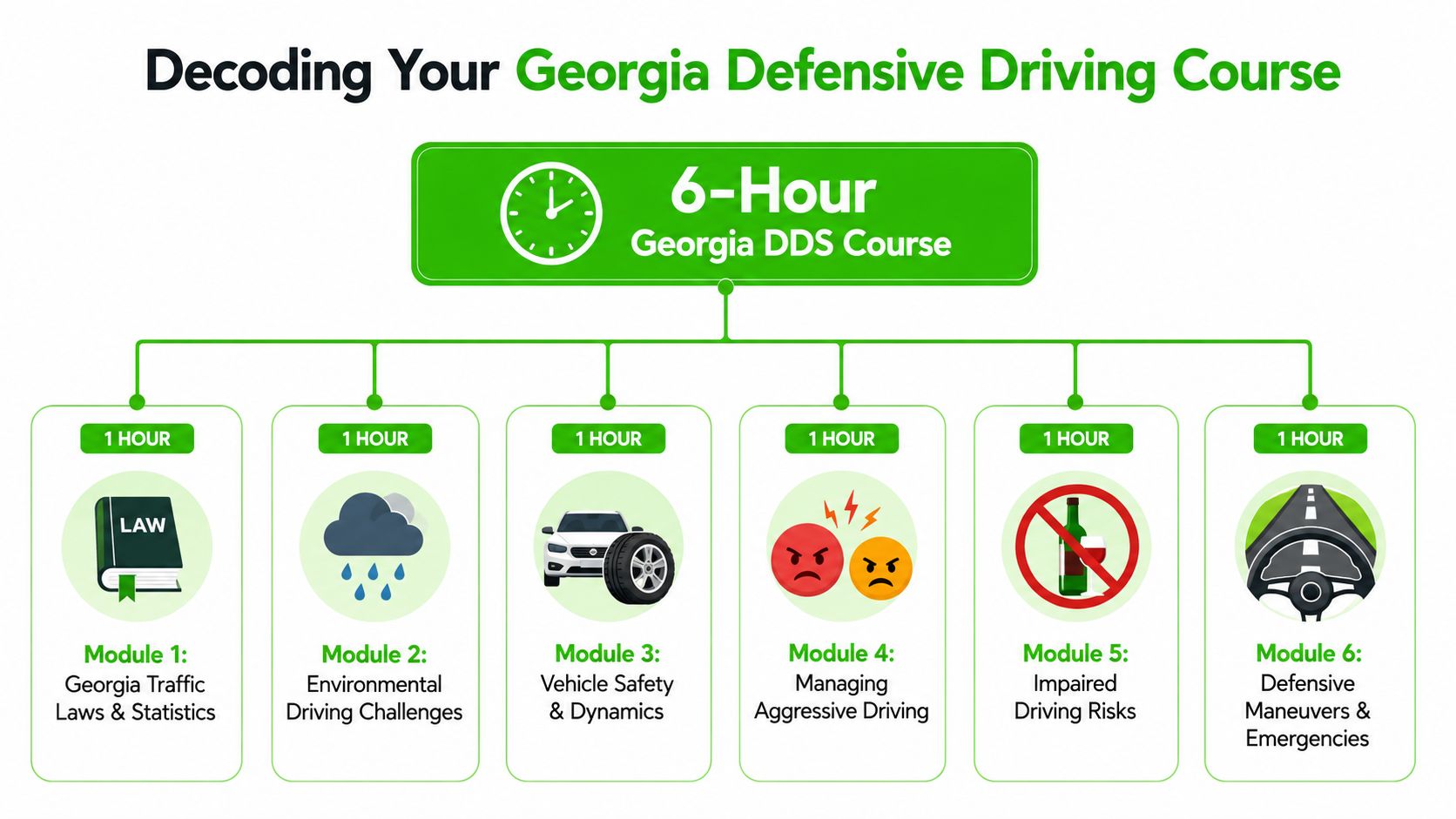
For the Georgia defensive driving piece itself, the state framework is clear. A certified 6-hour defensive driving course can remove up to 7 points from your license record, and you can use that point reduction only once every 5 years (Georgia defensive driving rules and fee details). The same source states that the cost for court-ordered or license-reinstatement purposes is set by law at $95.00 across DDS-approved clinics for those specific uses.
What the class is really about
The course is not just a test-prep session. It usually centers on the habits that reduce bad decisions before they become violations or crashes.
A typical Georgia defensive driving class covers topics like these:
| Course area | What students need to understand |
|---|---|
| Traffic laws | How Georgia rules apply in ordinary driving decisions |
| Hazard awareness | How to spot developing problems earlier |
| Driver attitude | Why impatience and overconfidence create preventable risk |
| Impairment issues | How alcohol, drugs, fatigue, and distraction affect judgment |
| Emergency response | What to do when conditions change fast |
Those subjects matter whether you attend online, live virtual, or in a classroom.
Where students confuse defensive driving with DUI-related requirements
A lot of drivers come in after a court order and assume every safety class meets every legal requirement. It doesn't. Defensive driving may help with points, insurance, or a court disposition in some cases. A DUI-related case may involve Risk Reduction, clinical evaluation, treatment recommendations, or a Victim Impact Panel depending on the facts of the case and what the court or DDS requires.
If a judge, probation officer, or attorney used a specific course name, follow that exact wording before you enroll.
That's especially important in Georgia, where legal consequences attach to the type of class, not just whether you sat in a class somewhere. If you want a lawyer's plain-language reminder about what Georgia drivers overlook after an arrest or stop, Miles Hansford's Georgia DUI tips are worth reading because they reinforce how quickly a driving case becomes a compliance issue.
What to expect on class day
Expect a structured program, not a trivia contest. The student who does well usually does three simple things:
- Shows up with the right purpose. Know whether your goal is points, insurance, court compliance, or a reinstatement-related step.
- Pays attention to legal language. Terms matter. “Defensive driving,” “Driver Improvement,” and “Risk Reduction” are not interchangeable in every legal setting.
- Listens for application. Instructors often emphasize what a rule looks like in everyday Georgia traffic, from Downtown Connector congestion to heavy suburban merging in Gwinnett or Cobb.
Once you know what class you're taking, the questions start making more sense.
Common Question Formats and How to Approach Them
Students who search for defensive driving course answers usually want the exact wording ahead of time. That's not what helps most. What helps is recognizing the pattern of the question and matching it to the course logic.
One reason this matters so much in court-related situations is that 42% of court-ordered drivers fail to connect course content with legal reinstatement criteria because quizzes emphasize generic tactics over jurisdiction-specific compliance rules (question-bank discussion of court-ordered driver confusion). In plain terms, people remember broad safety slogans but miss the Georgia-specific legal point.
Multiple-choice questions
These usually test whether you can separate the "sounds good" answer from the safest lawful answer.
A realistic example might look like this:
You're driving in heavy rain on I-20 westbound near Atlanta. What is the best response?
A. Maintain speed so traffic flow isn't disrupted
B. Increase following distance and reduce speed
C. Move quickly around slower drivers
D. Brake hard whenever visibility drops
The strongest answer is the one that increases your safety margin without creating a new hazard. In this example, B is the kind of answer defensive driving courses favor because it adds time and space.
Use this process:
- Eliminate aggressive choices first. Anything that rewards speed, weaving, or pressure-driving is usually wrong.
- Reject absolutes that create instability. Hard braking and sudden moves often sound decisive, but they're rarely the safest first move.
- Choose the option that preserves control. Defensive driving answers usually prioritize smooth, lawful adjustments.
If you want to sharpen that reasoning style before class, taking a defensive driving online test can help you practice the thinking pattern instead of trying to memorize isolated questions.
True or false questions
These are where students get trapped by absolute wording.
Example:
True or False: A defensive driver always has the legal right-of-way if another driver is behaving dangerously.
That kind of statement is built to test whether you notice the word always. In defensive driving, “always” and “never” can be warning signs unless the statement reflects a hard legal rule. Even when another driver is wrong, your safest response may still involve yielding, slowing, or creating space.
The course usually rewards the answer that avoids a collision, not the answer that proves a point.
When you see True/False, slow down and look for words like these:
| Watch for | Why it matters |
|---|---|
| Always | Often too broad |
| Never | Often ignores exceptions |
| Best | Signals a judgment call |
| First | Signals priority of response |
Scenario-based questions
These are the most useful and the most difficult. They ask whether you can think like a safe driver, not just repeat a phrase from the workbook.
Example:
A driver in Macon is stopped at a green light because traffic is backed up through the intersection. The car behind starts honking. Should the driver enter the intersection because the signal is green?
A weak student focuses on the light color only. A stronger student asks what action avoids blocking the intersection and creating a bigger hazard. The question is really testing judgment under pressure.
For scenario questions, use a three-part filter:
- What is the immediate hazard?
- Which option keeps me legal?
- Which option gives me the most control if another driver makes a mistake?
That's the method that gets you through the test.
Smart Study Strategies That Actually Work
Passive students usually struggle the most. They sit through the material, nod along, and assume the answers will be obvious later. Then the quiz asks them to apply a rule to a specific situation, and they realize they never built the reasoning habit.
That matters because the strongest research summary in this area found that the Defensive Driving Course didn't show a consistent statistically significant reduction in crash rates, but it did reduce traffic violations by about 10% across the reviewed evidence (controlled-study review of DDC outcomes). In practical terms, the course works best when students absorb the compliance mindset instead of treating the class like background noise.
Two students, two outcomes
One student takes the online class while answering texts, switching tabs, and half-listening. By the end, the material feels repetitive, but very little sticks.
Another student takes the same class and pauses after each segment to write one sentence: "What was the safest legal response here?" That second student usually performs better because they're practicing retrieval, not just exposure.
A classroom version looks similar. One person waits for the day to be over. Another listens for recurring patterns, especially around impaired driving risk, aggressive behavior, and space management in traffic. The second student leaves with usable judgment.
Study methods worth your time
These methods tend to work because they match how the course tests you:
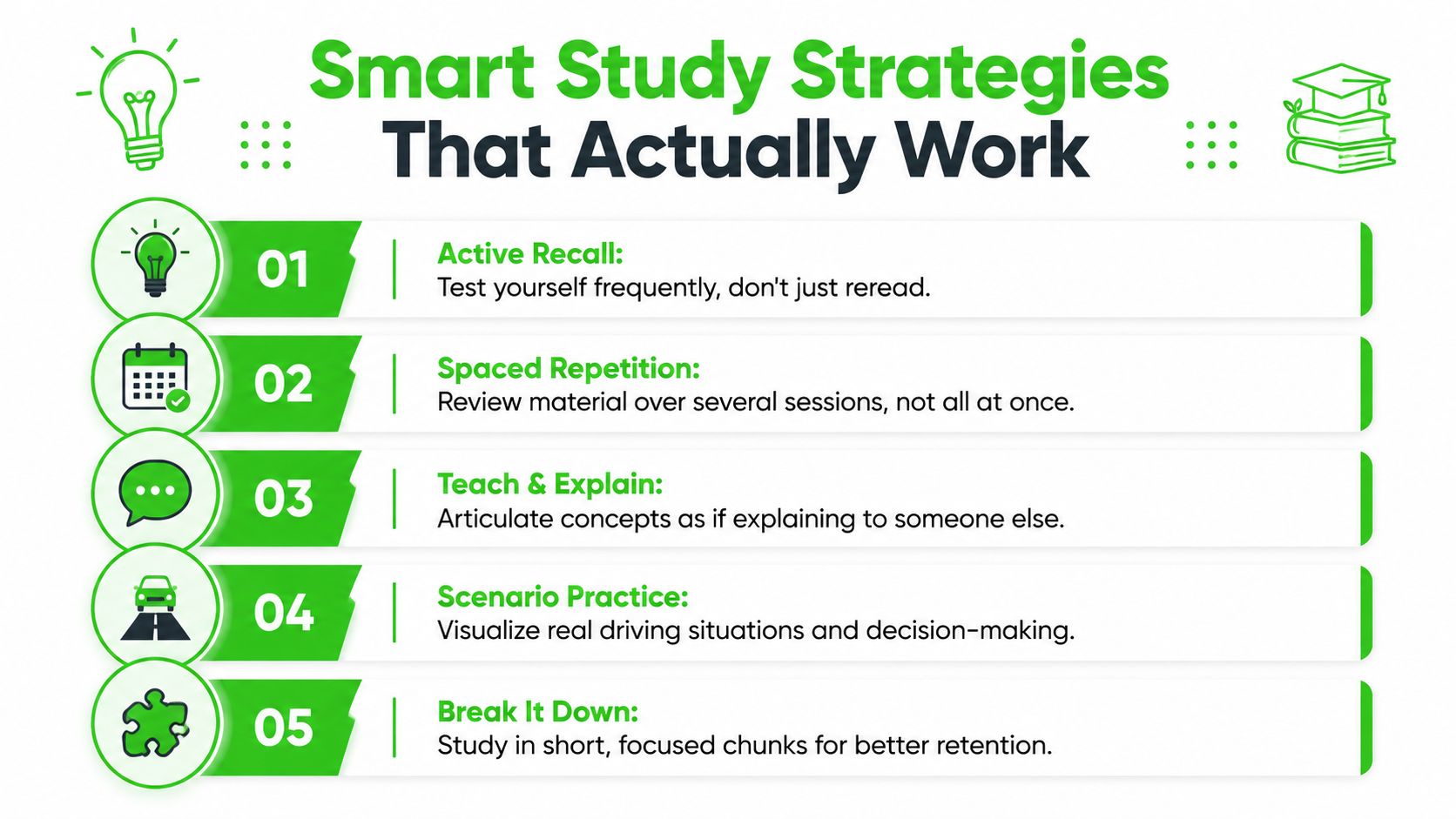
- Active recall: After each module, close your notes and explain the rule out loud in plain English.
- Scenario rehearsal: Take a common Georgia setting, like rain on GA-400 or stop-and-go traffic on I-75, and ask what a defensive driver would do first.
- Short note summaries: Write only the rule, the risk, and the reason. That keeps your notes usable.
- Spaced review: Break review into smaller rounds instead of one long cram session.
For students who need a refresher on learning technique itself, this guide to mastering active recall and spaced repetition is useful because it lines up well with how defensive driving material is retained.
Study cue: If you can explain a concept without looking at the screen, you're probably ready for the question.
Match your format to your habits
Not every student learns well the same way.
If you lose focus alone, a live virtual or in-person class may keep you engaged better. If your work schedule is chaotic, a self-paced option may give you enough breathing room to review carefully instead of rushing. The right format isn't the fanciest one. It's the one that makes you pay attention.
Students dealing with broader legal obligations should be even more deliberate. If your case also involves a Risk Reduction course, a clinical evaluation, treatment recommendations, or a Victim Impact Panel, keep each requirement separate in your notes so you don't mix one obligation with another.
Georgia Retake Policies and Next Steps After Failing
Failing a test feels bigger than it usually is. Most students take it personally when they shouldn't. A failed attempt usually means one of three things happened: you rushed, you guessed, or you misunderstood what the course was asking.
The right response is practical. Find out what the provider allows, confirm the timeline, and fix the weakness that showed up on the first attempt. If your course connects to a court matter, probation requirement, or reinstatement issue, don't ignore the deadline while you regroup.
Treat the first attempt as a diagnostic
Don't ask, "Why did I fail?" in a vague way. Ask better questions.
- Did I miss legal-compliance questions? That often means you studied general safety ideas but not the specific Georgia purpose of the course.
- Did I rush through scenario questions? That usually points to poor reading discipline, not lack of intelligence.
- Did I choose answers that sounded assertive instead of safe? That's a common pattern with drivers who are used to thinking in terms of right-of-way instead of collision avoidance.
Write down the themes you missed while they're still fresh. That turns a frustrating result into a map for the retake.
Know your consumer protections
Georgia-certified courses often have student-friendly policies. One documented example is that some certified courses provide a full refund if the student does not complete the course or earn a certificate, as long as the request is made within a timeframe such as 14 days (Georgia course refund policy example). Check the actual terms for your provider before assuming anything, but don't assume failure leaves you with no options.
That kind of policy matters for students whose schedules, court dates, or enrollment circumstances change.
A failed attempt isn't the end of the process. It's feedback.
What to do next
If you don't pass the first time, take these steps in order:
- Contact the school promptly. Ask about retake procedure, timing, and any documentation you need.
- Check your legal paperwork. If a judge or agency required completion by a certain date, protect that deadline first.
- Review by question type. Don't reread everything equally. Spend your time where you struggled.
- Retake with a slower pace. Most students improve when they stop trying to finish fast and start reading for meaning.
That approach is far more effective than hunting for a new batch of so-called answers online.
Turning Your Certificate Into Safer Georgia Driving

A certificate matters, but not for the reason many students think. The paper itself isn't the ultimate goal. The actual win is understanding how to make safer decisions when traffic turns ugly, another driver gets impatient, or you're tempted to drive like the rules only apply when police are watching.
That's why the search for defensive driving course answers should end in preparation, not shortcuts. The best answer on most quizzes is the one that reduces risk, follows Georgia law, and leaves room for other people's mistakes.
Use the course for more than compliance
Once you complete the class, apply the habits immediately:
- Back off earlier when traffic compresses on roads like I-285 or the Downtown Connector.
- Leave more room when weather cuts visibility in places like Athens, Marietta, or South Fulton.
- Watch your attitude when another driver does something foolish. Retaliation is not defensive driving.
- Separate legal requirements clearly if you're also dealing with DUI-related obligations such as Risk Reduction, evaluations, or treatment steps.
Drivers who take the material seriously often find the course does more than satisfy a requirement. It gives them a repeatable decision process.
Keep the benefit moving forward
If part of your goal is insurance savings, the next step is making sure you understand how completion may help with premiums through your carrier. This overview of a defensive driving course to lower insurance is a practical next read because it connects the certificate to a real-world outcome without turning the course into a gimmick.
The safest driver in the room usually isn't the fastest thinker. It's the one who keeps enough margin to make a good decision on time.
That's the actual answer students are looking for, even if they don't phrase it that way at first.
If you need a Georgia-approved class for points, insurance, or a court-related driving requirement, Georgia DUI Schools offers defensive driving options online, live virtual, and in person. Start with the course page that fits this topic best at Georgia Defensive Driving.