An arrest doesn't automatically mean a DUI conviction. In a statewide analysis of crash and conviction records from 2017 through 2021, 54% of drivers whose most serious post-crash citation was DUI were ultimately convicted of DUI, while 17% received a lesser conviction such as reckless driving, according to the Georgia impaired-driving safety analysis. That distinction matters, but it doesn't mean you can wait for the criminal case to end before addressing your license.
If you're facing a DUI in Atlanta, Georgia, start by separating your court obligations from your Georgia Department of Driver Services requirements. Then build a reinstatement plan around your actual DDS record, not someone else's experience. A course certificate, fee receipt, or completed suspension period may satisfy one condition without restoring your driving privileges.
DUI Penalties and License Suspensions by Case
Georgia sets different suspension rules by age, BAC result, and whether you took or refused the test. Find your row first, then match it to the notice that names the legal basis for your suspension.
| Case | Trigger | Minimum suspension |
|---|---|---|
| Driver 21 or older, BAC 0.08 or higher | Presumed under the influence of alcohol | At least 12 months under the applicable first-suspension rule, with possible earlier reinstatement |
| Driver 21 or older, BAC below 0.08 | No per se alcohol threshold; a charge can still rest on evidence of impairment | Set by the conviction rather than a BAC tier, so confirm the exact term with DDS |
| Driver under 21, BAC 0.02 or higher | Presumed DUI under zero tolerance | At least 6 months below 0.08; at least 12 months at 0.08 or higher |
| Refusal of implied-consent test | Test refused at arrest | At least 12 months under the applicable refusal rule |
The thresholds and suspension tiers in this comparison come from the Georgia DDS driver manual: 0.08 or higher for drivers 21 or older, 0.02 or higher for drivers under 21, at least six months for the under-21 lower tier, and at least 12 months for the higher BAC tier or a refusal.
An adult below 0.08 can still face a DUI charge based on impairment. In that situation the suspension term follows the conviction rather than a fixed BAC tier, which is why the table sends that driver to DDS for the exact term. Planning around the six-month under-21 figure when it does not apply to your case is the kind of early misread that costs you twice: you arrange your schedule and your spending around the wrong term, then start over once the actual notice arrives.
Match the rule to the person and the notice
For the adult higher-BAC row, distinguish the stated suspension term from eligibility for earlier reinstatement. A driver may qualify to apply before the full term ends, but only after satisfying the applicable conditions. That is an application opportunity, not automatic permission to drive.
For the underage row, the lower threshold matters even when the driver believes the result was too low for consequences. The higher BAC tier carries the longer minimum described in the table. A refusal sits in its own category, so the absence of a measured BAC does not mean there is no licensing issue.
Administrative suspension and conviction-related suspension work differently. Administrative action can begin before the criminal court resolves the charge, and a pending court date does not necessarily protect your license.
Practical rule: A BAC result, a refusal notice, and a conviction notice work like three separate locks on the same door. Satisfying one does not release the others, so read the suspension basis before comparing suspension lengths.
Use this short check before making plans:
- Locate the test result or refusal notation on your arrest and suspension paperwork.
- Match your age and the stated suspension basis to the relevant rule, rather than choosing the shortest row.
- Confirm the actual term with DDS. Prior convictions, other case circumstances, or separate suspensions can change your path.
These are license consequences, not a complete criminal sentencing chart. Your attorney should address the charge, potential sentence, and available defenses separately.
How an Atlanta DUI Case Moves from Arrest to Court
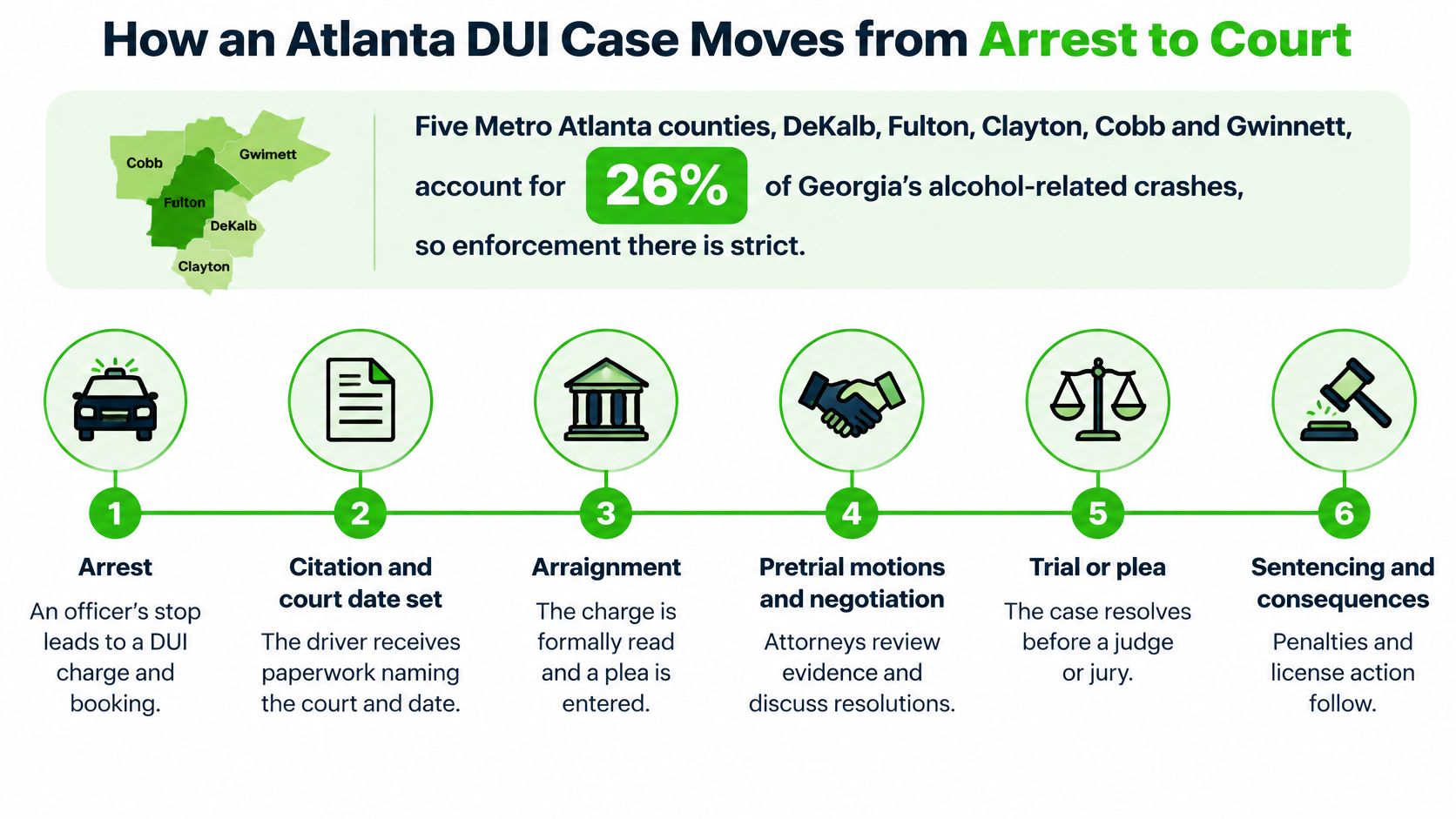
DeKalb, Fulton, Clayton, Cobb and Gwinnett accounted for 26% of Georgia's alcohol-related crashes, according to the Georgia traffic-safety analysis. For someone arrested in metro Atlanta, the immediate challenge is identifying which agency needs a response and which deadline comes first.
Say you're stopped in Atlanta after leaving dinner. The case may follow this general sequence, although the paperwork and court assignment control your actual obligations:
- Traffic stop and investigation. An officer investigates suspected impairment, potentially using field sobriety exercises or breath testing.
- Arrest and booking may follow, along with arrangements for the vehicle, including possible impoundment.
- License-related reporting. A chemical-test result or refusal can lead to a separate DDS administrative process. Don't assume booking itself tells you the effective suspension date.
- Review any suspension notice immediately for the deadline and procedure to request a hearing. Get legal help before that deadline passes.
- Arraignment. Attend the court named on your citation or subsequent notice. That may be Atlanta Municipal Court for a city case or another court with jurisdiction.
- The charge proceeds through evidence review, negotiations, a plea, or trial.
- Sentencing after a conviction can include a Risk Reduction requirement and other probation or court conditions.
The court process and licensing process overlap, but they don't move on the same schedule.
Identify which clock a notice belongs to
A court notice generally identifies a court, case number, appearance date, or sentencing obligation. A DDS notice concerns your driving privilege, suspension basis, effective date, hearing options, or reinstatement conditions. Keep both, even when they concern the same arrest.
The distinction is particularly important when testing is involved. Review the explanation of Georgia implied consent with your attorney so you understand how the test request or refusal connects to your licensing paperwork.
Create separate calendar entries for court appearances and DDS deadlines. If a notice is unclear, identify its issuing agency and ask your attorney which action it requires. Never substitute a court date for a DDS response deadline.
Georgia DUI Risk Reduction Program Requirements
A Risk Reduction certificate works like a boarding pass with two required stamps: Georgia mandates a screening assessment followed by an intervention course, and the certificate issues only after both are complete. Skipping ahead to the intervention, or finishing one component and assuming the other is optional, costs you the fee and the weeks you already spent.
The Georgia DDS DUI FAQs describe a 130-question NEEDS Assessment, followed by a 20-hour intervention course, and list the total program cost as $360.00. The assessment screens alcohol and drug use and how that use affects driving. The intervention combines therapeutic education with peer-group counseling across multiple group sessions.
Complete the assessment before the intervention
The certificate depends on this order, so work through it step by step:
- Complete the NEEDS Assessment. Answer accurately so the screening reflects your actual circumstances. A clinical evaluation, when your case requires one, is a separate appointment with its own provider.
- Enroll in the intervention through a DDS-approved provider. Confirm you are registering for DUI/Risk Reduction rather than a similarly named driving course.
- Attend every required group session. Compare the full schedule against work, childcare, transportation, and court obligations before booking. A missed session can push your completion date past a DDS or court deadline.
- Receive your certificate only after both components are done. An enrollment confirmation or payment receipt proves you paid, not that you finished.
- Keep copies for each recipient. Save the certificate electronically and keep a readable copy ready for DDS, the court, or probation when required.
For an Atlanta driver relying on someone else for a ride, a location you can reach every session beats the earliest available start date. A schedule you can finish is worth more than one you will have to interrupt.

Check the course format before paying
DDS does not accept certificates from online DUI/Risk Reduction courses for Georgia licensing or driving-privilege purposes. A website advertising a DUI certificate does not prove DDS will accept it, so confirm the delivery format before purchasing anything described as virtual or online.
Self-paced online defensive driving is a separate category. Georgia DDS does not accept those courses for point reduction, court orders, or license reinstatement. They generally count only toward an insurance discount, and only after your insurer confirms it.
A convenient course is only useful if the agency requiring it accepts the certificate.
A Georgia conviction follows you even if your home does not. A DUI client convicted in Georgia who lives in another state must complete a substantially similar DUI intervention program that is certified in the home state, runs at least 20 hours, and is verified by Georgia DDS. Confirm that verification path before paying for a local course, because a home-state certificate is not automatically sufficient because the program covers alcohol and driving.
Repeat Offenses, Ignition Interlock and Clinical Evaluations
| Case | Required suspension | Added requirements |
|---|---|---|
| First DUI conviction, age 21 or older | 12-month suspension, with eligibility to apply for reinstatement after 120 days | DDS-approved Risk Reduction certificate and reinstatement fee |
| Second DUI conviction within five years | At least 18 months, with no driving privileges for the first 120 days | Certified ignition interlock for 12 months where required, calibrated and monitored every 30 days |
| Two or more DUI convictions within ten years | Term set by the DDS record for the driver's conviction history | Documented state-approved clinical evaluation required for multiple convictions |
| Under 21, zero tolerance violation | The underage BAC or refusal rule shown on the DDS notice | Risk Reduction requirement for DUI reinstatement, regardless of the qualifying BAC tier |
The Georgia DDS reinstatement guide describes the adult suspension terms in this comparison, including the 120-day first-offense eligibility point and the 18-month minimum for a second conviction within five years. The Georgia DDS ignition-interlock documentation covers the device conditions: 12 months of interlock use where required, with calibration and monitoring every 30 days. Where the record shows multiple DUI convictions, DDS requires a separate clinical evaluation and sets the suspension term on the individual record.
Interlock compliance requires ongoing records
An ignition interlock demands attention for the entire period it is installed. The certified provider must calibrate and monitor it on the required schedule, and DDS expects a full monitoring report when you apply for reinstatement or a different permit. A gap in that report can stall an otherwise complete application.
For a driver commuting from Marietta into Atlanta, service appointments belong in the transportation plan from day one. Keep installation documents, service confirmations, and monitoring records together. Owning an equipped vehicle does not by itself establish eligibility to drive it.
Verify the requirement on your DDS record before paying for installation. Confirming first costs less than removing a device you were never ordered to use. The overview of an ignition-interlock restricted license can help you prepare questions about the permit you are seeking, while the record determines which restriction and process apply.
Clinical evaluation is a separate requirement
A state-approved clinical evaluation differs from the NEEDS Assessment built into the Risk Reduction course. If your record lists an evaluation, you need separate documentation showing that condition was satisfied. A course certificate presented in its place leaves the requirement open.
The evaluation also uses its own lookback period, which differs from the five-year repeat-offense suspension window. A conviction that falls outside one window can still count toward another condition, so list each requirement separately and attach the record that satisfies it.
Keep the requirements separate: Course completion, clinical documentation, interlock compliance, and suspension timing aren't substitutes for one another.
A completed course can leave several conditions unresolved for a repeat-offense driver. Organize the reinstatement file by requirement rather than by the order receipts arrive. Missing clinical reports and monitoring documents are easier to spot before the packet goes to DDS, and catching them early costs less than rescheduling appointments after a rejection.
Reinstating Your Georgia Driver's License Step by Step
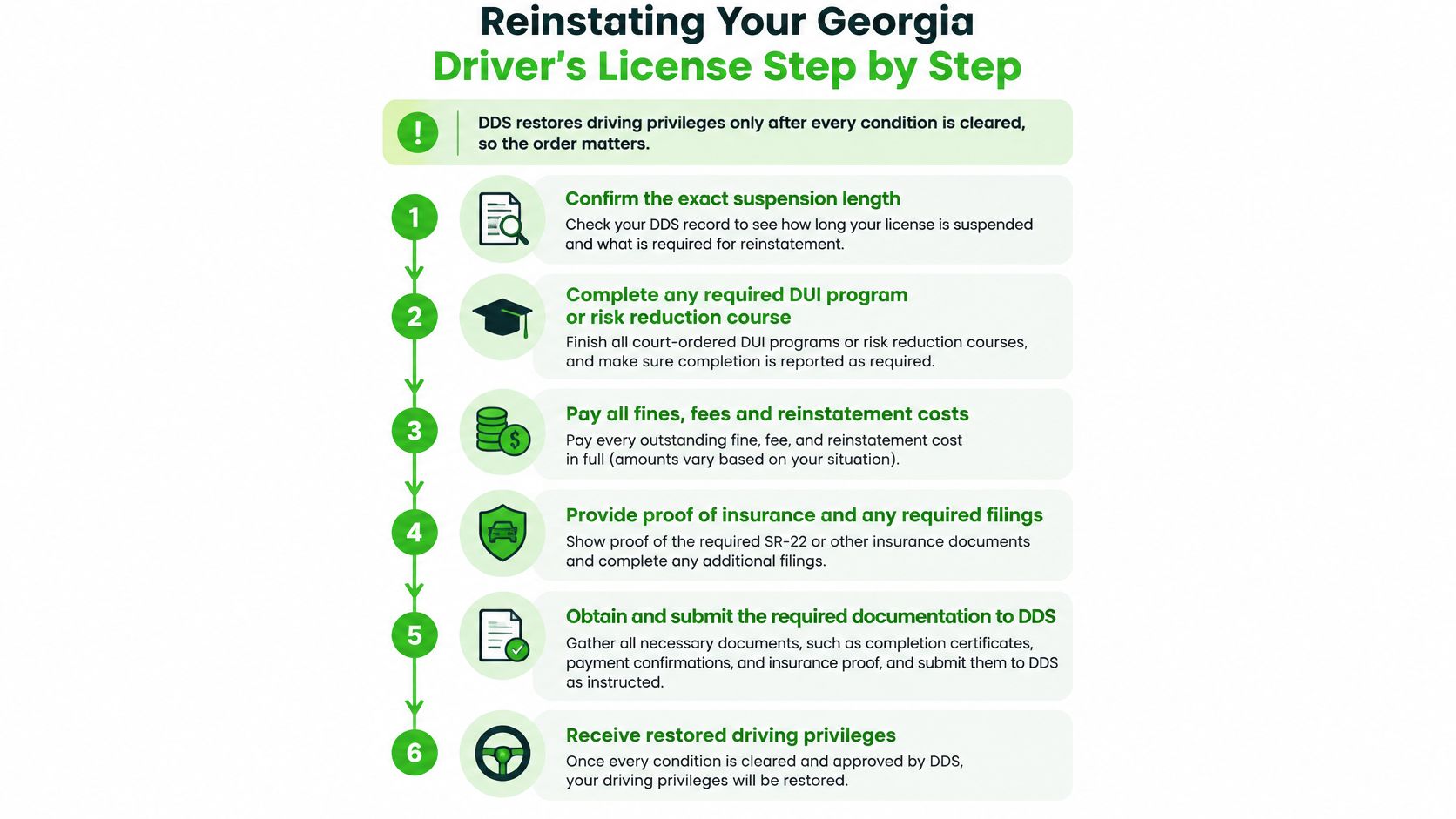
DDS restores driving privileges only after all applicable conditions have been satisfied and processed. The order matters because an unresolved suspension or missing document can prevent reinstatement even when you've completed other requirements.
For a driver age 21 or older with a first DUI conviction, the Georgia DDS reinstatement guide describes a 12-month suspension, with eligibility to apply after 120 days when the required conditions are met. Eligibility to apply isn't confirmation that your license is valid.
Build your packet from the DDS record
Confirm the exact suspension and every open restriction. Obtain your DDS reinstatement requirements and compare them with your court documents. Check the effective date and whether another suspension remains open. Completing the DUI requirements won't resolve an unrelated hold automatically.
Ask whether you qualify for a limited driving permit for permitted travel, such as work or school. Explain your actual situation rather than assuming a coworker's permit rules apply to you. If a permit is issued, read its restrictions before making trips between Atlanta, Decatur, or other metro communities.
Confirm course acceptance and timing, then complete the required program. Don't assume you must wait until the suspension ends to attend, and don't assume any earlier certificate will automatically satisfy your case. Have DDS or your attorney confirm applicable timing conditions before you spend money. The reinstatement eligibility date and the class attendance date are different questions.
Gather the identity, court, and completion documents DDS requires. Check that names, identifying information, and case details match. If your record requires an evaluation, use the Georgia DUI clinical evaluation information to distinguish that documentation from the class certificate. Missing required court paperwork can leave the application incomplete.
Pay the applicable reinstatement fee using the method DDS specifies. Keep the receipt with your application records. Payment alone doesn't restore driving privileges, and court payments shouldn't be assumed to satisfy a separate DDS fee.
Submit the complete packet and verify your driving status before driving. Confirm that DDS has processed every requirement and cleared every applicable suspension. Repeat-offense applicants should also verify that interlock service and monitoring records remain current while the application is pending.
This visual summarizes the process, but your individual DDS requirements remain the controlling checklist.
Resolve missing pieces before returning to the road
Suppose an eligible first-offense driver submits the course certificate and fee but leaves out required court documentation. The driver hasn't finished the process merely because the payment went through. DDS still needs the missing item before it can complete the review.
Insurance deserves a separate check, too. If coverage lapsed while the vehicle wasn't being driven, the Policy Quail lapse recovery guide offers a practical starting point for addressing the coverage gap. Confirm any case-specific insurance or filing requirement with DDS and your insurer.
Look for DDS confirmation that your privilege has been restored, supported by your current license status, rather than relying on a school certificate or bank transaction. If an online status screen and a notice appear inconsistent, resolve that discrepancy with DDS before driving.
Keep a copy of every submission, receipt, and confirmation. Follow the conditions on your DDS notice in order, and record when each item was accepted, not just when you sent it.
Enroll in a DDS-Approved Atlanta Risk Reduction Course
Once you understand your DDS conditions, choose a program location and schedule you can complete without interruption. Georgia DUI Schools is a state-certified DUI school certified by the Georgia Department of Driver Services. Our Atlanta DUI School is at 2000 Cheshire Bridge Rd. Suite D, Atlanta GA 30324.
We have 18 locations serving Atlanta-area communities and Athens, including Buford, Conyers, Decatur, Douglasville, East Point / College Park, Forest Park, Gainesville, Johns Creek, Jonesboro, Kennesaw, Lawrenceville, Marietta, Riverdale, Roswell, Sandy Springs and Snellville. Choose based on where you can reliably attend, not just where you live. Someone working in Atlanta but staying with family in Roswell may need to compare both locations.
Make the booking match your requirements
Enrollment follows this sequence:
- Select the Risk Reduction class. Use the requirement named on your DDS or court paperwork so you don't purchase defensive driving when you need DUI intervention.
- Pick the location that best fits your transportation and attendance arrangements.
- Book a date after checking the full schedule, assessment instructions, and any timing requirements attached to your case.
Before booking, confirm the provider's DDS certification and clarify any uncertainty about your suspension status. Bring your requirement list to the conversation, especially if your paperwork also names an evaluation, treatment, or another court obligation.
You don't need to solve every part of the criminal case before organizing your education requirement. You do need to know which program is required, whether the format is accepted, and how completion fits your individual reinstatement plan.
Georgia DUI Schools offers DDS-approved Risk Reduction education to help Atlanta-area drivers complete the education component of DUI reinstatement. Visit Georgia DUI Schools for school information, then review the Georgia DUI course options and book a session that fits your verified requirements and schedule.