You're home after a DUI arrest, looking at a court date, release paperwork, and possibly a notice about your license. You still need to get to work, arrange childcare, and figure out whether signing up for a class means you can drive again. It's understandable if those documents seem to describe different processes, because they do.
Understanding what happens after a DUI in Georgia starts with separating the criminal case from the licensing process administered by the Georgia Department of Driver Services, or DDS. Your court appearance, suspension effective date, course deadline, and eligibility for a driving permit aren't interchangeable. Keep each date separate, and don't assume that resolving one requirement resolves the others.
Georgia DUI Penalties at a Glance
A Georgia DUI arrest can create a court date, a DDS suspension date, and a course or reinstatement requirement at the same time. Each one has its own clock. Match the paperwork to the penalty category before assuming that one deadline explains another.
Use this Georgia DUI penalties guide to place the case categories below in context.
Georgia DUI consequences by case
| Case | License suspension | Other consequences and requirements |
|---|---|---|
| First DUI, driver 21 or older, BAC .08 or higher | 12-month minimum suspension | Risk Reduction program required; reinstatement requires satisfying DDS conditions |
| Second DUI within five years | 18-month minimum suspension | 120 days with no driving privileges; possible interlock eligibility afterward, subject to approval |
| Third offense within five years of a second | Five-year revocation | At least 15 days jail; $1,000 to $5,000 fine; at least 30 days community service; possible habitual-violator declaration |
| Refused chemical test | Minimum one-year suspension | Ineligible for a limited driving permit after a first DUI conviction under the applicable refusal rules |
These rows identify baseline consequences. Injuries, prior convictions, test results, and the particular charges can change what a driver must do.
The court and DDS handle different responsibilities
The court addresses the criminal charge and imposes any sentence following a conviction. DDS determines license status, applicable suspensions, permit eligibility, and reinstatement requirements. Paying a court fine leaves a DDS suspension in place until DDS confirms that the reinstatement conditions have been satisfied.
Administrative license consequences can begin while the criminal case remains unresolved. Waiting for the court case to finish can therefore leave licensing paperwork unanswered and shorten the time available to request review or pursue permit eligibility.
The Risk Reduction program sits beside the court and DDS tracks. A certified school issues a Certificate of Completion after the Assessment and Intervention components are finished. That certificate provides required completion proof, while DDS still decides when driving privileges can be restored.
If a suspension leaves no permit eligibility, course enrollment or the need to get to work does not create permission to drive. A limited permit or approved interlock option must be confirmed by DDS before the driver gets back on the road. The second-offense row shows the distinction clearly: driving privileges stop for the stated period, and interlock eligibility may become available afterward.
Practical rule: A receipt showing a paid court fine proves payment. Only DDS can confirm restored driving privileges.
Find the row that most closely describes your situation, then compare it with your actual paperwork. Check the arrest date, administrative notice date, suspension effective date, and court appearance date separately. If the documents appear inconsistent, ask your attorney to review the legal issue and DDS to confirm your licensing status. A course provider can explain enrollment and completion documents, but DDS controls whether a suspension applies and when you may legally drive.
The First Days After a DUI Arrest in Georgia
Say you've been arrested in Atlanta and released with a court date. A friend in Athens says their paperwork looked different, so now you are wondering whether yours is wrong. Release steps, court assignment, and scheduling can vary by jurisdiction. Your own notices matter more than someone else's timeline.
From booking to the next hearing
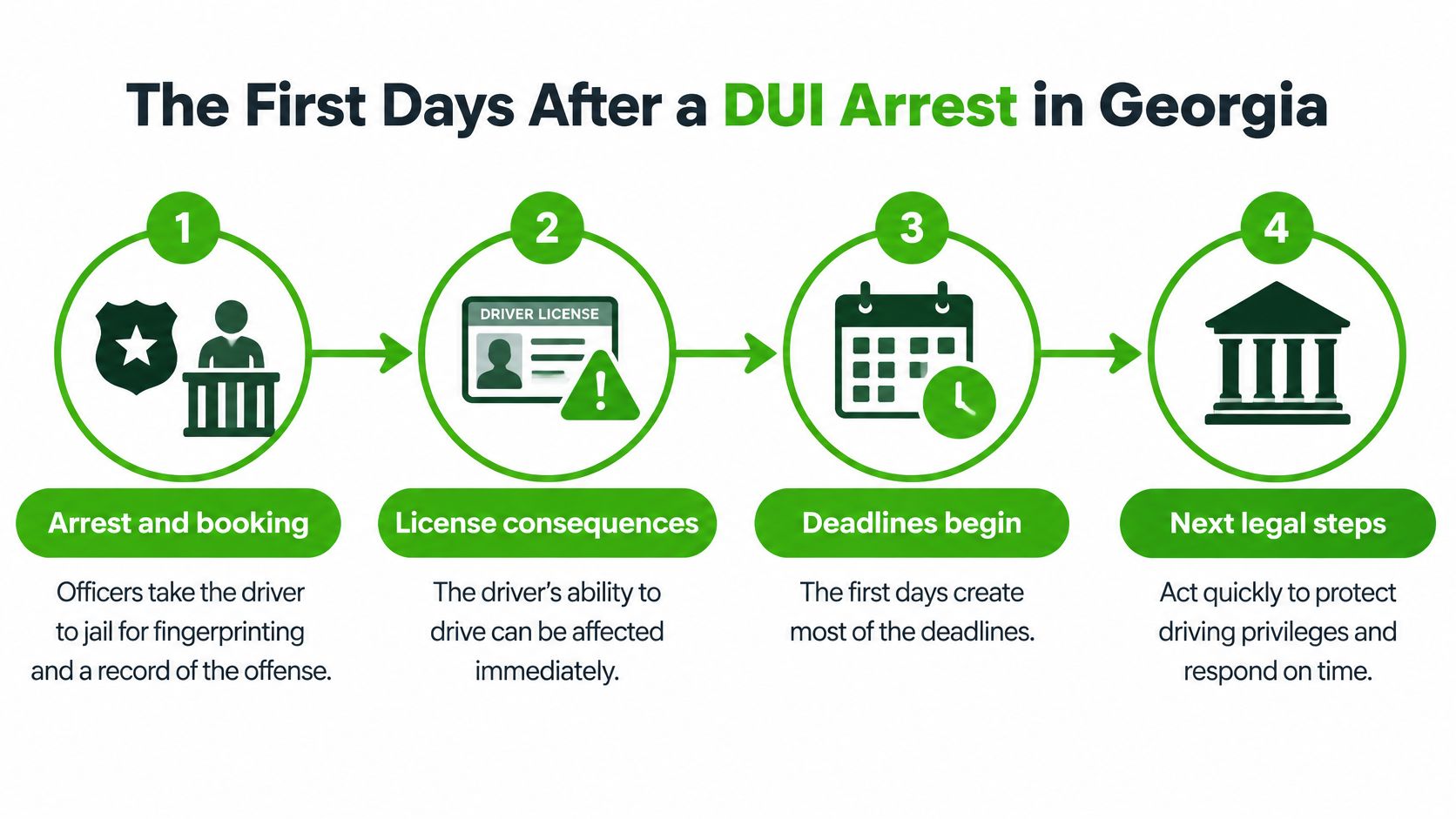
Arrest and booking generally involve transportation to jail, fingerprinting, and a record of the alleged offense. Your vehicle may be towed or impounded. Keep the release paperwork, property receipt, towing information, and court notice together so a practical problem does not make you miss a legal deadline.
Release arrangements are separate from the merits of the DUI charge. If release involves a bond in Forsyth County, families may come across options such as 24/7 Forsyth County bonding assistance; what controls your next step is still the release order, any conditions, and the court date written on your paperwork.
Chemical testing and licensing paperwork need prompt attention. A breath or blood test, or a refusal, can raise an implied-consent licensing issue that runs beside the criminal case. Have an attorney review any administrative notice immediately, rather than waiting until the appearance date printed on a citation.
Here is the confusion to avoid: the citation tells you where to appear for the criminal charge, while a DDS or implied-consent notice can start a separate license clock with its own instructions. Treat them as two tracks sharing one arrest date.
Court proceedings may involve different courts at different stages, including magistrate, municipal, state, or superior court, according to the charge and jurisdiction. An early appearance may address release conditions, charges, or future scheduling. It may leave the underlying case open.
Resolution doesn't eliminate compliance work
A plea, trial, or dismissal determines how the criminal matter ends. If requirements are imposed, follow the written order and document completion by the applicable deadlines. Ask each office a plain question: “What exact date controls this requirement?”
Do not assume the suspension question is settled because the court case is pending or because a fine has been paid. Before driving to work, school, court, or treatment, confirm your current DDS status and ask whether any limited permit applies. If no lawful driving privilege is in place, arrange another ride.
An Atlanta driver may need to organize notices from different offices. An Athens driver whose case is pending elsewhere may need to coordinate travel and document delivery with another county. Neither should assume that a school, court clerk, or lawyer automatically sends every record to every recipient.
During the first week, take these actions:
- Record every date: Put court appearances, notice-response deadlines, towing or impound deadlines, and bond-review dates on one calendar, copied from the actual documents.
- Separate the two tracks: Label which papers belong to the criminal case and which belong to DDS or implied consent, then ask who answers questions for each.
- Request your DDS status: Obtain the suspension information and confirm what is currently effective before you drive.
- Ask about lawful driving early: If your license is not fully valid, ask DDS and your attorney whether a permit is available and what limits it carries.
- Keep the evidence of compliance: Save receipts, notices, correspondence, certificates, proof of submission, and copies of anything handed to a clerk or sent electronically.
If a deadline is unclear, resolve the uncertainty promptly. A friend's timeline, another county's routine, or another state's hearing window cannot replace the instructions governing your case.
How to Reinstate Your License After a DUI
Reinstatement is an application process, not an automatic result of finishing court. For a first DUI offense involving a driver age 21 or older, the Georgia DDS first-offense guidance describes a 12-month suspension, with eligibility to apply after 120 days if the required conditions are met, and lists reinstatement fees of $200 by mail or $210 in person.
That earlier application opportunity doesn't mean everyone becomes eligible on the same schedule. Other suspensions, a refusal, or unresolved conditions can affect the path available to you.
Follow the DDS requirements in order
Confirm the suspension effective date and waiting period.
Ask DDS which date controls the applicable waiting period. Don't count automatically from your court date, arrest date, or the day you paid a fine. If you have more than one licensing action, ask which requirements apply to each.Complete the approved DUI Alcohol or Drug Use Risk Reduction Program.
Use a certified school and allow enough time for the assessment and the intervention schedule. Enrollment alone isn't completion, and a payment receipt doesn't show that you fulfilled the education requirement.Obtain the official Certificate of Completion.
Upon successful completion of both DUI components, the certified school issues this certificate. It's the legal proof needed for court or DDS reinstatement. Keep the original safe, make a digital copy, and follow the receiving office's instructions about what to submit.Pay the applicable reinstatement fee.
Follow DDS instructions for your payment method and application route. A court payment and a reinstatement payment serve different purposes, so retain separate receipts.Submit the required documents and verify the result.
Obtain your individualized reinstatement requirements from DDS, complete the applicable application or submission process, and address any outstanding conditions. Don't drive merely because you mailed the paperwork.
Check the file before applying
A complete submission is easier to evaluate than a folder containing unexplained receipts. Put your identifying information, suspension notice, completion certificate, and payment confirmation together, and keep a copy of the packet.
- Eligibility date confirmed: DDS has identified when you may apply.
- Education documented: Your official certificate is available.
- Other conditions checked: You've addressed any separate evaluation, treatment, monitoring, or court obligations that apply.
- Submission instructions followed: You've used the documents and payment method DDS requires.
- Driving status verified: DDS has confirmed the status that permits you to resume driving.
A court order may describe what you must accomplish. It isn't, by itself, confirmation that your license is valid.
If your application is incomplete, ask exactly what remains outstanding and where it must be sent. Keep the response with your reinstatement records rather than relying on memory.
How the DUI Risk Reduction Program Works
The DUI Alcohol or Drug Use Risk Reduction Program is a structured education requirement, not an ordinary defensive driving class. You can't substitute a different course just because it's shorter, cheaper, or available sooner.
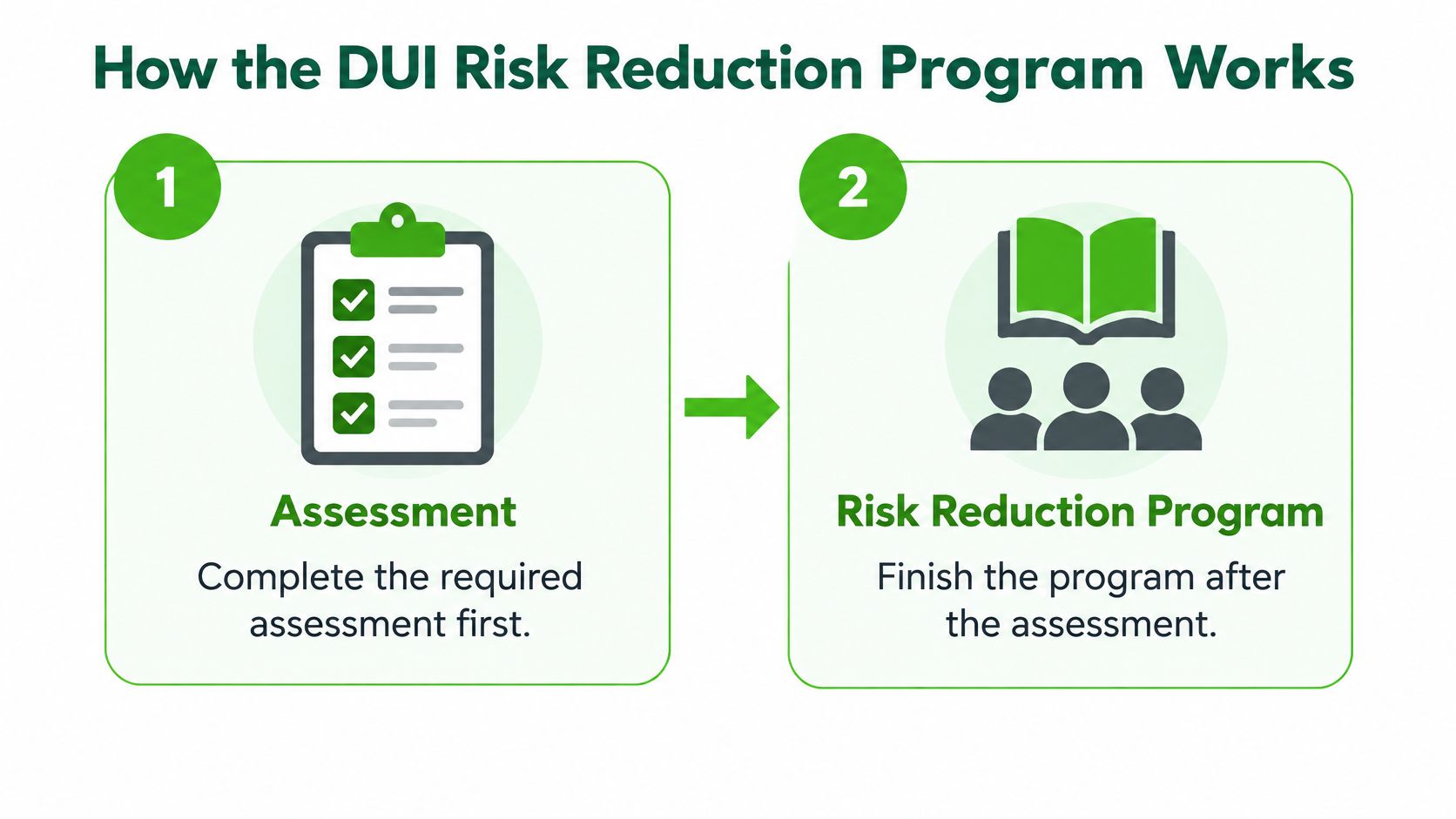
The Georgia DDS DUI program FAQs describe the required sequence as a 130-question NEEDS assessment, followed by a 20-hour Intervention Component delivered across multiple sessions. DDS identifies therapeutic education and peer-group counseling as parts of the intervention and requires a certified provider for accepted programs.
Complete the components in sequence
Start with the Assessment Component.
The NEEDS assessment screens alcohol and drug use and how that use affects driving. It isn't a pass/fail test. At our school, the assessment takes 25 to 45 minutes and must be finished before you take the class.Attend the Intervention Component.
The instruction combines education with guided group discussion about alcohol, drugs, decisions, and driving. The purpose is to examine risk and develop safer choices, not collect a signature for attendance.Reserve the entire schedule.
The intervention can't be completed in one day. A common schedule runs Friday evening, all day Saturday, and all day Sunday, or across several evenings. Check the actual session times before arranging work shifts, transportation, or childcare.Finish both components to receive the certificate.
Completing the screening without attending the intervention doesn't satisfy the program. Neither does attending part of the instruction.
Plan for attendance, not just enrollment
When you register, read the attendance policy before choosing a date. At our school, students who are late for any intervention session may be denied entry, can't make up the missed time, and must re-register and pay the full course fee to begin a new program.
That makes transportation planning especially important during a suspension. Arrange a lawful ride or select an available online format that fits your circumstances, and confirm any acceptance requirements in your order.
- For an in-person session: Plan your route, parking, and arrival time without assuming you may drive yourself.
- For an online session: Confirm the connection instructions and technical requirements before class begins.
- For either format: Protect the full class schedule from work calls, appointments, and other interruptions.
Confirm that the school is certified before paying. Our program is DDS-approved, but your court paperwork may also specify deadlines or separate requirements that need attention.
Bring your court paperwork and driver's license number to the first session. Having the correct identifying information available helps prevent avoidable mistakes in your completion records.
Clinical Evaluations, Treatment and Victim Impact Panels
The NEEDS assessment isn't a clinical evaluation, and a Risk Reduction certificate doesn't replace treatment or a victim impact panel. These requirements serve different purposes and may involve different recipients.
A Georgia DUI clinical evaluation is a separate clinical review that a court or DDS may require. If treatment is required following that evaluation, follow the prescribed schedule and retain the completion documentation. Don't assume that attending education sessions satisfies a treatment recommendation.
Match each obligation to its record
Say an Atlanta driver receives a county court order for an evaluation. The clinician identifies a need for treatment, so the driver schedules it and checks the completion requirements before submitting reinstatement paperwork.
An Athens driver whose case is pending in another county may discover that the evaluation report must reach the court before the next hearing. Attending the appointment alone won't establish that the required office received the report.
Keep these records separate:
- Risk Reduction certificate: Documents completion of the education program.
- Clinical evaluation: Documents the clinical review and any resulting recommendations.
- Treatment completion: Shows fulfillment of the required treatment plan.
- Victim impact panel attendance: Documents attendance if your order requires a panel.
Check your court order and DDS notices for panel requirements and acceptable attendance proof. For every document, identify who submits it, where it goes, and when it must arrive.
Driving Legally During a License Suspension
A DUI sets two tracks in motion. The court handles the criminal case on its own calendar, and DDS runs the license suspension on a separate clock. A court date can come and go while the suspension keeps running, so the question during that window is straightforward: do you hold valid authorization to drive, and does this specific trip fall inside it?
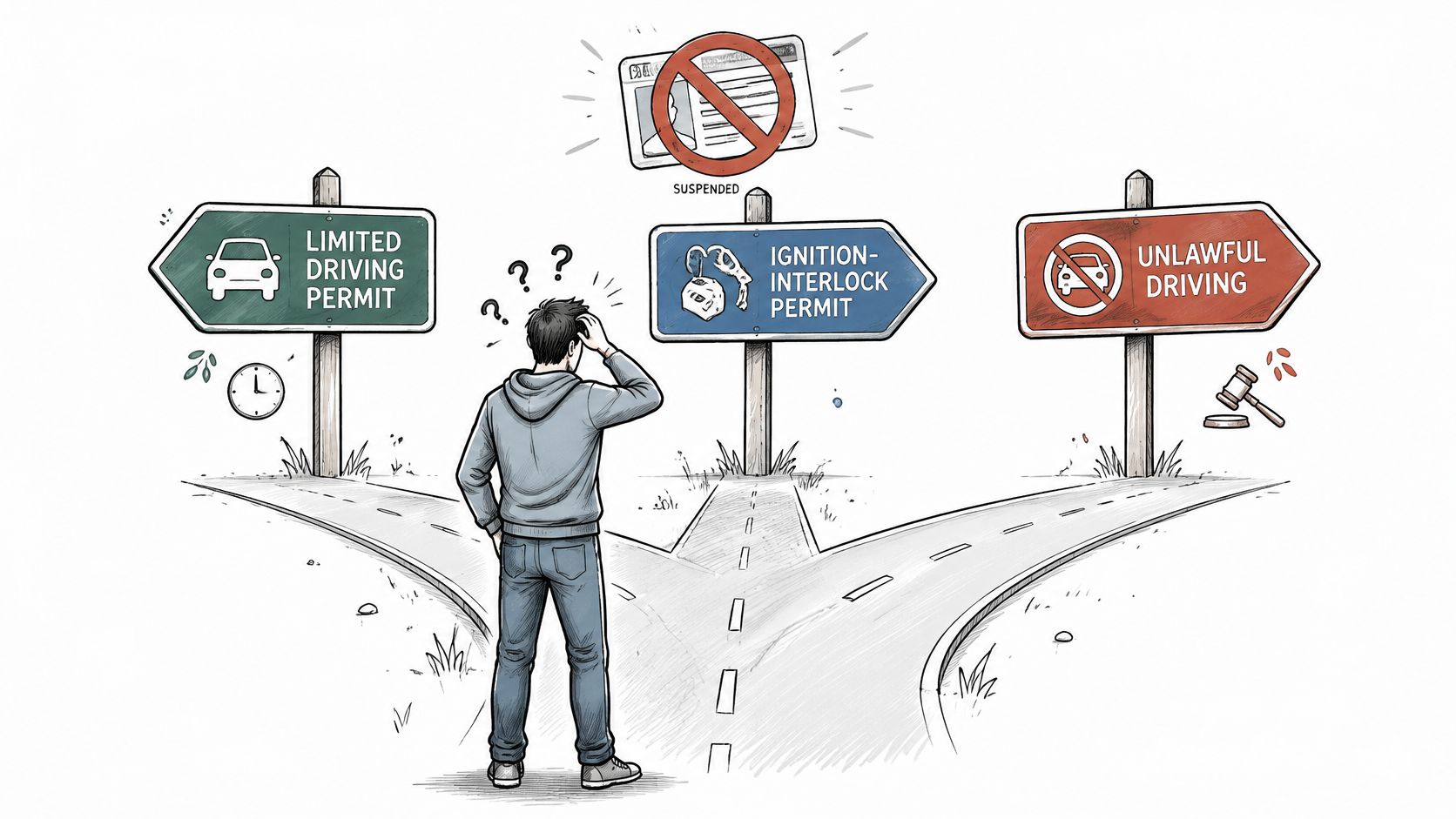
Some suspended drivers qualify for a restricted permit. Others cannot drive at all until the suspension period ends. A permit works like a visitor pass: it opens particular doors at particular times, and needing to get somewhere does not widen it.
Understand the available authorization
The Georgia DDS driving-permit guidance lists a $32 limited driving permit fee, with eligibility and restrictions determined by the specific suspension.
Options for driving during a Georgia suspension
| Option | Listed fee | What it means |
|---|---|---|
| Limited driving permit | $32 | Available to eligible drivers for the purposes authorized by the permit |
| Ignition-interlock permit | Set by DDS; the installer separately charges for device installation and monitoring | Requires a breath sample before engine startup and compliance with the interlock authorization |
| Unlawful driving | No permit | Driving without valid authorization during suspension isn't allowed and can add penalties |
A limited driving permit is a narrower authorization than a restored license. Read its stated purposes and conditions line by line. Permission for employment-related driving does not automatically extend to shopping, social visits, or every family obligation.
An ignition-interlock permit adds equipment conditions on top of travel limits. The device measures alcohol in the driver's breath and prevents engine startup when the result exceeds its programmed threshold. Installing the device is one step in the process; the permit itself and its other requirements must be in place before you drive.
The device is one part of your authorization
A NHTSA ignition-interlock evaluation reported a median 67% reduction in recidivism during installation, while finding that the protective effect largely disappears after removal. That supports treating the interlock period as part of an ongoing risk-management plan rather than a single installation appointment.
Follow the monitoring, maintenance, insurance, and reporting conditions attached to your authorization. A test refusal or repeat offense can change which options remain available.
For example, an Athens driver planning a treatment appointment should verify that the permit covers that travel before leaving. An Atlanta parent shouldn't assume a school drop-off is authorized because it's part of the normal morning routine.
Before taking the keys: Confirm both that you're authorized to drive and that the specific trip falls within your restrictions.
Check DDS Online Services or the DDS 2 GO app before driving. If your status or permitted purposes remain unclear, arrange another ride while you obtain clarification.
Repeat Offenses, Habitual Violators and Special Cases
A second or third DUI changes two things at once: the penalties the court can impose and the length of time DDS controls your license. Younger drivers and people who have moved out of Georgia face their own version of this split. The first-offense checklist stops being a reliable guide, so each of these situations needs an individualized review before you book classes or make transportation plans.
Repeat convictions and habitual-violator consequences
For a third offense within five years of the second, the Georgia DUI penalties guide describes a five-year license revocation, at least 15 days in jail, a $1,000 to $5,000 fine, at least 30 days of community service, probation, a mandatory clinical evaluation, and treatment if indicated. A probationary license may become available only after the first two years of that revocation, and certain prior convictions can disqualify a driver entirely.
A revocation works differently from a suspension. A suspension has a defined reinstatement path; a habitual-violator revocation removes driving privileges for a set term, and Georgia can also declare the driver a habitual violator and order the vehicle's license plate seized and forwarded to the Department of Revenue. The Risk Reduction course still sits on the requirements list, but completing it does not shorten the revocation or create eligibility for a probationary license on its own.
Consider a driver facing another conviction who needs transportation to a construction job. Finishing the 20-hour course satisfies the education requirement. It does not authorize a single trip to the job site. Any driving during the revocation has to rest on a probationary license with defined purposes, and eligibility for that license is a legal question, not a scheduling one.
Review the requirements for multiple DUI offenses in Georgia alongside the actual court order and your DDS record. A prior conviction that seems old can still count when DDS calculates the revocation period.
Younger drivers and out-of-state completion
Georgia's zero-tolerance rules require drivers under the applicable age limits to complete Risk Reduction regardless of BAC. Adult first-offense assumptions will miscalculate a younger driver's suspension length and permit eligibility, because the age-specific rules run on their own track.
A 19-year-old in Athens should have DDS confirm the age-specific licensing requirements rather than follow an older relative's reinstatement checklist. The education requirement answers one question. The license question is separate.
For a Georgia DUI client who now lives in another state, the intervention program must be substantially similar to Georgia's, certified in the home state, at least 20 hours long, and verified by Georgia DDS. A locally advertised DUI course is not automatically acceptable for the Georgia case. A driver who moved away after conviction should confirm the program's certification, instructional hours, and Georgia verification process before paying the home-state provider.
- For repeat offenses: Confirm revocation status and any probationary-license restrictions before driving.
- For younger drivers: Obtain the age-specific DDS requirements, not the adult version.
- For out-of-state completion: Verify Georgia acceptance before enrollment and keep the supporting documentation.
Choose the Right Georgia DUI Risk Reduction Course
Choose a DDS-approved DUI Risk Reduction course, not a general driving class. Before booking, identify the offense category, whether the driver is under the applicable age-specific rules, where the driver now lives, and which court or DDS deadline must be met.
Georgia DUI Schools is a DDS-approved provider serving Atlanta, Athens, and surrounding communities. We offer in-person and online DUI classes, with online options available statewide and DUI classes held every weekend. The total Risk Reduction program cost is $360.00; confirm the current price on the course page before paying.
Book around the actual deadline
Start by gathering your arrest paperwork and DDS suspension notice. Then choose the format and location that let you attend the entire schedule, including the assessment before class.
- Select the correct program: Match enrollment to the requirement in your paperwork.
- Choose a workable format: Account for lawful transportation or online participation.
- Book the date: Leave time to complete the program and submit the certificate.
Don't choose a session solely because it starts soon. Choose one you can finish and document on time.
At Georgia DUI Schools, we offer DUI Risk Reduction education, clinical evaluations, ASAM Level 1 treatment, and a Victim Impact Panel to help you address the separate requirements that may follow a DUI. Gather your DDS suspension notice, then enroll in the Georgia DUI Risk Reduction course and book your first session.