The court notice is on the kitchen table, the DDS letter is in the same stack, and the phrase substance abuse classes is the line you keep rereading. Maybe the stop was in Atlanta after a late shift, or the charge is a repeat DUI, or a drug case pulled your license into the same pile. A family member is already asking whether one class puts you back on the road before the suspension date.
A required class can close a legal step. It does not, by itself, answer whether you also need an evaluation, counseling, or medication. Georgia uses the DUI Alcohol or Drug Use Risk Reduction Program for certain license actions, and it uses a clinical evaluation as a separate decision when the case calls for one. People who treat those as the same booking end up with the wrong certificate, a missed panel, or a class a judge will not count.
Start with the offense printed on your order, not with the first course ad you see.
Georgia DUI Class Requirements by Case
The offense on the order picks the program. A Risk Reduction certificate and a clinical evaluation answer different questions, and booking only the class leaves a required evaluation unfinished.
| Case | Required program | Length | Key rule |
|---|---|---|---|
| First DUI conviction | DUI Risk Reduction Program (Assessment plus Intervention) | 20-hour intervention | DDS-approved; needed for certain license reinstatements |
| Repeat DUI conviction | Risk Reduction Program plus state-approved clinical evaluation | 20-hour intervention plus evaluation | Treatment may follow if the evaluation recommends it |
| Driver under 21 arrested for DUI | DUI Risk Reduction Program | 20-hour intervention | Required regardless of BAC level |
| Certain drug-possession offenses | DUI Risk Reduction Program | 20-hour intervention | Applies under DDS rules for drug offenses |
| Underage alcohol possession while operating a vehicle | DUI Risk Reduction Program | 20-hour intervention | Same two-part structure |
| Boating under the influence | DUI Risk Reduction Program | 20-hour intervention | Applies under the same program |
| Points reduction only | Certified defensive driving course | 6 hours | Up to 7 points once every five years |
| Conditional license request | Partial completion of the DUI program may be needed | Hours named on the DDS or court letter | Confirm with DDS and the court |
A first DUI conviction is the row most readers are in. The program has two mandatory parts, and they run in order: the Assessment Component first, then the Intervention Component. The assessment takes 25 to 45 minutes and must be finished before the class. The intervention is a 20-hour course that includes group counseling and education on alcohol and drug use and its effects on driving. The Georgia DDS first-DUI FAQ is clear that a DDS-approved Risk Reduction Program is what certain license reinstatements require. A repeat DUI conviction can also require a state-approved clinical evaluation, and treatment may follow if that evaluation recommends it. The class works on impaired-driving decisions. Clinical care, medication, counseling, and ASAM treatment stay separate when the evaluation or the order calls for them. No Certificate of Completion is issued until both components are finished, and that certificate is the legal proof used for court or for license reinstatement by DDS.
Rows people mix up
Drivers under 21 who are arrested for DUI still take Risk Reduction under Georgia's Zero Tolerance Law. The BAC reading does not waive the class. Certain drug-possession cases, underage alcohol possession while operating a vehicle, and boating under the influence sit on the same two-part program. A conditional license request can turn on partial completion, so the letter, not a guess, sets the hours.
Points reduction is a different product. A licensed Georgia resident can ask DDS to remove up to seven points once every five years after a certified six-hour defensive driving course, under the rules in the Georgia DDS defensive driving FAQs. A six-hour course does not replace Risk Reduction.
While the criminal case is still moving, DUI bail guidance from Cherokee Bail Bonds is a useful companion on how a Georgia DUI case travels from arrest into the license steps that follow. Bail status does not pick your class.
Before you pay anyone, answer three questions.
- Which offense is on the record: First DUI, repeat DUI, under-21 arrest, drug possession, underage possession in a vehicle, BUI, or points only.
- Who sent the order: The court, DDS, or both, and whether a panel or evaluation is written on it.
- Whether the license is suspended now: Reinstatement, a conditional request, and a points-only goal are not the same booking.
Practical rule: Match the court order or DDS letter to one row, then call the school with that row in hand.
When a Class Is Not Enough and Treatment Is Needed
A person may finish Georgia's required DUI class and still need clinical care. The Risk Reduction program provides education about alcohol and drug use, its effects on driving, and group counseling. It is a legal program requirement, not a diagnosis or a substitute for treatment when an evaluation identifies a clinical need.
The distinction matters because substance use disorders vary in severity. The 2023 National Survey on Drug Use and Health reported that 55.8% of people with a past-year substance use disorder had a mild disorder, while 21.3% had a severe disorder. A class can address impaired-driving risks, but a person needing treatment may require a separate clinical plan.
What the next step looks like
| Situation | Typical next step | Why it matters |
|---|---|---|
| Repeat DUI conviction | State-approved clinical evaluation | Evaluation results can add requirements beyond the class |
| Opioid use disorder | Medication options (methadone, buprenorphine, naltrexone) with counseling | Continued care can support treatment participation |
| Stimulant use disorder | Contingency management | It is a behavioral treatment option, though availability may be limited |
| Withdrawal risk or co-occurring mental illness | Clinical referral alongside or before the class | Classroom education cannot manage these needs |
| First offense with no clinical flags | Risk Reduction class may satisfy the legal requirement | Confirm sufficiency with the court or DDS |
Behavioral treatment addresses patterns that classroom education alone may not change. The NIDA treatment and recovery overview describes cognitive-behavioral therapy, motivational approaches, contingency management, and individual, group, or family counseling. These approaches can focus on triggers, cravings, problem-solving, and coping skills. For opioid use disorder, the overview names methadone, buprenorphine, and naltrexone as medication options, generally combined with counseling.
For people involved in the justice system, attendance alone does not show whether treatment is meeting the need. The NIDA criminal-justice treatment guide discusses treatment outcomes and identifies contingency management as an effective behavioral option for stimulant use disorders, while noting that it may not be widely available. If an evaluation recommends treatment beyond the class, ask what referral or level of care is available.
A repeat conviction may call for a state-approved clinical evaluation in addition to the class. Withdrawal risk or a co-occurring mental health concern calls for clinical attention, not more classroom discussion. If an evaluation recommends outpatient care, ASAM Level 1 treatment in Georgia may be a relevant option. The class requirement and the treatment recommendation are separate questions, so check the court order or DDS notice and follow the evaluation's instructions.
Required classes can also sit alongside other obligations in different legal settings. Understanding CPS parenting classes in Texas explains how a class may be one part of a broader service plan.
Check whether the evaluation or court order requires care beyond Risk Reduction. If it does, arrange the referral within the deadline on the order rather than waiting until the class is finished.
Victim Impact Panels and Habitual Offender Rules
A Victim Impact Panel is a session where people hurt by impaired driving, or their family members, describe what changed in their lives. The point is to make the harm specific. It is not group therapy, and it is not the 20-hour intervention. Some Georgia courts order the panel beside Risk Reduction. Others do not. Read the order, then schedule only if it is listed. Our Georgia victim impact panel page is the place to check session timing once you know the court wants it.
Habitual violator status is a license problem, not a classroom problem. Georgia's habitual violator law can bring a long revocation after repeated serious traffic convictions inside a set period. The count and the window depend on the offenses on your record. A completion certificate does not erase that status, and a certificate from a school that is not DDS-approved will not satisfy the Risk Reduction requirement either.
Other states use their own habitual formulas, which is why copying a friend's advice fails. Challenging a five-year license revocation, from Ticket Shield, PLLC, shows how a Florida habitual traffic case turns on the convictions and the statute, not on a class certificate. Georgia's list is Georgia's. If the notice uses habitual violator language, talk with a licensed Georgia attorney rather than assuming the school can clear it. This is not legal advice, and a school cannot give you that advice.
Pull the paperwork before you argue with a clerk.
- Driving record: Request it from DDS and keep the printout.
- Each conviction: Write the offense and the date, in order.
- Suspension notices: Look for habitual violator wording.
- Panel line: Get the requirement in writing from the court.
Work the most restrictive requirement first. A long revocation or a refused certificate controls the license calendar more than a convenient class date.
Online and Classroom Format Fit
You have a court deadline, but your work schedule makes weekday classes difficult. Format matters: Georgia DUI Schools offers in-person and online DUI classes, and its 20-hour intervention can be delivered in person or live virtually. For the virtual option, you must remain on camera with a live instructor for the entire course. A self-paced course completed on your own time does not meet that requirement.

What each format actually demands
| Factor | In-person Risk Reduction | Live virtual Risk Reduction | Self-paced online |
|---|---|---|---|
| Attendance | Attend the full 20-hour classroom course | Attend all 20 hours with a live instructor and camera on | Not accepted for the DUI intervention |
| Technology | No home broadband required | Device, camera, and reliable broadband | Requirements depend on the course |
| Privacy | Attend in a classroom | Choose a private space where the session will not be overheard | Not part of an accepted DUI class |
| Attendance and identity | Confirm with the school how attendance and identity are handled | Confirm with the school how attendance and identity are handled | Confirm whether the course is accepted for your requirement |
| Court or DDS acceptance | In-person DUI classes are offered by Georgia DUI Schools | Confirm acceptance with the court or DDS before enrolling | Does not substitute for the required Risk Reduction intervention |
| Best fit | No stable internet or a shared home | Can attend every live hour with a reliable connection and private space | Defensive driving or voluntary education, if allowed |
Before enrolling online, check the format requirements with the court or DDS and confirm that you can attend the full live course. A shared apartment, an unreliable connection, or a job that prevents you from joining every session may make the classroom the more practical choice. Review the online DUI class format and requirements before booking. A course completed on your own time is not a substitute for the live 20-hour intervention.
How to Complete the DUI Program in Order
The order is fixed. Finish the Assessment before class, attend the Intervention after that, and expect a certificate only after both components are complete. Booking the weekend first and "catching" the survey later is the mistake that burns the fee.
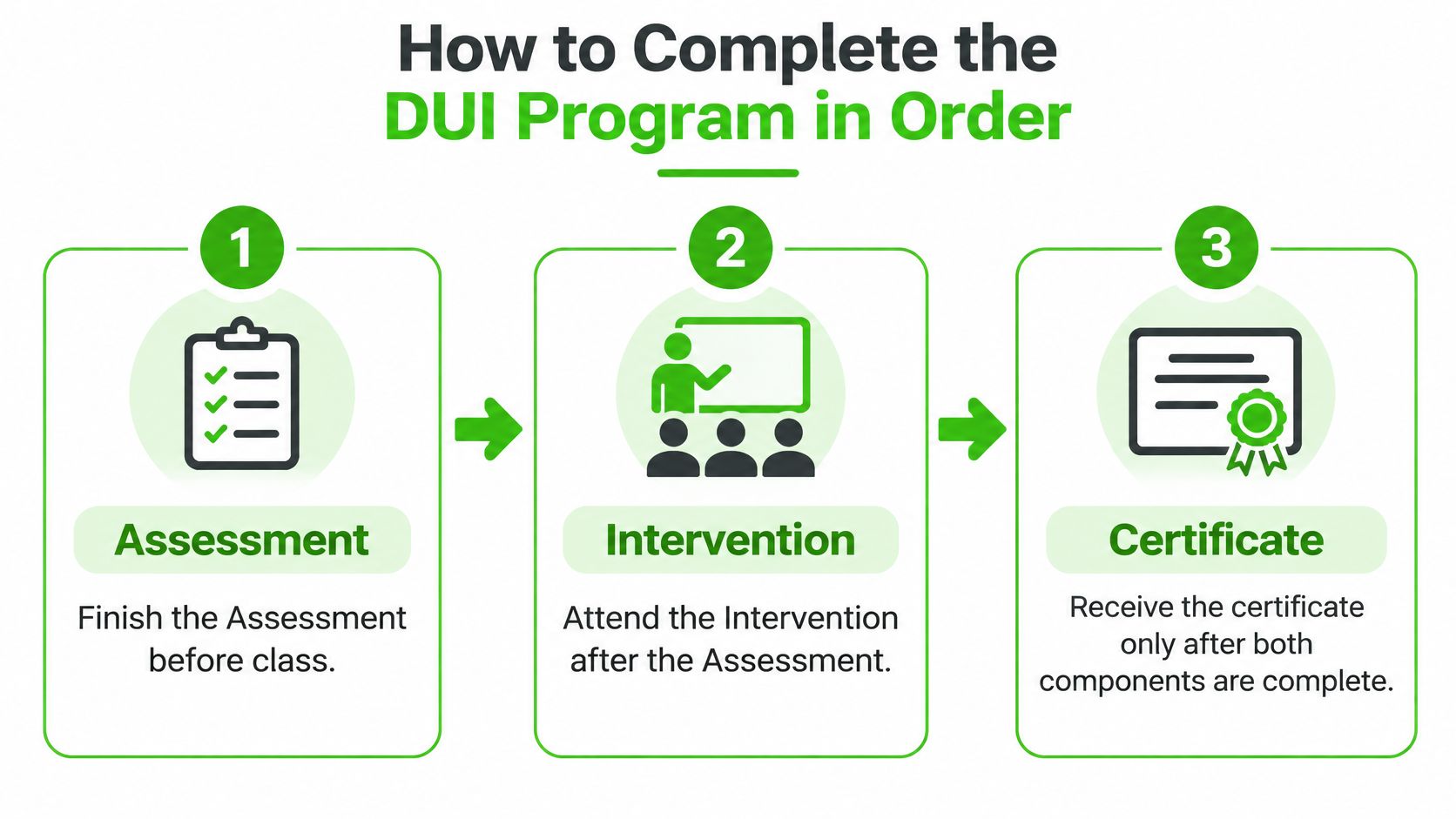
The Georgia DDS DUI FAQs describe two mandatory parts. The Assessment Component is a 130-question survey, commonly called the NEEDS assessment, and it looks at alcohol and drug use and the effect on driving. The Intervention Component is 20 hours of group-based therapeutic education and peer counseling on substance use and impaired driving. Both have to be completed successfully before a certificate of completion. The program covers DUI convictions, certain drug-possession offenses, underage alcohol possession while operating a motor vehicle, and boating under the influence.
The sequence that actually works
- Confirm the provider. Read the court or DDS notice and use a DDS-approved school. A bargain certificate from an unapproved provider will not move the license.
- Finish the assessment first. The NEEDS assessment takes 25 to 45 minutes and has to be done before class. People who book the intervention and treat the survey as homework get turned away.
- Sign the written contract. Payment on a website is not the contract. You sign with the school before you attend. I would sign that paperwork the same day you finish the assessment, not in the parking lot on Friday.
- Book hours that fit your schedule. The intervention cannot be finished in one day. A common pattern is Friday evening, all day Saturday, and all day Sunday, or several evenings. Leave room for the assessment before the first hour.
- Sit every hour. The intervention is group education and peer counseling on alcohol, drugs, and driving. Missing a block is not a partial credit problem. It is a restart problem.
- Take the certificate to the right office. After both components, the school issues an official Certificate of Completion. That paper is the proof the court or DDS uses for the legal step. It does not mail itself into your reinstatement file. You submit it.
Keep three documents together: the signed contract, the assessment confirmation, and the completion certificate. A photo on your phone is a backup, not the copy a clerk will stamp.
Say your hearing is in three weeks and the only open seat is this weekend. Do the assessment tonight, sign the contract before you leave, and only then hold the seat. Reversing that order is how a paid registration turns into a wasted weekend.
What Happens During the 20-Hour Intervention Class
A Saturday room in Decatur or Athens is usually a circle of chairs, not rows facing a podium. Across several days the instructor runs what many schools call the Prime for Life curriculum. You spend the hours in therapeutic education and peer group counseling, talking through how alcohol and drugs change judgment, reaction time, and the decision to drive. The class is built for behavior change.
Those classroom hours meet the legal intervention. A clinical evaluation or ASAM Level 1 treatment stays a separate requirement when the court or the assessment calls for it. I would keep the two tracks separate: finishing the circle does not close the evaluation, and an evaluation does not replace the hours.

Attendance is the rule people underestimate. Georgia DDS program policies require every student to attend all 20 hours of the intervention. Arrive late for any session and you can be denied entry. Missed time cannot be made up. You re-register and pay the full course fee to start a new program from the beginning. One late arrival can erase the hours you already sat.
Breaks, instructors, and the camera
Break length and how the hours are split across days come from the school schedule and the DDS policy guide. Confirm the break rules, the session calendar, and when the certificate is issued with the school and that guide before you pay. Plan food and childcare around the blocks printed on your confirmation.
Instructor credentials are set before the room opens. An instructor holds a degree from an accredited college or university plus at least two years of teaching or counseling experience, or is a credentialed substance abuse counselor with a high school diploma or GED. Ask who is certified for your dates if the roster looks thin.
Live virtual classes follow the same hour count. You stay present and on camera with a live instructor for the entire 20-hour intervention. A recording, a module you pause, or a course you finish on your own time is not acceptable. If a job or a shared house makes a private weekend unrealistic, settle the camera rule before you pay, not after the first session starts.
Fees and How to Book the DUI Course
Price the DUI program as three published charges before you add anything else. The Assessment Component is $100.00, the 20-hour Intervention is $235.00, and the workbook is $25.00. That is $360.00 before a clinical evaluation or a victim impact panel. Those add-ons are billed separately when a court or an evaluation requires them. Paying the class fee does not prepay the evaluation.
Georgia DUI Schools offers DUI classes in person or online, plus clinical evaluations, ASAM Level 1 treatment, and a Victim Impact Panel, so the extra steps can be scheduled with the same provider when the case needs them. Use that only if your row calls for it.
Book in four moves.
- Choose Risk Reduction unless the opening table shows points reduction is the only need. Defensive driving will not satisfy a DUI order.
- Pick a seat the order allows, either an in-person location or a live virtual seat the court or DDS will accept.
- Leave time before the first hour to finish the NEEDS assessment and sign the school contract. A date with no assessment window is a bad date.
- Bring the court order or DDS letter so the school can match your case row instead of guessing from a phone summary.
Enrollment itself is three clicks of intent: select the class, pick a location, and book a date. Weekend seats fill because classes run every weekend, including day and evening options. If you are in metro Atlanta, Decatur weekends are a common in-person pattern. After the completion steps are the ones your paperwork names, book the Georgia DUI course.
Georgia DUI Schools is a DDS-approved provider of the DUI Risk Reduction course, with classroom and live options plus clinical evaluations, ASAM Level 1 treatment, and Victim Impact Panels when your order requires more than the class. If your next step is the 20-hour program, start with the course that matches your case rather than a points class. Visit Georgia DUI Schools to see dates and book the requirement on your letter.