
You opened the envelope from court, then the notice from the Georgia Department of Driver Services, and the two pages do not say the same thing. One tells you to complete a clinical evaluation. The other talks about a Risk Reduction certificate before you can ask for your license. Probation wants proof by a date that already feels close. A friend with a first DUI only sat through a class, so you are left guessing whether the evaluation is extra, optional, or the step that decides treatment.
That mix-up is common, and it burns weeks. License reinstatement, a court order, and a clinician's written recommendation are three different duties. They can land on the same person, but they are not one checklist for every Georgia DUI.
A clinical assessment and treatment service is the clinical half of that picture. It is not the classroom course, and finishing class does not cancel a separate evaluation order.
What a Clinical Assessment and Treatment Service Does
Say two people leave the same Gwinnett courtroom with the same DUI charge. Marcus has a steady job, drinks a few beers on weekends, and has never been in treatment. Alicia drinks heavily most nights, already tried outpatient counseling, and was back to daily use within a month. Same charge. The next step is not the same set of hours for both of them.
A clinical evaluation is a separate, in-depth evaluation by a medical or mental health professional. In Georgia that professional is a DBHDD-approved evaluator. The purpose is to decide whether the person has a substance use disorder and whether treatment is required, then to name the level of care that fits.
The Risk Reduction class is a group safety briefing. Everyone in the room gets the same material. The clinical assessment is closer to a doctor ordering tests before writing a prescription. It asks what this specific person needs.
Three points usually clear the confusion:
- Separate order: A judge may order a clinical evaluation in addition to the Risk Reduction Program.
- Class does not replace it: Completing the Risk Reduction Program does not satisfy a separately ordered clinical evaluation.
- The recommendation is personal: Two drivers with the same charge can leave with different plans.
The evaluator looks at the substance-use pattern, prior treatment, legal history, mental health, motivation, and support at home. Marcus, with lighter use and a stable household, may leave with education only or a lower level of care. Alicia, with daily heavy use and a failed outpatient try, is more likely to be sent to structured treatment.
Plain definition: It is the step that decides whether treatment is needed and how much.
Which Requirements Apply to Your Georgia DUI Case
A Georgia DUI case can involve separate checklists. The Department of Driver Services (DDS) sets license reinstatement requirements, while the sentencing court can impose probation conditions. A requirement that applies to one does not automatically satisfy the other. For example, the Georgia DDS DUI FAQs state that a documented, approved clinical evaluation is required for reinstatement after two or more DUI convictions within 10 years. After a first DUI within five years, an evaluation and treatment are not required for reinstatement, although the court may still order them as probation conditions.
| Case Type | Clinical Evaluation | Treatment | Reinstatement Route |
|---|---|---|---|
| First DUI within 5 years, age 21 or older | Not required for DDS reinstatement; a court may still order it | Only if the court orders it as a probation condition | Apply after 120 days of a 12-month suspension with a Risk Reduction certificate and the reinstatement fee |
| Two or more DUI convictions within 10 years | Documented approved clinical evaluation required | Required when the evaluation recommends it | Evaluation documentation plus proof of recommended treatment |
| Habitual violator after a third DUI-related offense | Required in the reinstatement package | Required when the evaluation recommends it | Five years from the eligibility date, probationary license possible after two years, 12-month ignition interlock once eligible |
| Driver under 21 arrested for DUI | When a court order or DDS notice lists it | Risk Reduction requirement is set by DDS; clinical treatment only if ordered or recommended | Confirm timing with DDS and the court |
| Georgia conviction, resident of another state | Per the Georgia court order | Per the evaluation or court order | Substantially similar 20-hour Risk Reduction program in the home state, verified by Georgia DDS |
How each row actually works
For a driver age 21 or older with a first DUI conviction within five years, Georgia DDS first-offense guidance describes a 12-month suspension and allows an application for reinstatement after 120 days when the stated conditions are met. Those include a certificate from a DDS-approved DUI Alcohol or Drug Use Risk Reduction Program and payment of the reinstatement fee. Clinical evaluation and treatment are not part of that license path, but probation can still require them. The Georgia Risk Reduction course and its role in the DUI program explains the classroom component. Completing that program does not replace a separately ordered clinical evaluation.
With two or more DUI convictions within 10 years, the approved clinical evaluation is part of the reinstatement documentation. Treatment is required when the evaluation recommends it, so check both the evaluation and any court order before assuming the evaluation alone completes the requirement.
A third DUI-related offense can lead to habitual-violator status. Georgia DDS licensing guidance describes a five-year license revocation for a third DUI-related offense. A habitual violator may be eligible for a probationary license after the first two years, although some convictions prevent that option. A 12-month ignition-interlock requirement applies once the driver is eligible for reinstatement. The evaluation is part of the reinstatement package, and treatment is required when recommended.
For a driver under 21 arrested for DUI, Georgia's zero-tolerance rules apply. DDS sets the Risk Reduction requirement, so confirm its timing with DDS and the court. Clinical care is a separate question: it applies when a court order or evaluation recommendation requires it.
If you were convicted in Georgia and live in another state, you must complete a substantially similar DUI intervention program in your home state. The program must be certified there, last at least 20 hours, and be verified by Georgia DDS.
Three checks before you book anything
- Read the court order and mark each clinical or class condition by name.
- Read the DDS notice and compare its requirements with the case type above.
- Confirm the case type with probation before scheduling an evaluation or class.
Keep the paperwork for each requirement separate. Finishing an evaluation does not, by itself, finish a treatment condition. If the evaluator recommends no treatment, keep the written disposition as documentation. If the court names one level of care and the evaluator recommends another, ask probation how to meet the court's condition before scheduling services.
How the Intake and Clinical Assessment Works
A sound clinical assessment is a placement and treatment-planning process. It is not a compliance interview, and it is not the Risk Reduction class.
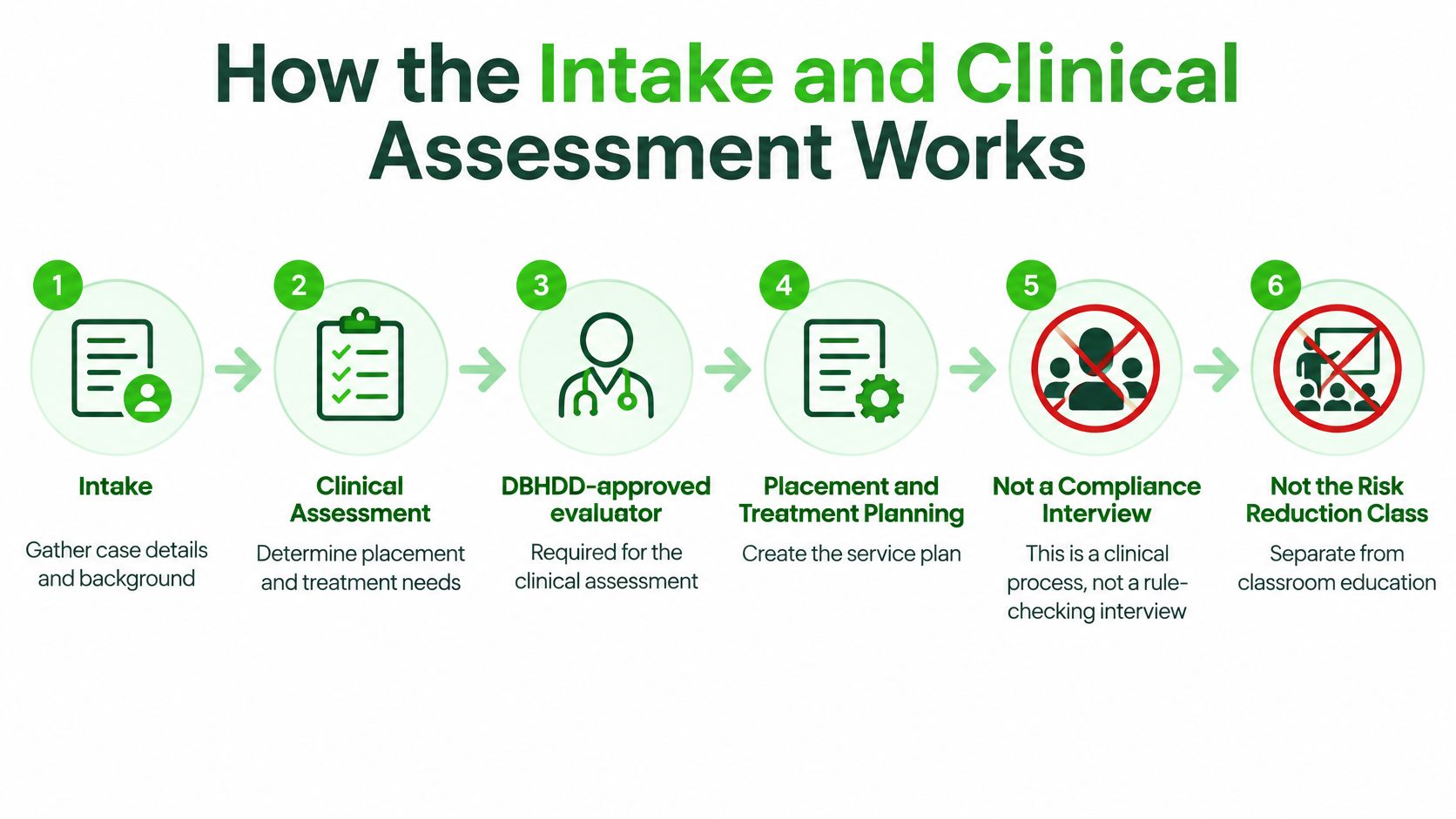
Georgia expects a DBHDD-approved evaluator to use a clinical interview, standardized screening, and further instruments, then decide whether a substance-related disorder exists and name an ASAM level. If you want a plain walk-through of how that interview is built, understanding evaluations in Georgia DUI cases from Brian Hansford Law is a useful companion to the steps below.
Keep the class screening in its own box
The DUI/Risk Reduction Program has two mandatory components, in order: the Assessment Component first, then the Intervention Component. The assessment piece is a 130-question screening instrument, often called the NEEDS assessment. It is not pass or fail. It must be finished before the class, and it takes 25 to 45 minutes. That screen does not replace the clinical evaluation.
Seven steps inside the evaluation
The Pennsylvania DDAP ASAM resources describe the framework clinicians use for this kind of placement. It is a multidimensional look at biopsychosocial needs, strengths, risks, and limitations, covering withdrawal potential, biomedical stability, emotional and behavioral conditions, readiness to change, relapse potential, and the recovery environment. For ASAM Level 1 outpatient care, that same guidance says programs generally deliver professionally directed services in regularly scheduled sessions, typically fewer than nine adult contact hours per week, and the plan should list prioritized problems, measurable goals, progress notes, and updates as status changes.
- Review the referral. Read the court or DDS order so the reason for the visit is on the page before the interview starts.
- Finish intake and limit the releases. Sign releases only for authorized contact with probation, the court, or DDS.
- Interview the history. Cover the use pattern, prior treatment, and legal history in the client's own words.
- Screen, then apply the ASAM dimensions. Standardized scores support judgment. They do not diagnose by themselves.
- Read collateral records when the release allows. Prior discharge summaries and probation notes fill gaps the interview misses.
- Screen mental-health, medical, and withdrawal risk. Refer above Level 1 when those risks, or a weak recovery environment, exceed outpatient care. Toxicology, when it is justified, informs the picture and does not replace it.
- Write the disposition. Name the ASAM level, or state that no treatment is recommended, and record the reasoning.
Ask for a copy of that written disposition before you leave. Hours and length of any later care are tied to those words, not to a verbal summary.
ASAM Levels and What Your Recommendation Means
The evaluator's recommendation names an ASAM level, and that level sets how much structure treatment has. The levels work like gears. Level 1 is the lowest gear that still moves you forward. Higher levels add structure as the needs grow. You do not pick a gear because a friend used it. The written level is the one that has to be followed.
| ASAM Level | Setting | Typical Contact | Typical Fit |
|---|---|---|---|
| 1 Outpatient | Scheduled sessions with professional direction | Fewer than 9 hours per week | Stable setting, able to attend regular counseling |
| 2.1 Intensive outpatient | Structured group and individual programming | 9 or more hours per week | Needs more structure than Level 1 provides |
| 2.5 Partial hospitalization | Day program with clinical services | 20 or more hours per week | Needs daily structure without an overnight stay |
What pushes someone past Level 1
Four problems usually force a higher gear. Withdrawal risk that cannot be watched safely between weekly visits. Psychiatric instability, such as active crisis symptoms that outpatient counseling cannot hold. Medical risk that needs closer clinical contact. Inadequate recovery support, meaning the home or daily routine cannot carry the person between sessions.
Take the two drivers again, this time at the recommendation stage. Marcus has moderate use, a stable job, and family who will drive him to a weekly session. He can usually fit Level 1: scheduled, professionally directed counseling he can attend without leaving work for most of the week. Alicia's daily heavy use, plus outpatient care that already failed, points toward Level 2.1 or higher, because weekly contact did not hold the last time.
What you should leave with
The level, the weekly hours, and the length in the written recommendation are the instructions probation and the next provider will follow. Request a copy, keep it with the court order, and do not let a scheduler substitute a different intensity because a group happens to have an opening.
Treatment Modalities, Frequency and Duration
Clinical treatment is a different service from the 20-hour Risk Reduction Intervention Component. That classroom course, often the Prime for Life curriculum, is therapeutic education and peer group counseling on alcohol and drug use and how they affect driving. It runs over several days and totals 20 hours. It is not ASAM Level 1 by itself.
We offer that intervention in person or live online. A live virtual class counts only when you stay on camera with a live instructor for the entire 20 hours. A course you finish on your own time does not count. The program fee is $100.00 for the Assessment Component, $235.00 for the Intervention Component, and $25.00 for the workbook. If the clinical evaluation recommends Level 1, that care is additional, and its weekly hours and total length follow the written recommendation rather than one statewide timetable. Telehealth substance abuse treatment is one way some clients keep those clinical hours when work or distance blocks a weekday office visit.
What each modality is for
| Modality | What It Involves | Typical Frequency | Typical Duration |
|---|---|---|---|
| Risk Reduction intervention (Prime for Life) | 20-hour classroom with therapeutic education and peer counseling; not ASAM Level 1 by itself | Several consecutive days | 20 hours total |
| Individual counseling | One-on-one sessions on goals and relapse risk | Weekly, per plan | Per evaluator recommendation |
| Group counseling | Peer groups addressing use patterns | Per treatment plan | Per evaluator recommendation |
| Motivational interviewing | Structured conversation about readiness to change | Within sessions | For the span of the written counseling plan |
| Toxicology monitoring | Breath or urine tests when clinically justified | Scheduled or random | Per treatment plan |
| Medication-supported treatment | Prescriber-directed care when indicated | Per prescriber | While the prescriber continues it |
Where that table has no fixed calendar, the individual plan sets it. A stable Level 1 plan might be a weekly individual session plus monthly toxicology. Daily heavy use with a failed outpatient history is referred above Level 1 instead of being stretched into a longer version of the same weekly hour.
Why the copy matters
Motivational interviewing is a way of talking inside those sessions, not a separate course you enroll in. Medication-supported treatment starts only when a prescriber indicates it. Breath or urine testing is added when it is clinically justified, on a set schedule or at random, and a single result does not rewrite the plan. Keep your own copy of the written recommendation so a missed group or a changed hour can be checked against the document probation already has.
How Clinical Services Connect to Reinstatement and Court Compliance
A driver may finish clinical care and still have a reinstatement document missing, or meet DDS requirements while still owing something to the court. Keep those paths separate: the license packet follows DDS rules, while probation conditions follow the court order.
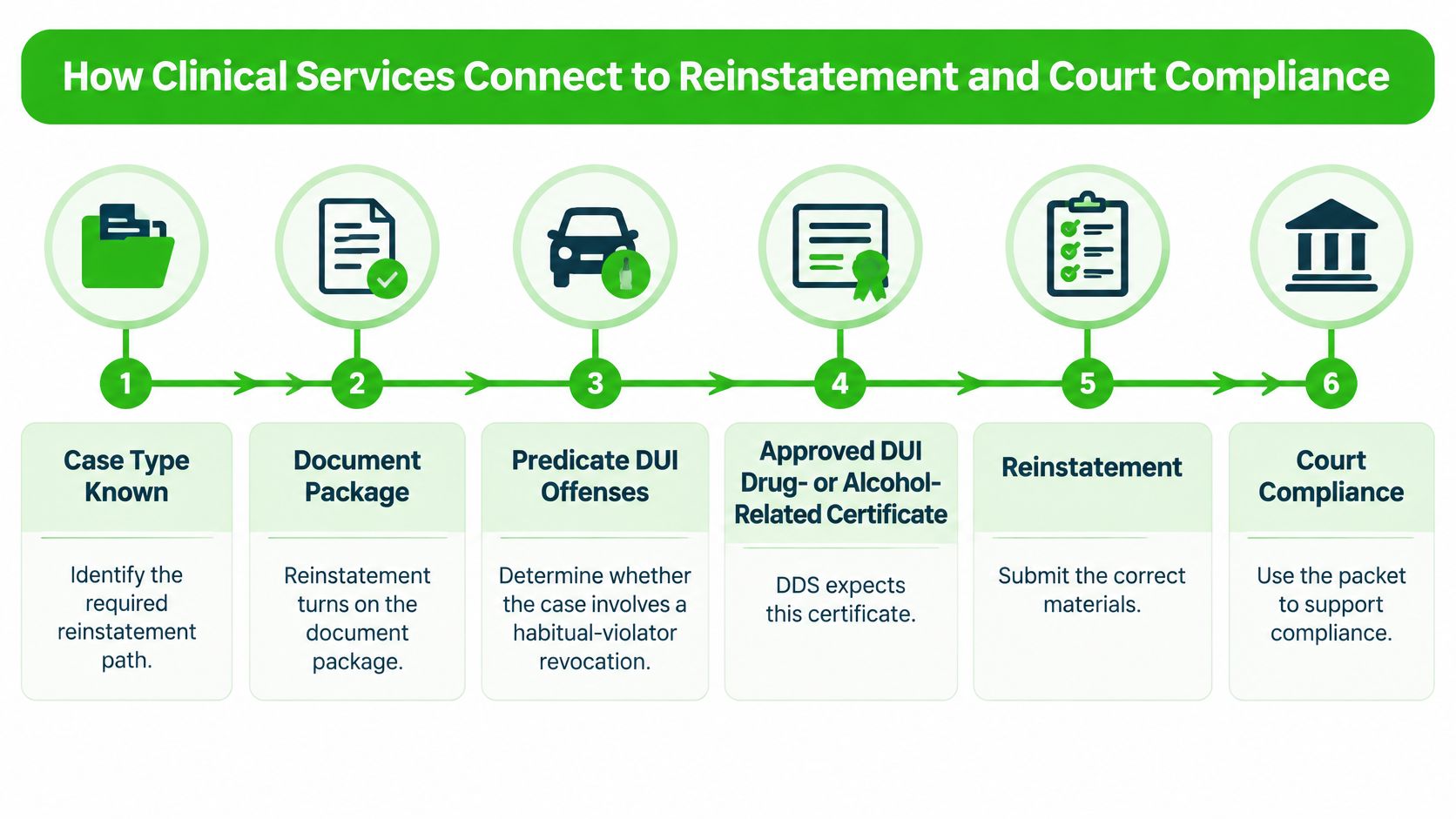
The habitual-violator packet
For predicate DUI offenses within a habitual-violator revocation, the Georgia DDS habitual-violator reinstatement rule requires a certificate from an approved DUI Risk Reduction Program, a clinical evaluation, and proof of treatment completion if treatment is recommended. The rule also sets a five-year waiting period from the applicable eligibility date and requires successful testing for the license class and type, payment of the reinstatement fee, and surrender of previously issued licenses or permits.
The listed fee is $210, or $200 by mail, for certain older revocations, and $410, or $400 by mail, for revocations imposed on or after July 1, 2009. Use the Georgia DUI license reinstatement guide to identify the class certificate that belongs in the packet.
Papers that stall the file
The DUI/Risk Reduction Program has two parts, completed in order: the Assessment Component first, then the Intervention Component. The certificate is issued only after both are finished. A completed clinical evaluation does not replace either program component.
If the evaluator recommends no treatment, keep the written disposition with your papers and follow the requirements that apply to your case. A clinical recommendation, a DDS requirement, and a court order are separate documents; one does not automatically replace another. If the court order names a different level than the evaluator, get probation's written direction on which terms to follow before scheduling any care.
Keep the court order, DDS notice, evaluation, and treatment proof together. Check that each required document is present before submitting the packet, and follow probation's instructions for any court-ordered care.
Confirm the Path Before You Schedule
The evaluation, court order, and license reinstatement process can call for different steps. An approved evaluator uses a clinical interview, standardized screening, and additional instruments to assess whether a substance-related disorder exists and recommend an ASAM level under the Georgia evaluator rules. If treatment is recommended, the evaluator provides a list of approved providers. The recommendation guides clinical care, while your court order and DDS notice identify separate requirements.
Before scheduling, ask:
- Opening: Can the provider see you within the timeframe in the recommendation?
- Format: Are telehealth or weekend sessions available?
- Paper flow: Which documents must go to the evaluator, probation, the court, or DDS?
- Fees: What will you pay, and what is not covered by insurance?
Keep the court order, DDS notice, written recommendation, releases, and completion proof together. Confirm which service was ordered and which level the evaluator recommended. Georgia DUI Schools offers clinical evaluations, ASAM Level 1 treatment, and the Victim Impact Panel, with DUI classes available in person at metro-area locations or online statewide. Call (770) 415-4384 to ask about scheduling.
Georgia DUI Schools provides DDS-approved DUI/Risk Reduction and defensive driving education, as well as clinical evaluations, ASAM Level 1 treatment, and Victim Impact Panels. Check your notice, court order, and written recommendation to identify the path that applies to your case, then use the Georgia DUI Schools website to review current class and clinical options.