The most common advice about DISA return to duty is to finish the required class, take a test, and wait for clearance. That skips the hand-offs where drivers often get stuck: a SAP hasn't documented eligibility, an employer hasn't sponsored testing, or a required record hasn't been updated. A passed test alone doesn't authorize you to return to safety-sensitive work.
DISA may handle employer compliance services, but the federal return-to-duty process is governed by DOT rules. The practical question isn't just what you need to complete, it's who must record each milestone and what must happen before you can work again.
Seven Steps From Removal Back to Safety-Sensitive Work
Most delays arise in the middle of the process, often because a driver starts arranging a test before the SAP has documented eligibility. The federal workflow has seven steps, and each one has a distinct owner and purpose.
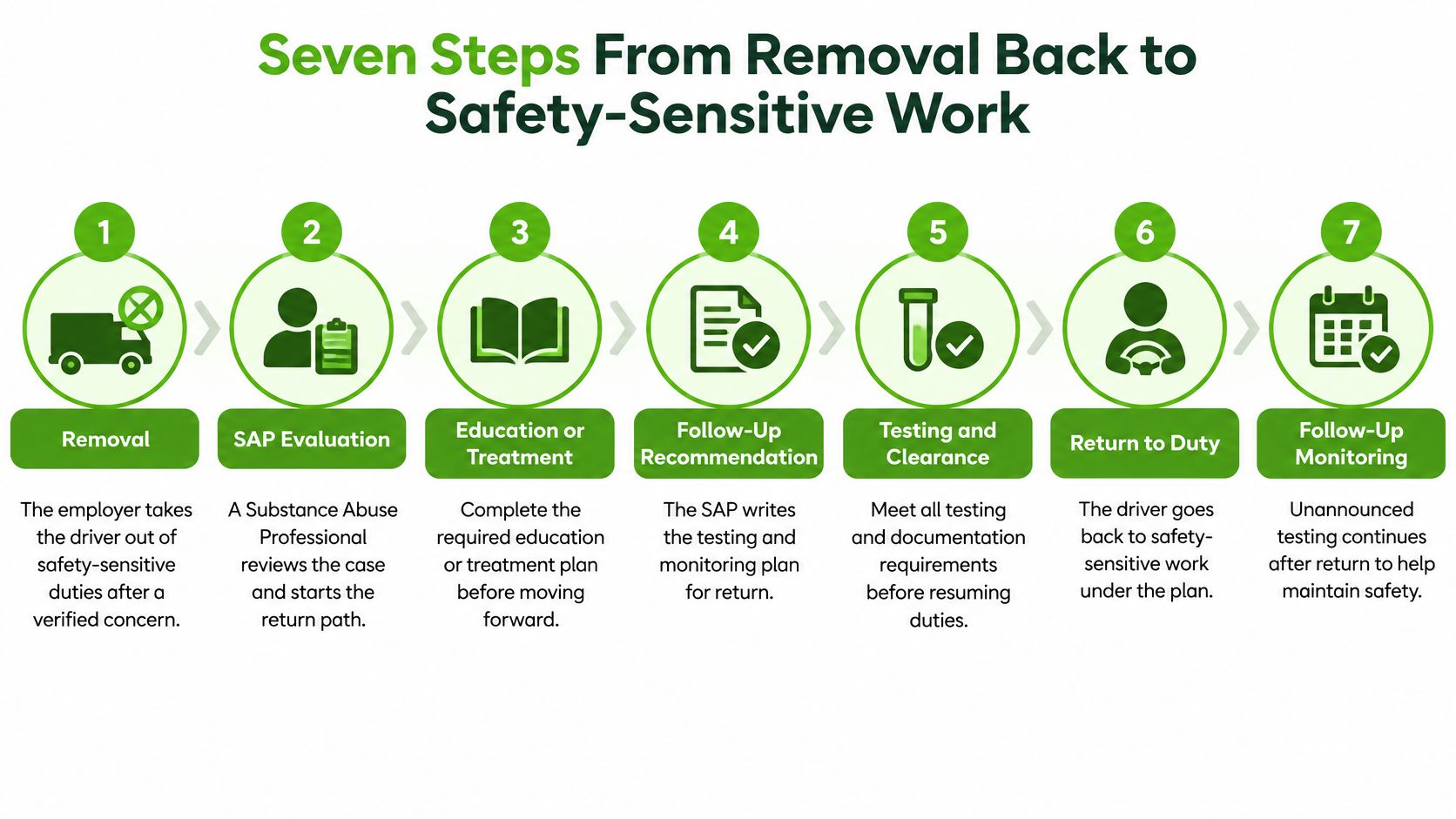
Removal from safety-sensitive duties. After a verified positive drug test, an alcohol result of 0.04 or greater, a refusal, or another covered violation, the employer removes the employee from safety-sensitive work. The employer should record the removal and explain which process applies. Continuing to perform covered duties while the case is unresolved is not a shortcut.
Evaluation by a DOT-qualified SAP. The driver completes an evaluation with a Substance Abuse Professional, or SAP. The SAP assesses the case and determines what education, counseling, or treatment is required. Don't assume a class you've already taken will satisfy a recommendation that hasn't yet been made.
Completion of the prescribed plan. Follow the SAP's written recommendations as given. Save provider records and completion documents; a partial program or an undocumented appointment doesn't establish that every requirement is complete.
SAP follow-up evaluation. After the prescribed work is documented, the SAP conducts a follow-up evaluation and decides whether the driver is eligible for return-to-duty testing. This is a separate decision from finishing treatment.
Employer authorization for testing. The employer must authorize the test. A driver who is between jobs can't order a test independently and treat the result as permission to return.
Return-to-duty test. The test must show a verified negative drug result and/or an alcohol concentration below 0.02. Even a qualifying result doesn't guarantee reinstatement. The employer may still decline to return the worker to the job.
Follow the monitoring plan. Returning to safety-sensitive duties starts the SAP-directed follow-up period, not a permanent clearance. Keep the plan and complete each required test.
Scheduling trap: Booking a laboratory test before SAP eligibility is documented can produce a result that doesn't authorize work. Confirm the eligibility record and employer authorization before you schedule.
The full process includes separate SAP, employer, and testing responsibilities. Drivers who want a plain-language reference for what comes after the return test can review follow-up testing with My Safety Manager. Keep in mind that the return-to-duty test is one milestone in the workflow, not its finish line.
Timeline and Who Owns Each Stage
| Stage | Responsible party | Typical timing | Proof of completion |
|---|---|---|---|
| Removal from safety-sensitive duty | Employer | Immediately after a verified violation | Removal record |
| Violation reported to Clearinghouse | Employer | By the third business day after the employer obtains it | Clearinghouse violation entry |
| Initial SAP evaluation | SAP | Scheduled promptly; date reported by close of next business day | Assessment date in Clearinghouse |
| Education or treatment | Driver and provider | As the SAP prescribes | Provider completion records |
| SAP follow-up evaluation | SAP | After documented compliance | SAP eligibility determination |
| Return-to-duty test | Driver, sponsored by an employer | Only after eligibility is documented | Verified negative drug result and/or alcohol below 0.02 |
| Follow-up testing | Employer under SAP plan | At least six tests in the first 12 months | Monitoring records |
The table separates who performs a task from who records its completion. The FMCSA Clearinghouse monthly report describes distinct status changes in the process. Under current guidance, employers report violation information by the third business day after obtaining it, while SAPs report assessment and eligibility dates by the close of the next business day.
Watch the hand-offs
Two transitions deserve close attention. First, the driver and provider must finish the SAP-prescribed plan and retain documentation before the SAP can make a follow-up determination. Second, the employer must authorize testing after eligibility is documented. A driver shouldn't assume that completing a program automatically prompts the next person to act.
A driver without a current employer faces a practical barrier: an employer must sponsor the return-to-duty test. Ask a prospective or current employer who will arrange the test and how the authorization will be issued before making a laboratory appointment.
Some dates depend on the SAP's schedule and the laboratory's availability. Get each appointment date, report date, and expected record update in writing. That gives you something specific to follow up on if the process pauses.
Evaluations, Treatment and Education Requirements
A DOT SAP evaluation and a Georgia DUI assessment serve different purposes. The DOT SAP evaluation sets the education or treatment required for a return to safety-sensitive work. Georgia's DUI Alcohol or Drug Use Risk Reduction Program is a separate state process that may be required for license reinstatement. Completing one doesn't automatically satisfy the other.
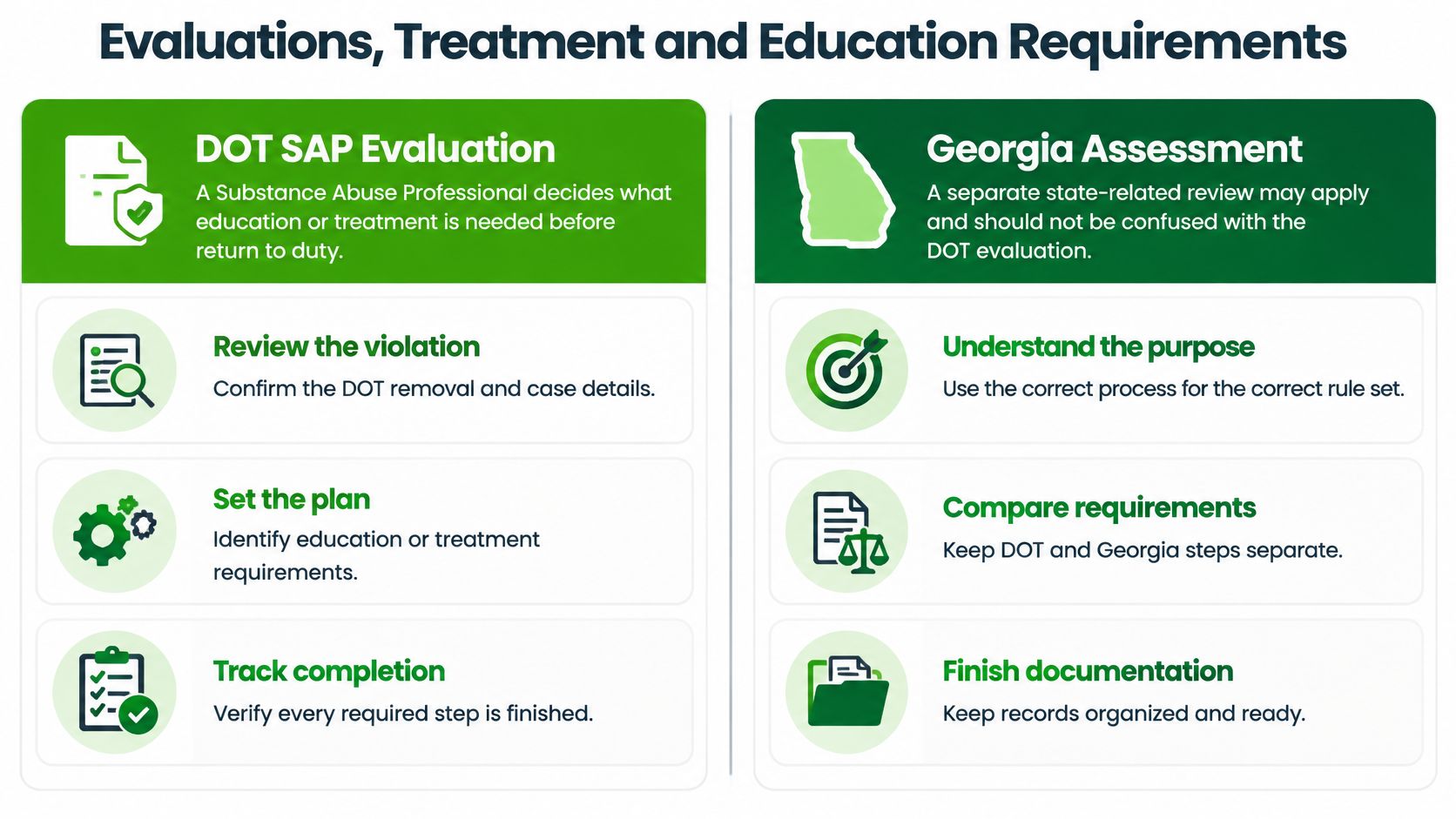
The SAP's written prescription controls the DOT steps. If the SAP requires a specific education or treatment plan, complete that plan and keep records showing what you finished. A Georgia DUI class doesn't replace a DOT recommendation because both involve substance-related education.
Georgia's two-part program
Georgia's DDS-approved Risk Reduction Program has two components: an assessment, commonly called the NEEDS assessment, followed by an intervention course. The Georgia DDS DUI FAQ states that both components must be completed successfully before a certificate of completion is issued. The intervention is a 20-hour course delivered across several sessions, with instruction conducted in a group setting.
The assessment comes before the class. It's a 130-question screening instrument, not a pass/fail test, and the assessment must be completed before the course. It takes between 25 and 45 minutes. Keep the resulting paperwork with the course completion certificate, especially if you're also managing a separate DOT case.
Consider a driver in Atlanta who enrolls in the Georgia intervention course before receiving a written SAP recommendation. The driver should compare the SAP's eventual requirements with the course records rather than assume that the earlier class satisfies the DOT plan. When the processes apply together, give the provider the SAP's written recommendation so the documentation can be checked against the actual requirement.
Clearinghouse Verification and Escalation
A return can stall because a record wasn't entered or updated, even after the driver has completed the required work. Don't rely on an employer or SAP to tell you that every status changed. Check the Clearinghouse record after each milestone and keep a dated note of what it shows.
| Milestone | Who reports | Deadline |
|---|---|---|
| Violation information | Employer | By the third business day after obtaining it |
| Initial SAP assessment date | SAP | By the close of the next business day |
| Return-to-duty eligibility date | SAP | By the close of the next business day |
| Return-to-duty test result | Employer or designated reporting party | After the test result is received |
| Follow-up testing plan | SAP | As part of the documented SAP plan |
Before anyone books the test, verify three items: the violation entry is present, the SAP assessment date is recorded, and the eligibility determination shows that you can proceed to return-to-duty testing. The DOT drug-test regulations for employers and drivers are a useful reference when sorting out which requirements apply.
If a record or employer action is missing
Say an employer in Savannah reported a violation late. Ask for the filing date in writing, then compare it with the Clearinghouse entry. Keep the email and any related correspondence with your case documents.
If an employer refuses to sponsor testing, take these steps in order:
- Request the refusal in writing. Ask for the reason and the person responsible for the decision.
- Verify SAP eligibility. Confirm that the eligibility determination appears in the Clearinghouse.
- Escalate with documentation. Contact the employer's compliance contact and provide the record and a copy of the SAP letter.
- Keep every reply. Save emails, letters, and appointment records in one file.
Include the removal notice, SAP assessment letter, education or treatment records, eligibility determination, test result, and follow-up schedule. A complete file makes it easier to identify the missing hand-off instead of repeating a step that's already done.
Follow-Up Testing and Monitoring After Return
A clean return-to-duty test doesn't end testing. The driver returns under a SAP-directed monitoring plan, and the employer must arrange the follow-up testing specified in that plan.
The FMCSA Safety Planner's return-to-duty guidance says the plan must include at least six unannounced tests during the first 12 months after returning to safety-sensitive duties. The plan may continue for as long as 60 months. If the SAP identifies polysubstance use, the testing plan should cover both drugs and alcohol, not only the substance associated with the original violation.
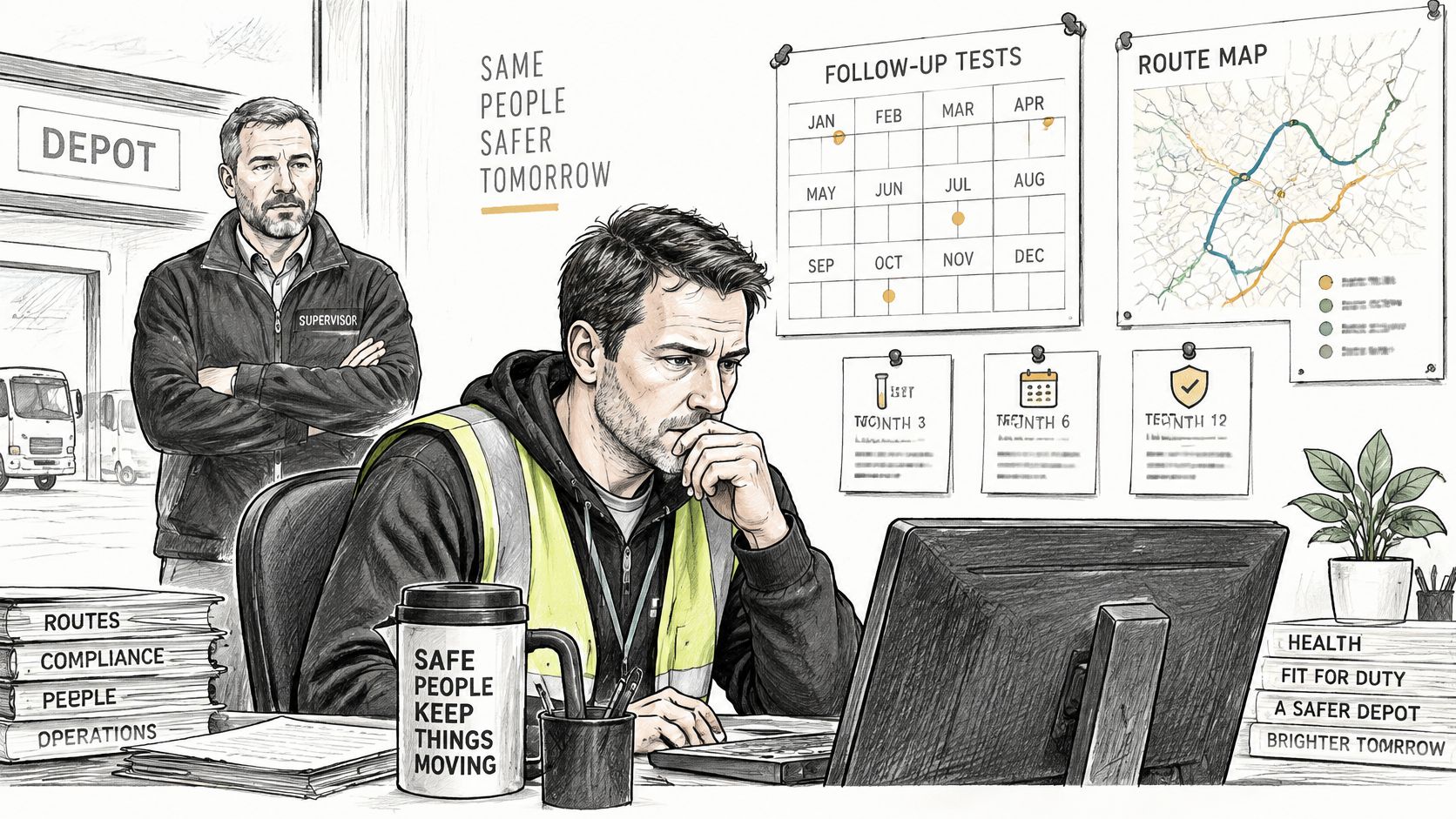
Consider a driver removed after an alcohol violation. During the evaluation, the SAP also identifies prescription drug use that affects the plan. Monitoring only for alcohol would miss the broader issue the SAP identified; the plan should address both substances when the evaluation indicates polysubstance use.
Keep the schedule and respond to selections
The SAP determines the monitoring requirements, and the employer administers testing under the plan. Ask for a written copy when you return, then keep it with your test records. You need to know which substances the plan covers and how the employer will notify you when you're selected.
A missed or late test can create a compliance problem. Don't assume that an appointment can be moved without consequence. Contact the employer promptly if you can't report as directed, follow its instructions, and save the communication.
For a practical reference on documenting the schedule and testing milestones, review this guide to a follow-up testing plan for the Clearinghouse process. Ask the employer for the monitoring schedule in writing on your first day back.
Georgia DUI Requirements Running Alongside DOT Steps
A Georgia DUI conviction can create a separate license-reinstatement track through the Department of Driver Services. Meeting federal DOT return-to-duty conditions doesn't, by itself, restore a Georgia driver's license.
| Case | Requirement | Easy-to-miss condition |
|---|---|---|
| First DUI, driver 21 or older | 120-day suspension, then DDS-approved Risk Reduction certificate | Reinstatement payment is also required |
| Habitual violator, three DUIs in five years | Proof of Risk Reduction completion before a new license is issued | Five-year wait generally applies, subject to statutory exceptions |
| Probationary license after habitual violator revocation | Five years revoked and two years since surrender, plus additional conditions | Time alone doesn't qualify; confirm added conditions with DDS |
For a first DUI offense involving a driver aged 21 or older, Georgia DDS's first-offense guidance says the driver may apply for reinstatement after a 120-day suspension, once applicable conditions are satisfied. Those conditions include submitting a certificate for successful completion of a DDS-approved DUI Alcohol or Drug Use Risk Reduction Program and making the required reinstatement payment. Finishing the class alone doesn't restore driving privileges.
Habitual-violator cases
A driver revoked as a habitual violator because of three DUI violations within five years must provide proof of Risk Reduction completion before a new license can be issued. The general waiting period is five years, subject to statutory exceptions. The Georgia habitual-violator statute also describes conditions that may apply to a probationary license after the revocation period.
A probationary license isn't automatic when time has passed. The driver may qualify only after five years of revocation and two years since surrender of the license or acceptance of the required affidavit, and only if additional conditions are met. Confirm the specific requirements with DDS before applying.
The state course itself has an order: the Assessment Component comes first, followed by the Intervention Component. Georgia DDS doesn't accept certificates from self-paced online DUI/Risk Reduction programs for license reinstatement or court purposes. Keep that distinction in mind when comparing state requirements with DOT-related services. The DOT SAP program overview can help clarify that the SAP track and Georgia's state program are not interchangeable.
Confirm Your Next Step Before You Drive
Finishing a class, completing treatment, or passing a test doesn't by itself authorize you to drive in a safety-sensitive role. You need documented SAP eligibility, employer authorization, and the required return-to-duty result. Georgia license reinstatement, when applicable, is a separate matter.
Use this order to confirm where you stand:
- Check the written SAP prescription. Make sure every required education, counseling, or treatment item is complete and documented.
- Verify Clearinghouse eligibility. Confirm that the record shows you're eligible for return-to-duty testing.
- Get employer authorization. Confirm that an employer will sponsor the test and provide the monitoring plan in writing.
- Check your Georgia DDS case. Use the case table above, and confirm whether you need a Risk Reduction certificate, reinstatement payment, or other conditions before driving.
For Georgia reinstatement, the certificate is issued only after both the NEEDS assessment and the 20-hour intervention are complete. The assessment must come first, and a course completion record alone isn't a substitute for the official certificate. A state-certified school issues that certificate after both components are successfully completed, giving the driver the proof needed for court or DDS reinstatement.
Bring your SAP letter and DDS paperwork to your first session so the provider can understand which requirements you're working to satisfy. Georgia DUI Schools helps drivers in Atlanta and Athens complete the required Risk Reduction Program to regain their licenses.
Georgia DUI Schools offers the Georgia DDS-approved DUI/Risk Reduction Program for drivers working toward license reinstatement, with the required assessment followed by the intervention course. If you're managing a Georgia DUI requirement alongside DOT return-to-duty steps, bring your SAP letter and DDS paperwork and visit Georgia DUI Schools to find the course that fits your case.