
Does a positive alcohol or drug test prove that someone was impaired while driving? Not necessarily, and confusing substance detection, clinical evaluation, and DUI course requirements can lead a Georgia driver to prepare for the wrong appointment.
If you're searching for an examen de alcohol y drogas, the Spanish phrase for an alcohol and drug examination, start by identifying what your court or the Georgia Department of Driver Services actually requires. A laboratory test, a screening questionnaire, and a Risk Reduction course serve different purposes.
What an Alcohol and Drug Exam Means in Georgia
For a Georgia driver handling a DUI requirement, an examen de alcohol y drogas often refers to the DUI Alcohol or Drug Use Risk Reduction Program. However, the phrase alone doesn't identify the required service. Your court order or DDS letter should name it.
Say an Atlanta driver receives paperwork mentioning an assessment and calls a school to schedule a drug test. The enrollment staff may explain that the appointment is for a questionnaire about alcohol, drugs, and driving, not specimen collection. That distinction changes what the driver needs to bring and what happens afterward.

Understand the service before booking
Think of a medical intake followed by an educational plan. The assessment gathers information about your substance-use patterns, while the intervention helps you examine choices associated with impaired driving. Unlike medical treatment, the classroom program doesn't automatically satisfy a separate treatment order.
Spanish-speaking drivers may hear evaluación, meaning evaluation, or examen, meaning examination. Neither word establishes whether the appointment is educational, clinical, or laboratory-based.
Keep these services separate:
- Risk Reduction: The required assessment and educational intervention.
- Clinical evaluation or ASAM Level 1 treatment: Separate clinical services when ordered or recommended through the applicable process.
- Victim Impact Panel: A separate activity addressing the effects of impaired driving on other people.
Before booking: Read the exact service name from your paperwork to the provider. Don't rely on the word exam alone.
An enrollment appointment also doesn't resolve whether you're eligible to drive. Before arranging travel or selecting a class, establish which requirement applies to your case and who must approve its completion.
Who Must Take an Alcohol and Drug Exam in Georgia
Your case determines the requirement, not BAC alone. A blood alcohol concentration result doesn't tell you everything about a conviction, an administrative suspension, a clinical referral, or eligibility for restricted driving privileges.
Use the following table to identify the questions to resolve. Some commonly repeated descriptions of Georgia DUI requirements are too broad to use as enrollment advice without checking the actual order.
Who must take the exam and what each case requires
| Case | Requirement | Who sets it |
|---|---|---|
| First DUI conviction | DUI Risk Reduction with the NEEDS Assessment and required intervention; confirm additional obligations | Court and DDS |
| Repeat DUI convictions | Risk Reduction plus any separately ordered evaluation, treatment, or counseling; don't assume a longer classroom course | Court, confirm details directly |
| Driver under 21 arrested for DUI | Confirm whether Risk Reduction is required; don't assume an arrest automatically establishes the requirement regardless of BAC | Court and DDS under applicable law |
| Conditional or limited license applicant | Confirm eligibility and required completion evidence; partial attendance or a promise to finish isn't an assumed qualification | DDS and the court |
| Habitual violator | Revocation and statutory conditions for obtaining driving privileges | DDS under applicable law |
An Athens student facing a DUI-related matter should therefore check the court order even if the student believes the alcohol reading was low. The relevant questions include whether there's a conviction, an administrative action, or another referral requiring participation.
Avoid assumptions about repeat cases and permits
A repeat offense may bring additional clinical or legal obligations. That doesn't establish that the standard Risk Reduction classroom itself becomes longer. Ask the court to distinguish the course requirement from added counseling or treatment.
Similarly, don't enroll on the assumption that beginning a course will qualify you for a conditional or limited license. Ask DDS what permit category, documentation, and other conditions apply before making work or transportation plans.
Bring conflicting instructions to your attorney or the issuing agency. If a probation officer's checklist and a DDS letter appear to name different services, ask for clarification rather than choosing whichever appointment is easiest to obtain.
The table is a starting point. The court order and DDS requirements control the final enrollment decision.
What Happens During the NEEDS Assessment and Intervention
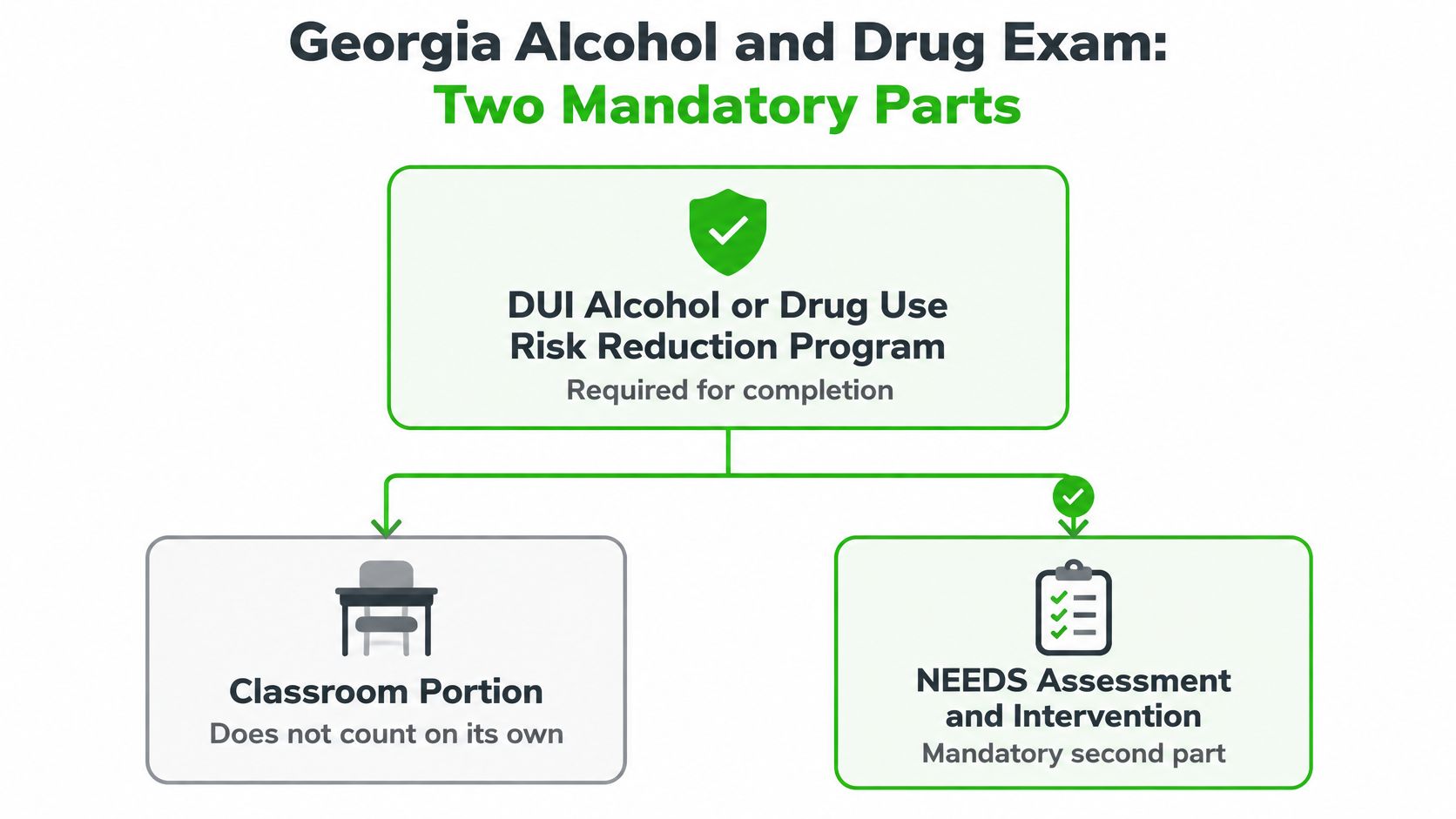
The Risk Reduction requirement has two mandatory components, and classroom attendance alone isn't sufficient. The Georgia DDS DUI FAQs identify a 130-question NEEDS Assessment followed by 20 hours of intervention instruction, with successful completion of both required for a Certificate of Completion.
The correct structure is assessment first, intervention second. The intervention is the classroom component, not an additional requirement outside the program.
Begin with the NEEDS Assessment
The questionnaire examines alcohol and drug use and its effect on driving. Expect to think about your patterns of use, the amount you consume, and whether substance use has affected driving decisions.
Answer truthfully and accurately. Trying to present an artificially favorable picture undermines the purpose of screening, while guessing at a confusing question can create an inaccurate account.
If you don't understand a word, ask staff what it means before answering. For someone who speaks Spanish at home, understanding the question matters more than finishing quickly.
Attend the intervention sessions
After completing the assessment, you can begin the intervention. DDS describes group-based therapeutic education and peer counseling addressing alcohol, drug use, and impaired driving.
Expect active participation rather than only listening to a lecture. Discussion may involve recognizing risky decisions, considering consequences, and planning alternatives to driving after substance use.
Your practical checklist is straightforward:
- Confirm the sequence: Schedule the assessment before the intervention begins.
- Check attendance rules: Ask how lateness, absences, and interrupted participation are handled.
- Understand participation expectations: Find out what materials, identification, or technology you'll need.
- Verify certificate delivery: Ask how completion is documented and how you'll receive your copy.
A driver commuting between Athens and surrounding communities should compare the full session schedule with work and transportation commitments. An opening session that fits your calendar won't help if later sessions conflict with your shift.
Before paying, ask the school for the assessment appointment, the entire intervention schedule, and its completion procedures. Plan around finishing the requirement, not merely starting it.
What Alcohol and Drug Test Results Can and Cannot Prove
A positive result isn't automatically proof of impairment. It may establish exposure to a substance without establishing when someone used it or how that person was functioning while driving.
The National Highway Traffic Safety Administration's drug-impaired-driving guidance explains that specimen selection affects interpretation. Blood can provide a quantitative concentration, but concentrations of many drugs can't reliably establish a particular degree of impairment.
What each specimen type shows and where it falls short
| Specimen | What the result shows | Main limit |
|---|---|---|
| Blood | Quantitative concentration; forensic reference matrix | Many drug concentrations don't reliably map to a specific degree of impairment |
| Breath | Alcohol concentration used in BAC-related interpretation | Measures alcohol, not drug exposure |
| Oral fluid | Relatively recent drug exposure; roadside screening commonly identifies a drug class | A screening positive doesn't independently establish concentration or impairment |
| Urine | Drugs or metabolites that can remain after effects end | A positive cannabinoid result doesn't prove recent use or impairment while driving |
For alcohol-specific terminology, review this explanation of breathalyzer testing. Don't assume that the interpretation of an alcohol reading transfers directly to a drug result.
Separate screening from confirmation
A rapid screen is like a smoke alarm: it flags something that needs investigation but doesn't explain everything about the event. Under SAMHSA's federal workplace-testing guidance, an initial screen is followed by analyte-specific confirmation, such as gas chromatography/mass spectrometry, and both must meet applicable cutoffs before a specimen is reported positive.
That federal framework illustrates why a presumptive result needs careful handling. It doesn't mean every DUI-related testing procedure follows identical workplace rules.
Chain of custody records specimen handling. Specimen-validity testing checks whether the sample is suitable for interpretation, while qualified medical review can consider medication explanations.
A laboratory can identify what it detected without answering every question about driving impairment.
Say a driver provides a urine sample after a traffic incident and the report identifies a cannabinoid metabolite. The result doesn't, by itself, establish that the driver was experiencing the drug's effects during the incident.
Ask which specimen was collected, when collection occurred, what substance or metabolite was identified, and whether the result was screened or confirmed. Also ask whether the report gives a concentration or only a positive-or-negative finding.
Legal Consequences Beyond the Classroom
Completing a course addresses an educational requirement. It doesn't automatically resolve revocation, points, chemical-test refusal, or other court and DDS obligations.
Think of points as a meter on your driving record and revocation as a locked gate. Lowering the meter doesn't necessarily open the gate.
Revocation and points address different problems
Georgia legislative materials describe habitual-violator revocation for three qualifying violations of Code Section 40-6-391 within five years, with statutory conditions before DDS may issue a new license. The same materials identify a separate seven-point reduction through an eligible course, without reducing accumulated points below zero.
Those provisions shouldn't be treated as interchangeable remedies. A points-reduction course addresses the record's point total, while habitual-violator conditions concern eligibility to hold or regain driving privileges.
Consider a driver who falls within the qualifying habitual-violator pattern but has a low point total. The driver can't assume that the low total cancels revocation. Another driver seeking a point reduction must still check whether the chosen course is eligible and whether a separate suspension applies.
Refusal and BAC require their own review
Refusing a state-administered chemical test can carry a suspension consequence independent of classroom completion. Confirm the applicable suspension period, notice requirements, and available responses with DDS and an attorney rather than relying on a general description.
A BAC below the familiar adult threshold also shouldn't be treated as proof that no impairment case exists. Driving observations and other evidence can matter, so an alcohol number alone isn't a reliable guide to whether you need legal advice.
For practical context, review these DUI consequences in Georgia, then compare your own notices with your attorney.
- Ask DDS about driving privileges: Confirm whether you're suspended, revoked, or eligible for a permit.
- Ask the court about separate obligations: Identify treatment, panels, monitoring, or other conditions.
- Ask your attorney about case-specific penalties: Don't ask enrollment staff to interpret a contested legal issue.
Read every DDS letter before driving. A school's confirmation that you completed its program isn't permission to operate a vehicle.
How to Prepare for Your Assessment Step by Step
Prepare for the appointment named in your paperwork, not for an imagined pass-or-fail exam. An assessment works more like a medical history than a roadside quiz: the evaluator needs accurate context, while the legal meaning of any result is a separate question. Good preparation means accurate information, an appropriate provider, and a schedule you can complete.
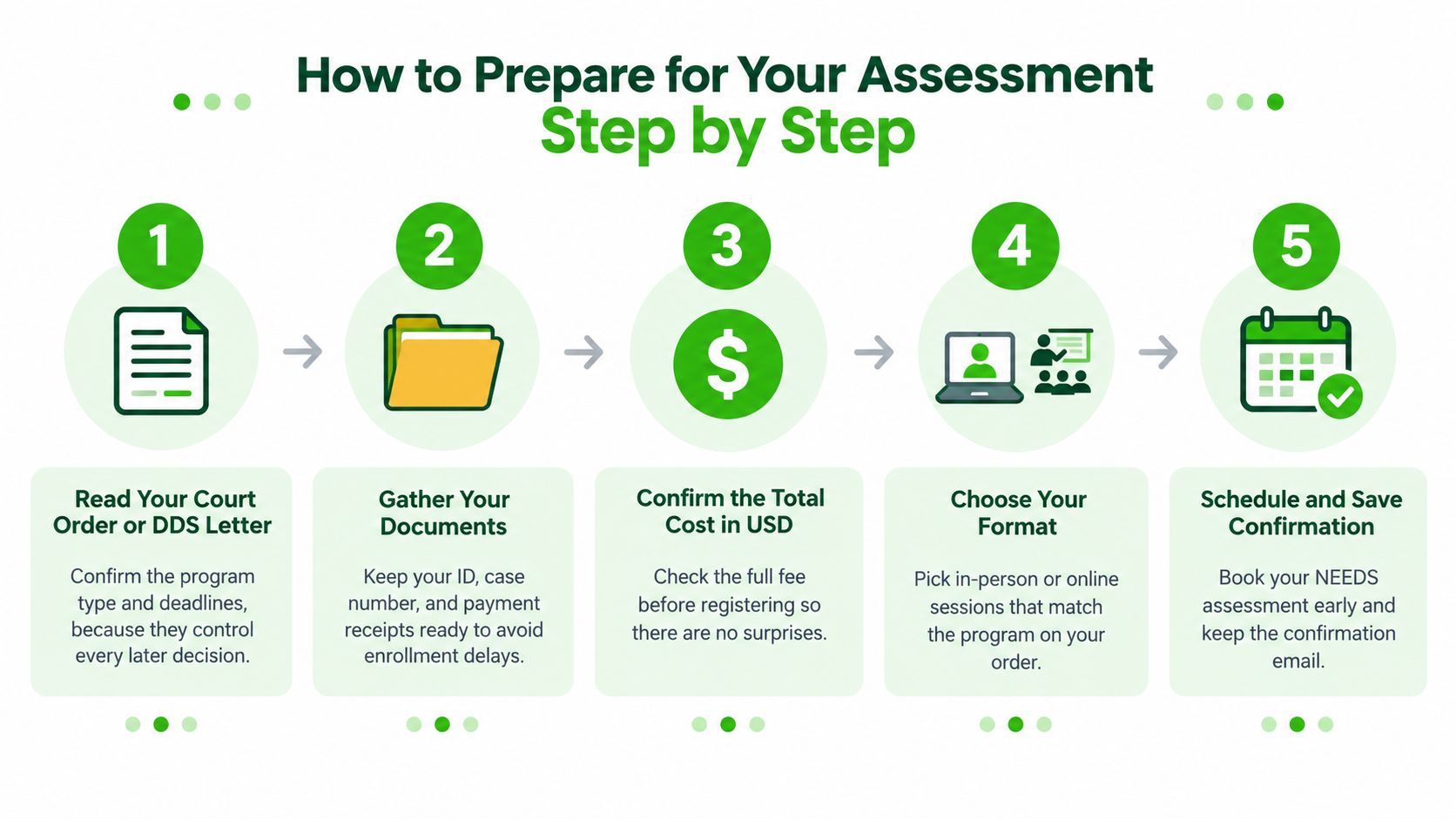
Follow this preparation sequence
Read the court order or DDS letter. Identify the exact program, any separate clinical referral, and the deadline. If the wording is unclear, contact the issuing office before registering.
Confirm DDS certification. Ask for the school's approved name and verify that you're booking the appropriate program. A convenient appointment isn't useful if the service won't satisfy your requirement.
Compare your violation and course dates. Have the violation date available when discussing enrollment. Don't assume a previously completed course can be reused for a later matter.
Prepare a complete medication list. Include prescriptions, over-the-counter antihistamines, sleep products, cannabis products, and supplements, with dose and timing. The Georgia DDS guide to medications and alcohol explains that medications don't change BAC, but combining them with alcohol can increase impairment.
Don't predict results using internet detection windows. Ask your attorney about legal interpretation and the evaluator or laboratory about the actual testing procedure. Don't stop prescribed medication or change a dose without your prescriber's guidance.
Choose a workable schedule. Compare weekday, weekend, and any approved remote options. Ask whether every required session fits your deadline and whether the delivery format is accepted for your specific obligation.
Arrange transportation. If your driving privilege is suspended or uncertain, plan a ride before appointment day. Don't assume traveling to a required class creates an exception.
Gather your enrollment records. Keep identification, the court or DDS letter, case details, and payment confirmations together. Ask staff what must be submitted beforehand.
Disclose context, not just a drug name
Say an Athens driver takes a prescription sleep aid and an over-the-counter allergy medicine. Listing only the prescription leaves out information that may matter to a clinical discussion about sedation and driving.
A test can detect a substance without proving impairment at the wheel. Georgia sets BAC thresholds and refusal consequences through its own legal rules, so confirm the exact standard and suspension period that apply to your case with DDS and your attorney rather than treating a medication guide as a legal manual.
Accurate disclosure gives the appropriate professional the context needed to interpret your situation. It also helps you separate three different questions: what may be detected, what the clinician should know, and what the state must still prove.
Documents, Certificates and Timelines to Track
For reinstatement or preventing a pending suspension, the course's timing matters. The DDS Risk Reduction program guidance explains that the certificate must reflect a course taken and completed after the violation date causing the suspension.
The guidance also addresses surrendering previously issued licenses or permits at reinstatement, including a habitual-violator probationary license. DDS warns that courses from uncertified schools won't be accepted for licensing, reinstatement, or court requirements.
Documents and timing checks before reinstatement
| Document or deadline | Requirement | Why it matters |
|---|---|---|
| Court order or DDS requirement letter | Names the program you must complete | Establishes what to enroll in |
| Certificate of Completion | Issued after successful assessment and intervention completion | Classroom-only participation isn't enough |
| Completion date | Must follow the violation date causing the suspension | Establishes acceptable timing |
| Reinstatement certificate | Used for reinstatement or preventing a pending suspension | Dates must match the applicable requirement |
| Prior licenses or permits | Surrender at reinstatement, including a habitual-violator probationary license | An incomplete surrender can obstruct processing |
| School DDS certification | Required for an accepted DUI program | Verify before paying |
| DDS processing time | Not established here; confirm directly | Course completion doesn't establish a reinstatement date |
Check the record before submitting it
Match your name, identifying information, violation date, and completion details against your case records. If something is wrong, contact the issuer rather than editing the certificate yourself.
Ask who submits each document. Don't assume that a school sends a certificate to your court, probation officer, attorney, and DDS automatically.
Keep a complete file: Save certificates, receipts, submission confirmations, and any written instructions about outstanding requirements.
For an Atlanta driver planning a return to work, the important date isn't just the last class session. It's the date DDS confirms the driver may legally resume driving.
Choose a Format and Enroll in the Right Course
Start with the course the order names. A driver told to complete a Georgia DUI Risk Reduction program needs that specific course, and a self-paced defensive driving class is a different product even when the same school sells both. Before paying, read the Risk Reduction course explanation so you can tell which program your paperwork requires, then confirm the accepted delivery method with the provider.
Format comes second. In-person instruction suits drivers who participate better in face-to-face discussion. Live virtual instruction fits drivers who can attend scheduled sessions but cannot travel easily. Ask about weekend scheduling if weekday work creates conflicts.
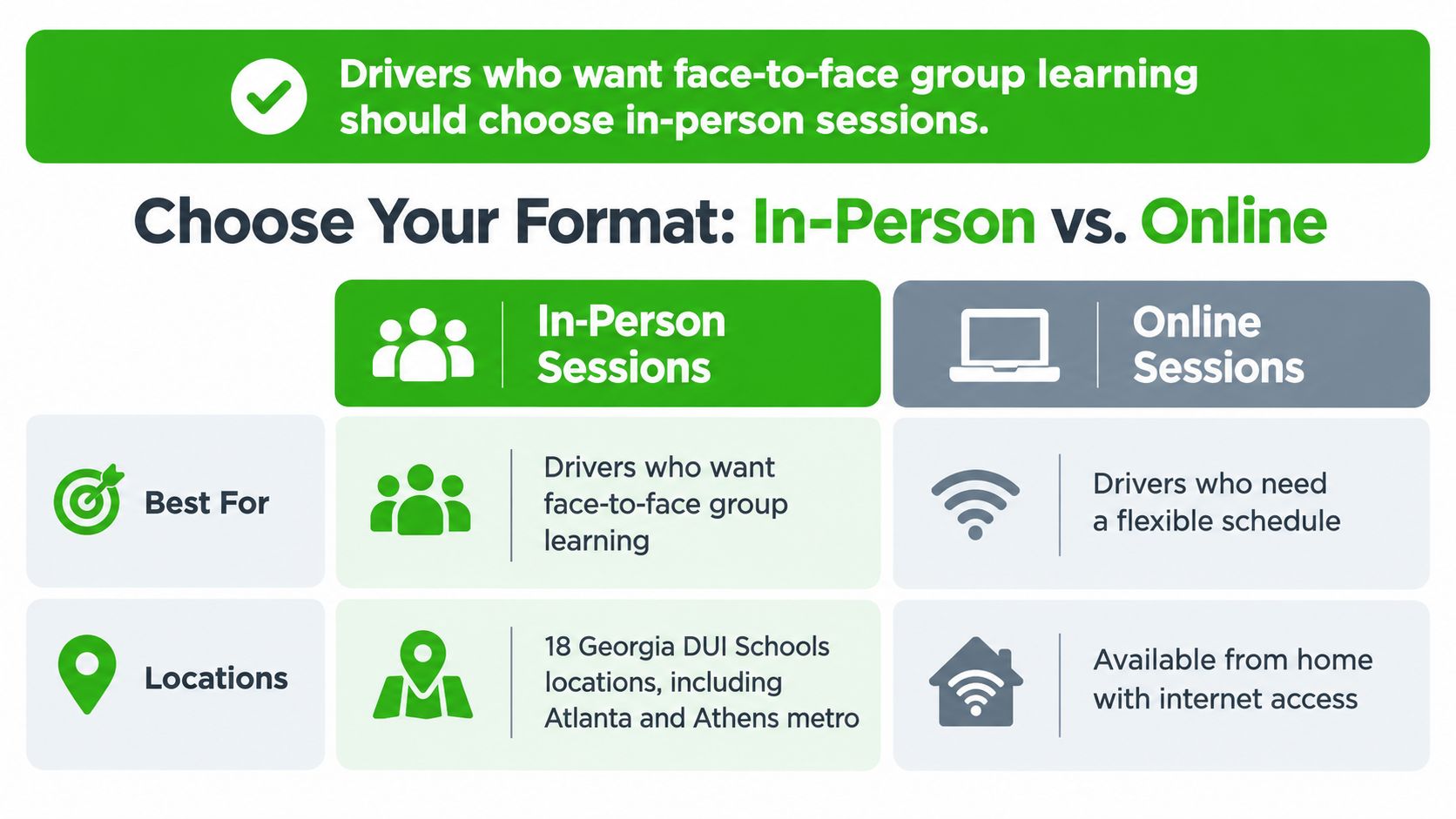
Format options for the Georgia DUI Risk Reduction course
| Format | How it works | Best for |
|---|---|---|
| In-person classroom | Local classroom sessions, including options serving Atlanta and Athens communities | Drivers who want face-to-face group learning |
| Live virtual (Zoom) | Instructor-led online sessions at scheduled times, subject to program availability | Drivers who need set times but can't travel |
| Online statewide | Confirm the specific delivery method your DUI requirement allows | Drivers balancing travel and irregular schedules |
| Weekend sessions | Ask about weekend availability in the accepted format | Drivers who work weekdays |
For an examen de alcohol y drogas, language access is a practical enrollment question. Ask whether instruction, assessment materials, and staff assistance are available in Spanish instead of assuming the entire appointment will be bilingual. The school can clarify this before you book, and the answer may shape which session you pick.
Keep two things separate in your planning. The examen documents what an assessment detected, and a Risk Reduction certificate proves you finished a course. One does not replace the other. Clinical evaluations, ASAM Level 1 treatment, and Victim Impact Panels also remain separate services when ordered, so ask whether the provider can arrange them without assuming a combined booking makes them part of the classroom certificate.
Before enrolling:
- Confirm the requirement in your court order or DDS letter.
- Choose an accepted format that fits every required session.
- Verify certification and dates, then save your enrollment confirmation.
Georgia DUI Schools offers DUI/Risk Reduction education and separate clinical services for drivers working through court and DDS requirements. Visit Georgia DUI Schools to discuss your paperwork, confirm an appropriate course format, and schedule your assessment and intervention.