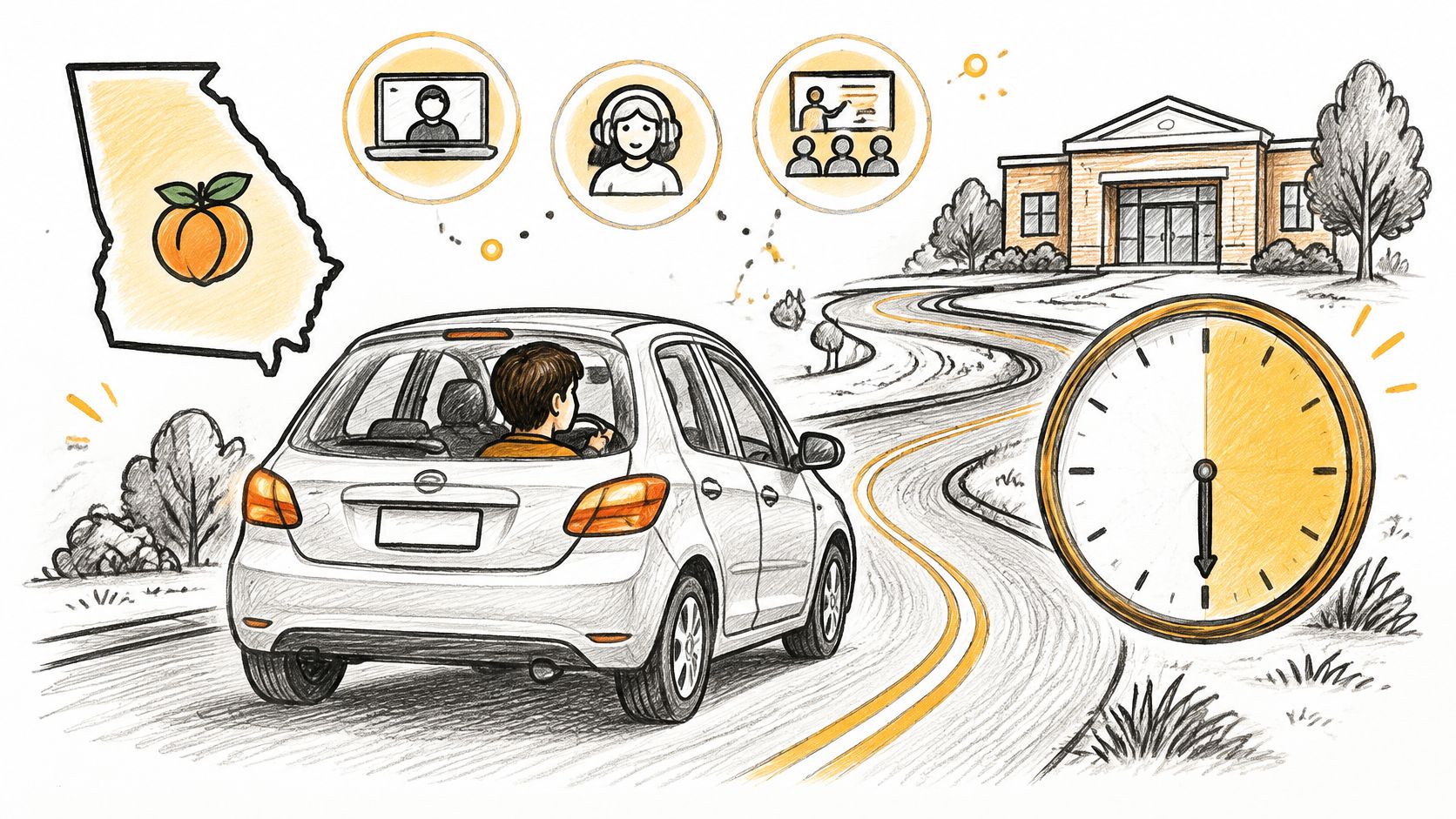
A Georgia defensive driving (Driver Improvement) course is 6 instructional hours, set by the Georgia Department of Driver Services, and the same six hours apply whether the course is online, live virtual or in a classroom. But completing those hours doesn't mean every format will count toward your license requirement.
That's the costly distinction: you can finish a course and still have no usable proof of compliance. Before comparing prices or clearing your calendar, identify who must accept the certificate.
Six Hours Is the Georgia Standard for Defensive Driving
The Georgia Department of Driver Services defines Driver Improvement, also called Defensive Driving, as a 6-hour course covering safe driving attitudes and behaviors for licensed drivers. DDS lists court orders, point reduction, license reinstatement, insurance-premium reduction, and voluntary education among its purposes.
This is a regulated program, not merely a collection of driving videos. For licensing, reinstatement, or court requirements, DDS says only DDS-certified schools are accepted. A provider should be able to identify its approved clinic and explain which course it's selling.
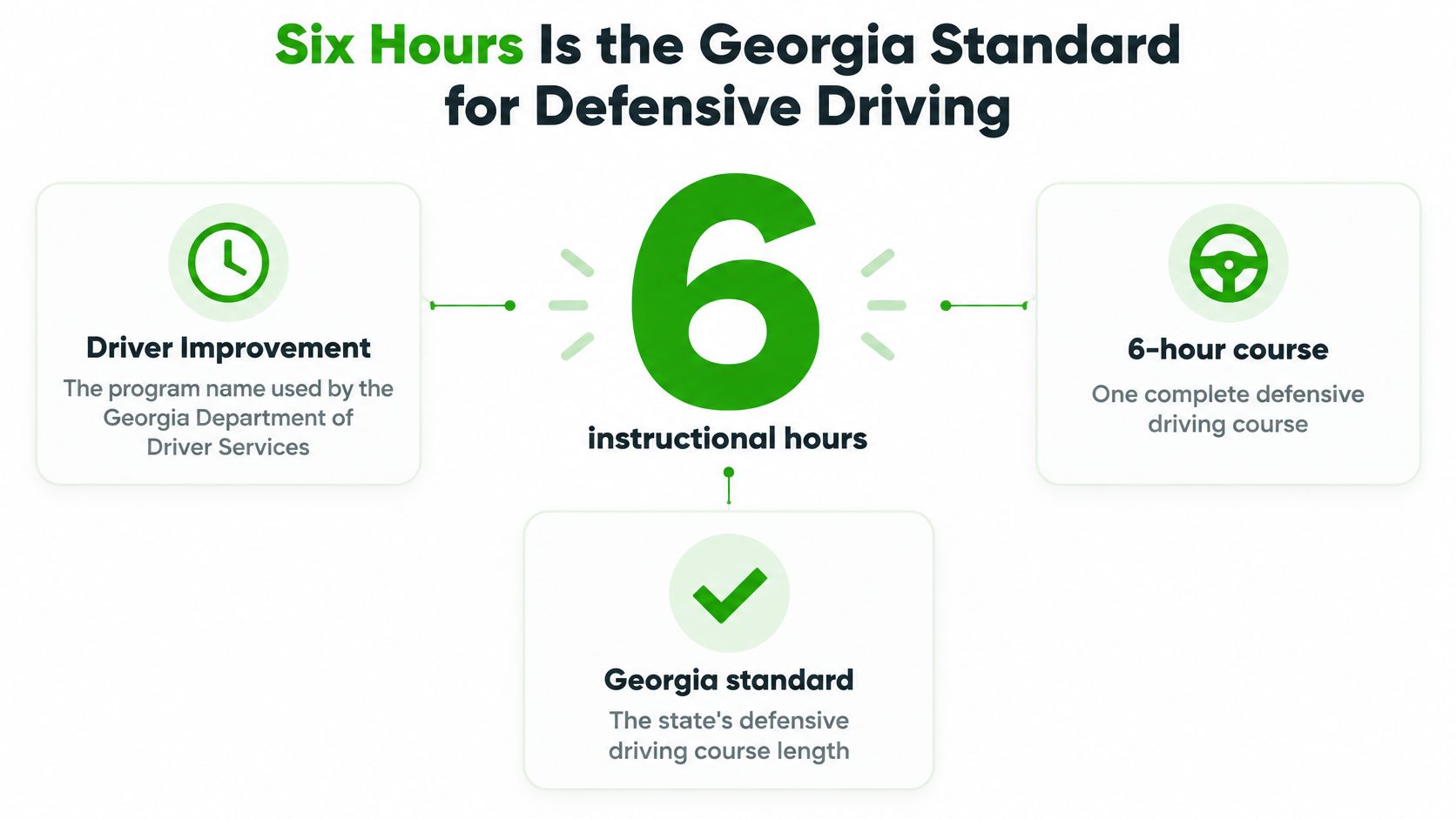
Georgia defensive driving course length by delivery format
The instructional benchmark doesn't shrink when you change screens or classrooms. What changes is the schedule and, more critically, whether the recipient accepts that delivery method.
| Format | Instructional hours | Scheduling pattern | Acceptance for DDS license matters |
|---|---|---|---|
| Self-paced online | 6 | Student sets the pace across one or more sittings | Not accepted under DDS guidance; ask the court or insurer about other uses |
| Live virtual (Zoom) | 6 | Scheduled sessions with a live instructor | Not accepted under DDS classroom-only guidance; ask the court or insurer about other uses |
| In-person classroom | 6 | Scheduled class day or days at a DDS-approved clinic | Accepted when taught at a DDS-approved clinic |
School approval and format acceptance are separate checks. An approved school may offer different products for different purposes. Its name on a website doesn't establish that every online option satisfies a DDS license requirement.
Driver Improvement also isn't initial Driver Education. DDS distinguishes it from the program associated with obtaining a Class D license at age 16. If you're resolving a ticket, points issue, or reinstatement requirement, shop for the program named in your paperwork, not a beginner-driving package.
Before paying: Ask for the exact course name, delivery format, and approval applicable to your purpose. A general claim of state approval isn't enough.
An advertised shorter Georgia course is a reason to check the DDS listing first. Don't assume a course designed for another state, an employer, or general insurance education meets Georgia's regulated Driver Improvement requirement.
What Counts Toward the Six Hours and What Doesn't
Instructional time isn't the same as time to recognized compliance. Enrollment, attendance, certificate issuance, and submission are separate tasks, often handled by different people.
The DDS defensive driving FAQs describe Driver Improvement as a six-hour course, state that approved courses are classroom instruction only without behind-the-wheel training, and require the original completion certificate for license reinstatement or point reduction. They also permit a reduction of up to seven points once every five years.
Where the time goes from enrollment to recognized completion
| Stage | Counts toward 6 hours? | Who sets it |
|---|---|---|
| Instruction (lessons, discussion, scenarios) | Yes | Provider's approved schedule |
| Breaks | Confirm the approved break policy; don't assume they count | Provider policy; confirm whether breaks extend the day |
| Knowledge check or testing | Confirm whether it's included in instructional time | Provider |
| Certificate issuance | No | Provider |
| Submission to DDS, court or insurer | No | Agency or insurer receiving the certificate |
Don't subtract lunch or a rest break from the instruction you expect to receive. Ask for both the instructional schedule and the actual arrival-to-dismissal schedule. Likewise, find out whether testing occurs within the advertised class window or after the lessons.
Can you finish in a single sitting? Use the provider's published schedule to answer that question, not the course title. A class might fit into a scheduled day, but registration, attendance checks, breaks, and certificate handling still need attention.
Completion needs a recipient
Think of the course like sending a package. Instruction is the trip, but delivery and paperwork determine when the package reaches the person who needs it. A certificate sitting in your inbox hasn't necessarily reached DDS, your court clerk, or your insurance agent.
Say an Atlanta driver completes an online class before checking license acceptance. The loss isn't just the study time: the driver must find an acceptable class and repeat the administrative steps, possibly after losing weeks on the wrong path.
Practical driving resources can supplement that instruction. Commercial drivers, for example, can use Patriot CDL's guide to practice defensive driving in a tractor-trailer, particularly when applying hazard awareness to a larger vehicle. That practice doesn't replace a required course or certificate.
Get these answers in writing before enrolling:
- Break policy: Are breaks outside the instructional requirement, and what is the actual dismissal time?
- Certificate delivery: On what date will the certificate be issued, and how will you receive the document your recipient requires?
How Course Length Affects Points, Insurance and Reinstatement
A longer-looking schedule doesn't automatically produce a better administrative outcome. The recipient checks whether you completed the required program, used an accepted format, and submitted acceptable proof.
Start with your purpose. A court order, DDS notice, and insurance policy can impose different acceptance and paperwork requirements even when the course descriptions look similar.
Course length requirements by purpose in Georgia
| Purpose | Course length | What you submit | Length-related check |
|---|---|---|---|
| Court-ordered defensive driving | 6 hours | Certificate the court accepts | Court deadline and accepted formats |
| Point reduction | 6 hours | Original DDS-certified certificate | Confirm eligibility and the permitted interval before enrolling |
| License reinstatement | 6 hours | DDS-certified completion submitted to DDS | Accepted format and submission date |
| Insurance premium reduction | 6 hours | Certificate the insurer accepts | Insurer sets the discount amount and accepted format |
| Voluntary personal education | 6 hours | Optional certificate | No compliance deadline; choose your preferred format |
For points, don't confuse course completion with an automatic change to your driving record. Follow the submission process and verify the result. The guide to removing points from a Georgia driving record can help you organize that task.
Partial attendance isn't completion
Leaving before the required instruction ends doesn't earn a partial certificate that satisfies the obligation. Ask about missed-session and makeup rules before registering, especially if your work schedule could interrupt attendance.
Don't assume the provider will let you resume exactly where you stopped. Until you know its attendance policy, you can't build a dependable completion calendar.
A course certificate is evidence of completion, not a promise that a court, DDS, or an insurer has granted the outcome you want.
A DUI Risk Reduction order is a separate case. It requires a different program with assessment and intervention components; defensive driving attendance can't be substituted just because both courses discuss unsafe driving.
For insurance, evaluate the benefit before purchasing the class. Mitchell-Joseph Insurance Agency's savings guide provides broader context for discussing premium reductions with an agent, but your insurer must confirm your actual eligibility.
Ask whether it accepts online or virtual certificates, what discount applies to your policy, how long that discount lasts, and whether it needs the original certificate or a copy. Get the answer from the insurer rather than relying on the course seller's general savings claim.
How DUI Risk Reduction Length Works Differently
Georgia's DUI Alcohol or Drug Use Risk Reduction program isn't defensive driving with a different label. It has an assessment requirement followed by a separate instructional intervention.
The DDS DUI FAQs require two components: a 130-question NEEDS assessment evaluating alcohol and drug use and its effect on driving, followed by a 20-hour Intervention Component. The intervention uses group lessons, therapeutic education, and peer-group counseling about alcohol, drugs, and impaired driving; a completion certificate follows successful completion of both components.
Instruction, attendance and deadlines
The DDS Risk Reduction policies and procedures guide requires attendance at all 20 intervention hours plus at least one hour of meal break outside those instructional hours. A hypothetical schedule advertised across four days therefore needs more total attendance time than the instructional total alone suggests.
A Georgia General Assembly legislative document states, for the referenced statutory provision, that completion is required within 120 days after conviction, or within 90 days after release when incarceration prevented completion during that period. Confirm the deadline applicable to your offense and order with the court; don't treat that provision as a universal deadline for every case.
- Start with the order: Identify the required program and the date from which your deadline runs.
- Book the assessment: Confirm how it fits before intervention attendance.
- Reserve the full schedule: Include required breaks and any separate court-ordered services.
Use the Risk Reduction course content page to understand the enrollment path. A DUI-ordered student needs that program, not a defensive driving certificate purchased because it takes less time.
Choosing Online, Live Virtual or Classroom for Your Week
Choose for acceptance first and convenience second. Once your recipient confirms the available formats, compare pacing control, instructor access, technology, travel, and distractions.

Match the format to how you finish work
- Self-paced online: A trail map you follow alone. You control when you study, but you must protect that time and keep moving toward completion.
- Live virtual on Zoom: A guide keeping the group together. You can ask questions during class, but you need a reliable connection, a suitable device, and uninterrupted attendance.
- In-person classroom: A fixed seat and start time. You trade travel for a dedicated learning environment and direct contact with the instructor.
An Atlanta commuter whose court or insurer accepts virtual instruction may prefer Zoom to another trip through traffic. That choice saves travel, not required instruction.
An Athens student working weekend shifts might arrange a shift swap for a Saturday classroom date. A fixed appointment can be more dependable than repeatedly postponing an online lesson until after work.
Pick the format you can actually complete, not the one that looks easiest to squeeze around everything else.
Check login requirements, attendance monitoring, and technical support before committing to remote instruction. For a closer look at provider claims, use the guide to whether online defensive driving courses are legitimate. Legitimacy and acceptance for your particular obligation still require separate answers.
Plan Your Six Hours and Confirm Before You Enroll
Build your schedule backward from the date the recipient needs proof. Don't start with the next available class and hope the paperwork catches up.
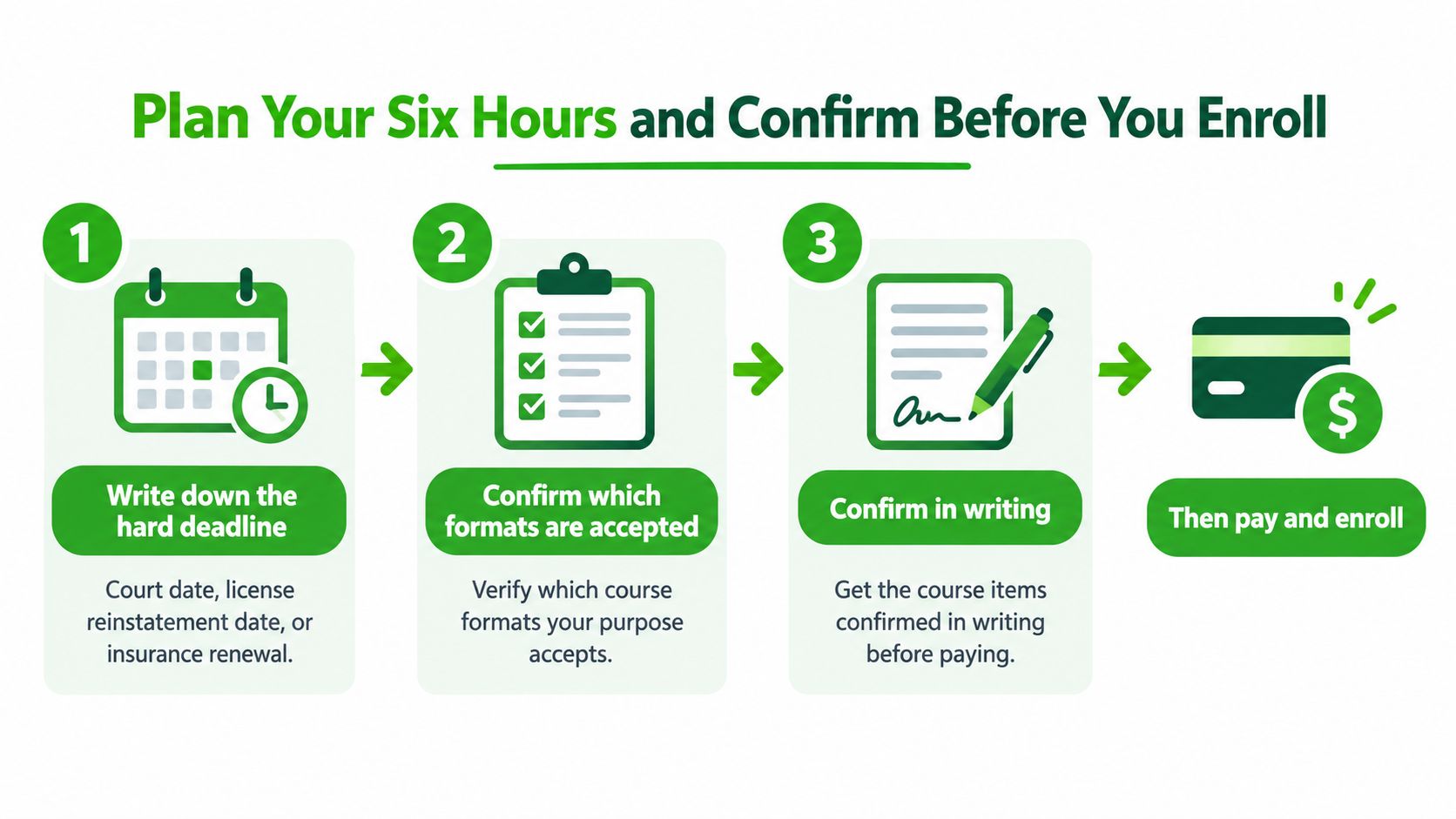
Work backward before paying
Write down the hard deadline. Record the court date, reinstatement requirement, or insurance renewal date. Clarify whether you must finish instruction or have proof received by that date.
Confirm the accepted format. Contact the court clerk, DDS, or insurer responsible for the outcome. Describe the exact course and delivery method instead of asking whether defensive driving generally counts.
Calculate the full attendance window. Add required breaks, check-in, and any testing outside instruction. For an in-person class, include travel and parking so you aren't late before attendance even begins.
Reserve a realistic pace. If an accepted classroom or live class fits into a full day, block the entire published schedule. For an accepted self-paced option, reserve specific study appointments rather than relying on spare time.
Leave a certificate buffer. As a planning recommendation, aim to finish at least a week before your deadline, and allow more time when delivery requires it. That buffer isn't a state processing guarantee; use the provider's actual issuance commitment.
Submit and retain proof. Send the original when required, keep a copy, and preserve submission confirmation. Check that the receiving office has what it needs rather than assuming the school reports completion for you.
Get the commitments in writing
Before checkout, save an email or enrollment document confirming:
- Course identity and approval: The program name, instructional requirement, DDS certification where applicable, and acceptance for your purpose.
- Attendance rules: Breaks, late arrival, missed sessions, makeup work, and testing.
- Certificate logistics: Issue date, delivery method, original-document availability, and who submits it.
- Your completion calendar: The planned finish date, delivery allowance, and recipient's submission deadline.
Consider an Athens driver with a Friday court date and three free weeknights. In this hypothetical, the court has expressly accepted self-paced instruction; the driver completes it in two sittings and submits proof the week before court. Without that format approval, the same convenient schedule would be a poor plan.
A Gwinnett-area driver with unpredictable weekdays might instead reserve a Saturday classroom session. The driver confirms dismissal time and certificate delivery before arranging transportation and clearing the day.
The avoidable mistake is booking your final lesson for the day before proof is due. A missed session, login problem, or certificate correction can then leave no room to recover.
Georgia DUI Schools offers defensive driving and DUI/Risk Reduction education for drivers in Atlanta, Athens, and surrounding communities. Visit Georgia DUI Schools to discuss your requirement and confirm the format and certificate timeline before paying. For this topic, start with the defensive driving course information and choose an enrollment option only after confirming it will count.