You're staring at a deadline, a court notice, or a probation check-in, and the phrase ignition interlock installation near me suddenly means more than a map pin. In Georgia, the wrong shop, the wrong paperwork, or the wrong appointment time can slow everything down, and that's where people get burned. Proximity matters less than compliance timing, and the drivers who understand that get through the process faster.
A man in Athens can have a shop ten minutes away and still miss his reinstatement window if that location can't document the install quickly enough. A driver in Atlanta can call the closest listing and still lose days because the provider won't handle the vehicle that day or can't align with the court timeline. The core job is finding a certified installer who can move on your schedule, not just yours on theirs.

Why Finding the Right Installer Matters More Than Proximity
A lot of Georgia drivers call the first nearby shop and assume the shortest drive wins. That's a mistake. If you're waiting on reinstatement, probation paperwork, or a judge's deadline, a shop that's 20 minutes farther away but can install today is usually the smarter move.
The compliance side is bigger than many realize. By July 1, 2021, 34 states and Washington, D.C. required interlocks for all alcohol-impaired driving offenders, and a 2019 state-data report recorded 147,027 new installations across 19 states and Washington, D.C., with 137,602 active installations on December 31, 2019, plus 212,752 total in-vehicle installations during 2019 across 18 states and Washington, D.C. TRB's state-data report makes the point clear, this is a regulated compliance market, not a casual accessory service.
What actually matters when you search near me
The strongest installer is the one that fits your deadline, your vehicle, and your reporting requirements. If the location can't fit you in before a court date, it doesn't matter how close it is.
Practical rule: the best installer is the one who can get your device mounted, tested, and documented before your deadline, not the one closest to your driveway.
Georgia drivers also need to think about how the provider communicates with the system that's supervising the case. If the shop is used to handling DUI compliance work, it's more likely to understand restricted-license timelines, proof-of-installation steps, and the urgency that comes with probation. For a broader guide on regaining driving status, Brian Hansford Law's appeal DUI suspension in Georgia resource is worth keeping nearby.
If you're dealing with the reinstatement side of the process, the internal process guide on return to duty process is also useful because it frames installation as part of a larger compliance sequence, not an isolated errand.
Legal Requirements and Documentation You Need Before Scheduling
Don't book an install until you know exactly what your case requires. In Georgia, drivers often mix up a court order, a DDS issue, and a program requirement, then show up underprepared. That leads to rescheduling, and rescheduling is how people lose time they can't get back.
The same thing happens nationally when people underestimate how structured interlock compliance is. The CDC notes ignition interlocks reduce repeat DWI offenses by about 70% while installed, yet only about one-fifth of people arrested for DWI have one installed CDC guidance. The policy is common, but the actual handoff from arrest to installation still trips people up.
What to bring before you call
Bring the documents that tie your install to the case file. If you don't have these ready, the shop may still schedule you, but your compliance paperwork can stall.
- Court order or administrative notice: This tells the installer why the device is required and under what authority.
- DDS paperwork or restricted-license documents: These connect the installation to your Georgia driving status.
- Proof of DUI education completion: If your case requires it, have the certificate ready so nobody has to chase paperwork later.
- Vehicle details: Year, make, model, and VIN help the provider confirm compatibility.
- Insurance and contact information: Some providers ask for this during intake or setup.
Georgia drivers should also understand that the interlock step can sit next to other reinstatement requirements, including education and fee-related steps. The Georgia DUI Schools license reinstatement fee page is a practical reference if you're trying to line up the money side with the legal side.
A useful way to think about it is simple. The provider needs to know who you are, what vehicle you're using, and which authority is watching the case. If one of those pieces is missing, the install can still happen, but your compliance trail may not be clean.
How to Verify Certified Interlock Providers in Georgia
A nearby address is not the same thing as a valid provider. That's the first trap. Some shops advertise ignition interlock service, but if they aren't approved for your Georgia case, you can end up with hardware that doesn't satisfy the requirement.
Georgia drivers should verify the provider before they ever hand over keys. The New Jersey MVC's approved-manufacturer list shows how states often rely on specific authorized networks rather than random repair shops, and Georgia works with its own approved ecosystem in the same general way New Jersey MVC manufacturer list. The point is the same everywhere, certification beats convenience.
Questions that cut through the sales pitch
Ask direct questions and listen for direct answers. Vague language is a red flag.
- Are you approved for Georgia DUI interlock installs? If they dodge that, move on.
- Can you handle my exact vehicle type? Push-button start systems, hybrids, and unusual wiring setups matter.
- Do you submit installation proof quickly? If the answer is fuzzy, expect delays.
- What happens if my court deadline is near? A real compliance shop should talk timeline, not just price.
- Do you service my location after install? Calibration access is part of the deal, not an extra afterthought.
Some of the slickest marketing pages are the least useful in practice. A provider that can't answer when you can get in, what it costs over time, and how they handle your specific vehicle isn't giving you a real compliance solution.
If you want a Georgia-specific reference for how restricted-license rules fit into the bigger picture, the Georgia DUI Schools ignition interlock restricted license guide 2026 is a solid companion. Use it to compare what the provider says with what Georgia compliance requires.
Also look for signs that the location is built for real scheduling, not just lead capture. The best shops usually tell you whether they can see your vehicle the same day, whether they need paperwork before you arrive, and whether they support the make and model you drive. If the staff starts pushing you into a rushed decision without answering those basics, keep looking.
What Happens During Your Installation Appointment
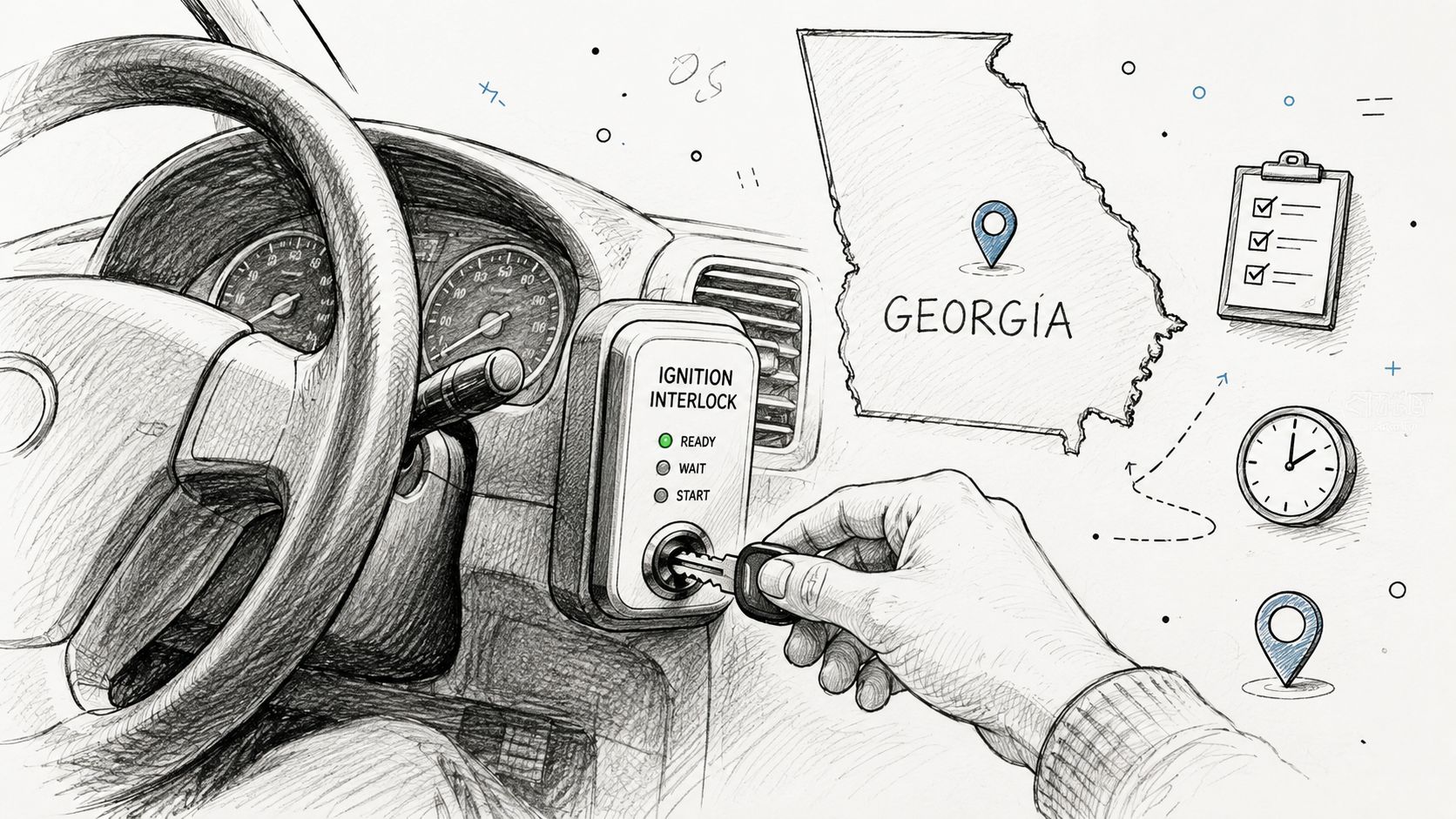
A professional installation should feel organized, not chaotic. The appointment usually starts with check-in and paperwork, then moves into a vehicle inspection, wiring and mounting, calibration, training, and final sign-off. Neutral provider guidance puts the full appointment at roughly 1 hour 45 minutes to 3 hours, with wiring and mounting often taking 45 to 90 minutes and calibration and testing commonly running 20 to 30 minutes RoadGuard installation checklist.
The appointment should follow a clean sequence
First, the technician checks your documents and inspects the vehicle. Then they verify the battery, ignition circuit, and starter circuit before any splicing happens. That's not bureaucracy, it's how they avoid false lockouts and no-start problems later.
The device must be mounted within easy reach of the driver and kept clear of airbags and controls RoadGuard installation guidance. After mounting, the installer wires the unit to the proper power, ignition, ground, and horn or alarm lead, then reconnects the battery and runs test blows to confirm the vehicle only starts after a passing sample.
Here's the part drivers underestimate. A good-looking install isn't enough if calibration is off or reporting setup isn't complete. Modern providers often need the reporting side active right away, so one loose ground or one bad connection can delay documentation even if the device looks fine in the dash.
Scheduling advice: plan for at least an hour at the service center, even if your install seems straightforward on paper.
If your vehicle has electrical quirks, you may need extra time. That's why I tell Georgia drivers not to stack the appointment on top of another obligation. Treat it like a real service window, not a quick errand between stops.
Understanding the Full Cost of Interlock Ownership
A cheap install can still become an expensive order if you ignore the rest of the bill. Drivers get burned when they compare shops by one number and forget about monitoring, calibration, removal, and administrative fees. For a DUI requirement, that is the wrong way to budget.
Start with the full program cost, not the first visit. One provider says most customers on a low-cost plan pay between $70 and $100 per month including monitoring and calibration Low Cost Interlock Rhode Island. Even if a local quote looks lower at the counter, recurring charges can change the total fast.
| Cost Category | Typical Range | Frequency |
|---|---|---|
| Installation | Varies by provider and vehicle | One time |
| Monthly monitoring | Often bundled in recurring service | Monthly |
| Calibration | Often included or billed per visit | Every 30 to 90 days, depending on program |
| Removal | Varies by provider | One time at program end |
| Lockout or service interruption charges | Varies by provider and event | As needed |
Compare the whole program, not just the first visit
A low upfront install can turn into a more expensive program if the provider charges more for recurring service or makes you travel farther for maintenance. Cheap at the start means little if every follow-up visit costs time, fuel, and missed work.
Georgia drivers should ask how the provider handles calibration visits, what happens if a visit is missed, and whether removal is included or billed separately. If reinstatement paperwork is part of the process, keep the Georgia DUI Schools license reinstatement fee page in view so the interlock bill does not catch you off guard when other fees come due.
Ask about appointment flexibility too. A provider with better scheduling can save money by reducing missed work, extra rides, and rescheduling headaches. Those hidden costs matter just as much as the invoice.
Maintenance Calibrations and the Removal Process
Once the device is in, your job changes from installation to maintenance. The interlock has to stay calibrated, and that means regular visits to a service center. One provider notes that calibration is typically required every 30 to 90 days, depending on state requirements, and that the initial installation itself usually takes 30 to 90 minutes Intoxalock installation page.
Missing a calibration visit is not a minor inconvenience. It can trigger compliance problems, service interruptions, or lockouts. A lockout is the kind of mistake that turns a normal day into a towing problem, a missed shift, or a court headache.
Keep the device on a fixed schedule
Put calibration visits on your calendar the day your install is finished. Don't wait for the reminder message to force the issue. If you work irregular hours, pick a provider with appointment options that fit your schedule instead of forcing every visit into a narrow weekday window.
If the device gives you a warning or stops the vehicle from starting, call the provider before you try random workarounds. The worst move is ignoring the alert and hoping it resets itself. It won't.
Removal is the final step, but it still has to be handled correctly. Once your mandated period ends, the provider removes the device and reports the completion back through the proper channel. That final paperwork matters because it closes the compliance loop and helps clear the case file.
Don't treat removal as an informal handshake. If the paperwork isn't sent, the record isn't finished.
Coordinating with Courts Probation and DUI Course Completion
The interlock is one piece of a larger Georgia compliance puzzle. Your court date, probation officer, and DUI course completion all affect whether the installation gets you back on track. If one piece lags, the whole process drags.
That's why I tell drivers to communicate early and clearly. Tell your probation officer when the install is scheduled, keep proof of completion, and confirm what your court or supervision team wants to see next. Don't assume everyone will automatically know you complied.
Georgia DUI education matters here too. If your case requires a Risk Reduction course, complete it on time so you're not sitting on an install while another requirement blocks reinstatement. Georgia DUI Schools offers DUI/Risk Reduction education, defensive driving, clinical evaluations, ASAM Level 1 treatment, and Victim Impact Panels for drivers working through these obligations.
If you're sorting out the case from multiple angles, don't just chase the nearest installer. Line up the interlock, the education requirement, and the reinstatement steps together so no one can say you missed a piece.
Georgia DUI Schools helps drivers handle the education and compliance side of a DUI case with Georgia DDS-approved Risk Reduction and defensive driving options, plus clinical evaluations and Victim Impact Panels. If you're trying to get your license back while managing an interlock requirement, visit Georgia DUI Schools and take the next step with the course or service that matches your case.