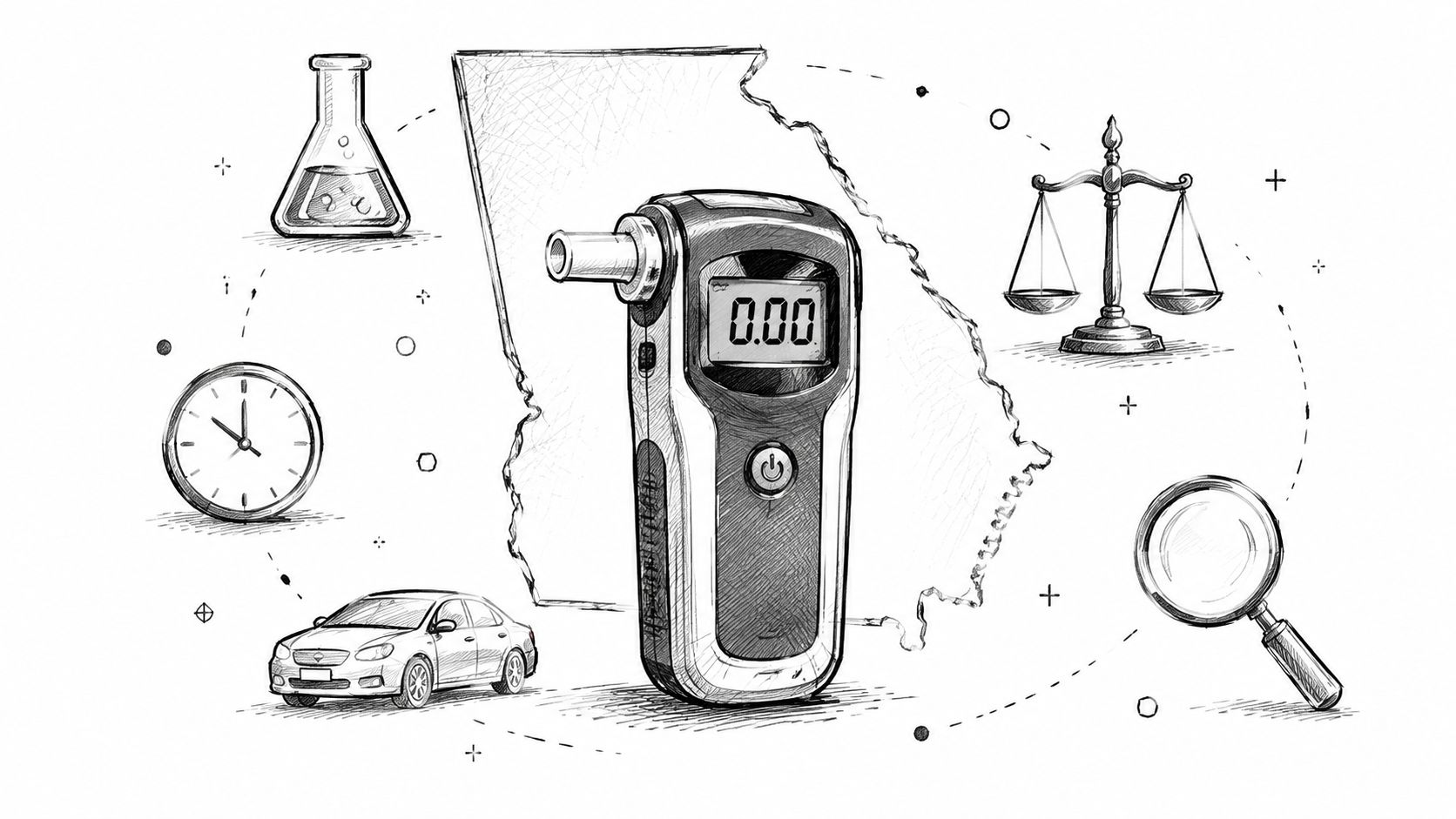
You're sitting on the shoulder of an Atlanta highway after dark, the blue lights are flashing, and the officer has already asked the question every Georgia driver hopes not to hear. If you've had even one drink, that moment can feel like the whole case is already decided. It isn't. Breathalyzer test information matters because the reading is only one piece of a process that includes timing, device type, your body, and how the officer handled the stop.
A breath test is designed to estimate blood alcohol concentration, or BAC, from exhaled breath, not to pull blood directly from your veins. For a Georgia driver, that difference matters because the machine is working from an estimate, the same way a thermometer gives a reading from contact with the surface it touches, not from a full medical workup. In the U.S., the commonly used legal driving threshold is 0.08% BAC. That number sounds simple, but the science behind it is not. Breath tests are estimates, and the uncertainty for a random subject in a postabsorptive state has been reported at least as ±15% in one review, with the same review finding that over 90% of that uncertainty came from biological variables rather than the machine itself.
On a Georgia roadside stop, that can matter fast. A driver who has been up late, has medical issues, or took a test long after the last drink may have questions that do not fit neatly into the number on the screen. The reading may still be used against that driver, but the context around the stop, the timing, and the test process can shape what the result really means.
Why Breathalyzer Tests Matter in Georgia
A Georgia driver can go from “I'm fine to drive” to “I need a lawyer” in a single roadside conversation. The breath test often becomes the number everyone argues about later, even though the underlying dispute usually starts much earlier, with the stop, the officer's observations, and the way the test was handled. That is why breathalyzer test information matters. It can shape how a driver reacts in the moment and what gets challenged later.
The number on the screen is only part of the story
A breathalyzer reading is an estimate of BAC from breath, not a direct blood draw. Like a kitchen thermometer that reads the surface of a roast instead of the temperature of every part of it, the machine gives a useful measurement, but it does not capture everything happening inside the body. Biology, timing, and test handling can all affect the result.
That matters for a Georgia driver because a reading near the legal threshold is not always the whole answer. A person stopped after driving on a busy corridor like I-75, I-85, or the Downtown Connector may have questions that the number on the screen does not answer by itself. Was the test given too soon after a drink? Was the device used correctly? Were there signs that something in the process could have skewed the result? Courts and police care about those questions because procedure is what gives the reading weight.
One medical review also found that breath testing can overestimate some subjects, which shows why a single result should be read with care (breathalyzer test overview).
Practical rule: if the test process feels rushed or incomplete, the details matter later, not just the number itself.
Georgia drivers also run into confusion over refusal. A roadside breath request can affect both the administrative side of a case and the criminal side, so the decision is not always as simple as “take it” or “refuse it.” The better question is whether the officer followed the required steps and whether the reading can be trusted.
Types of Breath Tests Used by Law Enforcement
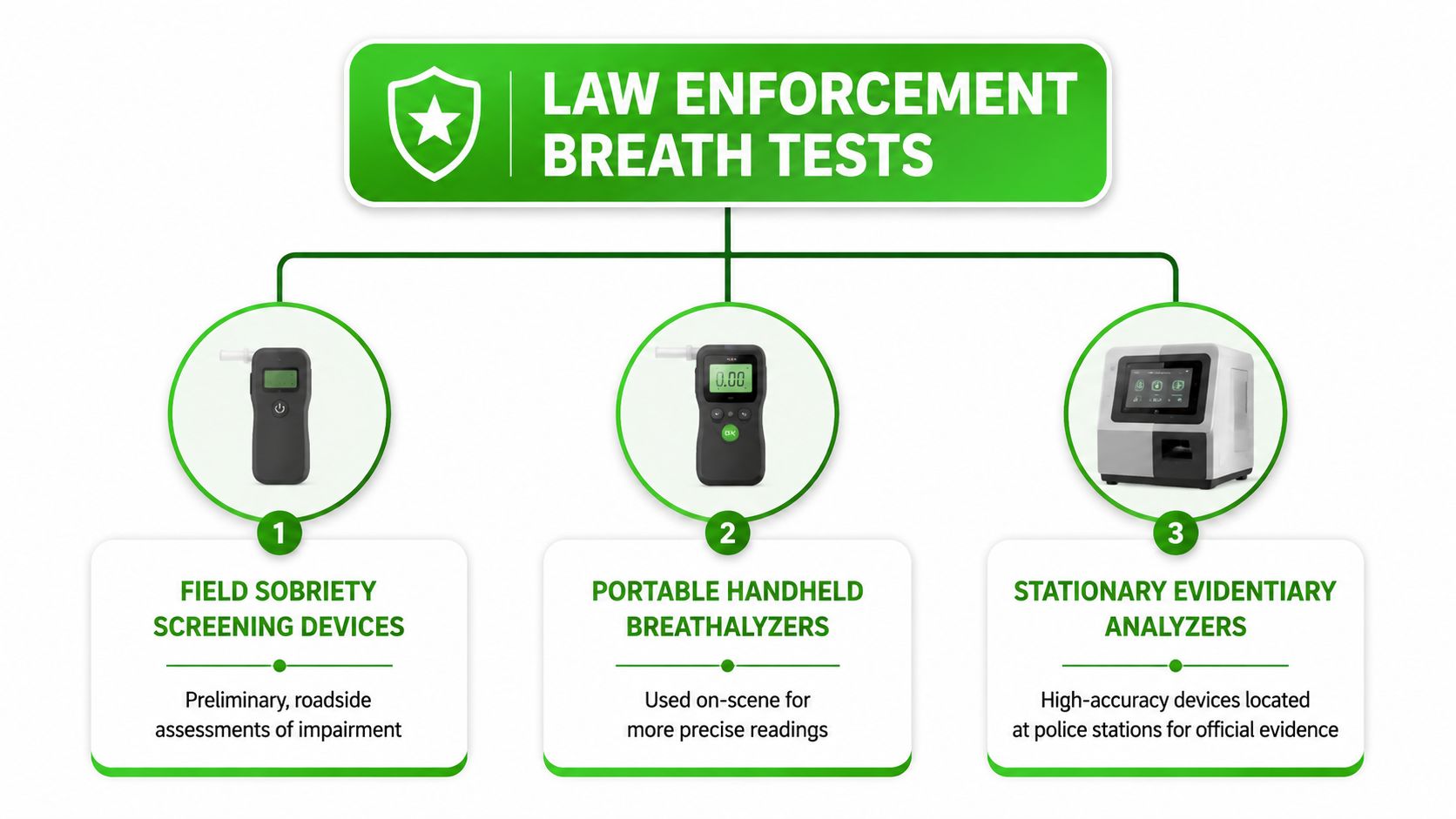
A Georgia driver who is stopped after a late-night turn onto a highway ramp or after leaving dinner in town may run into more than one kind of breath test. The device matters because it affects what the officer can do next, and it also affects how much weight the result may carry later. Some breath tests are only meant to screen for possible impairment. Others are built as evidential instruments for official use at the station and in court.
Roadside screening versus evidential testing
A roadside screening device is used for a quick check of probable cause. It helps an officer decide whether the stop should move from a traffic encounter into a DUI investigation. A portable handheld breathalyzer can give a more focused reading at the scene, but it still serves a different role from a stationary evidential analyzer.
The evidential machine is the one many people picture when they think of a formal DUI breath test. It is the more controlled device, and research from the evidential-device literature shows these analyzers can perform consistently at BACs of 0.020%, 0.050%, 0.100%, and 0.150% when tested against federal guidelines. That consistency matters because the state is relying on a device class built for official evidence, not just a roadside impression (DOT evidential breath analyzer research).
Why the legal weight changes
The legal question is not only whether a device gives a number, it is whether that number came from the right device, at the right time, under the right rules. A preliminary screen may support an officer's next step, but an evidential analyzer is the one most likely to become a courtroom exhibit. In practice, that means a handheld reading on a roadside near Athens may help with the stop, while a station-based result in another Georgia city may become the formal test used later.
Georgia drivers should treat the device type as a clue, not a minor detail. If the officer only used a roadside screen, the result may have a very different role than a station reading. That difference can matter as much as the number itself.
How Breathalyzer Devices Work
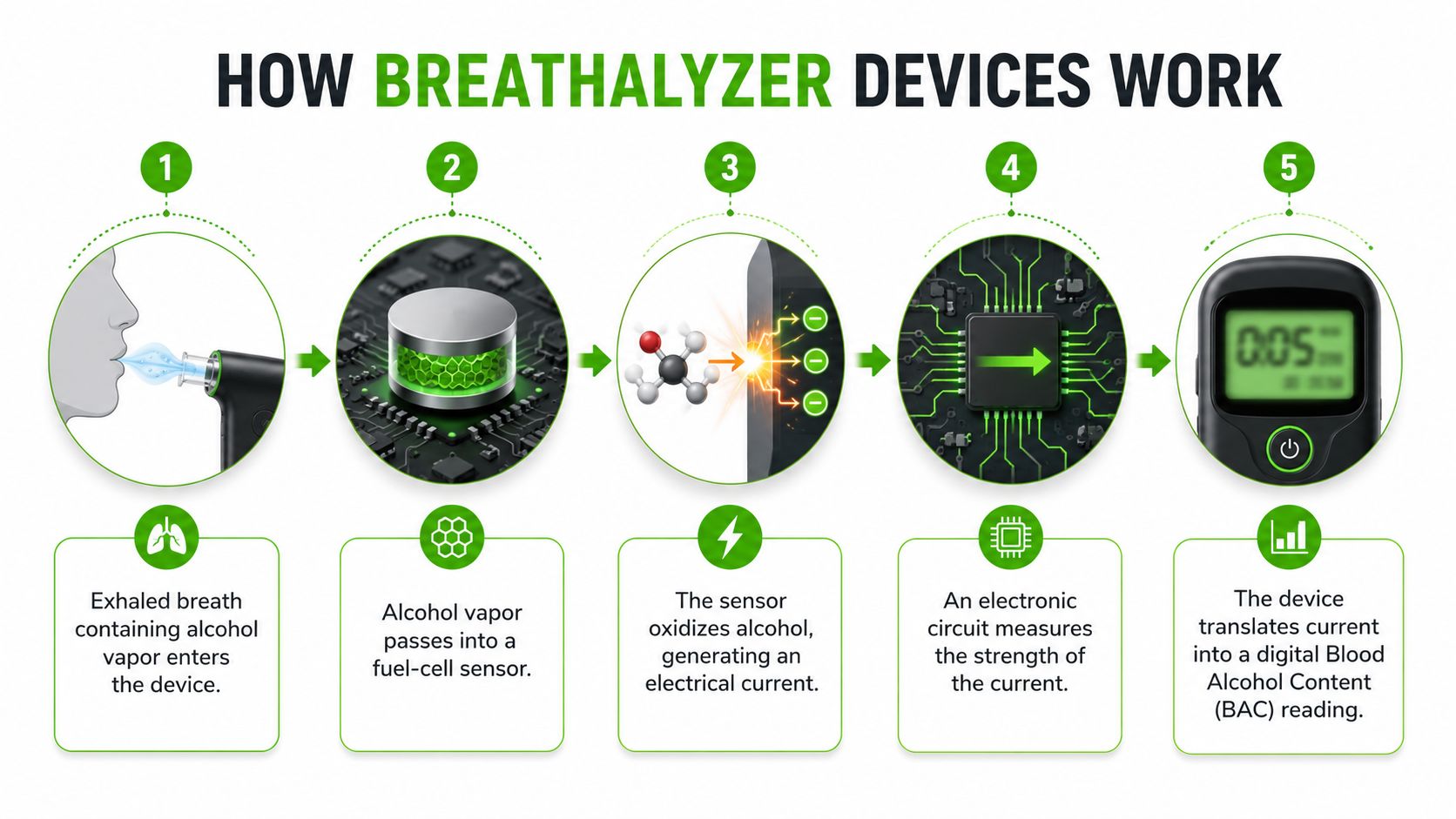
A breathalyzer works a little like a very sensitive litmus test. You blow into it, the device detects alcohol in the breath sample, and its internal electronics convert that chemical signal into a BAC reading. The machine is not “seeing” alcohol the way a camera sees an object. It is measuring a reaction and turning it into a number.
Fuel cells and infrared systems in plain English
Fuel-cell breathalyzers use a chemical reaction. Alcohol in the breath reaches the sensor, the sensor oxidizes the alcohol, and that reaction creates an electrical current. The stronger the current, the higher the reading the device calculates.
Infrared analyzers use a different method. They measure how alcohol molecules absorb light at specific wavelengths, then translate that absorption pattern into a BAC estimate. Both systems are designed to detect alcohol in deep lung air, because that is the breath most closely tied to blood alcohol levels.
A useful way to separate the two methods is to remember that one listens for a chemical reaction and the other reads a light pattern. Either way, the machine is only as good as the sample it receives and the way the operator uses it.
A well-maintained evidential instrument is not guessing. It is measuring a chemical or optical signal and converting that signal into a BAC estimate under a defined protocol.
Why calibration and maintenance still matter
Even a good device depends on proper setup. Federal-guideline testing has shown evidential analyzers can stay consistent across multiple BAC levels when they are maintained and operated correctly. That consistency is what gives the reading its value as formal evidence.
If calibration slips or the machine is used outside its intended conditions, the reading loses the reliability that makes it useful in the first place. For a Georgia driver, that can matter during a stop, but it can matter just as much later, when the result is reviewed for a hearing or court case.
Police paperwork, maintenance logs, and operator training are not busywork. They are part of the science behind the result. A driver may feel the machine is either “right” or “wrong,” but the primary question is usually whether the device was functioning correctly and whether the officer used it correctly. That is the question Georgia courts focus on.
Factors That Affect Test Accuracy
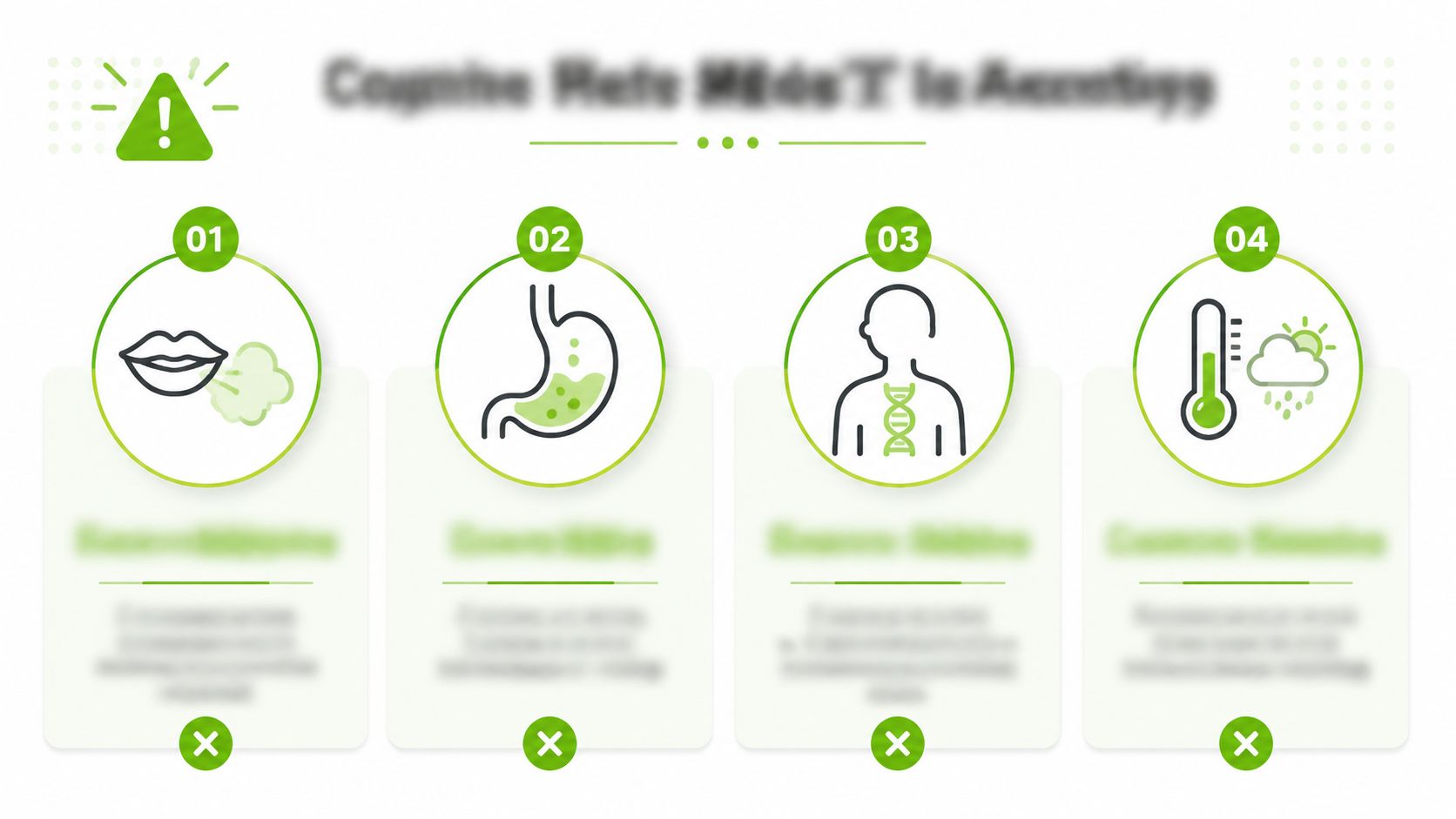
A breath test can look precise and still be skewed by what is happening in the mouth, stomach, body, or surrounding air. A Georgia driver may hear the machine described as scientific and assume the number speaks for itself. In practice, the reading depends on the quality of the breath sample and on whether the person collecting it follows the testing rules carefully.
Mouth alcohol is the most immediate problem
Residual mouth alcohol is a common source of a reading that comes back too high. A recent drink, a burp, regurgitation, or alcohol left in the mouth can make the sample look stronger than the person's deep lung air really is. Independent protocol guidance requires a 20-minute observation period before testing and asks whether the person has belched, burped, regurgitated, or taken a drink during that window (PhenX breath alcohol protocol).
That waiting period is there for a practical reason. It gives the mouth time to clear, because a breath sample should reflect air from deep in the lungs, not alcohol that is still sitting in the throat or mouth. The same guidance also reflects a broader point, much of the uncertainty in breath testing comes from biological factors rather than a broken machine (PhenX breath alcohol protocol).
For a driver, that detail matters at the roadside and later at a hearing. If the officer started testing too soon after a drink, or after the person burped during the observation period, the sample may not be a clean measure of body alcohol level.
Body chemistry and surroundings can also matter
Some medical and physical conditions can affect how a result should be read. Reflux, uncontrolled diabetes, ketogenic dieting, fever, and alcohol in the surrounding environment are all practical concerns discussed in the research. That does not mean each condition automatically creates a false reading. It means the result should be considered alongside the driver's health, recent activity, and the setting where the test happened.
A Georgia driver may see this issue in ordinary roadside situations. A person who had a drink, then burped at a gas station, then got stopped outside a bar where alcohol fumes were present gives the machine a far less clean sample than a simple screen number suggests. That is why challenges to breath results often begin with the officer's questions, the time between the stop and the test, and what the driver did in the minutes before the sample was taken.
Those facts can matter in a hearing because they help show whether the result reflects a true breath sample or a sample influenced by outside factors. For a closer look at how alcohol affects driving before a stop even starts, see how alcohol affects driving.
Georgia Laws on Breathalyzer Testing
A driver in Georgia can face breath testing rules that affect both the roadside stop and what happens later at a hearing. The legal limit is commonly discussed as 0.08% BAC, but that number is only one part of the picture because the officer's warnings, the timing of the test, and the driver's choices can all shape the outcome. A breath result can be treated as one piece of evidence, not the whole case, which is why the surrounding facts matter so much (breathalyzer test overview).
The legal limit and implied consent
Once a Georgia driver is lawfully arrested and hears the implied consent warning, the question changes from roadside suspicion to a formal decision about chemical testing. That warning works like a legal fork in the road. One path is to submit to the test, and the other is to refuse, which can lead to consequences separate from the DUI charge itself.
Refusal can affect driving privileges even before the criminal case is resolved. That is what confuses many drivers, because the state may begin an administrative action while the DUI case is still pending in court. The test result, or the refusal, can matter in more than one system at the same time.
Administrative consequences and criminal consequences are different
A license action and a criminal DUI case do not move on the same track. The state can act on driving privileges while the court case continues, and that split often catches drivers off guard. In practical terms, one part of the case is about whether you can keep driving, while the other is about whether the state can prove the DUI charge.
Georgia also ties DUI outcomes to education requirements. The Georgia DDS says the Risk Reduction program includes a 130-question assessment and a 20-hour intervention component, and both must be completed to receive a Certificate of Completion (Georgia DDS DUI FAQs). For a Georgia driver, that means the breath test decision can ripple beyond the arrest itself and into the steps needed to restore full driving status.
A useful way to connect the law to the road is to keep the driving behavior in view. Alcohol can slow reaction time, affect judgment, and change how a driver handles ordinary traffic decisions, which is why officers look at the whole stop and not just the machine reading. For a plain-language explanation of those effects, see this overview of alcohol effects on driving.
What to Expect During a Breathalyzer Stop
The stop usually starts with observation, not the test itself. The officer is watching how you respond, whether your speech is clear, whether your movements are steady, and whether the stop raises enough concern to keep going. If the officer decides a breath sample is needed, the process may move from roadside questions to a preliminary device and then, if an arrest happens, to a station test.
The sequence usually feels slower than people expect
A lot of drivers think the test happens immediately after the blue lights come on. In reality, there is often a chain of events, the stop, the conversation, the observations, the preliminary screen, the arrest decision, transportation, and then the evidential test. That gap matters because time affects both the body and the case record.
Georgia drivers also ask whether they should try to explain medical conditions on the roadside. The safer answer is that any relevant condition should be documented accurately, but the traffic stop is not the place to argue science with an officer. For a more practical breakdown of common officer questions, this guide to sobriety test questions can help drivers understand what they're likely to hear.
Keep the record clean: if you're under stress, short answers and accurate facts are better than long explanations that can be misunderstood later.
The evidential test at the station is the more formal stage. That's the point where the machine, the observation window, and the officer's procedure come together in a way a lawyer can later review. If the timeline is off, that can matter as much as what the number showed.
Using and Challenging Breathalyzer Results in Court
A breath result can look powerful in a case file, but it's only as strong as the foundation underneath it. Prosecutors usually lean on the device reading, the officer's certification, and the maintenance history to show the result should be trusted. If one of those pieces is weak, the defense has a place to push.
What lawyers usually look for first
The first question is often simple. Was the device maintained properly, and was the officer qualified to use it? If the answer is unclear, the reliability of the reading becomes easier to attack. Defense counsel also looks at whether the observation period was followed, because mouth alcohol and timing problems can create a falsely high result.
Cross-examination often turns on details the officer may remember imperfectly, such as exact timing, what the driver said, and whether the sample collection followed the required sequence. A useful resource for legal teams building that kind of review is HireParalegals' actionable playbook for law firms, which can help firms organize records, timelines, and discovery materials in a DUI defense file.
How a challenge changes the case
If the breath result is weakened, the case doesn't disappear automatically. Prosecutors may still rely on the stop, officer observations, and other evidence. But the pressure changes. A case built around one strong number becomes much less certain when that number has maintenance gaps, timing issues, or sampling problems.
Georgia drivers often ask whether there's a path to make the charge go away entirely. That depends on the facts, but the defense strategy usually starts with the same few questions, device history, operator conduct, and whether the sample accurately reflected the driver's condition at the time of driving. For a broader legal overview, this explanation of how DUI charges get dismissed gives useful context for what attorneys often scrutinize.
Next Steps for Georgia Drivers
A breath test can start two separate tracks at once, one with the Georgia driver licensing process and one with the criminal case. Treat both as active right away. If you wait, deadlines can pass while you are still trying to sort out what the arrest notice means.
A useful way to approach the next steps is to separate the paperwork from the defense work. The paperwork side involves hearing requests, education requirements, and any license-related notices. The defense side involves the facts of the stop, the device record, and whether the result really reflects what was happening when you were driving.
A practical checklist after a breath test stop
- Get the case dates in writing: the arrest date, citation date, and any notice about suspension or hearing rights all matter.
- Track the program requirement: Georgia's DDS says the DUI Alcohol or Drug Use Risk Reduction program requires the 130-question assessment and the 20-hour intervention component to earn a Certificate of Completion (Georgia DDS DUI FAQs).
- Budget for the state-set fees: the Georgia law text sets a $100 assessment fee and a $275 intervention fee for certified Risk Reduction programs (Georgia legislation text).
- Plan for in-person attendance: the same law says the intervention component must provide in-person therapeutic education and peer group counseling over 20 hours, and it prohibits online courses or remote participation platforms for that in-person component (Georgia legislation text).
Georgia drivers often ask why this matters if the breath test already happened. The answer is simple. A breath test report can affect your license status quickly, while the criminal case can keep unfolding in court. If you miss the first set of deadlines, it can be harder to address the second set later.
Georgia drivers who are also thinking about insurance should read the Schneider and Associates 2026 DUI guide to understand how DUI-related issues can affect coverage conversations after an arrest. It gives a practical look at what may come up outside the courtroom, which is often the part drivers do not plan for until after the stop.
If you are ready for the next step, line up the DUI education path, gather your hearing dates, and organize every notice you received. A quick, orderly response helps you keep track of the process instead of chasing it after a deadline has already passed.
A CTA for Georgia DUI Schools.